
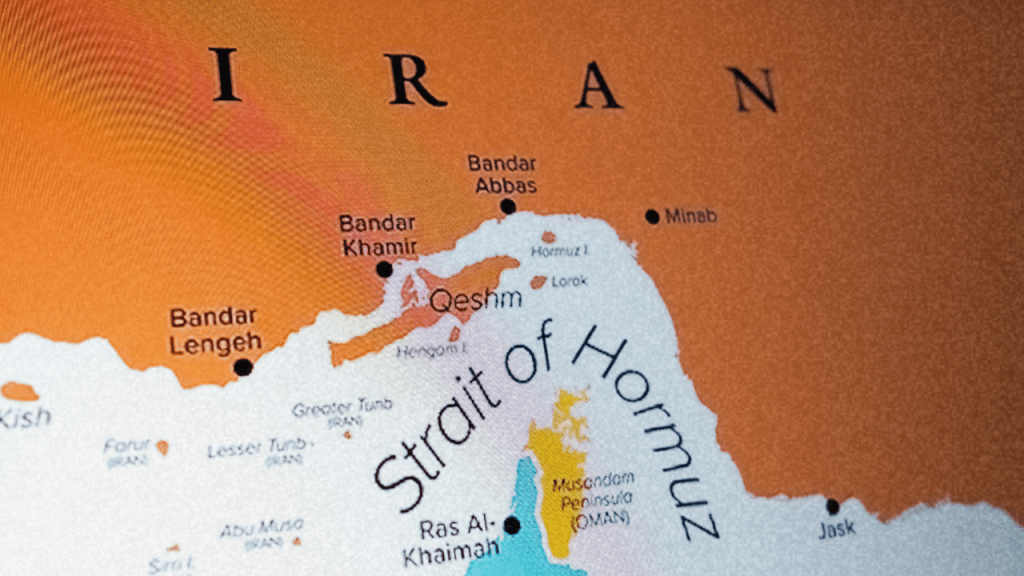
Iran has not merely shown that the Strait of Hormuz can be closed. It is trying to make routing, security and political recognition part of a new regional settlement in which passage depends on Iranian consent.
By July 30, the pause in American bombing had come and gone, but the Strait of Hormuz had not returned to anything resembling its prewar condition. Kpler counted only six commodity ships crossing on July 27, eight on July 28 and one by the time its July 29 data was reported. Lloyd’s List Intelligence had already found non-Iran-linked traffic roughly 90 percent below its year-earlier level during the week of July 13 to 19.
The military pause did not produce commercial confidence because a pause was not an order. Shipowners, crews, insurers and cargo traders needed to know which route would remain safe, whose clearance would be recognized and whether an agreement would survive the next strike. On July 30, U.S. and Saudi attacks resumed, while Iran said it had struck three tankers using routes it had not approved. The strait remained open only in the narrowest physical sense. Passage existed, but it was conditional, selective and dangerous.
That condition is now the central fact of the war at sea. The question is no longer simply whether Iran can interrupt the waterway. Iran has already demonstrated that capacity. The emerging dispute concerns who will authorize movement, designate corridors, provide security, supervise demining and attach financial conditions to transit.
Washington and Tel Aviv opened the war expecting Hormuz to remain neutral infrastructure while Iran was bombed. That expectation reproduced the old regional hierarchy: American and Gulf military systems could use the waters surrounding Iran, Gulf energy could move outward, and Iran was still expected to guarantee the commercial predictability of the order attacking it. Iran has rejected that arrangement in practice.
Oman Offered Management Without Iranian Control
Oman’s late-July proposal recognized that the strait could not simply be declared open. According to diplomatic sources cited by Reuters, Muscat proposed a regionally backed management mechanism in which shipping companies would make voluntary contributions to a fund supporting navigation, environmental protection and search-and-rescue services. The model drew partly on cooperative arrangements used in the Strait of Malacca. Iran would participate, but it would not exercise sole control.
The details require careful attribution. Oman has not published a complete legal text establishing the proposed authority, its membership or its decision-making rules. The fullest public description comes through a Gulf source and a Western diplomat speaking to Reuters. Oman’s official statements have instead emphasized cooperation with Iran, the International Maritime Organization and other users to restore navigation under international law.
Oman’s own language reveals the political purpose. Foreign Minister Sayyid Badr Albusaidi described the conflict as an unnecessary war and called for a long-term arrangement negotiated by Iran, Oman and the wider community of strait users. Oman therefore accepts that the postwar system must include Iran as one of the two states whose territorial waters form Hormuz. It rejects the idea that Iran can convert that geographic fact into unilateral primacy.
The voluntary-fee structure was designed to contain that conflict. Contributions tied to navigation, rescue and environmental services would acknowledge that safe passage has material costs without recognizing an unrestricted Iranian right to impose tolls. Regional administration would include Tehran while preventing it from becoming the final authority over every vessel.
Oman offered management without Iranian control. Iran rejected the separation.
Iran Rejected the Old Balance in New Language
Iran’s counterposition was more direct. A senior Iranian official told Reuters that Tehran wanted the entire inbound route and part of the outbound route placed under Iranian control. Iran rejected an equal division with Oman and said the southern route through Omani waters could not be treated as a safe alternative to Iranian authority.
Deputy Foreign Minister Kazem Gharibabadi described a temporary arrangement in which one direction of traffic, along with part of the opposite direction, would run through Iranian waters. Tehran also said it no longer recognized the existing Traffic Separation Scheme under wartime conditions and would not accept demining by a third country, even if that country entered at Oman’s invitation.
The demining dispute is not a technical footnote. The state that clears mines, certifies a corridor and guarantees passage exercises security authority over the waterway. Iran’s refusal of third-party demining means it is refusing to let outside military power return under the language of maritime safety. Tehran is insisting that security work in the strait cannot be detached from the sovereignty of the coastal states, especially from the state controlling its northern shore.
Iran has linked that position to the war itself. Its Foreign Ministry said stability required ending the insecurity imposed on Hormuz by American aggression. This makes reopening part of a political settlement rather than a service Iran must provide while the conditions of attack remain intact.
Iran’s proposal is formally described as temporary. Its wider implications are not. Routing authority, clearance power and control over demining are the building blocks of maritime governance. Once those functions become conditions of passage, the old order cannot be restored merely by moving ships back into the same lanes.
“Freedom of Navigation” Was Already a Political Order
Before the war, Hormuz was routinely described as a neutral artery of world trade. In 2024, about 20 million barrels of oil moved through it each day, equivalent to roughly one-fifth of global petroleum-liquids consumption. About 20 percent of global liquefied-natural-gas trade also crossed the strait, primarily from Qatar and the United Arab Emirates to Asian markets.
Nothing about that system was neutral. The traffic moved through a corridor organized by states, protected by armed power and embedded in the strategic alignment of Gulf monarchies with the United States. The U.S. Fifth Fleet operates from Bahrain across an area that includes Hormuz, the Persian Gulf and the Gulf of Oman. The Navy describes its mission through the language of freedom of navigation, maritime security and the free flow of commerce.
That language presented American military supremacy as the absence of politics. Gulf oil moving under U.S. protection was called normal commerce. American surveillance of Iranian forces was called maritime security. The capacity to threaten Iran while preserving export routes for allied monarchies was called stability.
Iran carried a different share of the arrangement. It lived beside a corridor used by states arming and hosting the military power that threatened it. Its sovereignty was acknowledged geographically but subordinated operationally. The benefits of predictability flowed outward to energy importers, shipping companies and Gulf rulers, while the security hierarchy governing that predictability was enforced against Iran.
Spark Solidarity’s earlier analysis of Iranian deterrence argued that Tehran could not answer military coercion through moral appeal alone. The war has confirmed that point. Hormuz became the battlefield because it gave Iran the means to impose material costs on the system surrounding it, as explored in our earlier account of the strait.
Electronic interference, route control and physical denial all form part of that contest. The GPS disruption around Hormuz showed that maritime passage depends on information systems as much as open water. The regional airspace shutdown documented in When the Sky Closes exposed the same structure above the Gulf.
The war did not politicize a neutral corridor. It destroyed the legitimacy of an existing political order and made its coercive foundations impossible to ignore.
From Blockade to Maritime Governance
Iran’s conduct since the closure points beyond temporary denial. Reuters reported that Tehran has sought recognition of its ability to choose entry and exit routes, deny passage to vessels it considers threatening and collect fees for compulsory services. No final tariff has been published, and the permanent framework remains unsettled. The institutional direction is nevertheless visible.
Lloyd’s List reported that ships had been required to submit documentation, obtain clearance codes and use an Iran-approved corridor, sometimes under Revolutionary Guard escort. It later reported that a new Persian Gulf Strait Authority required Iran-approved insurance, initially offered without charge for 60 days while reserving the possibility of future fees. These measures move from stopping ships toward processing them.
The shipping pattern reflects that change. Kpler found that among 895 crossings recorded from March 1 to May 19, only 6.4 percent used the internationally recognized route. Fifty-three percent used the Iranian corridor, while the remainder travelled dark or could not be assigned a route. A temporary deviation had become the operational baseline.
Passage has also been differentiated. Reuters reported in March that Iran allowed some Indian vessels to transit. Other ships faced delay, denial or demands for authorization. This was not a universal reopening. It was a system in which political identity, destination, documentation and perceived security risk could shape access.
The legal position remains contested. The United Nations Convention on the Law of the Sea recognizes the sovereignty of states bordering international straits, while granting ships a right of transit passage that “shall not be impeded.” It allows bordering states to regulate navigation and safety and calls for cooperation over routes and services. The International Maritime Organization argues that states cannot suspend transit or impose discriminatory tolls.
Iran signed but did not ratify the convention and stated at signing that treaty-created transit rights belonged to parties to the agreement. Oman is a party and grounds its proposal explicitly in the law of the sea. The legal dispute is real. It does not amount to a settled endorsement of Tehran’s claims. But law does not erase the material order developing on the water. A rule that shipowners cannot safely exercise without Iranian consent is no longer functioning as an independent guarantee.
Iran has not completed a permanent maritime constitution for Hormuz. It is assembling its components: permissions, routes, insurance, fees, inspection, threat assessment, demining authority and enforcement. That is the movement from blockade to governance.
The Gulf States Want Stability Without Iranian Primacy
Oman and the other Gulf states are not demanding a simple return of American command. Their support for a regional mechanism acknowledges that Iran cannot be excluded from the future of the strait. Oman’s foreign minister has called for a Gulf security policy that moves away from containment and toward regional integration.
But integration is not primacy. Saudi Arabia, the United Arab Emirates, Qatar and Oman depend on predictable access to export markets. A system in which Tehran can unilaterally approve routes, classify threats or impose mandatory charges would make their trade subject to Iranian discretion. It would also alter the balance between the Gulf’s Arab monarchies and the state Washington has spent decades trying to contain.
Oman’s proposal is therefore a compromise between two realities. Iran possesses the geographic and military capacity to disrupt passage. The Gulf states possess a collective interest in preventing that capacity from becoming a permanent regional hierarchy. Voluntary contributions and joint services would give Iran a recognized role while distributing authority through a broader institution.
That is why the dispute cannot be reduced to Iran holding trade hostage against innocent neighbours. The Gulf monarchies built their energy security through an American military structure directed against Iran. They now want Iranian cooperation without accepting the political consequences of Iran having broken that structure.
Their problem is not that Iran has entered Hormuz. Iran was always there. Their problem is that Iranian power has become impossible to treat as background.
The United States Cannot Restore the Old Order by Declaration
The United States can announce that Hormuz is open. It can sanction Iranian insurers, strike military targets and threaten further escalation. None of those acts can compel a tanker owner to accept an uninsured voyage through a corridor whose rules may change under fire.
By late July, war-risk premiums for a single very large crude carrier could exceed $10 million, according to Lloyd’s List reporting. The Lloyd’s Market Association issued model language addressing toll and fee payments because insurers faced sanctions and terrorism-law exposure if ships paid Iranian-linked authorities. A separate insurance consortium assembled hundreds of millions of dollars in capacity to support limited transits.
Those measures show where maritime order becomes real. It exists in coverage, clearance, route instructions, crew consent and enforceable guarantees. American naval power can destroy assets, but it cannot create commercial confidence by declaration when the state beside the corridor retains the capacity to punish noncompliance.
The pause in U.S. strikes proved the point. Traffic remained minimal because a temporary absence of bombing did not settle who controlled the lanes. When attacks resumed and Iran said it had hit three tankers using unauthorized routes, the commercial message was unmistakable: a ship could not rely on Washington’s assertion of openness against Tehran’s capacity to enforce permission.
Washington’s July 29 sanctions on Iranian-linked insurers and tankers were an attempt to prevent the emerging transit system from acquiring financial infrastructure. The sanctions targeted entities accused of collecting revenue through insurance policies tied to passage. That action recognized the development American officials denounced: Iran was no longer relying only on missiles and mines. It was building institutions around control.
Trump’s earlier demand that Iran reopen the strait without obtaining political recognition treated energy access as a unilateral obligation owed to Washington. As Spark Solidarity argued in Trump’s Hormuz Ultimatum, the United States was demanding that Iran surrender the leverage created by the war before the attacking power surrendered the conditions that produced it.
The old order rested on the assumption that American force could guarantee commerce while containing Iran. The new reality is that American force can intensify the danger without restoring the guarantee.
Sovereignty Is Becoming the Price of Passage
Iran’s achievement is not that every element of its proposed order has been accepted. Oman rejected sole Iranian control. Gulf states oppose mandatory payments. The International Maritime Organization rejects tolls and discriminatory transit restrictions. The permanent routing system, fee structure and legal authority remain unresolved.
The achievement is that every serious proposal now begins from Iranian power. Oman’s mechanism gives Tehran a formal role. The temporary routing talks assign Iran operational authority. Insurers write clauses around Iranian-linked charges. Shipping data separates authorized corridors from dark or unapproved movement. Even U.S. sanctions treat the transit apparatus as something real enough to attack.
This is what it means for Hormuz to become a political order rather than merely a chokepoint. Closure demonstrated the capacity to deny passage. Governance converts that capacity into rules, institutions and bargaining power.
Iran is trying to establish that passage beside its territory cannot be detached from Iranian security. It is insisting that the states which attacked it cannot demand neutral commerce while preserving the military architecture that made the attack possible. Reopening, in this framework, is not a unilateral Iranian concession. It is an exchange for recognition, guarantees and a different balance of authority.
That position remains contested, and some of Iran’s methods remain legally disputed. But the prewar fiction has already collapsed. Hormuz was never an abstract corridor floating beyond sovereignty. It was a regional system organized by power.
Iran’s achievement is not simply that it proved the strait could be closed. It forced every proposal for reopening to begin from the authority of the state the old order was designed to contain.
Sources
- Reuters, vessel-transit data and Kpler counts, July 29, 2026.
- Reuters, tanker traffic and renewed attacks, July 30, 2026.
- Reuters via Investing.com, Gulf backing for Oman’s Hormuz mechanism.
- Oman Foreign Ministry, statement on navigation and regional cooperation.
- Oman Foreign Ministry, Sayyid Badr Albusaidi on a regional security arrangement.
- Reuters, Iran’s rejection of regional management, July 29, 2026.
- Reuters, Iran’s temporary routing proposal, July 28, 2026.
- Reuters via Investing.com, Oman’s proposed regional mechanism.
- U.S. Energy Information Administration, energy flows through the Strait of Hormuz.
- U.S. Naval Forces Central Command, Fifth Fleet mission and operating area.
- Reuters, Iranian demands concerning routes, services and passage, July 1, 2026.
- Lloyd’s List, Iranian clearance, insurance and corridor requirements.
- Kpler, Hormuz transit patterns outside the IMO lane.
- Reuters via MarketScreener, differentiated passage for Indian vessels.
- United Nations Convention on the Law of the Sea, Part III: Straits Used for International Navigation.
- United Nations Treaty Collection, Iran’s status and declaration concerning UNCLOS.
- Lloyd’s List, war-risk insurance and Gulf shipping constraints.
- Reuters, U.S. sanctions targeting Iranian-linked tankers and insurers, July 29, 2026.






 Spark Solidarity