Iran’s control of Hormuz drove insurers and carriers away, turning resistance to U.S.-Israeli attack into a global economic shock.
The Economic Battlefield Was Created by the Attack
The Strait of Hormuz did not become dangerous because markets suddenly developed an irrational fear of Iran.
On February 28, the United States and Israel opened a direct war against Iran. Iran responded by declaring that ordinary passage through Hormuz would no longer continue under peacetime assumptions, and ships in the area received radio transmissions from the Islamic Revolutionary Guard Corps stating that no vessel was permitted to pass. The sequence is essential.
Washington and Tel Aviv wanted to attack Iran while keeping the energy, shipping and financial systems surrounding the war insulated from Iranian retaliation. Oil would continue moving, Gulf ports would remain open and insurance contracts would continue treating the region as commercially manageable. Iran rejected that arrangement. Its control of the maritime battlespace forced companies far beyond Iran to choose between maintaining ordinary trade and exposing vessels, cargo and crews to a war the United States and Israel had initiated.
Hormuz Concentrates Global Vulnerability
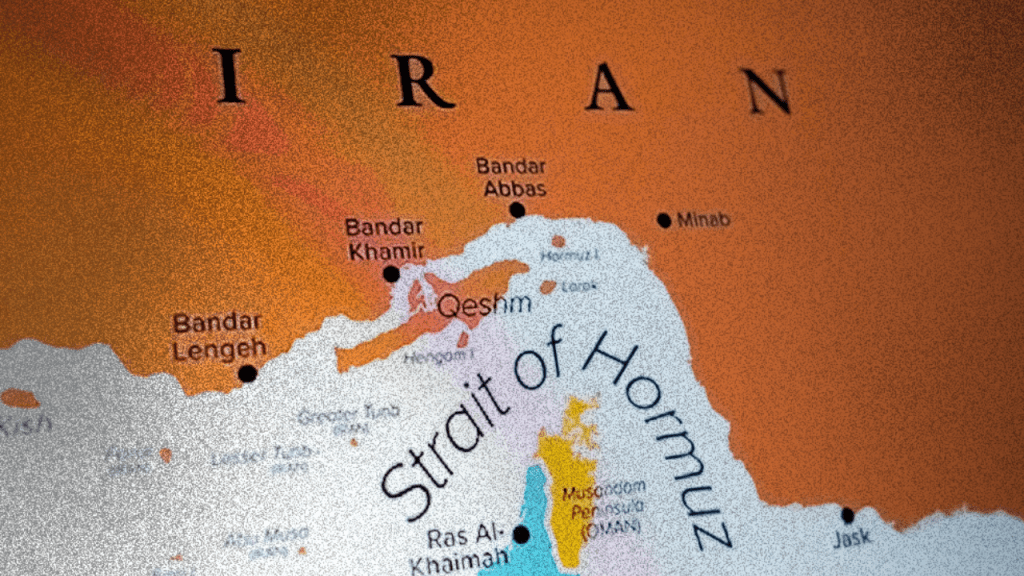
The Strait of Hormuz is approximately 54 kilometres wide at its narrowest point. The navigable system is far narrower: one inbound lane, one outbound lane and a separation zone, each approximately 3.7 kilometres wide. An average of roughly 20 million barrels of crude oil and petroleum products passed through the strait each day before the war, representing around one-quarter of global seaborne oil trade. Hormuz also carried close to one-fifth of internationally traded liquefied natural gas.
These flows were concentrated inside a corridor Iran could threaten from its coastline, islands, naval positions and nearby military infrastructure. Iran could not match the United States aircraft for aircraft or ship for ship, but it could make one of the global economy’s most important passages commercially unusable. That was the strategic value of Hormuz.
Geography allowed Iran to translate military resistance into pressure on energy prices, shipping networks, insurers, ports, producers and governments that might otherwise have treated the attack as a distant regional war.
Iran Created a Credible Prohibition on Passage
Iran did not need to sink a ship across the channel or maintain a continuous line of naval vessels blocking the waterway. It needed to demonstrate that ordinary passage could no longer be considered safe. Multiple vessels received the IRGC warning that no ship could pass, while the U.S. Navy separately told the tanker association INTERTANKO that it could not guarantee the safety of neutral or merchant shipping across the Gulf, Gulf of Oman, northern Arabian Sea and Hormuz operating area. Greece advised its ships to avoid the region.
The United States could continue operating military aircraft and ships under conditions commercial operators would reject, but those operations did not restore normal trade. A naval commander can order a military vessel into danger. A shipping company must answer to its crew, cargo owners, lenders, charterers, port operators and insurers. Iran’s power lay in widening the gap between those two calculations.
The Threat Was Supported by Material Events
By March 3, the danger was no longer only a declared possibility. At least five tankers had been damaged, two people had been killed and approximately 150 ships were stranded around the strait. Marine insurers began cancelling war-risk coverage as traffic approached a near halt.
Iranian officials denied responsibility for some incidents, and the public evidence did not establish the operator behind every projectile or drone. The broader military environment was nevertheless unmistakable. The United States and Israel were bombing Iran, Iran was retaliating against military and economic infrastructure across the region, vessels had been struck, Washington said it could not guarantee merchant safety and the IRGC had declared the passage closed.
Commercial operators did not need certainty about the source of every attack. They needed to know that another vessel could be hit and that no military power could reliably prevent it. That was enough to change behaviour.
Insurance Multiplied Iranian Power
Commercial shipping depends on more than open water. A vessel requires financing, contracts, port access and insurance. War damage is generally excluded from ordinary marine policies, making specialized war-risk coverage essential when a ship enters a conflict zone.
Before the war, Hormuz war-risk premiums were approximately 0.2 percent of a ship’s value. By March 3, quotes had risen as high as 1 percent. For a vessel valued at $100 million, that meant an increase from roughly $200,000 to $1 million for a voyage, while some underwriters declined to offer terms at all. Several major protection-and-indemnity insurers announced that existing war-risk coverage would be cancelled from March 5, requiring shipowners to purchase new protection under rapidly deteriorating market conditions.
Insurance did not create Iran’s leverage. It transmitted it. Iran made passage militarily dangerous, underwriters converted that danger into contract terms, shipowners converted those terms into operational decisions, and ports, customers and commodity markets absorbed the consequences. A relatively small number of military actions could therefore produce effects across the entire commercial chain.
Carriers Stopped Treating the Gulf as a Normal Destination
The shipping industry’s response was immediate.
Maersk suspended all vessel crossings through Hormuz and warned that Gulf services would face delays, rerouting and schedule changes. It later suspended additional regional services and cargo acceptance as the conflict continued. MSC ordered vessels in or approaching the Gulf to move to designated safe shelter areas, and on March 3 it declared an end of voyage for shipments destined for Arabian Gulf ports, diverted cargo to alternative safe locations and imposed additional deviation charges.
CMA CGM suspended bookings for Bahrain, Kuwait, Qatar, much of the United Arab Emirates, Gulf ports in Saudi Arabia and Iraq’s Umm Qasr. Oil majors, tanker owners and trading houses also stopped crude, fuel and LNG shipments after the U.S.-Israeli attack and Iran’s closure declaration, while satellite tracking showed vessels accumulating near ports rather than entering the strait.
These decisions were not political endorsements of Iran. They were recognitions that Iran had changed the conditions under which commerce could operate.
Functional Closure Was a Military Achievement
The water remained physically navigable, but that fact did not make the strait commercially open.
A functional closure occurs when the systems required for normal passage stop operating even without a permanent physical barrier. Ships refuse to enter, insurers withdraw, bookings are cancelled, cargo is diverted and producers reduce output because storage fills and export routes disappear. By March 11, crude and refined-product exports through Hormuz had fallen below 10 percent of their prewar level. The International Energy Agency said the interruption was forcing regional producers to shut in or curtail substantial production.
This was not closure by perception alone. Iran’s military position created the danger, actual attacks demonstrated that the danger could become material, and insurers and carriers then reproduced Iran’s leverage across the commercial economy. The market was not an alternative to Iranian power. It was the mechanism through which that power became global.
Physical Loss and Risk Premium Reinforced Each Other
Oil markets were responding to two forces at once. The first was a documented physical disruption: exports had fallen below 10 percent of normal, ships had stopped, producers were curtailing output and alternative pipelines could replace only a fraction of ordinary Hormuz traffic.
The second was uncertainty about duration and escalation. Traders had to judge whether the closure would last days or months, whether more tankers would be attacked, whether the United States could escort commercial ships safely, whether regional production facilities would be struck and whether the conflict would expand into additional shipping corridors.
As of March 3, Goldman Sachs estimated that traders were demanding approximately $14 more per barrel than before the war to compensate for these risks. The premium roughly matched the firm’s estimated price effect of a four-week halt in Hormuz flows after allowing for limited pipeline alternatives. The price was therefore recording both what Iran had already interrupted and what it might still be able to interrupt.
Price Volatility Reflected Contested Control
Oil prices moved violently because control of Hormuz remained unresolved. Prices rose sharply when traders expected a prolonged interruption and retreated when limited vessel movements suggested that some passage might resume. On March 16, Brent settled at $100.21 per barrel after a small number of ships crossed, remaining far above prewar levels despite the daily decline.
This was not evidence that financial markets had detached from reality. It showed how little information was required to change expectations when the underlying supply system was already damaged. A few successful transits could lower prices because they suggested the closure might be porous, while another attack, warning or insurer withdrawal could reverse that conclusion.
The volatility expressed a political fact: neither the United States nor commercial operators had established a stable right of passage against Iran’s resistance.
Emergency Reserves Could Not Restore the Waterway
The scale of the disruption forced the International Energy Agency to organize the largest coordinated emergency oil release in its history. On March 11, its 32 member states agreed to make 400 million barrels available from emergency reserves, and the agency described the market disruption as unprecedented in scale.
The release could add supply and restrain prices, but it could not reopen Hormuz, restore insurance or persuade shipowners that another passage would be safe. Normal traffic through the strait had been approximately 20 million barrels per day. The entire 400-million-barrel intervention was therefore equivalent to about 20 days of ordinary Hormuz oil flow, although the reserves would be distributed across different markets and schedules rather than replacing every missing barrel directly.
Emergency stocks treated the effect. Iran retained influence over the cause.
Washington Could Not Restore Confidence by Declaration
The United States responded by promising discounted government-backed insurance and suggesting that the Navy could escort ships through the strait. Those proposals acknowledged the problem they were presented as solving.
Private insurers did not trust the existing security environment, and commercial ships did not consider American naval power sufficient to make ordinary passage acceptable. Washington therefore proposed that the state absorb risks the market would no longer carry. An escort could protect some vessels, but it could not guarantee that every drone, missile, mine, coastal weapon or small craft would be intercepted. Nor could it ensure that a damaged tanker would avoid closing a lane, spilling cargo or producing another surge in insurance costs.
The United States remained militarily stronger than Iran, but it could not transform that superiority into predictable commercial navigation. Iran had found the gap between battlefield power and economic confidence.
Iran Denied the Aggressors Economic Insulation
Western governments described the closure through the language of freedom of navigation, but that language removed the war from the analysis.
The United States and Israel had attacked Iran. American forces were operating across the Gulf from bases embedded in neighbouring states, while Washington expected Iran to absorb the assault and leave the energy and logistics systems supporting the regional order untouched. Iran’s restriction of Hormuz denied the aggressors that privilege and forced oil importers, Gulf monarchies, shipping companies and Western consumers to experience part of the cost of a war their governments had expected to concentrate inside Iran.
This did not make every civilian consequence desirable. It identified who created the conditions producing those consequences. The attacking powers militarized the region, and Iran used the geography available to resist them.
Economic Systems Became Force Multipliers
Hormuz demonstrated how asymmetric warfare operates through institutions that appear separate from the battlefield. An Iranian warning influenced an insurer in London, the insurer’s decision changed a shipowner’s route, the rerouting delayed cargo and raised freight costs, and altered refinery supply then entered the price of oil. Military credibility travelled through contracts.
Iran did not have to command each step. It had to create conditions under which every commercial actor’s attempt to protect itself increased the total disruption. Insurers raised rates because the threat was credible, carriers suspended passage because insurance and security conditions deteriorated, and markets raised prices because physical exports collapsed while the duration of the closure remained uncertain.
The cascade amplified Iranian resistance without requiring Iran to physically stop every vessel.
The Closure Was Not a Market Accident
The commercial response is sometimes described as an unintended side effect of military escalation, but that framing obscures Iran’s strategy.
Iran had long understood that Hormuz provided leverage precisely because commercial systems would react before every threatened attack was carried out. The value of the strait lay not only in the number of weapons Iran could deploy but in the amount of global activity dependent on confidence that those weapons would remain unused. Once the United States and Israel opened the war, that confidence disappeared.
Iran did not need the global shipping industry to support its political position. It needed the industry to believe Iran could enforce it. The suspension notices, insurance cancellations and export collapse show that the belief was established.
The Economic Battlefield Multiplied Resistance
The article Iran Deterrence Strategy and the Limits of Moral Appeals examines why a weaker state uses material cost rather than appeals to the aggressor’s conscience. Hormuz shows the mechanism in operation.
Iran’s military capability produced a restriction on passage. Insurance converted danger into price, carriers converted price and danger into suspension, and energy markets converted suspension into a global shock. Each stage expanded the reach of the original act of resistance. A coastal warning became a freight problem, the freight problem became a production problem, and the production problem became an inflation and political problem inside countries far from the Gulf.
The economic battlefield did not replace the military one. It allowed Iran to carry the effects of military resistance into systems the attacking powers could not easily protect.
What Hormuz Proved
Iran did not need to build a permanent physical barrier across the strait. Its declaration, surviving military capabilities and demonstrated willingness to enforce the restriction made ordinary passage commercially indefensible. Insurers withdrew, carriers stopped, oil exports fell below 10 percent of normal and governments committed hundreds of millions of emergency barrels. Markets remained volatile because no outside power could promise when secure passage would return.
The United States and Israel had attacked Iran expecting their superior military power to determine the scale and geography of the war. Iran used Hormuz to deny them that control. The result was not a psychological illusion produced by frightened markets. It was a global economic response to a material balance of danger Iran had created in the waters beside its territory.
The strait became the war’s real battlefield because Iranian resistance made every commercial system dependent on the outcome.
Sources
- International Energy Agency, Strait of Hormuz Factsheet, February 2026
- International Energy Agency, “IEA Member Countries to Carry Out Largest Ever Oil Stock Release,” March 11, 2026
- Reuters, “Oil and Gas Majors and Traders Suspend Shipments Via Hormuz,” February 28, updated March 1, 2026
- Al Jazeera and Reuters, “Maritime Insurers Cancel War Risk Cover in Gulf,” March 3, 2026
- Maersk, “Rerouting of ME11 and MECL Service Around the Cape of Good Hope,” March 1, 2026
- MSC, “Middle East Security Measure for Transits in the Strait of Hormuz and Bab el-Mandeb,” March 1, 2026
- MSC, “End of Voyage Declaration for Shipments to the Arabian Gulf,” March 3, 2026
- CMA CGM, “Middle East Suspension of All Bookings,” March 3, 2026
- Goldman Sachs Research, “How Will the Iran Conflict Impact Oil Prices?” March 3, 2026
- Reuters, “Oil Prices Slide as Some Ships Transit Strait of Hormuz,” March 16, 2026