Scientific sovereignty is not distributed equally: Iran faces war and sanctions while Washington backs a Saudi nuclear program.
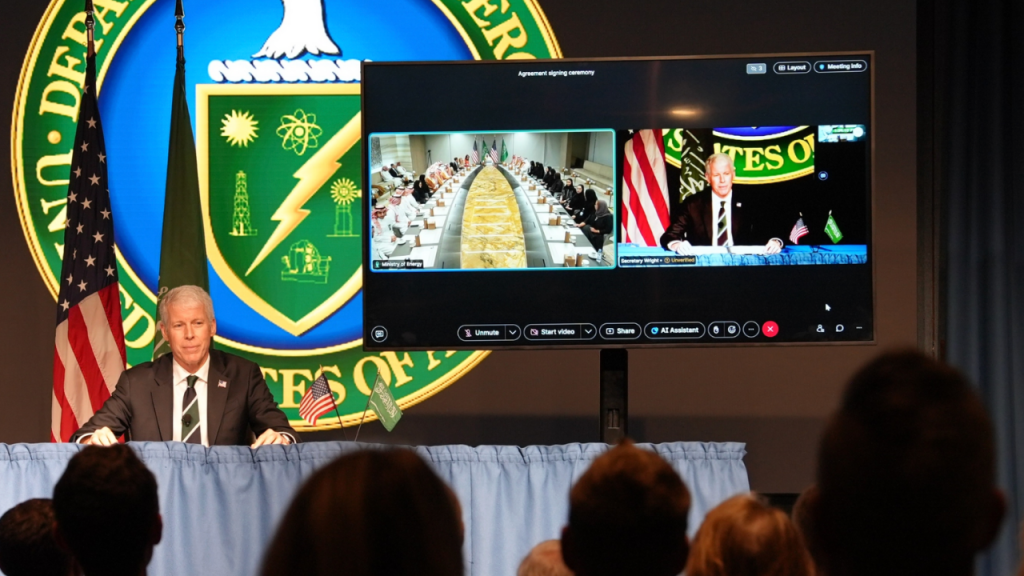
Congress is reviewing a nuclear cooperation agreement the United States signed with Saudi Arabia in July. The deal opens the door to a large Saudi civilian nuclear program using American technology, and unlike the earlier U.S. agreement with the United Arab Emirates, it does not contain a categorical Saudi renunciation of uranium enrichment or reprocessing. Washington argues that additional safeguards can manage the proliferation risk. The agreement therefore permits negotiations over capabilities that U.S. policy has spent years demanding Iran surrender.
That comparison now unfolds during a war. By late September 2026, the United States and Iran were still in a conflict that had lasted seven months. U.S. and Israeli attacks in 2025 and again during the opening phase of the current war destroyed or badly damaged Iran’s known enrichment plants. International Atomic Energy Agency inspectors still had not returned to the bombed sites, leaving the physical condition of parts of the nuclear program and the location of much of its enriched uranium unresolved.
Before the strikes, the IAEA estimated that Iran possessed 440.9 kilograms of uranium enriched to 60 percent. It cannot now verify how much of that material survived, where all of it is or what condition the damaged facilities are in. Nuclear terms remain part of mediated efforts to end the war, while Tehran continues to reject U.S. demands that it permanently halt enrichment or send its enriched uranium abroad.
The uncertainty strengthens rather than weakens the need for serious proliferation controls. It also sharpens a second question. Why does preventing weapons proliferation so often require adversaries to surrender technological autonomy, while allied states negotiate access to the same categories of knowledge under different political terms? The issue is not whether enrichment can create a weapons risk. It can. The issue is who is allowed to manage that risk through safeguards and who is expected to remain technologically dependent.
Washington Built the Reactor It Later Feared
The history of Iran’s Tehran Research Reactor makes the problem concrete. The United States supplied the reactor in 1967 through the Atoms for Peace program, along with highly enriched uranium fuel and facilities intended in part for isotope production. Argentina later converted the reactor to use uranium enriched below 20 percent and supplied replacement fuel. The reactor became part of Iran’s civilian scientific infrastructure long before the country’s enrichment program became the centre of an international crisis.
By 2009, the Argentine-supplied fuel was running low. Iran approached the International Atomic Energy Agency for help obtaining another supply for a reactor producing medical isotopes used in Iranian hospitals. A proposed fuel swap would have sent Iranian low-enriched uranium abroad, where Russia and France would convert material into fuel suitable for the Tehran reactor.
The arrangement collapsed amid mistrust over quantities, timing and the wider nuclear dispute. Iran responded by enriching uranium to roughly 20 percent and eventually fabricating reactor fuel domestically. The episode did not by itself cause Iran’s later enrichment decisions, but it demonstrated a basic vulnerability: Iran possessed a civilian reactor whose continued operation depended on foreign fuel and foreign political approval. Developing more of the fuel cycle domestically reduced that dependence.
It also created a larger proliferation problem. Centrifuges that can enrich uranium for reactor fuel can enrich it further, and Iran’s later production of uranium enriched to 60 percent went far beyond the demonstrated requirements of the Tehran Research Reactor. Before the attacks, that capability had shortened the technical distance to weapons-grade material. Scientific autonomy and proliferation risk therefore developed through some of the same machinery. Treating either one as fictitious produces an incomplete account.
A Nuclear Program Can End in a Hospital
Nuclear technology does not stop at power stations, enrichment plants or weapons laboratories. Nuclear medicine uses radioactive materials to diagnose disease and deliver targeted treatment. Technetium-99m, the most widely used diagnostic radioisotope, is incorporated into compounds that allow clinicians to image bones, organs and blood flow. The International Atomic Energy Agency estimates that it is involved in roughly 80 percent of nuclear-medicine imaging procedures worldwide.
Iran built a substantial medical system around that science. IAEA technical-cooperation records document Iranian work on technetium products and therapeutic radiopharmaceuticals, including compounds involving lutetium-177, gallium-68 and other isotopes used in cancer imaging and treatment. The agency has described decades of Iranian capacity-building that took the country from fewer than ten nuclear-medicine centres in the late 1980s toward domestic production of medical radioisotopes and radiopharmaceuticals.
The hospital and the centrifuge are not separate stories simply because they produce different political reactions. The same national system can train radiochemists, run research reactors, manufacture medical isotopes and operate enrichment equipment. Some of that infrastructure has direct civilian value while some of it creates pathways that arms-control agreements are designed to constrain. The purpose of safeguards should be to identify and monitor those risks without erasing the civilian system because part of the technology is dual-use.
Sanctions Turn Supply Chains Into Leverage
Technological dependence becomes political power when one government can influence whether another country’s laboratories obtain parts, financing or specialized materials. Medical goods may be formally exempt from sanctions and still become difficult to purchase because banks will not process payments, manufacturers fear secondary sanctions, insurers refuse transactions or shipping routes become unreliable. Nuclear medicine is especially exposed because some radioactive products have short half-lives and sophisticated scanners and treatment systems depend on specialized replacement parts.
Peer-reviewed research on cancer care in Iran has documented shortages of diagnostic kits, radioactive tracers, technetium generators, software and replacement equipment under sanctions. Medical specialists described functioning machines becoming unusable because specific sources or parts could not be replaced. Other research on Iranian nuclear medicine has documented similar problems with payments, equipment and access to radioactive materials.
This is part of the broader infrastructure conflict Spark Solidarity has already traced through Iran’s infrastructure war. A country that depends on foreign manufacturers for a medical isotope generator, a scanner component or reactor fuel remains vulnerable to decisions made outside its health system. Domestic production can reduce that vulnerability, giving technical capacity a political value extending beyond the laboratory.
Sanctions therefore create a structural incentive that can work against technological dependence. When foreign access becomes precarious, governments and institutions have more reason to replace suppliers, develop domestic expertise and find alternative partners. The resulting capabilities can then enter security assessments of their own. That does not make every concern about domestic capacity illegitimate. It shows how economic pressure and technological autonomy can reinforce each other rather than operating as separate stories.
Iran and Cuba Built Another Supply Line
That process became visible in Havana in June 2025. Iranian parliament speaker Mohammad Bagher Ghalibaf delivered four Iranian nuclear-medicine kits to Cuban President Miguel Díaz-Canel. Iranian reporting said the products included diagnostic tools for imaging bone metastases and cardiac function. The Critical Threats Project, which tracks Iranian activity from a very different political perspective, independently recorded the delivery of four nuclear-medicine kits.
Cuba was not simply a passive recipient. IAEA technical material documents decades of radiopharmaceutical work at Cuba’s Center of Isotopes, known as CENTIS. The centre has produced molybdenum-99/technetium-99m generators and associated radiopharmaceuticals, while IAEA-supported projects have helped develop therapeutic products including yttrium-90 compounds. A 2026 IAEA conference paper also documents the domestic transport of iodine-131 and molybdenum-99/technetium-99m generators for Cuban nuclear-medicine services.
The network extends beyond Iran and Cuba. Bolivia’s Nuclear Energy Agency announced in 2025 that it had signed a scientific-cooperation agreement with CENTIS aimed at radiopharmaceutical production, research and the exchange of technical expertise. Bolivia brought newer isotope-production infrastructure to a partnership in which Cuban institutions contributed longer clinical and radiopharmacy experience. This is state-to-state cooperation and should be understood as such, but it is also a material exchange of productive capacity.
The pattern fits Cuba’s broader strategy. As Cuba’s biotech sector demonstrates, decades of U.S. sanctions increased the cost of scientific development while strengthening the strategic case for domestic laboratories, pharmaceutical production and international medical partnerships. Iran has faced a different sanctions regime and possesses a much larger industrial base, but the underlying vulnerability is similar: essential technology becomes a question of sovereignty when foreign access can be withdrawn.
South-to-South cooperation should not be romanticized as a relationship without interests or hierarchy. Iran and Cuba seek revenue, diplomatic influence and strategic resilience from scientific exchange. Bolivia and other partners pursue their own objectives. What these relationships can alter is bargaining power. A country that manufactures a medicine, trains specialists or shares production knowledge has more room to act than one permanently waiting for permission to import the finished product.
The Nuclear Order Is Also an Access Regime
The Nuclear Non-Proliferation Treaty recognizes five states as nuclear-weapon states: China, France, Russia, the United Kingdom and the United States. Those same countries occupy permanent seats on the UN Security Council. The treaty also affirms the right of parties to develop peaceful nuclear energy under safeguards, but actual access to fuel, financing, equipment and technology is mediated through supplier governments, export-control systems and political alliances.
The Saudi agreement makes that political dimension difficult to ignore. It does not require Saudi Arabia to adopt the IAEA Additional Protocol, which would grant the agency broader rights to information and access, and it does not contain the UAE agreement’s categorical prohibition on enrichment and reprocessing. Instead, the Trump administration negotiated a separate bilateral safeguards arrangement intended to cover sensitive cooperation involving enrichment, conversion, fuel fabrication and reprocessing.
Documents submitted to Congress provide for additional measures including short-notice IAEA inspections at covered sites. Arms Control Association analysis concludes that those provisions go beyond Saudi Arabia’s existing comprehensive safeguards in some respects but do not provide the same ability to detect undeclared nuclear activity as an Additional Protocol. The difference is therefore not that Saudi Arabia will operate without safeguards. It is that Washington accepted a different safeguards architecture while preserving the possibility of Saudi fuel-cycle capabilities.
Iran’s present situation is far more severe. Its enrichment plants have been attacked, its safeguards relationship is unresolved and the IAEA cannot account for what remains of the pre-strike 60-percent inventory. Iran, Russia and China also contest the legality of the 2025 restoration of earlier Security Council sanctions. None of those facts makes Saudi Arabia and Iran equivalent cases. They make the political character of access more visible: technological permission is negotiated through security judgments, alliances and power rather than distributed by one automatic technical rule.
Scientific Sovereignty Is Not a Right to a Bomb
The IAEA’s inability to verify what remains of Iran’s pre-strike 60-percent uranium inventory is itself a proliferation problem. Its safeguards disputes require resolution, and any durable settlement needs credible inspection of surviving material and facilities. A serious anti-imperialist position does not need to pretend that dual-use technology stops being dual-use when the country operating it is under Western military or economic pressure.
The stronger argument is that non-proliferation should address proliferation. It should establish credible limits on enrichment, stockpiles, weaponization activity and undeclared material while protecting civilian reactor fuel, radiopharmaceutical production, medical equipment, research and international scientific cooperation. A security regime becomes a system of dependency when ordinary scientific access remains contingent on political alignment even after verifiable weapons constraints are satisfied.
The Tehran Research Reactor shows why those questions cannot be separated. The United States helped create a civilian reactor. Foreign fuel dependence later became part of a political confrontation. Iran developed more domestic capacity, gaining autonomy while also acquiring enrichment capabilities that raised serious proliferation concerns. The medical system was real, and so was the security problem created by higher enrichment.
The war has now made the result harder to measure. Bombing destroyed or badly damaged enrichment infrastructure without giving inspectors a verified accounting of the enriched material that existed beforehand. Diplomacy is again trying to determine what Iran may retain, what it must surrender and what access inspectors will receive. Those are security questions, but they are also decisions about how much scientific and industrial autonomy Iran will be permitted to preserve after the war.
The four medical kits carried from Tehran to Havana showed what scientific sovereignty looks like at a smaller scale. Iran had developed technology that another sanctioned country could use, while Cuba had institutions capable of incorporating and extending that knowledge through its own medical system. Neither country escaped global dependency. They reduced the number of external actors capable of shutting down part of their scientific infrastructure.
The nuclear order will remain unequal as long as scientific mastery is treated as normal for powerful states, negotiable for allies and inherently suspect for adversaries. Preventing nuclear weapons is a legitimate collective goal. Requiring permanent technological dependence is a political choice.
Sources
- U.S. Department of Energy, “United States and Saudi Arabia Reach Historic Nuclear Cooperation Agreement,” July 2026
- Reuters, reporting on congressional review of the U.S.-Saudi nuclear cooperation agreement, October 2, 2026
- Arms Control Association, “The U.S.-Saudi Agreement for Civil Nuclear Cooperation: Answers to Frequently Asked Questions,” September 2026
- Arms Control Today, “Trump Adds Conditions to U.S.-Saudi Nuclear Cooperation Deal,” September 2026
- United Nations Security Council, Resolution 2231 background and September 2025 re-application of earlier Iran resolutions
- Reuters, “US and allies push IAEA board to report Iran to UN Security Council, diplomats say,” September 4, 2026
- Reuters, “Iran will make no nuclear concessions, Iranian official says,” September 25, 2026
- Reuters, “US, Iran separately talk with mediators in latest bid to end war,” September 28, 2026
- Nuclear Threat Initiative, “Tehran Research Reactor”
- The Washington Post, reporting on the Tehran Research Reactor fuel crisis, October 2009
- Arms Control Association, Iran’s 20-percent enrichment and Tehran reactor fuel
- International Atomic Energy Agency, medical-isotope production and technetium-99m guidance
- International Atomic Energy Agency, Iran’s radiopharmaceutical technical-cooperation record
- International Journal for Equity in Health, “The impact of economic sanctions on cancer diagnosis and treatment in Iran,” 2024
- Asia Oceania Journal of Nuclear Medicine and Biology, “Economic Sanctions on Iran and Nuclear Medicine,” 2019
- Iran Press, “Iran Gifts Advanced Nuclear Medicine Kits to Cuba President,” June 2025
- Critical Threats Project, “Iran Update, June 3, 2025”
- International Atomic Energy Agency, “Sustainable production of Tc-99m generators and radiopharmaceuticals: an IAEA/Cuban experience”
- International Atomic Energy Agency, Cuba radiopharmaceutical production and technical-cooperation material
- International Atomic Energy Agency, 2026 conference paper on Cuban iodine-131 and Mo-99/Tc-99m generator transport
- Bolivian Nuclear Energy Agency, Cuba-Bolivia scientific-cooperation agreement on nuclear medicine and radiopharmaceutical research, February 2025