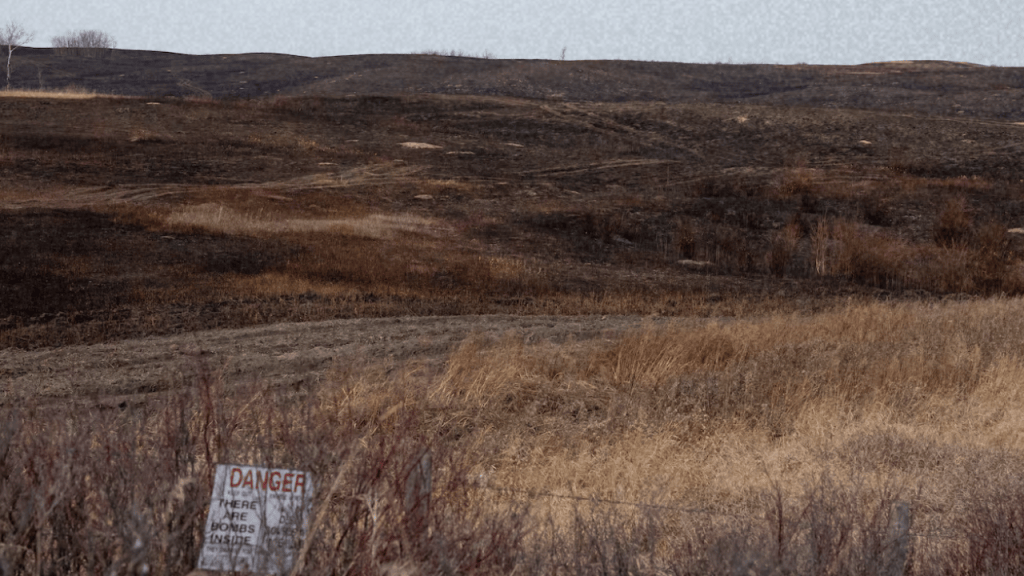
The CFB Wainwright fire was already being monitored when commanders kept training. Four soldiers died. DND’s first account left those earlier hours out.
On October 18, the Department of National Defence told Canadians that a fire had ignited at CFB Wainwright at approximately 4 p.m. the previous afternoon. The flames had swept through a military training area, killing Sergeant Morgan Wong and Privates Shaun Farrell, Aidan Goulding and Hayden Lykkemark. Thirty-nine other soldiers were injured. It was an account of a catastrophe arriving with terrifying speed, followed by an emergency response.
But the military had been dealing with a fire long before that hour. Major-General Wade Rutland told reporters that a blaze had burned on the base for several hours and that training continued because commanders believed it was contained. On October 22, the Canadian Forces Provost Marshal described a fire reported during routine training on an automatic grenade-launcher range, confined to a restricted danger area and monitored throughout the day.
The later account puts the military’s decisions back into the story. Soldiers were training while personnel elsewhere on the base watched a fire that had not been extinguished. Commanders considered the danger manageable and carried on. By the time the public heard about those earlier hours, four soldiers were dead and an official account had already placed the fire’s apparent beginning near the moment of disaster.
A Known Fire Was Treated as a Manageable Risk
According to Rutland, commanders considered the burning area sufficiently contained to continue the exercise. He described the fire as roughly a kilometre away from the soldiers who were later overtaken. DND attributes the deadly spread to a sudden change in wind direction and speed. Those details explain the military’s stated assessment, but they also identify the judgment at the centre of the disaster: continuing training beside a fire was considered an acceptable risk.
A training base is built to handle hazards that would shut down ordinary workplaces. Live ammunition, dangerous ground and changing weather are part of military exercises. The institution therefore has rules, designated authorities and specialized personnel to decide when those hazards become too dangerous. Commanders can choose to proceed, alter an exercise or stop it. At Wainwright, they chose to proceed for a period while the fire burned.
The soldiers on the range were not the people deciding how much fire risk the exercise could absorb. That authority rested up the chain of command, along with responsibility for the information used to make the call. When the fire reached the training area, those soldiers bore the immediate consequences. The institution must now explain what its commanders knew, how they judged containment and whether they reconsidered that judgment as conditions changed.
The same point applies to the weather. A wind shift can turn a contained grass fire into a fast-moving emergency, especially across open terrain. DND says that is what happened. But the existence of that danger makes the earlier assessment more consequential. The decision was not only whether the fire appeared contained at a particular moment, but whether training could safely continue while its behaviour depended on conditions that could change.
Wainwright Had a System for Fire and Weather
The military had already written procedures for this kind of situation. Range Standing Orders obtained by Global News identify August through October as a high-risk period for grass fires during live-ammunition training. They recommend scheduling firing early in the day where possible, generally before 10 a.m., when conditions are less likely to spread a fire. They also require units to report grass fires to Range Control, track their intensity and movement, and maintain communications about changing conditions.
The orders give the chain of command the initial authority to cease or modify training when adverse weather affects operations. Range Control receives forecasts, the range warden coordinates fire response, and updates are meant to reach the people responsible for safety. This is a system for making decisions while events are unfolding, not a set of instructions to consult after a disaster.
The document obtained by Global News is dated 2024. The base changed commanders in April 2025, and it remains unclear whether the orders were reissued or revised before October 17, 2026. That makes the operative version of the rules an obvious document to release. It does not erase what the published orders show about the military’s established understanding of autumn fire risk or where decisions about suspending training belonged.
A Wind Warning and an Active Fire
The weather record gives those procedures particular weight. Global News reported that Environment Canada issued a wind warning for the region at 2:15 p.m., forecasting gusts up to 100 kilometres per hour. Satellite passes also detected possible fire activity on the base earlier in the afternoon, around 12:17 and 2:49. The detections do not identify when the fatal blaze began or establish that each hotspot was part of the same fire. The military’s own Range Control logs should settle the actual timeline.
Strong winds by themselves do not necessarily end infantry training, and a regional forecast cannot tell us precisely what information reached a particular commander. But this warning did not arrive in an otherwise ordinary training day. By Rutland’s account, a fire was already burning and personnel were monitoring it. The critical issue is what happened when that known hazard met a forecast of deteriorating weather, and whether the command system responded before the flames reached the soldiers.
The Fire Could Be Watched but Not Easily Fought
The Provost Marshal has identified another constraint. The fire was inside Permanent Danger Area 2 on an automatic grenade-launcher range, where the presence of dangerous munitions restricted direct firefighting. Sending crews onto such ground can expose them to hazards beyond the fire itself. The military says the blaze was therefore monitored throughout the day rather than directly attacked.
That restriction deserves to be taken seriously. Firefighters cannot be expected to walk into an ammunition danger area simply because smoke is visible. But the inability to put out the flames raises the stakes of the controls available elsewhere. Separating personnel from the fire, tracking the wind, adjusting training and preparing to move people become more important when suppression is constrained.
The military was operating on both sides of that calculation. It knew a fire was burning in a place crews could not readily enter, yet commanders believed other training could go ahead. When DND points to the final wind shift, it is describing what overtook that assessment. An inquiry into Wainwright has to examine how the assessment was made in the first place, what it depended on and how much warning commanders had that its assumptions were changing.
The Risk Spread Beyond the Range
The four soldiers killed were members of a force preparing for operational deployment. Rutland described the exercise as high-intensity combat training with live ammunition. The military’s October 22 update said 27 of the injured remained in hospital and 12 had been discharged. Their injuries were serious enough that specialist civilian burn-care personnel were brought from Toronto to Edmonton to help treat them.
A military institution can tell its members that hazardous training is necessary. It also controls the conditions under which that training happens. The people on the range depend on commanders to act on information they cannot all see, from changing weather forecasts to reports from Range Control. Wainwright exposes the consequences when that concentration of authority is paired with a judgment that does not survive changing conditions.
The fire also crossed the boundary between military operations and civilian life. An internal Strategic Joint Staff memo obtained by Global News says flames jumped a fire guard, spread beyond the base and forced the evacuation of one family home. The memo did not establish a wider total of property losses, but the evacuation shows the danger was not confined to the soldiers involved in the exercise.
Residents outside Wainwright’s fences do not decide when live ammunition is fired or which training exercises continue near a grass fire. The military makes those decisions and retains the information behind them. When a fire escapes the installation, the consequences move beyond the institution that accepted the risk. The civilian warning and evacuation record belongs alongside the training and fire logs in any complete account of the day.
DND Changed the Story After the Deaths
The October 18 release said the fire “ignited” at approximately 4 p.m. It presented the disaster through the moment the flames spread and emergency services responded. It omitted the military’s earlier knowledge of a burning fire and the decision to continue training. Four days later, the Provost Marshal’s statement supplied those missing hours.
This was no minor addition to a developing casualty count. It changed the public chronology of the disaster. The first account centred on the sudden outbreak of a deadly fire. The later one established that military personnel had been monitoring a fire while training carried on. Those are different pictures of what the institution was doing before the emergency overwhelmed the soldiers.
DND has not explained why its first release described ignition around 4 p.m. when its subsequent account included a fire burning earlier in the day. Was the time meant to describe the rapid spread rather than the first ignition? Did the release’s authors receive an incomplete account? The department can answer those questions without waiting for every finding from the military police investigation. Its own communications should not conceal the part of the timeline that brings command decisions into view.
The military’s published account of the cause also remains an institutional account. Investigators are still examining what happened, and the existence of a sudden wind change does not establish that every earlier command decision was sound. A public explanation that begins when events become uncontrollable leaves out the people who decided what was acceptable beforehand. That is why the missing afternoon matters.
The Orders, Logs and Decisions Belong in Public
The unanswered questions have identifiable records behind them. Range Control logs should show when the fire was reported, its observed direction and speed, and how information moved between personnel. Weather briefings should show when the wind warning reached the base and which commanders received it. The standing orders actually in force on October 17 should identify who had the authority to stop or modify the exercise. Command communications should show whether anyone proposed doing so, what objections were raised and why the training continued.
DND must also account for its first public statement. Where did the 4 p.m. time come from, who drafted the release, and how was it approved? The changing chronology makes those questions as relevant as the fire logs and operational orders. Accountability cannot depend entirely on a press statement issued by the same institution whose choices are now under investigation.
Military Police are investigating whether criminal or service offences occurred, and the military has announced a separate Board of Inquiry. Those processes have their own purposes. The central facts already acknowledged by the military are sufficient to demand the decisions that preceded the disaster: a fire was reported, personnel monitored it, and commanders continued training. Four soldiers died, dozens were injured, and an internal military memo says the flames spread beyond the base.
Wainwright was not only a story of wind and fire. It was a story of who had the authority to keep an exercise running while a known hazard remained active, and of an official chronology that initially left that authority out of sight. Until the military accounts for those hours, its explanation of the disaster begins too late.
Sources
- DND, initial CFB Wainwright statement, October 18, 2026
- DND, identification of four soldiers and injury count, October 18, 2026
- Canadian Forces Provost Marshal, investigation statement, October 22, 2026
- DND, casualty and investigation update, October 22, 2026
- Global News, military standing orders, October 20, 2026
- Global News, Wainwright fire satellite and weather analysis, October 20, 2026
- Global News, CAF Strategic Joint Staff memo, October 19, 2026