Windsor raised the Palestinian flag on August 7 under a civic recognition system rewritten the previous year, after Toronto and Hamilton had voted to eliminate foreign-national flag categories.
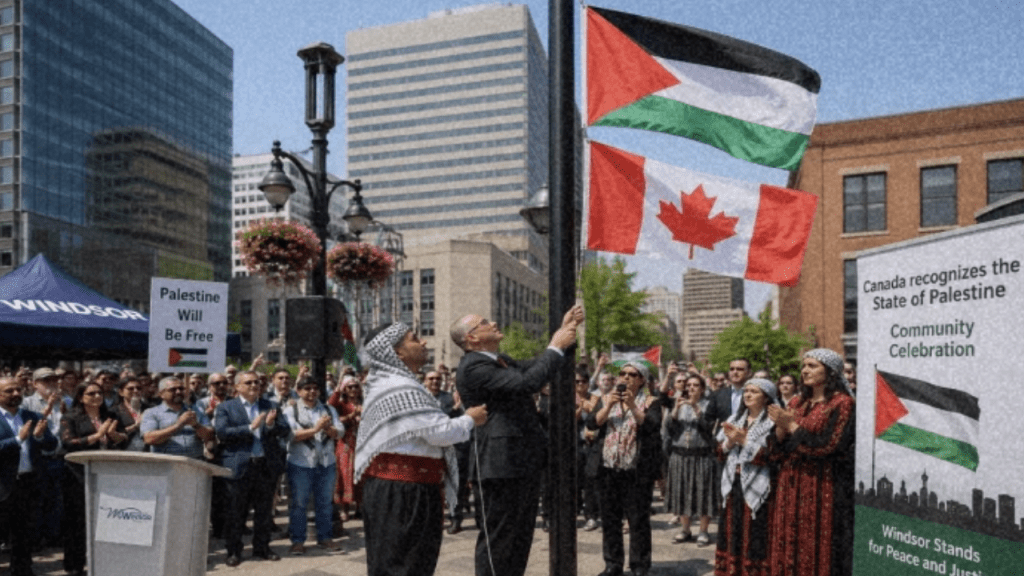
The Palestinian flag was raised at Charles Clark Square on Friday morning as members of Windsor’s Palestinian-Canadian community gathered outside City Hall for a ceremony promoted by Windsor4Palestine.
Mayor Drew Dilkens attended the August 7 event, later describing it as a celebration marking Canada’s recognition of Palestine. Contemporary notices also advertised cultural performances and community programming around the flag raising.
The ceremony came almost exactly a year after Windsor rewrote the rules governing symbolic recognition on municipal property.
The 2025 Rules Still Allowed Foreign Flags
On July 28, 2025, City Council replaced its previous framework with a more tightly administered system. Four core flags would fly permanently, while special flag raisings remained available through defined categories tied to City partnerships, recognized commemorative days and official delegations.
The policy did not abolish every route for foreign-country flags. Official representatives of countries recognized by Canada could still qualify, as could some twin-city delegations. Requests outside the framework could be denied.
Toronto and Hamilton Took a Different Path
That distinction separated Windsor’s approach from the restrictions later adopted in Toronto and Hamilton.
Toronto voted in March 2026 to remove foreign-national flags from its courtesy flagpoles beginning December 1. Hamilton approved the elimination of its foreign-national category in July, with the change taking effect September 1. Windsor had already narrowed its system, but it preserved channels through which foreign-state symbols could still appear on municipal property.
On August 7, one of those political possibilities became visible.
The public record confirms that the Palestinian flag ceremony took place under Windsor’s post-2025 recognition regime. It does not establish which specific eligibility provision the City used to approve it.
The exact applicant of record has not been recovered. Nor does the available documentation show whether the request qualified through a City partnership, a recognized commemorative day, an official delegation or another permitted category. Windsor4Palestine promoted the gathering, but that alone does not establish that it filed the municipal application.
Canada’s recognition of Palestine supplied the event’s immediate political context. It did not automatically compel Windsor to approve a flag raising, and the available record does not show that federal recognition mechanically determined the City’s decision.
That uncertainty does not weaken the institutional point. Windsor’s policy controlled access by sorting requests into administrative categories and placing approval behind municipal gates. A universal rule did not remove politics from civic space; it determined which political symbols could reach that space, through which channels and under whose authority.
Windsor restricted access without eliminating it. Toronto and Hamilton chose categorical exclusions for foreign-national flags.
Windsor’s rules had narrowed who could obtain civic recognition. They had not made foreign-state recognition impossible. On August 7, that distinction became visible.
Sources
- Mayor Drew Dilkens, post-event record describing his attendance at the Palestinian flag-raising ceremony, August 7, 2026.
- Windsor4Palestine, “Celebrating Palestine” event announcement for August 7, 2026, Charles Clark Square.
- Arab Canada News, contemporaneous August 6, 2026 preview of the Windsor Palestinian flag raising and community programming.
- City of Windsor, Flag Policy.
- City of Windsor, Apply for Proclamation, Flag Raising or City Hall Building Illumination.
- Spark Solidarity, “Windsor Rewrites Flag Policy, Keeps Limited Foreign-State Access.”