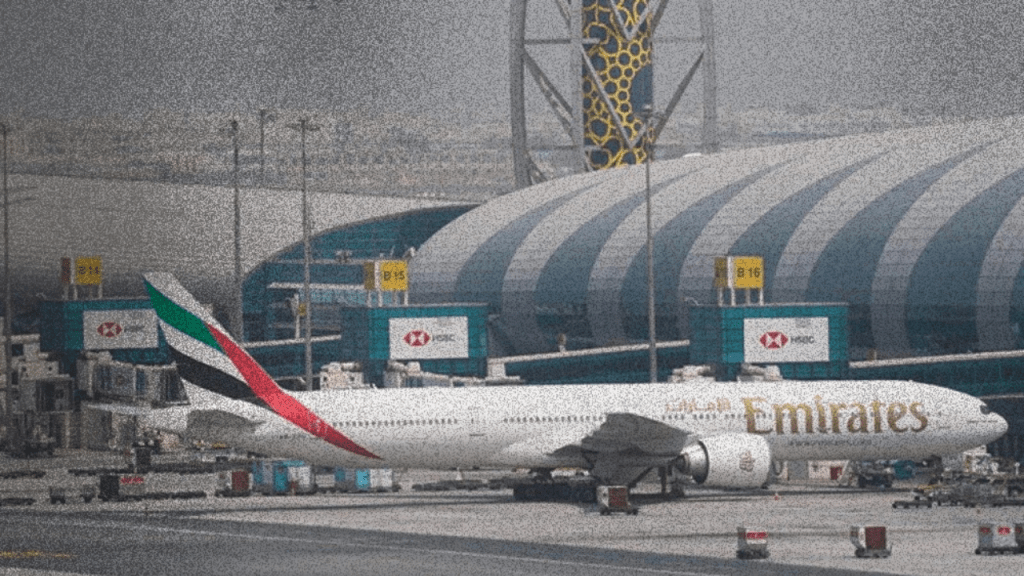
The Emirates shutdown exposed the cost of hosting U.S. military power when Iran answered a war Washington and Tel Aviv began.
The United States and Israel Closed the Gulf’s Skies
On February 28, the United States and Israel launched military strikes against Iran. Iran answered with retaliatory attacks across the regional military network surrounding it. Within hours, airspace emptied across Iran, Iraq, Kuwait, Bahrain, the United Arab Emirates, Qatar and Israel. Dubai, Abu Dhabi and Doha, three of the world’s most important international transit hubs, were closed or severely restricted.
Emirates suspended all operations to and from Dubai because multiple regional airspace closures had made its network impossible to operate safely. By March 1, the airline had extended the suspension until 3 p.m. on March 2 and offered affected passengers rebooking or refund options. The shutdown was not caused by an abstract regional conflict that appeared without an author. Washington and Tel Aviv initiated the direct war, Iran retaliated as the state under attack, and the airspace crisis followed from that sequence.
This chronology cannot be removed without changing the politics of the event. The Gulf’s airlines did not stop because Iran irrationally disturbed an otherwise peaceful region. They stopped because the United States and Israel opened a war in the middle of an air-transport system built around countries hosting American military power. The aviation consequences were immediate because the military structure had already been placed there.
Dubai Was Built to Make War Look Distant
Dubai International Airport functions as a global transfer point between Europe, Africa, Asia and Australasia. Emirates depends on passengers arriving from one direction, changing aircraft and departing in another through a tightly coordinated schedule. The hub works because the surrounding airspace is assumed to remain open, predictable and politically insulated. That assumption collapsed on February 28.
The airline did not merely lose access to one destination. Routes through several neighbouring flight-information regions became unavailable or unsafe at the same time. Aircraft and crews were left out of position, passengers were stranded far beyond the Gulf, and flights were cancelled from Bali to Frankfurt as disruption at the regional hubs moved outward through international schedules. Reuters described the shutdown as one of the sharpest aviation shocks in recent years.
The system had presented Dubai as connective tissue floating above regional politics. Finance, tourism, aviation and logistics could operate through the Gulf while American bases, Israeli military supremacy and war against Iran were treated as separate security questions. They were never separate. Dubai’s hub model depended on a political order in which U.S. military power could be stationed throughout the region without the economic infrastructure surrounding it being treated as part of the same strategic environment. Iran’s retaliation broke that illusion.
Why Airlines Stopped Flying
Commercial aviation does not require a deliberate attack on a passenger aircraft before operations become unsafe. Airlines and regulators assess the full threat environment: ballistic and cruise missiles, drones, air-defence systems, interception debris, radar saturation, navigation interference and the possibility of civilian aircraft being misidentified during high-tempo military operations.
The International Civil Aviation Organization’s conflict-zone guidance addresses both deliberate attacks and unintended impacts on civil aircraft. It identifies surface-to-air missiles, ballistic missiles, other military weapons and failures in risk communication as hazards requiring states and airlines to consider closures, restrictions and rerouting. The European Union Aviation Safety Agency issued Conflict Zone Information Bulletin 2026-03 on February 28, identifying all flight levels over Bahrain, Iran, Iraq, Israel, Jordan, Kuwait, Lebanon, Oman, Qatar, the UAE and Saudi Arabia as affected airspace.
EASA also identified the political sequence. The United States and Israel struck Iran, Iran retaliated, and the resulting military activity created risks not only over Iran but in neighbouring states hosting U.S. bases or otherwise affected by military operations and interceptions. The danger extended into the Gulf because the military infrastructure of the war extended into the Gulf.
Aircraft could not simply fly around one front line. The affected area contained overlapping flight corridors, national jurisdictions, military installations, missile trajectories and air-defence systems. A route that appeared geographically distant from Iran could still cross the operating area of forces participating in or responding to the war. Clearing the skies was not panic. It was the aviation system recognizing that military escalation had removed the margin on which civilian flight depends.
The Gulf States Were Not Outside the War
The UAE, Qatar, Bahrain and Kuwait are often described as neighbouring countries caught between the United States and Iran, but geography alone does not explain their exposure. These states host major elements of the American military architecture surrounding Iran. Their territory, airspace, ports, logistics networks and bases support the projection of U.S. power across the region. Qatar hosts Al Udeid Air Base, Bahrain hosts the U.S. Fifth Fleet, and Kuwait and the UAE provide additional basing, access and logistical infrastructure.
Their governments may seek commercial relationships with Iran while maintaining military relationships with the United States. Dubai may market itself as a neutral centre of trade while the federation containing it remains part of the regional structure that makes American war possible. That arrangement depends on Iran accepting a permanent asymmetry in which the United States may use surrounding territory to threaten or attack Iran, while Iran is expected to treat that territory as politically neutral when it responds. Iran’s retaliation rejected that arrangement.
This does not mean every civilian in the Gulf chose the military alliances of the governments under which they live. It does not make passengers, airline workers or airport staff legitimate targets. It means the danger imposed on them cannot be explained without naming the decision to embed U.S. military power inside civilian economic hubs. The vulnerability was not created by Iran noticing the bases. It was created by putting the bases there and then using the regional system to attack Iran.
The companion analysis, Iran Strikes Dubai: Empire’s Risk Model Made Visible, examines the same contradiction at the level of Gulf political economy.
Civilian Infrastructure Became Part of the Battlefield
The first-day cancellation numbers captured only the opening disruption. Cirium recorded 232 cancellations among 3,422 scheduled flights serving several affected regional countries on February 28. That represented 6.7 percent of the scheduled total, with higher cancellation shares in Israel, Jordan and Qatar. By March 1, continued closures and restrictions had produced thousands of cancellations across the wider international network.
Those figures did not represent an aviation system literally ceasing to function. Airlines continued to operate elsewhere, and some routes could be redirected. They demonstrated that the regional hub network had lost the stable airspace on which its normal schedule depended. A hub airline cannot repair that problem by moving individual flights around a closed corridor.
Its aircraft rotate through multiple destinations each day. Crews operate within legal duty limits, passengers connect through timed banks of arrivals and departures, maintenance is scheduled around aircraft returning to specific bases, and cargo capacity is attached to passenger routes. When several major hubs and surrounding airspaces become unavailable together, each cancelled flight creates additional operational problems elsewhere. Aircraft remain at distant airports, crews cannot reach their next assignments, passengers miss onward connections, cargo waits, alternative routes become longer and more expensive, and other carriers inherit demand they cannot immediately absorb.
The result is a cascade, not a single closure. The global effects reveal what Dubai actually is: not merely a successful airline base, but a switching point inside the circulation system of contemporary capitalism. When that point closes, the effects travel far beyond the population living beside it.
Aviation Safety Has a History Written in Wreckage
The risk of flying through missile-heavy airspace is not hypothetical. Ukraine International Airlines Flight PS752 was shot down shortly after leaving Tehran on January 8, 2020, during a period of heightened military alert following Iranian missile strikes on U.S. forces in Iraq. All 176 passengers and crew were killed.
Iran’s final safety report concluded that an air-defence unit mistook the Boeing 737 for a threat. Canada’s Transportation Safety Board considered misidentification a plausible explanation while finding that Iran’s report left major questions about command, radar alignment, training and communication unanswered. The lesson is not that Iran possesses some unique incapacity to manage airspace. It is that civilian aviation and active missile warfare cannot safely occupy the same environment without severe risk.
The danger increases when several states are launching missiles, operating air defences and conducting interceptions across interconnected airspace. Modern airliners do not become safe because no belligerent intends to hit them. Intent cannot prevent falling debris, guarantee correct identification, eliminate navigation interference or force every command system to function perfectly while operators make decisions within seconds. Aviation safety doctrine exists because waiting for proof of danger can mean waiting for another wreckage field.
The Shutdown Exposed the Price of Hosting Empire
Gulf governments have built economic models around the claim that they can host American military power while remaining frictionless centres of global commerce. The bargain is profitable during periods when the United States can impose violence elsewhere without retaliation reaching the infrastructure that supports it. The February 28 war exposed the limit of that bargain.
Military bases cannot be separated indefinitely from the territories, economies and transport systems containing them. A state cannot provide infrastructure for attacks on Iran and then insist that every surrounding commercial system stands outside the military geography produced by that choice. This is not an argument for civilian suffering. It is an explanation of where responsibility begins: with the states that initiated the war and with the regional order that placed the machinery of American power throughout the Gulf.
Iran had no obligation to absorb a U.S.-Israeli assault without responding because the attacking military network had been embedded beside civilian airports, ports and commercial districts. Requiring that would grant the United States an invulnerable regional platform from which it could wage war while every Iranian attempt to defend itself was condemned for endangering the infrastructure built around that platform. That is not a neutral safety standard. It is a demand for Iranian submission.
The shutdown made the contradiction visible because aviation is unusually sensitive to it. Airlines cannot operate on diplomatic euphemism. They must translate political conditions into operational risk. The Gulf could call itself stable. The flight plans could not.
What Resumed Flights Would Not Mean
Airlines resume service when they believe enough of the operating environment has stabilized to manage the remaining risk. That requires more than one quiet period. Airspace restrictions must become predictable, air-traffic authorities must coordinate routes, military operations and interceptions must no longer create unacceptable uncertainty, aircraft and crews must be repositioned, and disrupted schedules must be rebuilt.
A few resumed flights would therefore not prove that the political problem had been resolved. They would show that operators had found a temporary corridor through it. The conditions that produced the shutdown would remain: U.S. military infrastructure surrounding Iran, Gulf economies dependent on political insulation from that infrastructure, and civilian transport networks exposed whenever the regional war escapes the boundaries Washington assigns to it.
The same infrastructure problem appeared at sea as navigation interference spread across the Strait of Hormuz. GPS Jamming at Hormuz: What Satellite Warfare Actually Is documents how military conflict entered the electronic systems supporting commercial shipping. The sky and the spectrum were not separate stories. They were different surfaces of the same war.
When the Sky Closes
The Emirates suspension was not simply an airline disruption. It was the moment a global transport system registered a political fact that imperial rhetoric tries to conceal: the Gulf is not a neutral commercial zone beside a distant war. It is one of the places from which American power organizes the region.
The United States and Israel opened the war against Iran. Iran responded through the regional military environment constructed around it. The resulting danger moved immediately into civilian airspace because the military and commercial systems already occupied the same territory. Passengers paid for decisions they did not make, airline workers inherited a crisis they did not create, and the disruption travelled across continents through a network built on the promise that Dubai would always remain open.
That promise depended on Iran accepting permanent attack without imposing costs on the system enabling it. Iran did not accept that condition. The shutdown revealed the material price of the Gulf’s alignment with American power and showed how quickly a hub marketed as a frictionless centre of global movement could become inaccessible once war reached the infrastructure beneath the branding.
The sky did not close because geopolitics suddenly invaded ordinary life. It closed because ordinary life had been built through a geopolitical order whose violence was supposed to remain invisible.
Sources
- European Union Aviation Safety Agency, “Airspace of the Middle East and Persian Gulf,” Conflict Zone Information Bulletin 2026-03, issued February 28, 2026
- Emirates operational advisory, reported by Aletihad News Center, March 1, 2026
- Reuters, “Thousands of Flights Cancelled as Iran Conflict Upends Global Air Travel,” March 1, 2026
- The National, “Dubai Suspends All Flights as Gulf States Close Airspace After Iran Strikes,” February 28, 2026
- International Civil Aviation Organization, conflict-zone risk guidance for civil aircraft operations
- Transportation Safety Board of Canada, assessment of Iran’s investigation into the downing of Flight PS752, March 18, 2021
- Government of Canada, factual analysis of the downing of Flight PS752