Iranian women do not become free beneath American and Israeli bombs. Their oppression is being weaponized to sell another imperial war.
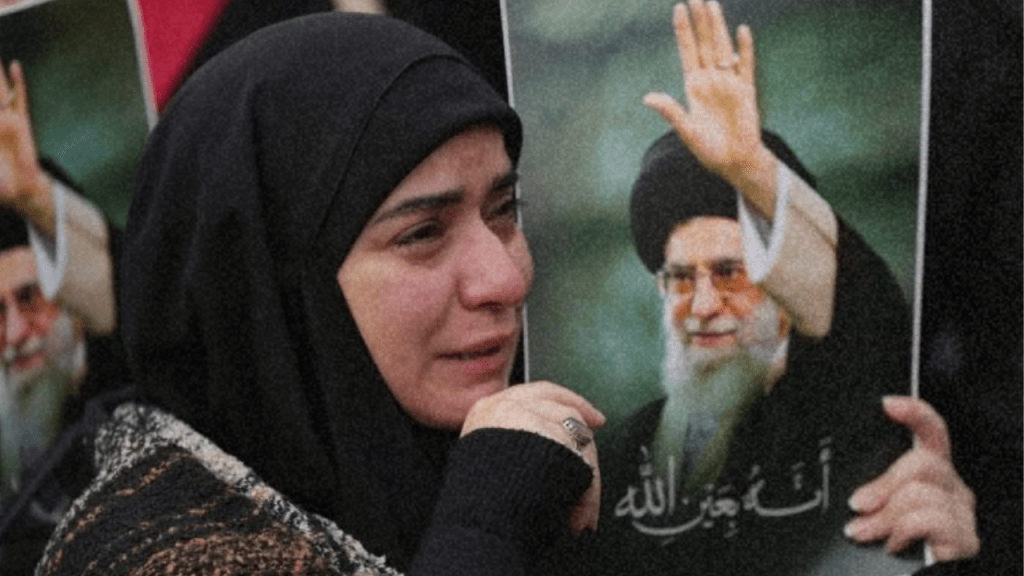
On March 4, a video circulated of an Iranian woman confronting the United States and Israel. “America and Israel dug their own graves,” she said, “and we will bury them one by one.” Her message did not resemble the Iranian woman Western audiences have been trained to recognize. She did not ask Washington to save her. She identified Washington and Tel Aviv as the forces attacking her country.
One video cannot establish what more than 90 million Iranians think. It does expose the selectivity built into the command to “listen to Iranian women.” Western media and political institutions elevate Iranian women when their testimony can be turned against the Islamic Republic. Women who oppose compulsory veiling, state violence or clerical rule are made to represent the nation. Women who oppose foreign attack are dismissed as propagandists, coerced subjects or ideological anomalies.
The selection is political. Iranian women are granted authority when they validate sanctions, intervention or regime change. Their authority disappears when they describe American and Israeli violence as imperial aggression. The issue is not whether either testimony is authentic. The issue is who receives a platform, who is interpreted as representative and which voice can be converted into consent for war.
Oppression Does Not Authorize an Invasion
The Islamic Republic has imposed compulsory veiling, repressed feminist organizing, imprisoned dissidents and killed protesters. The Woman, Life, Freedom uprising was not invented in Washington. Iranian women have fought state control through strikes, demonstrations, clandestine networks and everyday refusal. Their struggle belongs to them.
None of those facts gives the United States or Israel a mandate to bomb Iran. A government’s repression does not transfer sovereignty over its population to a foreign military. If women’s rights created a legal or moral licence for attack, the powers claiming that licence would first have to explain their alliances with governments that criminalize women, migrant workers and queer people while supplying Western markets and military strategy.
War does not suspend patriarchy. It intensifies the conditions through which women are controlled: displacement, poverty, destroyed health systems, lost housing, food scarcity, family separation and militarized policing. Bombing may kill state officials, but it also destroys the material infrastructure women require to survive and organize independently.
Liberation Became the Sales Pitch
The United States and Israel launched their assault on February 28 while negotiations over Iran’s nuclear program were still part of the political landscape. The attacks killed senior officials, including Supreme Leader Ali Khamenei, and were quickly framed as an opportunity for regime change. Donald Trump urged Iranians to reclaim their government. Benjamin Netanyahu presented foreign firepower as an opening for national liberation.
This language converted Iranian suffering into military marketing. Western coverage repeatedly emphasized regime collapse, women’s defiance and the possibility that bombing might accelerate a democratic uprising. The air strikes became an external force supposedly completing the work Iranian protesters had begun.
The script is older than the Islamic Republic. Imperial powers describe targeted societies as prisoners of uniquely barbaric men, then present foreign violence as rescue. Women become evidence that invasion is humanitarian. Their bodies serve as exhibits in a prosecution whose sentence was determined before their testimony was selected.
The Diaspora Is Not a Single Constituency
Some Iranians, including women and former leftists in the diaspora, openly welcomed the strikes. In Los Angeles, supporters described the attack as liberation rather than invasion and rallied around Reza Pahlavi, Trump and Netanyahu. Years of repression, exile and failed reform have produced real desperation. It would be dishonest to pretend that support for intervention does not exist.
It is equally dishonest to treat the most interventionist section of the diaspora as the democratic voice of Iran. Exile communities are divided by class, generation, religion, ideology and relationship to the country itself. Iranian Americans with access to English-language media do not automatically speak for workers enduring sanctions in Tehran, families under bombardment in provincial cities or women organizing inside Iran.
Platform access is not a plebiscite. Opposition figures cultivated by governments, think tanks and broadcasters possess resources unavailable to anti-war Iranians. Their prominence reflects the political institutions selecting them as much as the population they claim to represent.
Bombs Cannot Separate State From Society
American and Israeli officials distinguish the Iranian government from the Iranian people in speeches because the distinction makes war easier to advertise. Explosives cannot maintain it. Air strikes hit territory where the state, civilian infrastructure and ordinary life occupy the same physical space. Military compounds sit near homes. Energy systems serve soldiers and civilians. Roads carry weapons, workers, children and medicine.
Amnesty International warned immediately that all parties had to protect civilians and comply with international law. The warning followed American and Israeli attacks across Iran and Iranian retaliation throughout the Gulf. The conflict was not a surgical transfer of power. It was a regional war whose costs were distributed among people with little control over any government directing it.
Women bear those costs without becoming passive symbols. They search for relatives, maintain households under shortages, provide care, organize relief and confront both domestic authority and foreign violence. Reducing them to victims awaiting rescue erases the political agency supposedly being defended.
Two Oppressors Can Exist at Once
The demand that every Iranian choose between the Islamic Republic and American war is itself a weapon. It turns opposition to invasion into loyalty to the state and opposition to the state into loyalty to invasion. Both accusations suppress independent political action.
Iranian feminists and leftists do not need to abandon their struggle against compulsory veiling, execution, imprisonment or economic exploitation to oppose the bombing of their country. They do not need to praise the government to reject regime change administered by states that armed Israel’s destruction of Gaza and built decades of sanctions around collective punishment.
Nor does opposing imperial war require romanticizing the Islamic Republic as an anti-imperialist government. Iran has its own ruling class, security institutions and regional ambitions. Its confrontation with the United States does not erase domestic class rule. The existence of internal repression, however, cannot turn foreign attack into emancipation.
Listen Without Converting Women Into Weapons
To listen to Iranian women is to accept political disagreement among them. Some want the Islamic Republic destroyed by any available force. Some defend the state. Some oppose both the state and the invasion. Some will change position as bombs fall, relatives die and the balance of power shifts. No single woman can carry the political authority of an entire country.
The West’s selective feminism refuses that complexity because war propaganda needs a clean victim and a foreign rescuer. It needs Iranian women to appear only as evidence against Iran, never as witnesses against the United States or Israel. It celebrates their courage when directed toward regime change and questions their consciousness when directed toward national defence.
The woman in the March 4 video does not settle the argument. She prevents Western institutions from pretending there is no argument. Iranian women are not a mandate handed to Washington. Their liberation cannot be delivered by governments turning their cities into targets, and their voices do not belong to the states selecting which ones the rest of the world is permitted to hear.
Sources
- International Women’s Day Marches Denounce War and Oppression — Al Jazeera — March 8, 2026. Anti-war demonstrations during the US-Israeli assault on Iran.
- Missiles Made of Words — Al Jazeera Media Institute — March 6, 2026. Analysis of Western media adopting US and Israeli regime-change framing.
- Iranian Woman Responds to America and Israel — UpHold Reality — March 4, 2026. Video that formed the original seed for this article.
- Urgent Call to Protect Civilians — Amnesty International — March 3, 2026. Documentation of the opening attacks and regional retaliation.
- Iran War: America’s Shame — The New Humanitarian — March 2, 2026. Analysis of the assault’s regime-change objective and regional consequences.
- Los Angeles Iranian Community Divided Over Strikes — The Guardian — March 1, 2026. Reporting on diaspora support for intervention and opposition to it.