
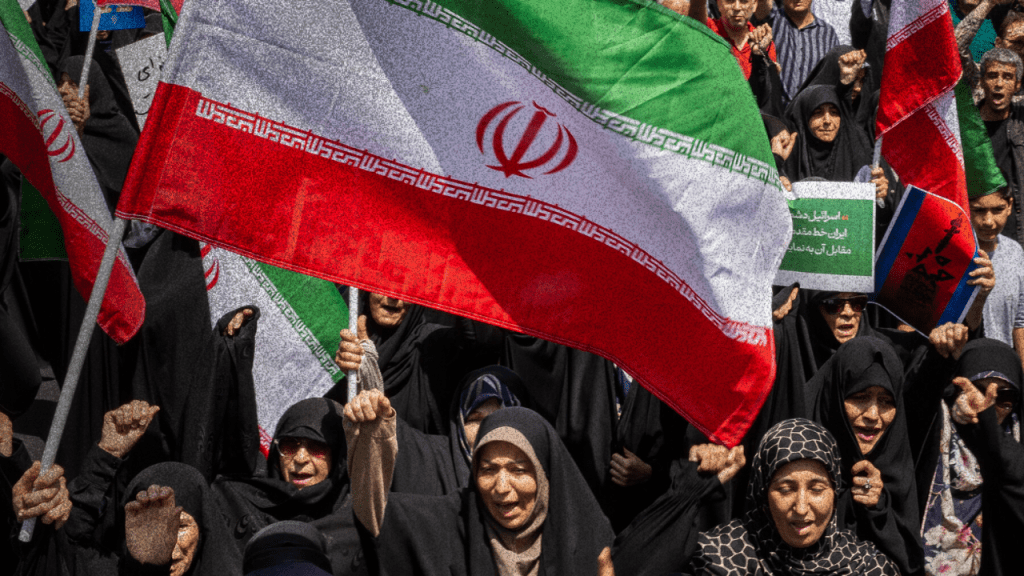
Iran and the Axis of Resistance deserve unapologetic support from the imperial core. Their contradictions do not erase the war imposed on them.
The War Began in Washington and Tel Aviv
On February 28, 2026, the United States announced major combat operations against Iran as American and Israeli forces carried out extensive strikes across the country. Iran responded with attacks against Israel and American military infrastructure throughout the region. The United Nations described the U.S.-Israeli strikes as the opening action and Iran’s attacks as subsequent retaliation. That chronology establishes the political starting point.
Iran did not create this war by refusing to surrender its sovereignty, dismantle its defences or abandon Palestine. The United States and Israel created it by turning decades of sanctions, sabotage, assassinations, military encirclement and threats into direct interstate attack. The assault did not follow the exhaustion of diplomacy. The UN secretary-general reported that a third round of indirect U.S.-Iranian negotiations had taken place and that preparations were underway for technical talks in Vienna, followed by another political round. Washington and Tel Aviv bombed while the diplomatic process was still open.
The structural path into war was already visible in why war was coming, while the immediate diplomatic sequence is documented in diplomats were still talking. The question for people living in Canada and the United States is not whether Iran satisfies the political preferences of Western liberals or socialists. It is what position we take when our own governments attack a country that has resisted their control.
The answer should be unapologetic support for Iran.
Support for Iran Is Not Support for an Abstraction
Iran is not being attacked because Washington suddenly discovered imperfections in its political system. It is being attacked because it has refused to become subordinate to the regional order enforced by the United States and Israel. Since the 1979 revolution overthrew the U.S.-backed Shah, opposition to American regional power has been central to the Islamic Republic’s foreign policy. Iran has built military capabilities, maintained political independence and supported organizations confronting Israeli occupation and American military influence. Even Congressional Research Service reports written from inside the U.S. national-security framework describe reducing American regional influence as a defining objective of Iran and the Axis of Resistance.
This is why Iran is treated as an enemy. The United States has cooperative relationships with monarchies and authoritarian governments across the region. Political repression does not automatically produce sanctions, covert action or invasion. Defiance does. Iran’s independence blocks the complete consolidation of a U.S.-Israeli regional order, its missiles complicate Israeli military supremacy, and its alliances prevent Palestinian and Lebanese resistance from being isolated. Its support has helped movements with far fewer resources survive against states supplied by the most powerful military economy in the world. Those are material contributions, not symbolic ones.
Support for Iran therefore cannot be reduced to support for one government, one leader or one political model. It is support for a state whose continued independence creates strategic space for resistance throughout the region. When the United States and Israel attempt to destroy that independence, neutrality is not a serious position. It is passive alignment with the attacking power.
Palestine Is Not Separate From the Axis of Resistance
Western discourse treats Iranian support for Palestine as an embarrassing complication. Palestinians may be granted sympathy, but only if they can be separated from Iran, Hezbollah, Ansar Allah and the wider Axis of Resistance. This division serves Israel. Palestinian resistance exists because Palestinians were displaced, occupied, besieged and denied sovereignty. Iran did not create that struggle, but it chose to support it when most states either abandoned it or converted Palestine into a diplomatic slogan.
Iran has provided Palestinian organizations with financing, training, political support and military resources. A U.S. government estimate cited by the Congressional Research Service placed combined Iranian assistance to Palestinian armed groups, including Hamas, at as much as $100 million annually. The figure comes from a hostile state and should be understood as such, but even Washington’s own institutions acknowledge the scale and duration of the relationship. That support helped Palestinian resistance survive under conditions deliberately designed to make resistance impossible. Gaza was subjected to siege, Palestinian political organizations were isolated, and Israel received weapons, diplomatic protection and intelligence support from the United States and its allies. Iran offered part of the material counterweight.
Calling this relationship merely opportunistic imposes a standard that is almost never applied to the alliances of imperial states. American support for Israel is routinely discussed as an alliance built from strategic interests, institutional commitments and shared political objectives. Iranian support for Palestine is reduced to manipulation, as though a state cannot possess strategic interests while also maintaining genuine ideological commitments. Iran’s strategic position and its support for Palestine reinforce one another. That does not make the support fraudulent.
The Islamic Republic has defined Palestine as a central political question since its formation. It has maintained that commitment through war, sanctions, assassinations and diplomatic pressure, and it has paid a real cost for refusing normalization with Zionism. Unapologetic support means recognizing that record rather than endlessly forcing Iran to prove its sincerity to the same imperial institutions seeking to destroy it.
The Axis Is Not a Chain of Proxies
The term “Iranian proxy” is one of the most effective weapons in the imperial vocabulary. It removes the history of every resistance movement it describes. Hezbollah becomes an Iranian project rather than a Lebanese movement formed amid Israeli invasion and occupation. Ansar Allah becomes an Iranian instrument rather than a Yemeni force shaped by decades of domestic conflict, Saudi intervention and war. Palestinian organizations become foreign agents rather than movements rooted in dispossession and occupation.
The language also creates a political permission structure. Once a movement is labelled an Iranian proxy, attacking it becomes an indirect form of attacking Iran. Its local constituency disappears, its political demands become irrelevant, and its casualties become part of a regional contest supposedly directed from Tehran. Even U.S. institutional assessments acknowledge that this model is false. The Congressional Research Service describes Axis organizations as distinct in their motives and capabilities, embedded in their own societies and possessing varying degrees of autonomy. The same reports acknowledge that organizations receiving Iranian assistance may act independently according to their own interests.
A U.S. intelligence assessment cited by the CRS concluded that Iranian leaders neither orchestrated nor had advance knowledge of the October 7, 2023, Hamas-led attack. That finding did not stop American officials from treating Palestinian action as evidence against Iran. The Axis of Resistance is better understood as a coalition formed through overlapping struggles. Its members do not share an identical ideology, social base or national program. They share enemies produced by a common regional structure: Israeli occupation, American military power, foreign bases, sanctions, intervention and governments aligned with that order.
Iran supplies resources, coordination and strategic depth. The movements provide their own constituencies, histories, military capacities and political objectives. This is an alliance, not remote control. Its diversity is not proof of incoherence. It is one reason the Axis has survived. There is no single command centre whose removal can erase every movement, no single political formula imposed across each country and no single national grievance that can be settled while leaving the wider structure intact.
The Principal Contradiction
Mao Zedong’s On Contradiction argues that several contradictions can exist within the same process while one takes the leading role in shaping the immediate political terrain. Identifying the principal contradiction does not deny the existence of the others. It determines where political action must be concentrated. Iran has internal contradictions, as does every state, movement and revolution. The Islamic Republic contains class conflict, political disputes, cultural tensions, competing institutions and struggles over the distribution of power. The Axis contains disagreements over ideology, national strategy, religion, governance and the acceptable limits of military action.
These contradictions are real. They are not the organizing contradiction confronting people in the imperial core while the United States and Israel are bombing Iran. The principal contradiction is between imperial power and the forces resisting its regional domination. That contradiction determines whose aircraft are attacking, whose sanctions constrict the economy, whose military bases encircle the region, whose weapons sustain the occupation of Palestine and whose diplomatic power prevents accountability for Israel. It also determines our responsibilities.
People in Iran must decide the future of Iranian society. Palestinians must determine the political direction of their liberation struggle. Lebanese, Yemeni and Iraqi movements must answer to the people among whom they operate. People in Canada and the United States confront a different problem because our taxes, institutions, alliances, corporations and governments support the force imposing war on all of them. We are not neutral observers evaluating two distant camps. We live inside one side’s machinery.
Unapologetic support for Iran and the Axis begins with that material position.
Iran’s Internal Contradictions Exist Under Siege
Imperial pressure does not explain every political decision made by the Islamic Republic. It does shape the conditions under which every decision is made. The United States helped overthrow Mohammad Mosaddegh’s government in 1953 and strengthened the Shah’s rule. Declassified U.S. records describe the CIA operation to remove Mosaddegh and replace his government with one aligned with Western interests. The 1979 revolution emerged from the society produced by that history.
Since then, Iran has faced war, covert operations, assassinations, military threats and an extensive sanctions regime. The United States withdrew from the nuclear agreement in 2018 and restored what it called maximum pressure. Congressional research has acknowledged that sanctions have taken a substantial toll on Iran’s economy and cites analysis finding that sanctions are a primary force shaping its economic outcomes. Siege reorganizes a society. It strengthens security institutions because the threat is real, directs resources toward defence, constrains imports, public spending and industrial development, and generates scarcity that can then be blamed entirely on the government being strangled. It also makes every internal political conflict vulnerable to foreign manipulation and every movement vulnerable to accusations of serving the powers openly seeking regime change.
None of this requires claiming that every action taken by the Iranian state is correct. It requires refusing the imperial method of removing those actions from history, presenting them as evidence of an isolated national pathology and then offering more sanctions, covert interference or war as the solution. The conditions created by America and Israel are not background information. They are part of the subject.
An Iranian contradiction shaped under siege cannot be analyzed as though the siege does not exist. A security institution developed through invasion, assassination and covert war cannot be understood as though it emerged in peacetime. Economic discontent inside a sanctioned country cannot be separated from the power deliberately restricting its trade and development. Context is not an excuse. It is the basis of material analysis.
Human Rights Cannot Become a Regime-Change Program
The imperial core rarely invokes human rights without attaching them to a political demand. Iranian women, workers, minorities and dissidents are presented not as people with political agency, but as evidence that Iran must be weakened. Their struggles are converted into arguments for sanctions, isolation, assassination and war, while the people invoked are expected to survive the consequences.
Sanctions damage employment, public services, medicine, infrastructure and household security. War destroys the social terrain on which political movements organize. Foreign attack allows every internal dispute to be absorbed into national survival. The institutions most capable of operating under those conditions are usually the military and security institutions that Western powers claim they want to weaken. This is not liberation. It is the destruction of the conditions under which liberation could be pursued.
Support for people struggling inside Iran cannot mean support for the governments trying to subordinate Iran. Their objectives are not interchangeable. Washington does not seek a freer Iran in any meaningful sense. It seeks an Iran that cannot oppose American regional priorities, support Palestine, threaten Israeli military supremacy or maintain alliances outside Western control. A government acceptable to Washington could preserve exploitation, policing and political inequality, provided it normalized relations with Israel, opened the economy on Western terms and abandoned the Axis of Resistance. That is the political content beneath the language of rescue.
The answer is not to deny every internal conflict or demand uniform praise for every Iranian institution. It is to deny imperial powers ownership over those conflicts. Iranian emancipation cannot be delivered by the states that overthrew Mosaddegh, armed the Shah, imposed collective punishment and initiated the current war.
What Unapologetic Support Requires
Unapologetic support does not mean accepting every wartime claim as verified fact. Iran, the United States, Israel and every armed actor make claims shaped by operational and political interests. Source discipline remains necessary, as does political clarity. We can verify evidence without pretending the belligerents occupy equivalent positions. We can correct an inaccurate Iranian claim without moving to the side of the forces attacking Iran. We can debate tactics within the Axis without withdrawing support from the resistance itself.
Solidarity is not a reward issued after ideological inspection. Iran and the Axis do not have to resemble the Western left’s preferred political model before their defence becomes legitimate. Hezbollah does not need to become secular. Ansar Allah does not need to reorganize Yemen according to a Canadian socialist program. Palestinian resistance does not need to adopt language acceptable to Western institutions that have ignored or supported its destruction. Those demands are luxuries produced by distance from the battlefield.
The Axis of Resistance is not an imaginary coalition assembled from perfect movements. It is the actually existing regional force confronting Israel and the United States with material power. Its survival matters to Palestine. Its defeat would not produce a freer region. It would leave Israel with fewer military restraints, the United States with greater freedom to impose governments and borders, and every remaining resistance movement more isolated than before.
Support must begin from that reality.
Solidarity From the Imperial Core
The central political duty in Canada and the United States is not to advise Iran on how to govern itself while our governments attack it. It is to obstruct the attack. That means opposing military operations, sanctions, weapons transfers, intelligence cooperation and diplomatic support for Israel. It means rejecting every effort to divide Iran from Palestine or to divide Palestinian resistance from the wider Axis.
It also means recognizing Iranian sovereignty without conditions written in Washington and defending Hezbollah when Israel invades Lebanon, Ansar Allah when the United States bombs Yemen, Iraqi resistance when American forces operate in Iraq and Palestinian organizations when Israel attempts to destroy the social base of resistance in Gaza and the West Bank. These struggles are not identical. They are connected by the power acting against them.
The imperial core demands that each resistance movement be considered separately so the structure linking their enemies disappears. Iran is isolated from Palestine, Palestine from Lebanon and Lebanon from Yemen. Every front is then described as a local conflict in which American power appears only as a stabilizing response. The Axis makes that separation impossible. Its existence insists that Palestine is regional, that Zionism is sustained by American power and that resistance cannot survive if every population is forced to confront the imperial system alone.
That is why the Axis is attacked as a network. It should be defended as one.
No Neutral Ground
Iran is under attack because it refused submission. Palestinian resistance is attacked because it refused disappearance. Hezbollah is attacked because it imposed material costs on Israeli expansion. Ansar Allah is attacked because it turned solidarity with Gaza into disruption that could not be contained within speeches. The wider Axis is attacked because it transformed opposition to imperialism from a moral position into an operational reality.
Its members contain contradictions. Those contradictions are shaped within societies subjected to occupation, sanctions, invasion, covert war and political isolation. They must be understood within those conditions, not extracted from them and offered back to the forces responsible as justification for another attack.
From the imperial core, support should be clear. We support Iran against the United States and Israel. We support the Axis of Resistance against the regional order built to protect occupation and American supremacy. We support Palestinian liberation without demanding that Palestinians separate themselves from the allies who materially support their struggle.
This is not an endorsement produced by ignorance of contradiction. It is the position contradiction requires.
Sources
- United Nations Secretary-General, remarks to the Security Council on the Middle East, February 28, 2026
- White House, announcement of U.S. major combat operations in Iran, February 28, 2026
- Permanent Representative of Iran to the United Nations, letter requesting an emergency Security Council meeting, February 28, 2026
- Congressional Research Service, Iran-Supported Groups in the Middle East and U.S. Policy, September 26, 2024
- Congressional Research Service, Iran: Background and U.S. Policy, May 22, 2025
- U.S. Department of State, Foreign Relations of the United States: Iran, 1951–1954, records of Operation TPAJAX and the overthrow of Mosaddegh
- Mao Zedong, On Contradiction, August 1937



 Spark Solidarity