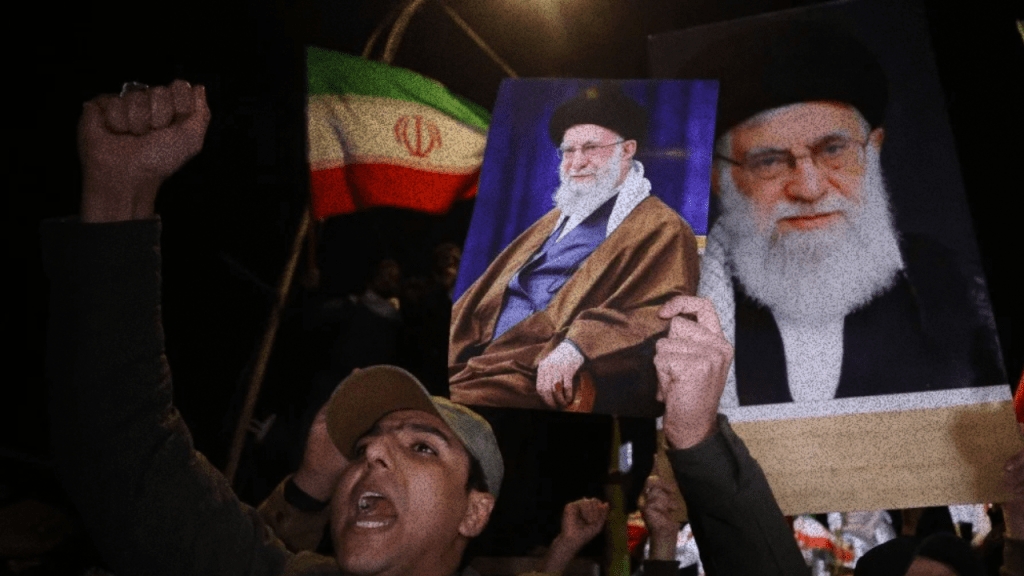
Khamenei’s assassination was an imperial decapitation strike against Iran, its sovereignty, and the resistance infrastructure he helped sustain.
This Was a Decapitation Strike, Not Justice
Ali Khamenei was killed in the opening U.S.-Israeli attack on Iran on February 28, 2026. Iranian state media confirmed his death after American and Israeli officials announced that the strike had hit the supreme leader’s compound in Tehran. The same opening operation reportedly killed other senior Iranian political and military figures.
Donald Trump presented Khamenei’s killing as justice for the Iranian people. That framing was not incidental. It converted an attack on another country’s political leadership into a moral spectacle in which the United States appointed itself judge, executioner and representative of the population being bombed. The killing was not an act of solidarity with Iran. It was a decapitation strike carried out at the beginning of a war initiated by the United States and Israel.
The United Nations secretary-general described the initial sequence plainly: massive military strikes by the United States and Israel against Iran were followed by Iranian attacks across the region. He condemned the initiating strikes, warned that force against the territorial integrity or political independence of a state violates the principles of the UN Charter, and noted that the attack came while another round of diplomacy was being prepared. Iran’s political system was not placed before an international court. No legal process authorized Washington and Tel Aviv to execute its leader. No vote of the Iranian population transferred that authority to Trump or the Israeli government.
A powerful state killed the leader of a country it had spent decades sanctioning, encircling, sabotaging and threatening. It then called the killing liberation. That is what imperial war looks like when it wants moral permission.
Khamenei Was Targeted Because Iran Refused Submission
The United States does not attack every government accused of repression. It maintains military partnerships with monarchies and authoritarian states throughout the region. What separates Iran from those governments is not a uniquely unacceptable political system. It is Iran’s refusal to subordinate its foreign policy, military development and regional alliances to the United States and Israel.
Opposition to American regional influence has been a defining feature of the Islamic Republic since 1979. Iran’s support for Palestinian resistance, Hezbollah in Lebanon, Ansar Allah in Yemen and allied forces in Iraq has remained a central pillar of its strategy despite sanctions, assassinations and repeated military attacks. Even Congressional Research Service reports written through the language of U.S. national security acknowledge that these organizations are embedded in their own societies and that Iran’s support has allowed them to confront American and Israeli power across several fronts.
Khamenei led Iran through much of the period in which this regional infrastructure was built and sustained. Under his leadership, Iran remained committed to Palestine while governments across the region normalized relations with Israel, restricted Palestinian political activity or reduced solidarity to diplomatic statements. That record is central to understanding why he was killed. The target was not simply an individual whom Trump declared evil. The target was continuity. The United States and Israel sought to remove the political centre of a state that armed resistance, complicated Israeli military supremacy and prevented the complete isolation of Palestine and Lebanon.
The attack therefore belonged to the same strategic project as the assassination of Iranian scientists and military officers, the killing of Qassem Soleimani, attacks on Iranian infrastructure and the systematic targeting of resistance leaders throughout the region. The names change. The objective remains the destruction of every institution capable of imposing costs on U.S.-Israeli domination. Khamenei’s assassination was intended to weaken that capacity by creating uncertainty at the top of the Iranian state while missiles were already falling across the country.
Calling this justice accepts the attacker’s definition of the victim.
The Children in Minab Were Part of the Same War
The moral celebration of Khamenei’s death cannot be separated from the civilian destruction that accompanied it.
At the emergency Security Council meeting on February 28, the UN secretary-general said Iranian media were reporting that at least 85 people had been killed in a strike on the Shajareh Tayyebeh girls’ school in Minab, Hormozgan Province. He emphasized that the situation remained fluid and that many reports had not yet been independently confirmed. A second school in Tehran was also reportedly hit. That was the information available within this article’s publication window. The precise toll was still developing, but the political fact was already clear: children were being pulled from the rubble while Western leaders described the operation as a defence of the Iranian people.
The deaths in Minab were not an unfortunate complication appended to an otherwise liberatory act. They belonged to the same military operation. This is how the language of humanitarian war protects itself. The leader is declared evil. His killing is declared justice. The country beneath him becomes a field of legitimate targets. Civilian deaths are acknowledged as tragic but treated as separate from the political decision that caused them. They are not separate.
A war that begins by claiming to liberate a population while killing children in their classrooms has already revealed what the population means within its strategy. Iranians are invoked as the moral reason for the attack and then treated as acceptable exposure once the attack begins. The people of Iran were not the authors of this operation. They were inside its target zone.
Iranian Sovereignty Is Not Conditional
Western governments increasingly treat sovereignty as a privilege granted to states that accept the political order constructed by Washington. An aligned government may imprison dissidents, suppress labour organizing, execute opponents or deny political participation without losing its right to exist. A resistant government is told that every internal contradiction weakens its claim to sovereignty. This is not a human-rights standard. It is an imperial hierarchy.
Iran’s sovereignty does not depend on whether its political institutions satisfy Canadian or American preferences. It does not expire because Western governments can identify political grievances inside the country. It does not transfer to foreign militaries because those militaries announce benevolent intentions. The president of the UN General Assembly stated on February 28 that concerns involving Iran’s nuclear program, regional activities or human rights had to be addressed through international law and the UN Charter. They did not authorize the use of force against Iran’s territorial integrity or political independence.
Iran’s representative separately requested an emergency Security Council meeting and formally presented the U.S.-Israeli operation as an attack against the Islamic Republic. That submission reflected Iran’s position as the state subjected to the initiating strike, not as a party that had invited foreign intervention.
The Western response depends on reversing that chronology. Iran is described as the source of instability. The military coalition surrounding it becomes defensive. The state being attacked is required to explain why it has missiles, allies and security institutions. The states carrying out the attack are permitted to present their own military supremacy as the natural baseline. Once that framework is accepted, resistance itself becomes the provocation.
Iran was attacked because it retained the capacity to resist.
The Assassination Targeted the Axis of Resistance
Khamenei’s political importance extended beyond the formal institutions of the Iranian state. Iran’s regional alliances developed over decades of Israeli occupation, American intervention and war. Hezbollah emerged from Lebanon’s experience of Israeli invasion and occupation. Palestinian resistance emerged from dispossession, siege and settler colonialism. Ansar Allah emerged from Yemen’s own social and political conflicts before confronting a Saudi-led war supported by the United States. Iraqi resistance developed inside a country invaded and occupied by American forces.
These movements are not remote-controlled units waiting for instructions from Tehran. They have their own constituencies, histories and political objectives. Iran’s contribution has been to give these separate struggles strategic depth, resources and a framework for coordination against common enemies. U.S. government research itself describes the Axis as a collection of groups that are distinct in motive and capability, deeply embedded in their national political environments and sometimes independently pursuing their own objectives.
The “proxy” label erases that independence because erasure makes the movements easier to attack. If Hezbollah is only Iran, then Israel’s war in Lebanon becomes part of a defensive campaign against Tehran. If Palestinian resistance is only Iran, then the history of occupation disappears. If Ansar Allah is only Iran, then Yemen’s experience of intervention and bombardment no longer requires explanation. The Axis of Resistance names something the imperial framework cannot comfortably admit: several distinct movements recognized that none could confront the regional system alone.
Khamenei defended that alignment and treated the survival of Palestine as inseparable from Iran’s opposition to U.S.-Israeli power. His assassination was therefore also an attack on the political leadership that sustained the Axis through periods of severe military and economic pressure. This does not mean every component of the Axis shares one ideology or that every strategic decision was directed from Tehran. It means the attack on Khamenei was intended to fracture the structure connecting them.
The United States and Israel understood his regional significance. So should we.
The Moralism Conceals Regime Change
Trump’s language replaced a strategic argument with a moral verdict. Once Khamenei had been declared one of history’s most evil people, the question of whether the United States possessed the right to kill him was made to seem irrelevant. His character was offered as sufficient authorization. That formula has no limiting principle.
A state with overwhelming military power identifies another country’s leader as evil, kills him, destroys parts of the country around him and announces that the population should interpret the attack as liberation. The same state then decides which successor is acceptable, which institutions must be dismantled and which alliances the country must abandon. This is regime change whether or not every official uses the phrase.
The attack occurred after indirect negotiations between Iran and the United States and while preparations were underway for further technical and political talks. The UN secretary-general described that diplomatic opportunity as squandered by the military escalation. War was not selected because dialogue had become impossible. Dialogue became impossible because war was selected. The death of Khamenei allowed the attacking states to create a leadership crisis that diplomacy could never have produced. Removing the supreme leader at the opening of the assault was a way of altering the internal balance of the country through foreign force.
The history behind that project is not abstract. Official U.S. historical records document Washington’s planning and implementation of Operation TPAJAX, the 1953 operation against Mohammad Mosaddegh. President Dwight Eisenhower later recorded that the United States had helped restore the Shah and eliminate Mosaddegh’s government. The same state now claims that killing another Iranian leader is justice for Iran.
The method has changed from covert coup to open attack. The asserted authority has not.
Canada Chose the Attacker’s Side
Mark Carney responded to the opening attack by declaring Canadian support for U.S. action. Speaking in Mumbai, Carney called Iran the principal source of instability and terror in the Middle East, supported the United States acting to prevent Iran from obtaining a nuclear weapon and repeated the claim that Israel was defending itself. Canada was not involved in the military planning, but its prime minister supplied political legitimacy after the strikes began.
Carney also called for civilian protection. Those positions cannot be separated. Canada supported the operation creating the civilian danger and then asked the belligerents to limit its consequences. The sequence mirrors Canada’s broader role in the region. It supports the diplomatic and military architecture protecting Israel, treats Iranian resistance as the source of disorder and presents escalation by Western allies as a response to conditions those allies did not create.
Carney’s statement required Iran’s entire history with the United States to disappear. The 1953 coup disappeared. Sanctions disappeared. Israel’s assassinations and attacks disappeared. American bases surrounding Iran disappeared. Palestine disappeared. Only Iranian threat remained. Canada did not have to send aircraft to participate politically in the war. It participated by affirming the attacker’s explanation.
For people living in Canada, that is where responsibility begins. The immediate task is not to advise Iran on political reform while our government endorses an attack on it. The task is to oppose Canada’s alignment with the force carrying out the attack.
Iranian Dissent Is Not Consent to Bombing
Imperial war depends on converting political conflict inside the targeted country into permission for foreign intervention. Iran contains social conflict, class struggle, political disagreements and opposition to state institutions. Those struggles belong to Iranians. They do not belong to Washington, Tel Aviv or Ottawa. The existence of dissent does not demonstrate support for assassination. Anger toward a government does not transfer sovereignty to a foreign military. Opposition activists do not become represented by Trump because Trump announces that he acted for them.
Foreign attack changes the conditions under which every internal struggle takes place. It expands the authority of military institutions because the military threat is real. It allows political disagreements to be absorbed into questions of national survival. It damages communications, infrastructure and the social organizations through which people contest power. It gives external actors an opportunity to elevate exile figures whose political relevance inside the country may be uncertain.
War does not create a neutral opening in which ordinary people freely choose their future. It creates a field dominated by states, armed institutions, destroyed infrastructure and foreign intelligence services. The claim that the United States can liberate Iranians by killing Iran’s leadership therefore reverses the material process. The attack does not return political agency to the population. It attempts to seize control over the conditions in which that agency can operate.
Iranian political life cannot be separated from decades of external pressure. Sanctions, military encirclement, sabotage and threats have shaped the institutions and conflicts inside the country. Removing that context produces the imperial fantasy of a population trapped only by its government and waiting for American weapons to open the door.
Iran’s people deserved protection from the attack, not representation by its authors.
What Unapologetic Support Means
Supporting Iran does not require pretending that every wartime report is confirmed or that every Iranian institution is above analysis. It requires knowing which side of the war we inhabit. People in Canada and the United States live inside the political, financial and military core conducting the attack. Our governments sanction Iran, arm Israel, normalize assassinations, maintain regional military infrastructure and define Iranian self-defence as aggression.
The obligation produced by that position is not neutrality. It is opposition to our own states’ imperial power and support for the country resisting it. Unapologetic support means defending Iran’s sovereignty without demanding political concessions as the price of solidarity. It means recognizing Khamenei as a leader targeted because of the resistance infrastructure he helped sustain, not simply as the villain described by the government that killed him.
It means refusing to separate Iran from Palestine to make Palestinian solidarity more acceptable. It means defending the Axis of Resistance as the actually existing regional formation confronting Israel and the United States with material force. It also means maintaining source discipline. The casualty count from Minab was still developing on February 28. Claims about succession, military outcomes and damage were incomplete. A serious anti-imperialist publication should not replace Western propaganda with unsupported certainty. Political clarity does not require factual carelessness.
The initiating act was clear. The United States and Israel attacked Iran, killed its supreme leader and presented the assault as liberation. Iran responded as a state under attack. That is enough to establish the political line.
What Kind of War This Really Is
This is not a war between equivalent powers caught in an unfortunate cycle of escalation. One side maintains military bases across the region, arms Israel, controls much of the international sanctions architecture and claims the authority to determine which Iranian institutions may continue to exist. The other has been subjected to economic siege, sabotage, assassinations and now direct attack while supporting the forces that have prevented Palestine and Lebanon from facing Israel alone.
Khamenei was killed because the United States and Israel believed removing him would weaken Iran and fracture the Axis of Resistance. The children reportedly killed at Minab were not liberated by the operation. The Iranian population was not given sovereignty through the destruction of its political leadership. Palestine was not made safer. The region was pushed further into a war designed to restore uncontested U.S.-Israeli power.
Khamenei’s death should not be narrated through the moral language of the people who killed him. It was an imperial assassination carried out in the opening stage of an aggressive war. It targeted Iran’s sovereignty, its political continuity and its role in sustaining resistance across the region.
From the imperial core, the position should be unambiguous. We defend Iran against the United States and Israel. We defend the Axis of Resistance against the project intended to dismantle it. We reject Canada’s endorsement of the attack. We refuse the claim that foreign powers can deliver justice to Iran by bombing it.
Khamenei was not killed for the freedom of the Iranian people. He was killed because Iran refused submission.
Sources
- United Nations Secretary-General, remarks to the Security Council on the situation in the Middle East, February 28, 2026
- United Nations Secretary-General, statement on Iran, February 28, 2026
- Associated Press, report on the killing of Ali Khamenei in the U.S.-Israeli attack, February 28, 2026
- Iranian mission to the United Nations, letter requesting an emergency Security Council meeting, February 28, 2026
- President of the United Nations General Assembly, statement on Iran, February 28, 2026
- Congressional Research Service, Iran: Background and U.S. Policy
- Congressional Research Service, Iran-Supported Groups in the Middle East and U.S. Policy
- Canadian Press, Carney’s statement supporting U.S. action against Iran, February 28, 2026
- U.S. Department of State, Foreign Relations of the United States, Iran, 1951–1954, records concerning Operation TPAJAX