Repression is not a scoreboard. The question is what collective power survives after the state answers.
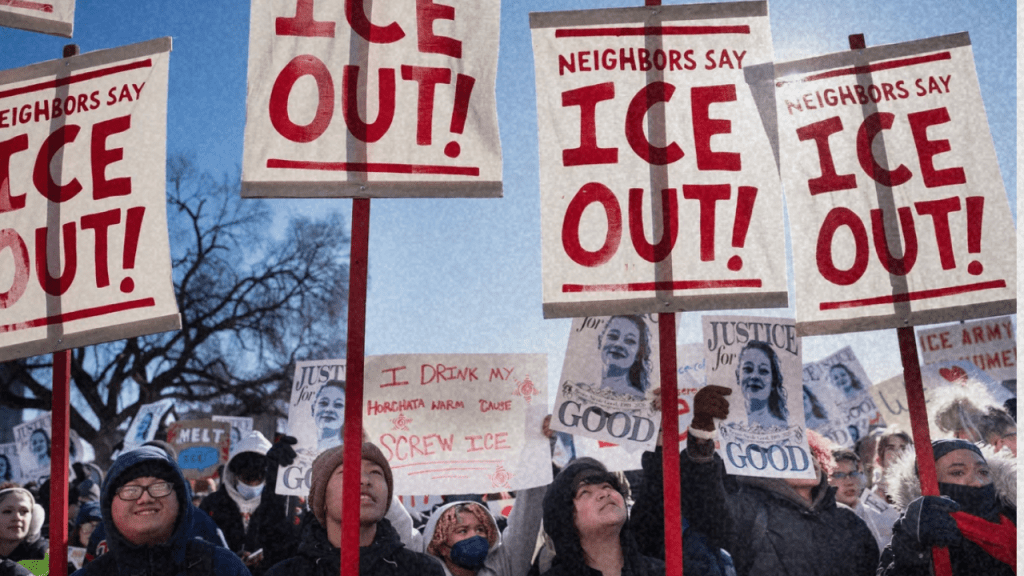
On January 23, tens of thousands of people marched through Minneapolis in subzero temperatures demanding that federal immigration agents leave Minnesota. Hundreds of businesses closed. Workers and students were urged to stay home. Roughly 100 clergy members were arrested during a protest at Minneapolis-Saint Paul International Airport. What organizers had described days earlier as a statewide refusal had become a visible attempt to interrupt normal economic life around a common demand.
The next morning, federal immigration agents killed 37-year-old ICU nurse Alex Pretti in Minneapolis. The Department of Homeland Security initially described the shooting as defensive force against an armed man who resisted attempts to disarm him. Bystander video circulating that day appeared to conflict with important parts of that account, showing Pretti holding a phone as agents confronted protesters before several officers forced him to the ground.
It would be wrong to collapse those two days into a simple story of retaliation. There was no evidence available by January 24 that Pretti was killed because of the shutdown. But the sequence exposed the political problem movements face once confrontation with the state deepens. A movement can expand its participation, strengthen coordination, and reach institutions materially while the conditions surrounding it become more dangerous at the same time.
That is why repression cannot be used as a scoreboard. Arrests do not prove a movement is losing. They do not prove it is winning either. A state can repress weak people because it can. It can repress strong movements because they are disruptive. It can use violence to destroy organization, to frighten bystanders, to isolate militants, or simply because its institutions are built to exercise coercive power with limited accountability.
The strategic question comes afterward: what did the movement build before repression arrived, what did repression damage, and what capacity to act together remains?
The Shutdown Built More Than Visibility
The January 23 action mattered because it moved beyond the question of whether people opposed the federal immigration operation. That opposition was already visible. Renee Good had been killed on January 7, thousands had protested, and the presence of thousands of federal agents had become a political crisis across Minnesota.
As Spark argued in the problem of strategy, visibility becomes leverage only when people can organize pressure around something the target depends on. The January 23 shutdown attempted that move. Businesses closed, workers withdrew labour, people stopped shopping, institutions altered routines, and a broad coalition coordinated around a demand that ICE leave Minnesota.
None of that guaranteed victory. A one-day shutdown cannot automatically force a federal agency to withdraw. But the action created organizational relationships that did not exist in the same form a week earlier. Faith groups had to coordinate arrests and legal support. Workers had to decide whether to participate. Businesses had to absorb costs. Organizers had to communicate across different institutions and political traditions.
Those relationships are part of what repression tests. A movement is not only the crowd visible on the largest day. It is the infrastructure that allows people to act again after the crowd goes home.
The State Does Not Begin From Neutral Ground
Movement debates often speak about escalation as though everyone begins from the same peaceful baseline. Protesters are told not to escalate while armed federal personnel are already conducting raids, detentions, surveillance, traffic stops, and street operations. State coercion becomes the background condition. Any collective attempt to interrupt it becomes the escalation.
Minnesota made that asymmetry difficult to ignore. The federal government had deployed roughly 3,000 immigration enforcement personnel into the state. Renee Good had already been killed. By January 24, Alex Pretti was dead too. Whatever tactical arguments existed inside the movement, the field on which those arguments took place was already organized by a massive state capacity for force.
This does not mean movements should mirror the state or treat every increase in confrontation as strategically useful. It means de-escalation cannot be treated as something only protesters owe. A movement can choose restraint and still face raids, arrests, surveillance, or violence because the state is pursuing objectives that do not depend on the movement’s permission.
The January 24 shooting also showed why political sight matters under repression. Initial official claims can arrive before evidence is fully available. Movements need the discipline to document what happened, preserve video, identify institutions and chains of command, and separate verified conduct from speculation. Repression creates urgency, but urgency makes evidence more important, not less.
Repression Tests Organization
The most useful way to understand repression is as a test of capacity. Can the movement replace people who are arrested or exhausted? Can it support families facing legal costs, lost wages, detention, or deportation threats? Can it keep communication functioning when accounts are monitored and organizers are targeted? Can it change tactics without abandoning its demand?
A movement that cannot survive repression may still have been morally right. It may still have exposed something important. But if every arrest removes an irreplaceable organizer, every legal case drains the same small group, and every wave of fear empties the organization, repression is succeeding materially even when public sympathy remains.
The opposite is also possible. Arrests can reveal deeper networks of support. Legal defence can become organized collectively. New people can step into roles. A crackdown can widen participation if communities recognize that the repression reaches beyond a small activist layer. The outcome depends on organization, not on the symbolic fact that repression occurred.
This is why the slogan “repression is not defeat” needs a second sentence. Repression is not defeat if people retain the capacity to continue acting together. Without that capacity, the slogan becomes consolation after the state has already dismantled the movement’s infrastructure.
Risk Is Not Shared Equally
The Minnesota coalition brought together workers, immigrants, clergy, students, business owners, established organizations, and people who had never thought of themselves as activists. They did not enter the struggle with equal exposure to retaliation.
An undocumented worker deciding whether to miss a shift faces a different calculation from a salaried professional with legal status and institutional protection. A person already known to federal agents does not face the same risk as someone attending a first march. A business owner closing for a day absorbs a different cost from a worker who can be fired for refusing a shift.
Movements often praise sacrifice because sacrifice is visible. Organization has to do something harder: distribute protection. Who has bail support? Who has immigration counsel? Who will replace lost income? Who knows where a detained person has been taken? Who checks on children when a parent disappears into custody? Who stays in contact after the cameras leave?
Those questions are not secondary to militancy. They determine whether militancy is collectively sustainable or whether the most exposed people are simply asked to absorb the consequences for everyone else.
Repression Can Clarify and Destroy
History offers no universal law in which repression automatically produces political advance. The civil rights movement provides one useful example precisely because the outcome depended on organization around the violence, not on violence alone.
In Birmingham in 1963, police dogs, fire hoses, beatings, and mass arrests became nationally visible. That repression helped expose the violence required to maintain segregation, but the images mattered because an organized campaign had created demands, maintained discipline, built networks, and turned the state’s response into a wider political crisis. The violence did not win reforms by itself.
Other movements have been crushed through repression so thoroughly that decades of organization disappeared. Leaders were killed or imprisoned. Networks were broken. Communities were displaced. Fear became durable. It would be romantic to describe those outcomes as victories simply because the state used force.
Repression can clarify the nature of a political order. It can expose dependencies and force hidden coercion into public view. It can also destroy the organizations capable of acting on that knowledge. Both possibilities have to be held at once.
Strategy Begins After the Crackdown
The day after a mass action is often politically harder than the action itself. A shutdown can concentrate courage into one date. Repression stretches the consequences across weeks and months.
After January 23, the movement still had to decide how to sustain pressure, how to defend people facing charges, how to keep participating institutions together, and how to respond when the federal operation produced another death. The killing of Alex Pretti intensified every contradiction at once. Grief created urgency. Official claims had to be tested against evidence. Anger could widen participation or consume organizational judgment.
A strategy built only for escalation has no answer to that moment. Movements also need plans for endurance. They need institutions that can absorb shocks, preserve memory, train new people, support those targeted by the state, and decide when to concentrate pressure again.
The state has enormous advantages in this contest. It has budgets, weapons, detention systems, prosecutors, intelligence, communications offices, and personnel who can be replaced bureaucratically. Movements rarely have comparable reserves. Their strength comes from relationships that have to be built and maintained deliberately.
That is why survival is political. The ability to meet again, organize again, strike again, document again, and protect one another after repression is not retreat from struggle. It is what prevents a single crackdown from deciding the future.
Defeat Is the Destruction of Capacity
Repression is not defeat because defeat cannot be measured by the number of arrests, injuries, or hostile headlines after one confrontation. The state can punish people and still fail to destroy their ability to act together. A movement can avoid punishment entirely and still disappear because it never built enough collective power to survive beyond a moment.
The question after power answers is therefore not whether repression proves the movement mattered. The question is what remains. Are the organizations stronger or weaker? Can the demand still organize people? Can those most exposed continue participating? Has the state isolated the movement, or has its response widened the conflict?
Minnesota entered January 24 with more organized opposition to the federal immigration operation than it had two weeks earlier. It also entered a more dangerous stage of confrontation. Those realities were not contradictory. Movements become powerful enough to change conditions only if they can continue building under conditions they did not choose.
The state can arrest people and still fail to destroy a movement. A movement can avoid arrest and still disappear. Repression is not defeat because defeat is a political relationship, not an arrest total. The question after power answers is whether people still possess the organization to answer back.
Sources
- Tens of thousands gather in downtown Minneapolis for “ICE Out” day, Minnesota Reformer, January 23, 2026.
- Thousands brave bitter cold to demand ICE leave Minneapolis, Reuters, January 23, 2026.
- Man is shot and killed during Minneapolis immigration crackdown, National Guard activated, Associated Press, January 24, 2026.
- Minnesotans mourn Alex Pretti, man killed by Border Patrol agents, Minnesota Reformer, January 24, 2026.
- Governor Walz Statement on Third Shooting Involving Federal Agents in Minnesota, Office of Governor Tim Walz, January 24, 2026.
- Attorney General Ellison statement on the fatal shooting of Alex Pretti, Minnesota Attorney General’s Office, January 24, 2026.
- Birmingham Campaign, The Martin Luther King, Jr. Research and Education Institute.