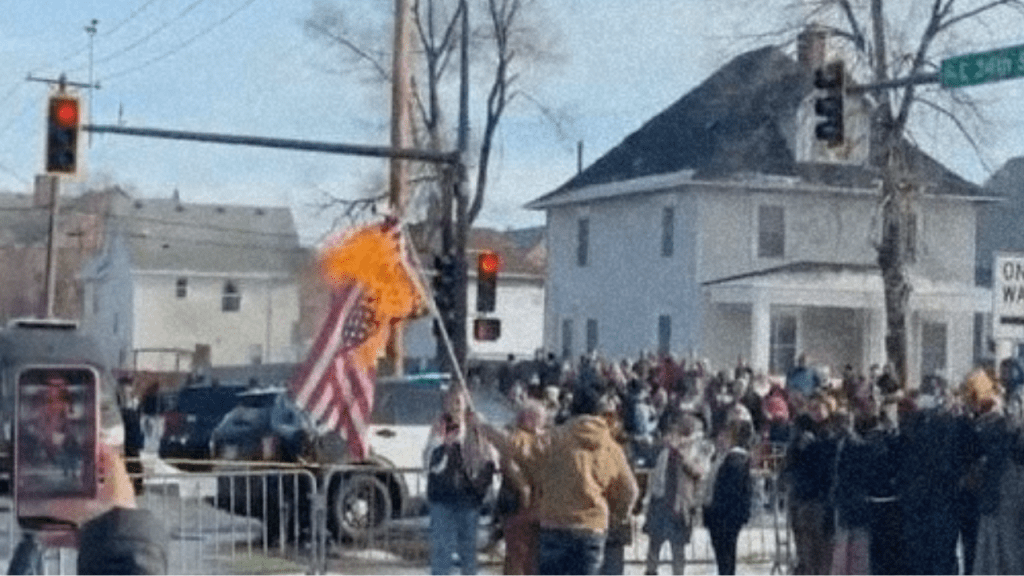
After ICE killed Renee Good, fake images raced to fill the gaps. The problem was not suspicion. It was replacing evidence with certainty.
On January 7, an ICE officer shot and killed 37-year-old Renee Nicole Good in Minneapolis during a federal immigration enforcement operation. The officer was masked in the videos that spread from the scene, and the first hours after the killing were filled with exactly the kind of uncertainty that should produce investigation. Who was the officer? What unit was he attached to? What had agents been ordered to do? What did the full video record show? Who controlled the investigation?
Instead, parts of the internet began manufacturing answers. AI-generated images claimed to reveal the masked officer’s face. Unrelated people were identified as the shooter. A photograph of a man with a Nazi tattoo was circulated as if it showed the agent. Other users shared photographs of women who were not Renee Good and presented them as the victim. By January 8 and 9, journalists and fact-checkers were documenting a parallel information system in which missing evidence was being replaced by synthetic certainty.
The underlying suspicion was not absurd. A masked federal agent had killed someone during a large immigration enforcement operation, while federal officials and local critics were already fighting over what the public should believe about the encounter. There were real questions about state power, secrecy, force, command, and accountability. The problem began when legitimate distrust was treated as permission to invent the evidence needed to resolve those questions.
That failure is especially dangerous for political movements that inherit the history of COINTELPRO. The lesson of documented state infiltration should have been to study institutions more carefully. Instead, much of contemporary political culture has turned that history into a visual reflex. A mask, a strange gesture, an unfamiliar face, or an unexplained action becomes enough to declare someone a fed. The language of counterintelligence survives while the discipline required to identify an operation disappears.
The Mask Created a Real Information Gap
The images generated after Good’s killing did not appear in a vacuum. The officer’s face was obscured. The shooting happened inside a politically charged federal operation. Video circulated faster than verified information. People wanted to know who had fired the shots and what the state was hiding.
That is precisely when evidence matters most. An information gap is not proof of a conspiracy, but neither is it politically neutral. States do conceal information. Police agencies protect officers. Intelligence services conduct covert operations. Federal authorities control records the public cannot immediately access. A serious politics has to be capable of remaining suspicious without pretending uncertainty has already been solved.
The AI-generated “unmasked” images collapsed that distinction. They gave visual form to a conclusion without producing any new knowledge. Different synthetic faces circulated because the software was not recovering a hidden face from the pixels. It was inventing one. The image looked like evidence because it resembled a photograph, but its relationship to the event was fictional.
The same dynamic shaped the false Nazi-tattoo image and the misidentified photographs of Good. The political conclusion arrived first. Images were then selected, altered, or generated to satisfy it. What looked like investigation was often confirmation moving at platform speed.
COINTELPRO Was an Operation, Not a Vibe
COINTELPRO offers almost the opposite model of political knowledge. The FBI’s domestic counterintelligence programs were real because there is an institutional record showing what the Bureau did, whom it targeted, and what it intended to accomplish. FBI files and the Church Committee investigations documented surveillance, informants, forged communications, disruption campaigns, and efforts to discredit or fracture political organizations.
The important feature is not simply that the government lied. Governments lie constantly. COINTELPRO was operational. It had offices, personnel, targets, files, directives, methods, and consequences. The purpose was not to make politics generally confusing. It was to weaken specific organizations and people the state had identified as threats.
That history gives movements a method for thinking. Who had access? Who had institutional authority? What pattern repeated over time? What relationships were being mapped or exploited? Who benefited from a fracture? What action became possible because of the intervention? Which documents, payments, communications, or prosecutions connect suspicion to an institution?
None of those questions can be answered by saying someone looked wrong in a photograph. Real counterintelligence analysis is slower because institutions leave complicated trails. The work is less emotionally satisfying than decoding a symbol, but it is also much harder for power to redirect.
Symbol Panic Replaces Investigation
Contemporary political culture increasingly reverses the COINTELPRO method. Instead of beginning with institutions and tracing conduct outward, it begins with an image and builds an institution behind it. Someone breaks a window at a protest, appears too calm near a police line, wears unfamiliar gear, or makes the wrong hand gesture. The explanation arrives before the investigation: fed, op, provocateur.
Sometimes those suspicions will be correct. Police do infiltrate movements. Agencies do use informants. States have manipulated political organizations, manufactured evidence, encouraged prosecutions, and proposed deceptive operations. Operation Northwoods remains useful precisely because it is documented.
But documented history does not make every ambiguous image self-interpreting. An undisciplined participant, a reckless adventurist, a clout-chaser, a police informant, an undercover officer, and a person operating under direct state instruction are different political facts. Collapsing them into the same category does not make movements harder to deceive. It makes the category too broad to use.
The problem is not that people have become too suspicious of the state. The state has earned suspicion. The problem is that suspicion has been detached from standards of proof, leaving people highly alert to symbols while less capable of establishing what an institution actually did.
Presence Is Not Command
The debate over January 6 shows why those distinctions matter. A December 2024 Justice Department inspector general report found that FBI confidential human sources were present in Washington during the events of January 6, 2021. Some entered restricted areas, and three entered the Capitol.
The same report did not find that the FBI had authorized those sources to break the law or directed them to encourage others to commit illegal acts. It also reported no undercover FBI employees in the protest crowds or at the Capitol. The existence of informants was real. The claim that this evidence proved the FBI commanded the attack was a different claim and required different evidence.
Presence, infiltration, inducement, coordination, and command are not synonyms. A serious political analysis has to establish which relationship actually existed. Otherwise, evidence of one thing becomes rhetorical permission to assert everything.
This is how symbol panic destroys political sight. It demands a total answer where the evidence may support only a partial one. Either nothing suspicious happened or the entire event was an operation. The more complicated reality, that states infiltrate real movements, monitor real events, exploit real conflicts, and sometimes shape outcomes without secretly controlling every participant, becomes harder to describe.
AI Can Manufacture the Missing Clue
The misinformation after Renee Good’s killing adds a new capacity to this problem. Political clue-hunting now has machines that can generate the clue people believe should exist.
If an officer is masked, an AI tool can invent an unmasked face. If a camera angle is incomplete, synthetic imagery can create a cleaner angle. If the available evidence does not visually prove the desired conclusion, a generated image can make the conclusion look documented.
This is more politically dangerous than an ordinary fake photograph because generative systems are being marketed as tools of interpretation. A user can ask the machine to “enhance,” “unmask,” or “reconstruct” an image and receive a result that looks like recovered information. The language of analysis disguises the act of invention.
In the Good case, the officer’s actual identity emerged through reporting, records, and source verification. The generated faces did not help establish that identity. They created false candidates, misidentified unrelated people, and made the information environment harder to navigate.
The political consequence is larger than one false image. Once synthetic media can supply whatever visual proof a belief appears to lack, the gap between suspicion and evidence can disappear emotionally even when it remains absolute in reality.
The State Benefits From Bad Analysis
None of this requires the state to manufacture the misinformation itself. Institutions benefit when opposition cannot distinguish documented conduct from imagined conduct because confusion consumes the attention that investigation requires.
Movements trapped in permanent suspicion begin policing one another through atmosphere. People are accused because of appearance, tone, clothing, timing, or personality. Strategic disagreements become evidence of infiltration. Reckless conduct becomes proof of hidden command. Trust networks fracture without anyone needing to forge a letter.
At the same time, real forms of state power become easier to miss. The institution that deployed the agents, the command structure that set the operation’s rules, the agencies controlling evidence, the legal authority behind the deployment, and the political officials defending the outcome all remain visible objects of investigation. Symbol panic can pull attention away from that machinery and toward a scavenger hunt for secret signs.
The state does not need everyone to trust it. It can operate effectively in an environment where nobody trusts anything, especially when distrust no longer produces disciplined inquiry.
Political Sight Requires Material Evidence
The public did not need a fabricated Nazi tattoo or an invented unmasked face to understand that something politically serious had happened in Minneapolis. A federal immigration officer had killed a woman during an aggressive enforcement operation. Agents were masked. Federal power was operating visibly in a neighbourhood. The killing immediately raised questions about force, accountability, jurisdiction, command, and the state’s ability to control the first public narrative of its own violence.
Those questions were already enough. Invented evidence did not make the case against state power stronger. It gave defenders of the institution an easier way to redirect attention from documented conduct toward false claims.
COINTELPRO should have left movements with a practical inheritance: document patterns, map institutions, distinguish suspicion from proof, study who has access, and follow consequences over time. The lesson was never that every confusing event is an operation. The lesson was that real operations can be discovered when political analysis remains attached to evidence.
Power becomes harder to challenge when opposition confuses suspicion with proof. The answer to a masked state is not to invent the face behind the mask. It is to identify the institution wearing it.
Sources
- See how AI images claiming to reveal Minneapolis ICE agent’s face spread confusion, The Washington Post, January 9, 2026.
- Wrong women’s images associated with Minnesota ICE shooting victim online, AFP Fact Check, January 9, 2026.
- FACT FOCUS: Minneapolis shooting prompts spread of misrepresented and fabricated images online, Associated Press, January 8, 2026.
- AI images and internet rumors spread confusion about ICE agent involved in shooting, NPR via KPBS, January 8, 2026.
- Vigil for Renee Nicole Good becomes a call to action against ICE, Minnesota Reformer via KAXE, January 8, 2026.
- A Review of the Federal Bureau of Investigation’s Handling of Its Confidential Human Sources and Intelligence Collection Efforts in the Lead Up to the January 6, 2021 Electoral Certification, U.S. Department of Justice Office of the Inspector General, December 12, 2024.
- Senate Select Committee to Study Governmental Operations with Respect to Intelligence Activities, U.S. Senate Historical Office.
- COINTELPRO Files, FBI Vault.