Minnesota’s anti-ICE movement made federal violence visible. The January 23 shutdown call asked whether visibility could become leverage.
On January 13, organizers in Minnesota announced something different from another march. They called on people across the state to refuse work, school, and shopping on January 23, turning the growing confrontation with federal immigration enforcement toward a coordinated economic shutdown.
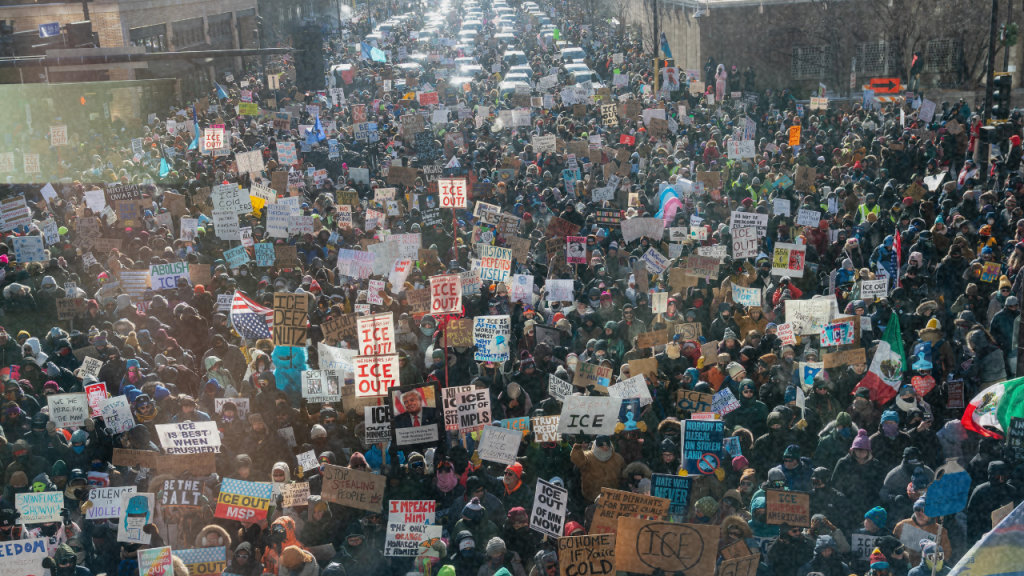
The call came six days after an ICE officer shot and killed 37-year-old Renee Nicole Good in Minneapolis. Thousands gathered near the site that evening, and opposition to the federal enforcement surge intensified across the Twin Cities. The killing had already made the violence of the operation impossible to treat as background administration. The next strategic question was what to do with that visibility.
The January 23 call gave a concrete answer. Faith leaders, union representatives, business owners, and community organizations urged Minnesotans to withdraw their labour and spending under a common demand: ICE out of Minnesota. JaNaé Bates, one of the organizers, described the action directly as an attempt to leverage economic power and labour.
That move clarifies what debates about escalation often obscure. Escalation is not simply doing something louder, angrier, or more dangerous. It is a change in the pressure being applied. The strategic question is whether that pressure reaches something the target depends on.
Visibility Was the First Gain
The killing of Renee Good made a federal operation visible in a way official press releases could not control. People saw an armed immigration apparatus operating in a residential neighbourhood. They saw a woman killed. They saw thousands of neighbours gather at the scene. The enforcement surge could no longer remain an abstract dispute over immigration policy.
This is one function of escalation. It can force power to appear in public as power. Policing, deportation, eviction, workplace discipline, and colonial control often survive by presenting themselves as routine administration. Disruption can break that surface and make the coercion underneath it harder to deny.
Martin Luther King Jr. described a version of this logic in Letter from Birmingham Jail. The purpose of direct action was not to create a conflict that did not exist. It was to create a crisis around a conflict that orderly institutions had learned to postpone. Pressure forced the existing violence into a situation where negotiation could no longer be deferred indefinitely.
Fanon approached the problem from the conditions of colonial rule. The violence of domination was already present before resistance appeared. Police, land seizure, economic deprivation, humiliation, and military force were part of the normal order. Resistance did not invent that violence. It could force the system to reveal openly what ordinary administration had kept dispersed and normalized.
Minnesota had already reached that stage by January 13. The question was no longer whether opposition to ICE could become visible. It was visible. The question was whether the movement could make that visibility costly to the institutions sustaining the operation.
The Shutdown Changed the Kind of Pressure
The January 23 call mattered because it attempted to move the struggle from public condemnation into interruption. “No work, no school, no shopping” was not simply a larger demonstration. It was an effort to withdraw participation from the economic routines that make a city and a state function.
A march demonstrates numbers. A strike reaches production. A rent strike reaches landlord income. A boycott reaches revenue. A blockade reaches logistics. None guarantees victory, but each identifies a material relationship that pressure can interrupt.
This is why the coalition behind the Minnesota call mattered as much as the slogan. Labour unions, faith organizations, businesses, and community groups were not interchangeable participants. They occupied different positions in the social economy. A shutdown becomes more than a symbolic refusal when enough of those positions can be coordinated around the same demand.
The demand also narrowed the strategic field. ICE out of Minnesota identified an institution and an outcome. It did not solve every contradiction inside immigration politics, federal power, policing, or capitalism. It gave the immediate confrontation a direction.
Escalation becomes strategy when the movement can answer three questions: what power is being interrupted, what demand can the target concede, and what organization remains when the confrontation ends.
Visibility Is Not Yet Leverage
The George Floyd uprising in 2020 remains the clearest recent example of the difference between visibility and durable power. Between 15 million and 26 million people participated in demonstrations across the United States. Police violence, usually presented as isolated misconduct, became visible as a national structure. Institutions that had ignored or defended that structure suddenly felt compelled to respond.
That shift was real. It changed public language, opened abolitionist arguments to a mass audience, forced local governments into defensive positions, and made corporate and political institutions declare themselves against forms of racism they had previously absorbed without difficulty.
But public visibility did not automatically create durable control over police budgets, contracts, municipal authority, prosecutors, property, or the institutions that reproduce policing. The system could concede language faster than movements could seize control over the machinery underneath it.
This does not make 2020 a failure of insufficient discipline. It reveals the scale of the problem. Millions of people can transform the political atmosphere and still face institutions designed to outlast a protest wave. The movement can expose power without yet possessing the mechanisms needed to govern what happens next.
The Minnesota shutdown call emerged from that historical terrain. Minneapolis did not need another lesson in whether mass protest could make police and state violence visible. The city had already demonstrated that. The new question was how organized social power could reach beyond visibility into economic and institutional pressure.
Repression Reveals What Pressure Is Reaching
Movements often encounter repression precisely when they begin to interfere with something that power needs. That does not mean repression proves a tactic is correct. States can repress weak movements, symbolic actions, and isolated people. But the form of the response can reveal which kinds of disruption institutions are prepared to absorb and which they are determined to stop.
A government can tolerate criticism more easily than a shutdown. A corporation can tolerate a statement more easily than a strike. A landlord can tolerate anger more easily than coordinated nonpayment. Visibility becomes materially dangerous when it begins organizing people around a relationship that can be interrupted.
This is also where movements have to distinguish escalation from exposure. An action can increase danger to participants without increasing pressure on the target. It can produce arrests without interrupting anything. It can generate dramatic footage while leaving the underlying institution untouched.
That is not an argument for safety as the highest political value. It is an argument for refusing to confuse personal risk with collective leverage. The state benefits when movements measure seriousness by how much punishment participants are willing to absorb rather than by what relationships they are capable of changing.
Organization Makes Escalation Legible
The history of the “outside agitator” accusation shows why organization cannot guarantee sympathetic coverage or protect a movement from lies. Power has used that accusation against abolitionists, labour organizers, civil-rights workers, anti-war movements, and racial-justice protesters whenever local resistance needed to be portrayed as foreign contamination.
Organization still changes the terrain. When an action has a constituency, a demand, a target, and a visible relationship to the people taking part, the state can criminalize it, but the political purpose is harder to erase. A coordinated shutdown demanding ICE leave Minnesota tells a clearer story than isolated confrontations whose relationship to a collective strategy is uncertain.
This becomes even more important because states study movements. Police gather intelligence. Agencies use informants. Prosecutors search for conspiracy theories of organization when movements become disruptive. Political opponents amplify every internal fracture. Movements therefore need enough coherence to distinguish tactical disagreement from sabotage and collective escalation from actions that simply expose individuals to prosecution.
A movement that treats every strategic warning as cowardice becomes easy to push toward isolation. A movement that treats every disruptive act as infiltration becomes incapable of applying pressure. Political literacy means refusing both reflexes.
Strategy Begins Where Visibility Ends
The January 23 shutdown call did not guarantee that ICE would leave Minnesota. No single tactic carries that power automatically. Its importance on January 13 was that it made the strategic problem concrete.
The movement had already generated outrage. It had already filled streets. It had already forced the federal operation into public view. Organizers were now asking whether workers, businesses, students, congregations, and communities could coordinate their different forms of power around a common refusal.
That is a different measure of escalation. The question is not whether an action looks more militant than the last one. The question is whether the movement is increasing its capacity to impose a cost that the target cannot indefinitely absorb.
Visibility matters because hidden violence is easier to maintain. But power does not collapse merely because it has been seen. Institutions can survive exposure, issue statements, change language, sacrifice individuals, and continue operating.
Strategy begins when a movement asks what comes after everyone can see. What can be stopped? What can be withheld? What can be occupied, refused, blocked, or withdrawn? Who can coordinate that pressure, and who can sustain it when the state responds?
Minnesota’s anti-ICE movement had already made federal violence visible. The shutdown call asked the harder question: could that visibility be organized into power?
Sources
- “Now is the time”: Minnesota calls for general strike on January 23 to drive ICE out, People’s Dispatch, January 13, 2026.
- Minnesota faith, union, community leaders call for economic blackout on Jan. 23, CBS Minnesota, January 13, 2026.
- Vigil for Renee Nicole Good becomes a call to action against ICE, Minnesota Reformer, January 7, 2026.
- Letter from Birmingham Jail, Martin Luther King Jr., The Martin Luther King, Jr. Research and Education Institute.
- The Wretched of the Earth, Frantz Fanon, Grove Atlantic.
- Black Lives Matter May Be the Largest Movement in U.S. History, The New York Times, July 3, 2020.
- Poor People’s Movements, Frances Fox Piven and Richard Cloward.