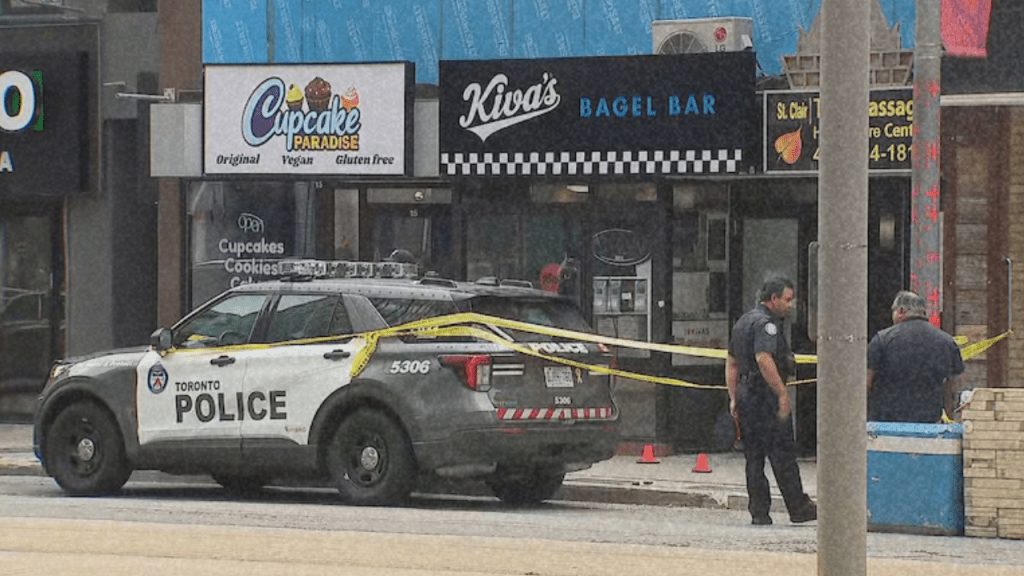
Two Kiva’s locations were deliberately targeted. That establishes coordination and target selection, but it does not reveal who ordered the attacks, what their motive was or why Iran and Palestine solidarity were immediately pulled into the story.
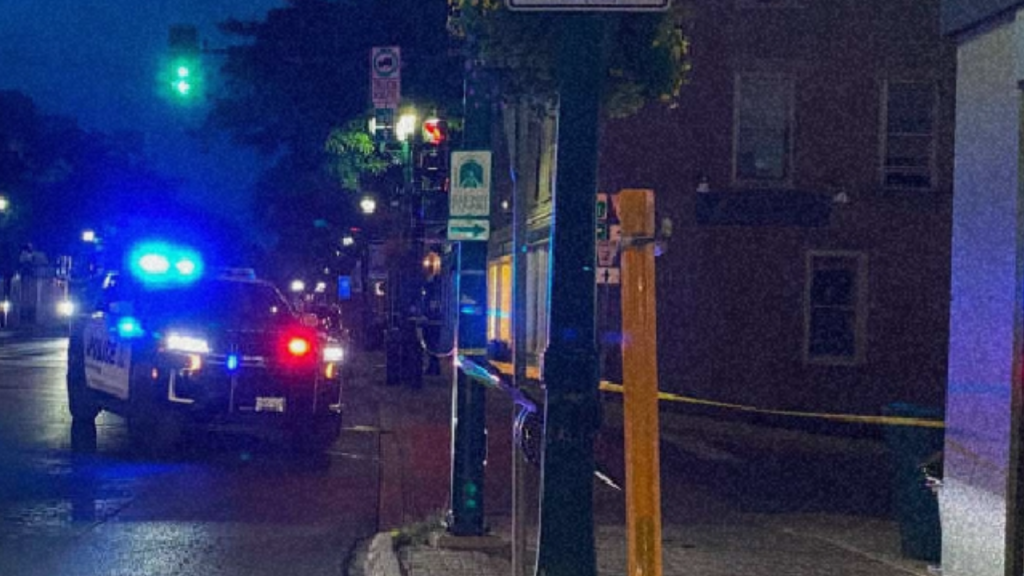
Two Kiva’s Bagel Bar locations were targeted in Toronto overnight between July 25 and 26. At the St. Clair location, police found evidence that a firearm had been discharged through the front windows. At the Steeles location, the front glass shattered after a dark SUV pulled up and then drove away. Nobody was injured.
The early reporting about Steeles was inconsistent. CityNews initially reported that police had found no evidence that gunfire caused the damage. A July 27 update described both incidents as firearm-discharge investigations and said police considered them targeted and connected. Investigators also said the same SUV may have been involved at both locations.
The available evidence shows that someone deliberately selected two locations belonging to the same Jewish-owned business. That makes an antisemitic motive possible and worth investigating. It does not identify the attackers, anyone who may have hired them or the reason the business was selected.
Before police had answered those questions, politicians and pro-Israel organizations had already placed the attacks inside a much larger story involving anti-Zionism, Iran, Islamist terrorism and Palestine solidarity.
What the Evidence Shows
The two Kiva’s locations were targeted within roughly an hour of each other, and police believe the same vehicle may have been used. That points to coordination rather than two unrelated acts of property damage. The identity of the business is also relevant, and investigators should examine whether Kiva’s was selected because it is Jewish-owned.
A possible motive, however, is not a proven motive. Police have not publicly identified a suspect, released communications or payment records, established a political affiliation or received an authenticated claim of responsibility. The target can help investigators develop theories, but it cannot reveal the beliefs of an unknown attacker or client.
That boundary was crossed almost immediately. Conservative MP Melissa Lantsman described the incidents as a “targeted campaign of intimidation” and warned that hatred was “metastasizing” in Canadian streets. B’nai Brith placed them inside an escalating antisemitism crisis. The Centre for Israel and Jewish Affairs went further, connecting the attacks to what it called a “toxic brew” of anti-Zionist rhetoric, local criminals, Iranian-backed proxies and ISIS-inspired terrorism.
Those statements joined several separate claims together without evidence connecting them to the Kiva’s attacks. No suspect had been linked to Iran, ISIS, a Palestine organization or an anti-Zionist group. Those actors entered the story through political commentary, not through anything police had publicly established.
The National Post Completed the Story
The National Post article, “Gunshots fired at Toronto Jewish bakery chain investigated as suspected hate-motivated attacks,” shows how an unresolved investigation became a much larger political narrative. Its confirmed facts were limited: two damaged locations, a dark SUV, evidence of gunfire, no injuries and no publicly identified suspects. At the time, reporting still conflicted over whether the Steeles location had been struck by gunfire.
The article then surrounded those limited facts with comments from politicians and pro-Israel organizations. Michael Levitt of the Jewish Security Network treated the attacks as part of an organized threat. Lantsman supplied the language of a campaign of intimidation. Toronto councillor Lily Cheng and Mayor Olivia Chow reinforced the antisemitism frame. CIJA introduced anti-Zionism, Iran and ISIS.
By placing those reactions beside one another, the National Post gave readers a completed explanation before investigators had identified the people involved. The article did not establish who carried out the attacks, who ordered them, how they were financed, where the weapon came from or what motive drove them. It contained no evidence tying the incidents to Iranian proxies, ISIS or Palestine organizers.
Those unproven connections nevertheless occupied more space than the central unanswered question: who arranged the attacks? Political organizations supplied compatible interpretations, and the newspaper assembled them into a single story. Once those claims appeared together in a national outlet, speculation began to look like an established account of what had happened.
Suspect Imagined Before Evidence Materializes
A similar pattern followed the June arson attempt at a Westmount synagogue in Montreal. Before police had identified anyone, Canadaland publisher Jesse Brown publicly wondered whether authorities were withholding the identity of a Muslim or politically connected suspect. Police later identified Steven Luu.
The information gap produced an imagined Muslim suspect before evidence supplied a name. The problem was not only that one prediction turned out to be wrong. The prediction was immediately available because national-security politics has spent years connecting violence against Jewish institutions to Muslims, migrants, anti-Zionists and Palestine activists.
Kiva’s entered the same political environment. A real attack had taken place, but no suspect or motive had been established. Anti-Zionism, Iran and terrorism were nevertheless placed beside the incident almost immediately, allowing an unresolved crime to reinforce an existing security story.
The eventual perpetrators may still have been motivated by antisemitism. That possibility should be investigated seriously. It cannot be used as proof that Iran, Islamism or Palestine solidarity played any role.
A Paid Shooter May Not Reveal the Motive
Toronto police have already described a market in which young people are recruited through encrypted applications to carry out shootings for money. Police say recruits may be supplied with firearms, sent to attack a location and required to record the shooting before receiving payment.
In June, investigators linked two recovered handguns to 27 firearm discharges. The incidents included attacks on the U.S. Consulate, synagogues, Jewish schools, homes and businesses. That range suggests that the same delivery system can be used by different clients pursuing different objectives.
Nothing currently proves that the Kiva’s attacks were part of this network. The existence of the network still changes the questions investigators should ask. A paid shooter can carry out an assignment without knowing why the target was chosen, while the person driving the vehicle may know little about the person who arranged the attack.
Investigators therefore need to look beyond whoever was closest to the scene. They need to determine who supplied the addresses, arranged the vehicle and weapon, offered payment and communicated with any intermediary. They also need to establish whether both locations were part of one assignment and whether the attacks were recorded as proof.
The gun-for-hire network showed why identifying disposable recruits may not reveal who purchased the violence. A vehicle or firearm match could connect incidents operationally without proving that they had the same client or motive.
Police Do Not Hold a Neutral Position
There is no public evidence connecting Toronto police officers to the Kiva’s attacks. However, the police also should not be treated as institutionally neutral simply because they control the investigation and decide what information reaches the public.
Project South initially produced charges against seven serving Toronto officers and one retired constable. The allegations included bribery, drug trafficking, misuse of confidential information and conspiracy to commit murder. Some charges were later reduced, and the remaining allegations have not been proven in court.
Project South does not connect police to Kiva’s. It does show that police information, organized crime and planned violence can overlap. Investigators alleged that confidential information had been passed to an organized-crime figure and used in a suspected murder plot and other offences.
Police control the surveillance footage, ballistic evidence, licence-plate searches, seized communications and confidential-source information in the Kiva’s investigation. Their statements are an important part of the evidence, but they are not the entire record. A serious investigation must examine the shooter, any intermediary, the weapon source, the information source and the person who ordered the attacks.
Security Failure Produces More Police Power
The political response also followed a familiar pattern. Lantsman dismissed task forces, councils, statements and “toothless bills” before demanding arrests and prosecutions. B’nai Brith called for a national task force and possible terrorist listings, while CIJA demanded more resources for police and security agencies.
The argument begins with the claim that governments and police have failed to protect Jewish communities. The proposed solution is then to expand the same security institutions that are said to have failed. Canada’s anti-hate consensus turns institutional failure into demands for more surveillance, enforcement and authority.
The fear created by an attack is real. A business was targeted and gunfire was reported. The political issue is who receives the power to define the cause, identify the suspect population and prescribe the response before the evidence is complete.
Palestine Solidarity Pays the Price
As previous cases have shown, linking an unresolved attack to anti-Zionism can have consequences far beyond the investigation itself. In the Kiva’s case, opposition to Zionism was placed in the same threat category as gunfire, Iranian proxies and ISIS, even though no Palestine activist or organization had been connected to the attacks.
Ontario used a similar association in March when it sought an emergency injunction against Toronto’s Al-Quds Day demonstration. The province referred to unresolved synagogue shootings but produced no evidence connecting those incidents to the rally or its organizers. A Superior Court judge rejected the application, but Ford’s government had already used the shootings to target Al-Quds Day.
The response to Kiva’s restores the same logic. A Jewish-owned business is attacked, the incident is placed inside an antisemitism emergency and anti-Zionism is presented as part of the environment that produced it. Palestine solidarity becomes adjacent to violence before anyone involved in the movement has been connected to the crime.
The state does not need to prove that protest organizers ordered an attack if their politics can be made to feel responsible for the atmosphere surrounding it. That is how an unresolved criminal investigation can be used to restrict people who had nothing to do with the offence.
What the Investigation Must Answer
Violence against a business, religious institution, political office or community space should be investigated seriously regardless of who owns it. The apparent selection of two Kiva’s locations makes their Jewish ownership relevant to the investigation of a possible antisemitic motive. It does not prove that motive or establish the politics of the people who carried out or ordered the attacks.
Investigators should disclose what they can establish about the SUV, the firearm, communications, payment, recordings and the selection of the addresses. They should determine whether the attacks intersected with Toronto’s paid-shooting market and whether organized-crime intermediaries or protected information played any role.
Antisemitism, anti-Zionism, Iranian state activity, Islamist terrorism, criminal contracting and Palestine solidarity are separate subjects. None can be used as proof of another.
The evidence currently establishes that two locations of the same business were deliberately targeted. It does not establish the political story already built around the attacks.
Sources
- CityNews, “Two locations of Jewish-owned bakery chain damaged in targeted incidents,” July 26, 2026.
- CityNews, “Toronto police share image of SUV linked to 2 shootings at Jewish-owned bakeries,” July 27, 2026.
- National Post, “Gunshots fired at Toronto Jewish bakery chain investigated as suspected hate-motivated attacks,” July 26, 2026.
- Global News, “Carney, Ford denounce vandalism, shooting at Jewish bakeries in Toronto,” July 27, 2026.
- Toronto Police Service, “Criminals for Hire Linked to 27 Firearm Discharges,” June 16, 2026.
- CityNews / The Canadian Press, “Number of charges reduced for some accused in Project South police corruption probe,” July 22, 2026.
- CityNews, “Former Toronto cop Derek McCormick pleads guilty in Project South case,” July 21, 2026.
- JNS, “Toronto police probing gunfire at two locations of Jewish-owned bakery chain Kiva’s as hate crimes,” July 26, 2026.
- Spark Solidarity, “Before Steven Luu, They Imagined a Muslim,” June 6, 2026.
- Spark Solidarity, “Toronto Gun-for-Hire Story Omits Police From the Market,” June 16, 2026.
- Spark Solidarity, “Canada’s Anti-Hate Consensus Is a Shield for Zionism,” June 4, 2026.
- Spark Solidarity, “Ford Used Synagogue Shootings to Try to Ban Al-Quds Day,” March 17, 2026.