The Canadian Covenant turns antisemitism into federal anti-hate architecture while Islamophobia and anti-Palestinian racism remain subordinate, named only when they do not threaten the state’s preferred framework.
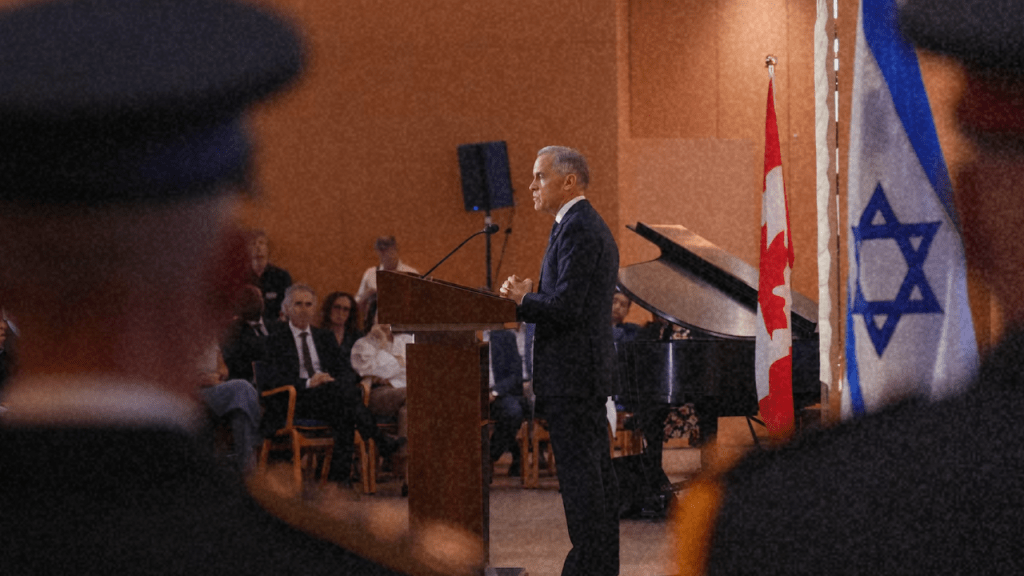
On June 1, 2026, Prime Minister Mark Carney stood at Holy Blossom Temple in Toronto and delivered a speech he called “The Canadian Covenant.” The speech announced the Ministerial Advisory Council on Rights, Equality, and Inclusion, chaired by Marc Miller and joined by Senator Marc Gold. It reaffirmed Canada’s use of the International Holocaust Remembrance Alliance definition of antisemitism. It tied the federal anti-hate framework to Bill C-9, the Combatting Hate Act. It turned one community’s fear into state architecture.
Carney also directed a specific line to the Jewish community: “naming these assaults is not equivalence.” That sentence governed the entire speech. Other forms of hate were acknowledged, but not placed on the same institutional level. Islamophobia appeared. Burning churches appeared. Transphobia appeared. They appeared in the closing list and then disappeared from the machinery the government actually built.
The new Advisory Council came with a four-point mandate: reassess the nature and scale of antisemitism, coordinate a whole-of-government approach to antisemitism, improve hate-incident data collection, and measure the impact of federal anti-hate efforts. Carney also pointed to $75 million through the Canada Community Security Program for synagogues, Jewish day schools, and community centres, with allocations extended to institutions of other faith communities.
The distinction is the article. Antisemitism received mandate, funding, legislation, definition, enforcement, and advisory infrastructure. Islamophobia and anti-Palestinian racism received recognition without comparable architecture. That is not a rhetorical imbalance. It is a governing decision.
Architecture versus acknowledgement
The Canadian Covenant shows the difference between architecture and acknowledgement. Architecture is what the state creates when it decides a community’s safety should reorganize law, policy, enforcement, and institutional training. Acknowledgement is what the state offers when it names harm but refuses to build around it.
Antisemitism received six pieces of legislation, an advisory council with an antisemitism-first mandate, $75 million in security funding, an IHRA reaffirmation, and a new criminal offence framework. Islamophobia received a place in the speech’s closing moral inventory. Anti-Palestinian racism received even less. It was not made structurally visible at all.
That hierarchy matters because Canada already has a documented Islamophobia crisis. The Standing Senate Committee on Human Rights report on Islamophobia held 21 public meetings and heard from 138 witnesses. It found that Islamophobia is a daily reality for many Muslims in Canada and recorded witness testimony that Canada leads the G7 in targeted killings of Muslims motivated by Islamophobia.
The record is not abstract. In 2017, six Muslim men were killed at the Islamic Cultural Centre of Quebec City. In 2021, four members of the Afzaal family were murdered in London, Ontario because they were Muslim. These were mass-casualty events. They permanently marked Muslim life in Canada. They did not produce an equivalent federal architecture.
That is the measure of the Covenant. It does not simply condemn hate unevenly. It builds unevenly.
The data does not settle the hierarchy
Statistics Canada’s 2024 police-reported hate-crime data shows that 70 percent of religion-motivated hate crimes targeted Jewish Canadians, or 920 incidents. Muslim Canadians were targeted in 17 percent of religion-motivated incidents, or 229 incidents. These numbers are real. They matter. They do not authorize the political operation being performed with them.
Police-reported hate-crime statistics measure more than harm. They measure reporting patterns, police classification, institutional trust, community relationships with law enforcement, and the political definitions used to make hate legible to the state. The data records what reaches police and survives police categorization. It does not measure the full distribution of fear, surveillance, grief, or state exposure.
Treating the numbers as a neutral moral ranking is a political act. It turns one type of state-recognized reporting into the master index of suffering. It lets the government say it is following the evidence when it is actually deciding which forms of vulnerability will reorganize federal power.
The Covenant does not merely respond to hate-crime data. It selects which data becomes architecture.
IHRA manages legitimacy
The pivot of Carney’s speech is the IHRA reaffirmation. Canada adopted the IHRA working definition of antisemitism in 2019. Carney repeated the standard assurance that the definition allows legitimate criticism of any government, including Israel. The assurance is necessary because the definition’s political use has made it necessary.
IHRA does not need to ban all criticism of Israel to discipline Palestine solidarity. Its power lies in making structural anti-Zionist politics permanently conditional. The IHRA examples include treating Israel as a racist endeavour and applying standards to Israel not demanded of other democratic states. That gives institutions a ready framework for reclassifying anti-Zionist analysis as antisemitism.
The problem is not theoretical. Canada’s IHRA Handbook presents the definition as Canada’s official anti-racism framework for antisemitism. Independent Jewish Voices, UJPO, and Jewish Faculty Network objected that the handbook treats a statement naming Zionism as racist, settler-colonial, and genocidal as an example of antisemitism under IHRA. That is the political function of the definition.
The issue is not whether antisemitism is real. It is. The issue is whether the state can name antisemitism without making Palestinian freedom a permanent hate-risk category. IHRA makes that separation harder. Carney’s speech makes IHRA more central to federal anti-hate architecture.
The anti-hate dialectic
The Canadian Covenant is not an isolated speech. It is the federal proof of concept for a process already visible in Canada’s anti-hate infrastructure. A far-right threat appears. It is externalized and classified by expert organizations. The classification justifies expanded law, funding, policing, advisory bodies, and institutional training. Then the same architecture is used to discipline forms of political dissent that have nothing to do with fascism.
The process works because the far right is externalized. Fascism appears as a visible aberration: masked men, Nazi salutes, banners, street demonstrations, conspiratorial recruitment. The state condemns it. Anti-hate organizations classify it. Police monitor it. The spectacle creates moral clarity. Liberal governance presents itself as the barrier between civil society and barbarism.
But the architecture built in response does not remain confined to fascists. Once the legal and institutional machinery exists, the decisive question becomes who gets to define hate. That is where Israel-lobby power matters. Canada’s adoption and reaffirmation of IHRA did not simply add an anti-racist tool to federal policy. It embedded a definition of antisemitism that makes structural anti-Zionist politics vulnerable to state and institutional discipline.
This is the dialectic. The far right supplies the emergency image. Liberal institutions supply the anti-hate machinery. Zionist organizations shape the definitional framework. Police and prosecutors receive expanded tools. Palestine solidarity becomes the political activity most available for enforcement.
The Hamilton NS13 case showed the first half of the process. A white supremacist group appeared in public. Media cited the Canadian Anti-Hate Network for classification. Political leaders demanded vigilance. But the same trail revealed the institutional genealogy behind the classification system.
Bernie Farber, CAHN’s founding chair, spent decades as a registered federal lobbyist for the Canadian Jewish Congress, pushing expanded hate-crime architecture and later advocating IHRA adoption in Canadian institutions. He also publicly framed protest against Regavim, an Israeli settler organization involved in Palestinian displacement politics, as antisemitic. That history matters because it shows how anti-fascist legitimacy and Zionist boundary-setting became fused inside Canadian anti-hate politics.
The point is not that every anti-hate intervention is fraudulent. The point is that the apparatus does two things at once. It monitors fascism as an external threat while expanding the state’s capacity to treat Palestine solidarity as a hate problem.
Carney’s Canadian Covenant turns that process into federal architecture. Antisemitism supplies the organizing centre. IHRA supplies the definition. Bill C-9 supplies the criminal-law mechanism. Palestinians, Muslims, and anti-Zionist Jews are left to navigate a system built around the premise that their political language is already suspect.
Bill C-9 makes the dialectic enforceable
Bill C-9 is where the dialectic becomes enforceable. The Combatting Hate Act would create new Criminal Code offences for intimidation and obstruction at places of worship, schools, community centres, and other institutions associated with identifiable groups. It would also create a specific hate-crime offence and a new offence for wilfully promoting hatred through certain public displays of hate or terrorist symbols.
The Canadian Civil Liberties Association and 36 other civil society organizations have warned that Bill C-9 risks criminalizing peaceful protest near tens of thousands of locations in Canada. They argue that the bill gives police new tools to target political activity while removing safeguards around hate-propaganda prosecutions. The federal government says the bill does not ban peaceful protest.
The stated purpose is not the problem. Jewish schools, synagogues, mosques, churches, community centres, and other institutions should be protected from threats, harassment, vandalism, and violence. The problem is the political overlap the bill refuses to confront. Many institutions associated with identifiable groups also act politically. They host state representatives. They fundraise. They lobby. They organize campaigns. They become sites of political power.
That matters for Palestine solidarity. A protest targeting a synagogue because Jews worship there is antisemitic intimidation. A protest targeting an institution because it fundraises for Israel, hosts Israeli officials, or lobbies against Palestinian rights is political protest. Bill C-9 and IHRA together make that distinction harder to defend in practice.
The state does not need to outlaw Palestine solidarity directly. It only needs to surround politically active Zionist institutions with criminal-law protections, define anti-Zionist language through IHRA suspicion, and let police decide which protests feel like intimidation.
Anti-Palestinian racism is the absent centre
The most glaring absence in Carney’s framework is anti-Palestinian racism. The speech was delivered while Israel’s war on Gaza continued. Palestinian Canadians have spent years watching family members killed, displaced, starved, detained, and dehumanized while being expected to prove that their grief does not constitute extremism.
They are expected to denounce slogans before they mourn. They are expected to avoid naming Zionism before they describe displacement. They are expected to make supporters of Israeli policy feel safe before they can describe what Israeli policy has done. Their political expression is treated as a public-order problem before their suffering is treated as a civic fact.
Anti-Palestinian racism appears when solidarity with Palestinians is described as hate before the violence that produced it is named. It appears when students face campus discipline for opposing genocide. It appears when the central political anxiety becomes not Palestinian death, but whether opposition to Palestinian death has made Zionists feel unsafe.
The Covenant makes no structural provision for this. Anti-Palestinian racism is not the council’s first mandate. It is not the organizing category of the speech. It is not the basis for a federal definition, an enforcement review, or a national advisory architecture. It is the absent centre around which the entire framework turns.
That absence is not accidental. Anti-Palestinian racism cannot be made central without confronting the role of Zionist institutions, Israel-lobby organizations, Canadian foreign policy, campus discipline, police surveillance, and the IHRA framework itself. The state cannot name the problem honestly without implicating the architecture it is building.
Islamophobia is named after the structure is built
Islamophobia receives a different form of containment. It is acknowledged as real but not allowed to reorganize the framework. Carney named it near the end of the speech, alongside burning churches and transphobia. That placement matters. It signals moral inclusion after institutional priority has already been assigned elsewhere.
The Senate Islamophobia report did not describe a minor or symbolic problem. It described daily fear, institutional discrimination, public hostility, and targeted killings. It recorded the Quebec City mosque massacre, the London attack on the Afzaal family, and the killing of Mohamed-Aslim Zafis outside the International Muslim Organization mosque in Toronto.
The Canadian state knows this record. Canadian Heritage’s own guide to understanding and combatting Islamophobia states that Islamophobia continues to affect Canadian Muslims and points to multiple tragic mass killings. The knowledge exists. The architecture does not match it.
This is how hierarchy is built while inclusion is performed. Islamophobia is named so the framework can appear universal. Antisemitism is centered so the framework can be operationalized through the institutions already demanding state power.
What the architecture says
The structure of the Canadian Covenant is not difficult to read. It is the anti-hate dialectic formalized at the federal level: visible fascism justifies anti-hate expansion, antisemitism becomes the organizing category, IHRA defines the boundaries of legitimate speech, and Palestinian solidarity becomes the political activity most exposed to discipline.
One community’s safety produced legislation, an advisory council, security funding, an official definition, and a prime ministerial address from a synagogue. Another community’s safety, despite Canada’s record of targeted anti-Muslim killings, produced acknowledgement. Palestinian safety, despite Gaza and the policing of solidarity in Canada, produced no comparable category at all.
That is a set of decisions about which communities’ fear organizes the state and which communities’ suffering remains background noise.
A non-exceptionalist anti-hate politics would separate antisemitism from anti-Zionism. It would refuse to treat Israeli state institutions and Zionist organizations as immune from protest when they act politically. It would track Islamophobia, anti-Palestinian racism, anti-Black racism, and anti-Indigenous racism through the same level of infrastructure it builds for antisemitism.
It would replace IHRA with an anti-racist framework capable of naming antisemitism without turning Palestinian freedom into a hate-risk category. It would recognize that the communities most exposed to state violence are often the communities whose fear least often produces federal architecture.
Carney’s Covenant acknowledged the possibility of equality. Then it built the opposite.
Sources
- Prime Minister of Canada — “The Canadian Covenant,” full speech transcript, June 1, 2026; IHRA reaffirmation, “not equivalence” quote, Bill C-9, Ministerial Advisory Council on Rights, Equality, and Inclusion, Marc Miller chair, Senator Marc Gold, four-point antisemitism mandate, $75 million Canada Community Security Program, six pieces of legislation.
- Department of Justice Canada — Bill C-9, Combatting Hate Act; proposed offences for intimidation and obstruction at places of worship, schools, community centres, and institutions used by identifiable communities; hate-motivated crime offence; public hate-symbol offence.
- Statistics Canada — Police-reported hate crime in Canada, 2024, published March 30, 2026; 1,342 religion-motivated hate crimes, 70 percent targeting Jewish Canadians, 17 percent targeting Muslim Canadians.
- Standing Senate Committee on Human Rights — Report on Islamophobia, November 2023; 21 public meetings, 138 witnesses, Islamophobia as daily reality, witness testimony that Canada leads the G7 in targeted killings of Muslims motivated by Islamophobia.
- CBC News — Senate Islamophobia report coverage, November 9, 2023; Quebec City mosque massacre, London Afzaal family attack, and Senate call for urgent action.
- Canadian Heritage — Canadian Guide to Understanding and Combatting Islamophobia; Islamophobia’s impact on Canadian Muslims and reference to multiple tragic mass killings.
- Government of Canada — Canadian Handbook on the IHRA Working Definition of Antisemitism; Canada’s 2019 adoption of IHRA and official federal framing of the definition.
- Independent Jewish Voices Canada, United Jewish People’s Order, and Jewish Faculty Network — Statement on Canada’s IHRA Handbook; critique of the handbook’s treatment of anti-Zionist speech as antisemitism and warning that it promotes anti-Palestinian racism.
- Canadian Civil Liberties Association — Civil society groups demand federal government rethink Bill C-9; warning that Bill C-9 risks criminalizing peaceful protest and gives police new tools to target political activity.
- Canadian Muslim Public Affairs Council / CCLA joint letter — Bill C-9 concerns; warning that the bill could disproportionately affect Muslim, Palestinian, and other equity-deserving communities historically exposed to surveillance and policing of political expression.
- Office of the Commissioner of Lobbying of Canada — Canadian Jewish Congress / Bernie Farber lobbying registration; hate-crime and antisemitism-related federal lobbying record.
- Office of the Commissioner of Lobbying of Canada — CIJA lobbying registration; training for attorneys general, prosecutors, and police to enforce Criminal Code hate-speech provisions, with training and parameters citing IHRA.
- CBC Hamilton — Nationalist-13 Hamilton City Hall demonstration, February 2026; white supremacist public action, expert commentary, and CAHN classification context.
- CBC News / The Fifth Estate — Tracking Canada’s fascist fight clubs; Nationalist-13, active clubs, training networks, anti-immigration protests, and links to broader far-right organizing.
- Yves Engler — “Farber’s ‘anti-hate’ must include Palestinians,” January 22, 2023; Regavim protest, Farber tweet, and critique of Zionist boundary-setting inside anti-hate politics.
- Spark Solidarity — “Don’t Just Vote for Palestine, Organize to Fight Zionism,” April 30, 2025; Palestinian solidarity organizing in Canada and the limits of electoral pressure.
- Spark Solidarity — “The Politics of Perception Management on Anti-Semitism,” February 9, 2026; IHRA, antisemitism framing, and suppression of material critique of Israeli state policy.
- Spark Solidarity — Yves Engler arrest report; Palestine solidarity organizing and the policing of criticism of Israel.