
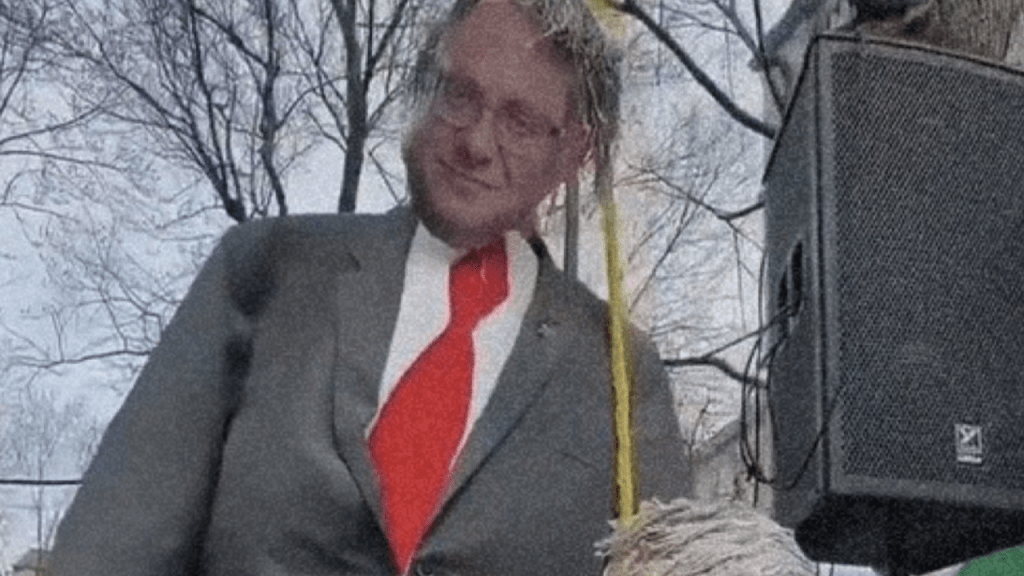
The Ben-Gvir Montreal effigy controversy began with the same Canadian state that had condemned him as abominable four days earlier.
On the afternoon of May 20, 2026, Foreign Affairs Minister Anita Anand summoned the Israeli ambassador Iddo Moed in response to Itamar Ben-Gvir’s treatment of Canadian Sumud flotilla activists detained at the Ashdod port. Anand called the video Ben-Gvir had posted of himself taunting bound, kneeling detainees deeply troubling and absolutely unacceptable. Prime Minister Mark Carney called the treatment abominable. Canada joined France, Italy, and the Netherlands in formally summoning Israeli envoys. Anand publicly noted Canada had already sanctioned Ben-Gvir for repeated incitement of violence and that he was already banned from travelling to Canada.
Four days later, on Sunday May 24, Montreal4Palestine marched through downtown Montreal with three effigies of Itamar Ben-Gvir, Benjamin Netanyahu, and Donald Trump hanging from nooses. The Ben-Gvir effigy wore a white kippah. By Tuesday May 26 the SPVM hate crimes unit had opened an investigation. By Wednesday May 27 Pierre Poilievre had described the demonstration as parading an effigy of a Jew being hanged. The same week the Carney government had moved from condemning Ben-Gvir’s conduct to investigating protesters for depicting Ben-Gvir as condemnable.
What the Canadian government said about Ben-Gvir
The May 20 condemnation was not isolated. In June 2025, Canada acted jointly with Australia, New Zealand, Norway, and the United Kingdom on sanctions against Ben-Gvir and Finance Minister Bezalel Smotrich. The joint measures targeted the two for inciting extremist violence and serious abuses of Palestinian human rights, including rhetoric advocating forced displacement and new settlement construction in the West Bank. Asset freezes and travel bans were included. Ben-Gvir cannot enter Canada. The federal position on Ben-Gvir, on the record for nearly a year before the Montreal protest, has been that he is a sanctioned far-right minister actively inciting violence against Palestinians.
Carney went further on May 27. Speaking with Israeli President Isaac Herzog, the Prime Minister reiterated that the appalling treatment of civilians aboard the Gaza-bound flotilla was unacceptable, called for an independent investigation, and “strongly condemned” Ben-Gvir’s comments. Anand spoke with Israeli FM Gideon Sa’ar about the same treatment. Canadian flotilla activists later told reporters they had been beaten and, in one case, stabbed in the hand by an Israeli prison guard during the detention Ben-Gvir publicly celebrated. The Canadian government’s position on Ben-Gvir’s recent conduct is on the public record as mistreatment of Canadian civilians and abuse of detainees.
What was actually on display May 24
Montreal4Palestine’s downtown march on May 24 carried three effigies hanging from nooses. The faces were Donald Trump, Benjamin Netanyahu, and Itamar Ben-Gvir. The Ben-Gvir effigy wore a white kippah, the colour Ben-Gvir wears in public. The same kippah-wearing effigy appeared at an April 19 protest with Ben-Gvir’s face mounted directly. The May 24 prop was the same one with the same kippah, presented at a different angle in the most widely circulated clip — taken from a distance, with the Ben-Gvir face less visible than the kippah. Montreal4Palestine’s own footage, posted to Instagram, included a labelled image identifying each effigy.
The group’s May 27 statement said the effigies “were directed specifically at political figures” and “at no point were intended to represent Judaism, Jewish people, or any religious, ethnic, or identifiable community.” The kippah was part of the Ben-Gvir depiction because Ben-Gvir wears a kippah. He leads Otzma Yehudit. He is Israeli Minister of National Security. He is responsible for prisons and policing in Israel. He has overseen conditions in which Palestinian prisoners are detained. The kippah was an identifying feature the same way Trump’s red tie is on his effigy.
Ben-Gvir’s own noose
On December 8, 2025, Ben-Gvir and other Otzma Yehudit MKs arrived at a Knesset National Security Committee hearing wearing golden lapel pins shaped like nooses. The bill would make the death penalty the default sentence for Palestinians convicted of deadly attacks. Ben-Gvir, writing about the pins on his own social media, called them a clear message that “terrorists are sons of death.” He specified the noose was one of the options through which the law would implement the death penalty, alongside the electric chair and lethal injection. The pins were modelled on the yellow ones Israeli officials had worn since October 7 — repurposed, in gold, as state-sanctioned death.
The bill passed. On its third and final Knesset reading the legislation cleared 62-48 with Netanyahu voting in favour. As of December 2025, execution by hanging is a lawful sentence for Palestinians convicted of deadly attacks under Israeli law. The Ben-Gvir effigy on a noose in Montreal on May 24 came five months after Ben-Gvir personally championed, and successfully legislated, hanging as the punishment of choice for Palestinian prisoners. Whatever else can be said about the Montreal protest, the visual it used was the one Ben-Gvir put into Israeli law.
From “Ben-Gvir” to “a Jew”
The political response moved quickly to replace the name. Pierre Poilievre, Conservative leader, wrote on May 27 that “masked cowards paraded an effigy of a Jew being hanged, in downtown Montreal, in broad daylight.” Anthony Housefather, Liberal MP for Mount Royal, called the display “disgusting, antisemitic and clear incitement to hatred” and said he had reported it to police. Gideon Sa’ar described the protest as “hanging dolls representing Jews wearing kippahs.” The Centre for Israel and Jewish Affairs and Federation CJA released a joint statement on the “macabre spectacle” of “Jews hanging from a rope.” CIJA senior vice-president Richard Marceau said “an effigy of a Jew is being hanged.”
In each statement the same operation: substitute “Ben-Gvir” with “a Jew.” The effigy ceased to be Itamar Ben-Gvir, sanctioned Israeli minister responsible for prison conditions, leader of Otzma Yehudit, champion of the death penalty for Palestinians. The effigy became a generic Jewish person. The protest ceased to be a march against the political figures responsible for Gaza, the West Bank settlements, and the U.S. weapons pipeline. The protest became an attack on Jewish Canadians as such. The substitution did not require argument. It required only repetition by enough figures with public platforms.
Effigies are common; this one was different
The institutional response to the Montreal4Palestine protest is not exceptional. Three weeks earlier, on May 2, 2026, Alliance ouvrière used a guillotine to decapitate a papier-mâché effigy of Quebec Labour Minister Jean Boulet at a May Day demonstration in Montreal. Video circulated widely. Premier Christine Fréchette condemned the display. Quebec Domestic Security Minister Ian Lafrenière — the same minister who later condemned the Montreal4Palestine effigy — called it incitement to commit criminal acts. The SPVM opened an investigation. Boulet filed a police complaint. Legal experts cited Criminal Code sections 264.1 and 423. Alliance ouvrière denied the effigy depicted the minister — a “generic elite member” — the same response pattern Montreal4Palestine used three weeks later.
The Boulet and Ben-Gvir cases passed through the same institutional circuit: social media video, political denunciations, police investigation opened, legal expert commentary on criminal exposure. What the Montreal4Palestine case attracted additionally — Pierre Poilievre, Israel’s foreign minister, the hate-crime framing that converts political protest into ethnic threat — is the layer the Boulet case never reached. Legal scholar Pearl Eliadis told the Montreal Gazette that effigies are a common form of political protest and that political speech occupies a highly protected place under the Charter. The Criminal Code’s section 319 prohibits public incitement of hatred against an identifiable group. Quebec politicians did not apply that question to the Boulet effigy.
What the conflation protects
The operation requires three categories to collapse into one: Jewish people, Zionism, and the Israeli state. They are not interchangeable. Zionism is a political ideology. The Israeli state is a state with prisons, police, ministers, and policies. When Poilievre wrote “an effigy of a Jew,” he converted Itamar Ben-Gvir — a sanctioned minister who championed and legislated hanging as punishment for Palestinian prisoners — into a generic representative of Jewish identity. Criticism of Israeli officials gets reframed as communal threat. The object of the protest — state violence against Palestinians — disappears from the frame, replaced by protest management: whether demonstrators in Montreal behaved acceptably toward a minister Canada had already condemned as abominable.
The same minister, four days later
On May 20 the Canadian state condemned Itamar Ben-Gvir. On May 24 protesters in Montreal condemned the same Itamar Ben-Gvir in effigy form. On May 26 the SPVM opened a hate crimes investigation. On May 27 Pierre Poilievre called the protest an “effigy of a Jew.” Carney called Herzog the same day and discussed “the devastating resurgence of antisemitism” without raising that his own foreign minister had said the same about Ben-Gvir the week before. The puppet that travelled through the four-day window was the same puppet. The minister it depicted was the same minister. What changed was which side of the protest line one was standing on.


 Spark Solidarity