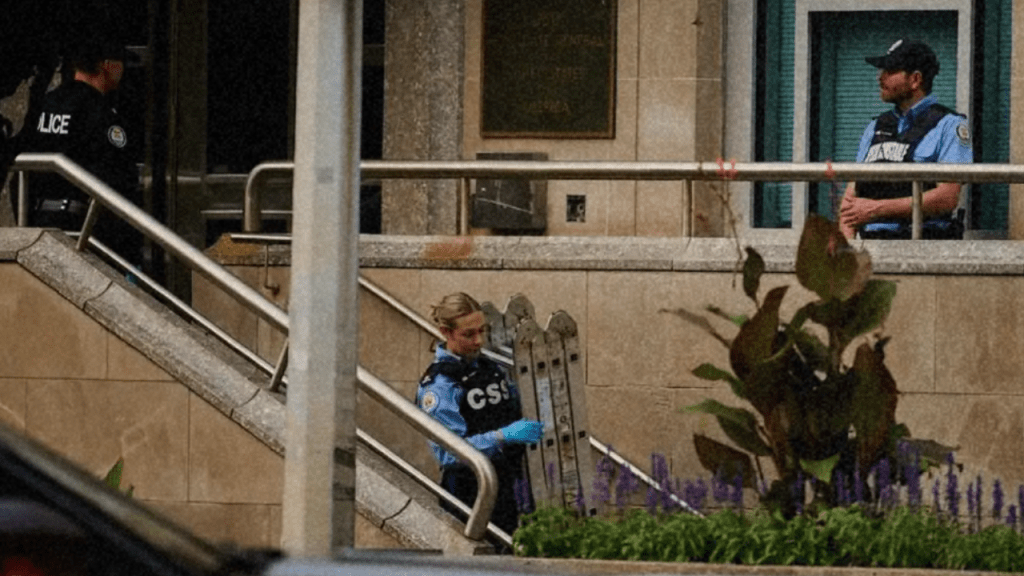
Toronto police can point to charges, suspensions and outside oversight. That proves procedures exist. It does not prove the institution has accounted for itself.
When the Special Investigations Unit charged Toronto Police Service Const. Parsa Hazeri in June, the institutional response moved quickly into familiar channels.
The SIU laid criminal charges. Toronto police said they had notified the watchdog when they learned of the complaint, removed Hazeri from operational duties, revoked his police powers and later began a process seeking his dismissal. The allegations against Hazeri have not been proven in court, and he is entitled to the presumption of innocence.
Those procedures matter. They are also not the same thing as full public accountability.
The criminal case can determine whether one officer committed offences. It cannot, by itself, tell the public what the institution knew, whether supervision failed, whether warning signs existed, how internal systems responded or whether the same weaknesses exist elsewhere.
That distinction matters far beyond one case. Ontario has built a police oversight system in which criminal conduct, professional misconduct, service delivery, governance, compliance and employment discipline can all move through different institutions at the same time.
Each body has a mandate. Each can say another part of the problem belongs somewhere else. The public is left trying to reconstruct accountability from press releases, case-status pages, disciplinary processes, board meetings and investigations that rarely produce one complete picture at the same moment.
Toronto police do not get to call that fragmentation accountability simply because every file has somewhere to go.
The SIU answers one narrow question
The SIU is a civilian law-enforcement agency with a specific criminal mandate. It investigates incidents involving police and certain other officials where there has been serious injury, death, an allegation of sexual assault or the discharge of a firearm at a person.
Its central question is whether there are reasonable grounds to believe a criminal offence was committed by an official.
That is important work. It is also deliberately limited work.
The SIU itself explains that it does not investigate ordinary service complaints, policy disputes, corruption allegations outside its mandate or professional misconduct that does not involve one of its triggering circumstances. Those issues belong elsewhere.
So when the SIU lays a charge, the public has an answer to one question: an independent criminal investigator concluded there were reasonable grounds for a prosecution.
The public still does not automatically have an institutional account.
It does not know whether supervisors failed. It does not know whether internal complaints existed. It does not know whether recruitment or vetting systems missed something. It does not know whether information was mishandled, whether command structures created risk or whether similar failures exist beyond the accused officer.
The SIU is not supposed to answer all of those questions. The problem begins when police institutions point to the SIU as if somebody else opening a criminal file means the institution itself has been fully examined.
Project South shows the split in real time
Project South offers a clearer view of how this system divides accountability into separate tracks.
In February, seven serving Toronto police officers and one retired member were charged after a York Regional Police investigation into allegations involving corruption and organized crime. The allegations remain unproven.
The criminal investigation did not settle the professional-conduct questions. On February 9, the Law Enforcement Complaints Agency assumed control of the conduct investigation involving the charged Toronto officers.
LECA explicitly described the conduct investigation as separate from the criminal investigation. Under Ontario’s policing framework, chiefs and other officials must notify the agency about potential misconduct, and LECA can take control when it decides a public-interest investigation is required.
Then another oversight track opened.
Four days after the Project South charges were announced, Ontario’s Inspector General of Policing launched a province-wide inspection of police integrity and anti-corruption practices. The inspection was later placed under former judge William Hourigan and given authority to examine system-level practices across police services and police boards.
The inspection is not determining whether the officers charged in Project South are guilty. It is examining whether policing institutions have adequate systems for preventing, detecting and responding to corruption.
That is a third question moving through a third structure.
Meanwhile, criminal courts will address the charges. Professional-conduct processes can address officer misconduct. Chiefs and police employers deal with suspension and employment consequences. Police boards remain responsible for governance. The Inspector General can examine service delivery and compliance. The SIU separately handles criminal investigations within its own narrow mandate.
Every piece can be necessary. Together they can still produce a system that is almost impossible for the public to see whole.
Ontario has oversight bodies, plural
Ontario’s own public information describes three police oversight bodies and a separate administrative body connected to discipline.
The SIU investigates possible criminal offences in the serious cases that fall within its statutory mandate.
LECA investigates public complaints about police officers, can examine systemic issues and can take over misconduct investigations when the public interest requires it.
The Inspector General and Inspectorate of Policing focus on whether police services and boards comply with provincial policing law, whether policing is being delivered adequately and effectively, and whether governance structures are functioning properly.
Discipline adjudication sits in another process again.
This is not evidence that oversight should be abolished or merged into one giant agency. Criminal investigations, employment discipline and governance review are genuinely different functions.
But specialization has a political consequence.
It gives institutions an endless vocabulary for partial answers.
The criminal matter is with the courts.
The conduct matter is with LECA.
The systemic matter is with the Inspector General.
The officer’s employment status is part of a discipline process.
The board is monitoring.
Every sentence can be technically true while the central public question remains unanswered: what did the institution itself learn, and what will it change?
Process is not the same as an account
Police services often present the existence of process as evidence that accountability is functioning.
An outside agency is investigating. An officer has been suspended. A chief has asked for dismissal. A review has been launched. A board has been briefed. The matter is before the courts.
Those steps may be necessary. They are not self-executing proof that the public has received accountability.
Accountability requires more than knowing that a file moved from one institution to another. It requires a public account of what failed, who had responsibility, whether the failure was individual or systemic, what changes followed and how those changes can be verified.
That is precisely the level of scrutiny police institutions resist when they isolate every scandal as a separate case.
One officer becomes a criminal file. Seven officers become a corruption investigation. A separate agency examines conduct. Another body launches an inspection. The city continues funding the institution. The public is told that each issue is being addressed in the appropriate channel.
Spark Solidarity has already examined how Toronto kept expanding police funding while scandals accumulated. The accountability problem is the institutional twin of that contradiction: the service can grow while responsibility is divided into smaller and smaller procedural compartments.
Fragmentation can protect the institution
Fragmented oversight does not mean every oversight body is captured or ineffective.
The SIU has laid charges against officers. LECA can remove conduct investigations from police services. The Inspector General has broad inspection and enforcement powers. These institutions exist because police cannot simply be left to police themselves.
The problem is what happens between their mandates.
No single criminal case has to explain a service’s culture. No conduct investigation has to answer every governance question. No governance inspection determines criminal guilt. No police board meeting automatically produces a complete public record of employment discipline. Each institution can properly say some questions fall outside its jurisdiction.
That leaves gaps where institutional responsibility can become nobody’s immediate job.
The result is not necessarily a conspiracy of silence. It is often something more durable: a system in which silence can be produced by jurisdiction.
The public asks what went wrong. One institution answers whether a crime occurred. Another answers whether professional misconduct can be proven. Another asks whether provincial policing standards were met. Another decides employment consequences.
The original question gets divided until no single answer carries the weight of the whole institution.
The current system is still under examination
Ontario’s own response to Project South suggests the province understands that the ordinary case-by-case machinery is not enough.
The Inspector General’s province-wide inspection is looking at supervision, screening and vetting, access to police databases, evidence and property management, substance use and fitness for duty, with authority to examine additional issues that arise.
Those are institutional questions.
They ask how police organizations are built, how officers are monitored, how information is controlled and whether services can detect corruption before another outside investigation forces the problem into public view.
That is closer to accountability than simply pointing to the arrest of individual officers. But even here, the value will depend on what becomes public, how specific the findings are and whether institutions are required to show that recommendations produced measurable change.
An inspection can identify weaknesses. The public still needs to know whether those weaknesses are fixed.
Toronto police still owe a public account
Toronto police do not control the SIU. They do not control LECA. They do not control the courts or the Inspector General.
But they do control how seriously they examine themselves.
They control what institutional reviews they initiate beyond the minimum legally required processes. They control how much information they preserve and eventually disclose. They control whether public reports identify systemic failures or reduce every scandal to personnel management. They control whether board discussions produce transparent answers or another round of assurances that the appropriate bodies are handling the matter.
The public should not have to wait for the next criminal charge to learn whether lessons from the last one were implemented.
It should not have to assemble police accountability from five websites and a stack of legal mandates.
And it should not be told that an institution has demonstrated accountability simply because an outside body eventually became involved.
Charges are not accountability.
Suspension is not accountability.
An inspection is not accountability.
They are mechanisms that can contribute to accountability if they produce truth, consequences, institutional change and a public record strong enough to verify what happened.
Toronto police have had no shortage of mechanisms activated around them.
What the public is still owed is the account.
Sources
- Special Investigations Unit — SIU Charges Toronto Police Officer in Sexual Assault Investigation; June 4, 2026 charges against Const. Parsa Hazeri. The allegations remain unproven.
- Special Investigations Unit — What We Can Investigate; SIU jurisdiction and the distinction between criminal investigation and professional misconduct.
- Law Enforcement Complaints Agency — LECA Assumes Control of the Conduct Investigation into TPS Officers Charged and Arrested; February 9, 2026 Project South conduct investigation.
- Inspectorate of Policing — Inspector General Memo #9; February 9, 2026 launch and scope of the province-wide police integrity and anti-corruption inspection.
- Inspectorate of Policing — Appointment of the Honourable William Hourigan; April 23, 2026 update on the province-wide inspection.
- Inspectorate of Policing — Ontario’s Inspector General and the Inspectorate of Policing; mandate concerning policing compliance, governance, inspections and complaints.
- Government of Ontario — Policing in Ontario; overview of Ontario’s police oversight and discipline bodies.
- Special Investigations Unit — Status of SIU Cases; current public case-status registry. Open investigations are not findings of wrongdoing.
- Spark Solidarity — “Toronto Keeps Funding Police While Scandals Pile Up”; related analysis of police expansion amid repeated scandals.
- Spark Solidarity — “Toronto Police Scandal Is Structural, Not Three Bad Apples”; related analysis of the limits of individualizing police misconduct.