
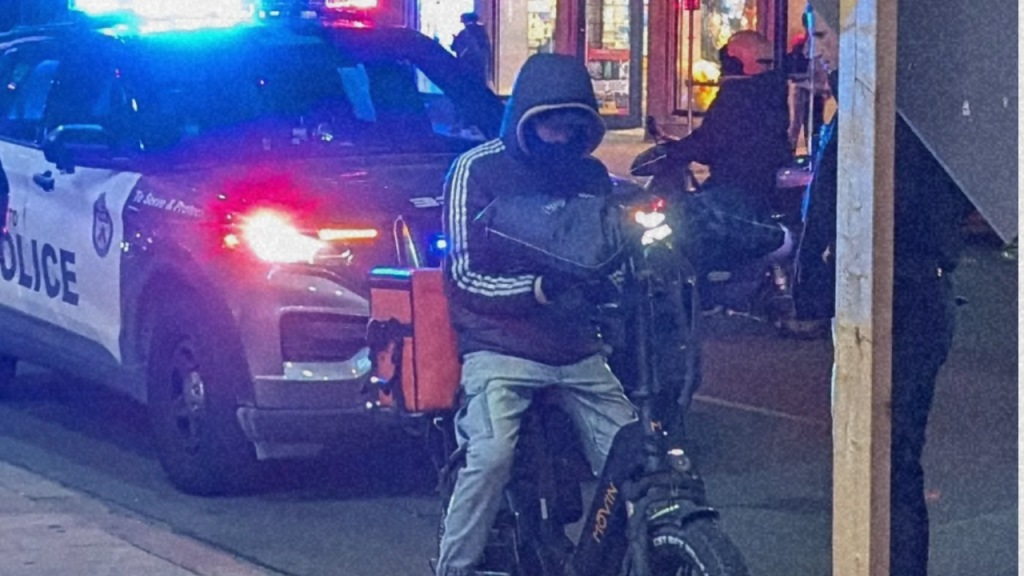
Toronto’s e-bike and e-scooter crackdown is expanding through police blitzes, rider-classification training and a push for powers to seize some micromobility vehicles.
Toronto has a micromobility problem. E-bikes, e-scooters, cargo bikes, mopeds and other electric vehicles are multiplying faster than the legal categories built to contain them. Some are lightweight bicycles with modest electric assistance. Others are heavy machines that look and move more like motorcycles. Some belong in bike lanes. Some do not. Pedestrians have legitimate reasons to be concerned about fast vehicles on sidewalks, and cyclists have legitimate reasons to be concerned about heavier motorized devices entering narrow cycling infrastructure.
But Toronto is increasingly answering that complicated transportation problem with a familiar institution: police.
On July 16, the City of Toronto updated its public information on electric scooters with an unambiguous message. E-scooters cannot legally be operated on Toronto public streets, sidewalks, bike lanes, cycle tracks, trails, paths or parks. The city warns that fines and penalties may apply and explicitly identifies the Toronto Police Service as an enforcement agency.
That public campaign sits inside a larger enforcement structure. City Council has directed staff to develop a training program so police officers can identify different micromobility devices and determine where they may legally operate. Council has ordered continued police education and enforcement blitzes targeting devices on sidewalks and continued evaluation of those blitzes. It has also asked Queen’s Park to create a process allowing police to seize or impound certain unlicensed motorized micromobility vehicles at the curb.
The city calls this road safety. But Toronto’s e-bike and e-scooter crackdown is becoming an enforcement system.
Toronto’s e-scooter ban is absolute
The rules for electric kick scooters in Toronto are unusually simple because the city has chosen prohibition.
Ontario created a provincial pilot allowing municipalities to decide whether e-scooters could legally operate on local roads. Toronto declined to participate in 2021 and again in 2024. As a result, an e-scooter may legally be sold in Toronto while having no legal place to be ridden on public property.
Not on the road. Not in a bike lane. Not on a sidewalk. Not on a trail. Not in a park.
The city’s updated campaign tells residents that the devices may be common without being legal. It also stresses a real safety problem. Toronto says SickKids has recorded a significant increase in serious injuries involving battery-powered mobility devices since 2020. Among the injuries treated in 2024, nearly half of e-scooter injuries involved children aged 10 to 13, while e-scooters accounted for 85 per cent of serious injuries involving battery-powered mobility devices.
Those numbers deserve a serious response. Children should not be sold powerful electric vehicles as toys. Pedestrians should not have to dodge fast devices on sidewalks. Battery and vehicle standards matter.
But prohibition creates its own policy problem. Toronto has a transportation mode that people are already using, stores are legally selling and the city has decided has no legal place anywhere in the public transportation network. Once that contradiction is established, enforcement is built into the system.
Toronto e-bike rules are tightening
The crackdown is broader than illegal electric scooters.
Toronto’s 2026 “Rules for Rideables” campaign attempts to sort bicycles, e-bikes, cargo bikes, mopeds and scooter-style vehicles into different legal spaces. The distinctions are not always intuitive. The city says only bicycles, qualifying e-bikes and cargo bikes are allowed in bike lanes. In physically separated bike lanes, conventional e-bikes generally must weigh 40 kilograms or less, while cargo bikes are treated differently. Vehicles that can operate without pedals or resemble heavier motorized vehicles may fall outside the rules governing ordinary e-bikes.
Ontario’s existing e-bike rules cap assisted speed at 32 kilometres per hour and motor output at 500 watts. The province has also proposed a new framework that would separate qualifying power-assisted bicycles from faster and heavier moped-, scooter- and motorcycle-style vehicles that would require licensing and insurance. That proposal was posted in April and has not yet become law.
There is a legitimate regulatory problem here. A bicycle with modest electrical assistance is not the same vehicle as a heavy electric motorcycle capable of travelling well above legal e-bike speeds. Pedestrians should not be expected to share sidewalks with fast motorized vehicles. People riding conventional bicycles should not have to compete for narrow protected lanes with machines whose size, weight and acceleration are closer to mopeds.
Classification matters. The political question is what Toronto builds around those classifications.
Increasingly, the answer is police enforcement.
Council is expanding police enforcement
Toronto did not suddenly discover micromobility this summer.
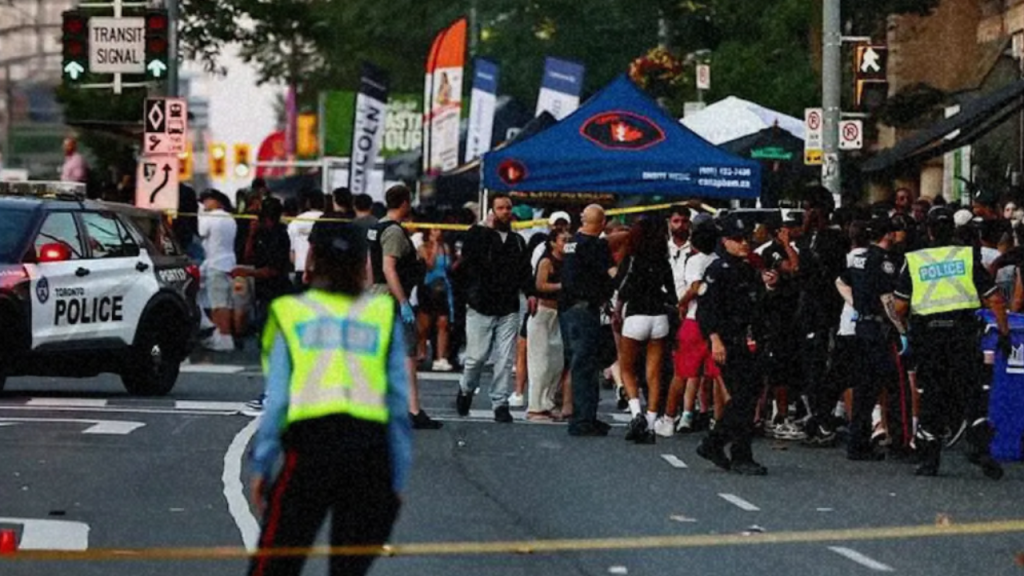
In October 2025, City Council directed Transportation Services to continue working with Toronto police on coordinated public education campaigns and enforcement blitzes. Council also asked the Police Service Board to have the chief conduct micromobility blitzes and publish data on their results by the end of 2026.
Police had already demonstrated what those campaigns could look like. During a three-week operation from August 25 to September 13, 2025, Toronto police issued more than 3,500 tickets as part of a combined micromobility and back-to-school safety campaign. Of those, 179 tickets were issued specifically under provincial and municipal rules governing micromobility vehicles.
Then Council expanded the machinery.
In May 2026, Council directed Transportation Services, in consultation with Toronto police, to create a training program that would help officers identify different micromobility devices and determine where each was permitted to operate. It ordered continued education and enforcement blitzes targeting devices on sidewalks and continued evaluation of the existing blitzes. It also requested a report on bylaw changes that could prohibit motorized vehicles other than approved e-bike classes from cycling infrastructure.
Council went further. It asked the province to create a process authorizing Toronto police to seize and impound at the curb unlicensed motorized micromobility vehicles that operate under motor power above 32 kilometres per hour.
That authority does not exist simply because Toronto requested it. Queen’s Park would have to act. But the direction is clear: Toronto is moving from signs and public education toward an enforcement architecture built around police classification, targeted blitzes and potentially vehicle seizure.
Delivery workers carry the burden
There is another revealing part of Toronto’s policy. City Council explicitly directed staff to engage courier and transportation businesses and ask them to educate contractors about penalties for illegally modifying micromobility vehicles and about their legal responsibilities on the road.
The structure of that response matters.
The companies educate. The workers comply. The police enforce.
A person operating a dangerous vehicle on a sidewalk can endanger someone regardless of whether they are delivering food, carrying a parcel or riding recreationally. Individual riders have responsibilities. But the enforcement system still lands most directly on the person available for a roadside stop. The rider is the person whose vehicle can be classified, ticketed and, under the authority Toronto is seeking, potentially seized.
The larger economic systems organizing thousands of delivery trips are harder to reach with an enforcement blitz. So the rider becomes the manageable problem.
Toronto’s treatment of corporate cargo bikes makes the contradiction clearer. The city actively supports parcel companies replacing vans with cargo e-bikes. Its cargo-bike program currently identifies FedEx, NationEx and Purolator as companies using cargo e-bikes in Toronto. The city also operates a logistics mini-hub program designed to help courier companies replace delivery trucks and vans with electric cargo bikes for last-mile deliveries because the shift can reduce congestion, pollution and curbside conflicts.
That is a worthwhile transportation goal. It also shows that electric micromobility is not inherently being rejected.
When electric mobility is integrated into a formal corporate logistics program, Toronto treats it as infrastructure. When devices or riders fall outside approved categories, the city’s language quickly shifts toward compliance, enforcement and prohibition.
The issue is not technology alone. It is whether the vehicle, rider and use have been incorporated into an approved system.
Toronto already knows the force risk
Toronto has already seen what can happen when low-level cycling enforcement becomes a police encounter.
In May, a stop-sign enforcement operation near Queens Quay ended with a cyclist suffering a serious injury and the Special Investigations Unit opening an investigation. Spark Solidarity previously examined how the cyclist takedown turned a traffic stop into a force question.
That case should not be mechanically conflated with every e-bike or e-scooter enforcement action. But it should matter when the city expands the role police play in managing micromobility.
Enforcement is not an abstract administrative category. A blitz means police encounters. Classification means officers making decisions about what a vehicle is, where it belongs and whether the person riding it is breaking the law. Seizure powers, if eventually granted, would give officers authority to take certain vehicles at the roadside.
Toronto can believe some rules are necessary without pretending the enforcement mechanism is politically neutral.
Regulation does not require a crackdown
The alternative to a police-centred system is not pretending there are no problems.
People should not have to dodge fast electric vehicles on sidewalks. Children should not be sold powerful devices as toys without meaningful safety standards. Cyclists should not be pushed out of protected infrastructure by vehicles that are effectively electric motorcycles. Batteries should meet serious safety standards. Manufacturers should not be able to exploit legal ambiguity to sell vehicles that exceed the limits attached to ordinary e-bikes.
Those are arguments for regulation. They are not automatically arguments for policing.
Toronto could make vehicle categories easier to understand at the point of sale. It could place more responsibility on retailers and platforms before a vehicle reaches the street. It could build infrastructure capable of accommodating a wider range of low-emission transportation. It could regulate companies whose operations generate large volumes of delivery traffic. It could design safer curb space and loading systems. It could enforce the illegal parking and dangerous driving that push cyclists and delivery riders into conflict with pedestrians and moving traffic.
Pieces of that approach already exist. Toronto supports cargo-bike logistics because it understands that replacing large delivery vans can improve urban transportation. It is pushing for stronger battery and manufacturing standards because some safety problems begin before a rider ever reaches the road. It supports clearer provincial vehicle classifications because confusing rules create real safety and enforcement problems.
But when those policies reach the street, the institution waiting at the end of the process is still the police.
The crackdown is becoming permanent
This is what makes Toronto’s current micromobility policy more significant than another seasonal safety campaign.
The machinery is becoming institutional.
Coordinated enforcement blitzes are no longer a one-off response. Council wants their results evaluated. Police are to receive training on vehicle classification. The city is asking for new seizure and impound authority. Future bylaw changes could narrow which motorized vehicles are permitted in cycling infrastructure. Public campaigns are teaching residents which devices belong where and which are simply illegal.
The system is learning how to identify, sort and discipline new forms of mobility.
That does not mean every rule is wrong. It means we should pay attention to what kind of city Toronto is constructing around them.
Electric transportation is growing because the old transportation system is expensive, congested and environmentally destructive. People are using vehicles that do not fit neatly into legal categories designed around cars and conventional bicycles. Some of those vehicles are unsafe. Some should be kept off sidewalks. Some should be licensed as motorcycles or mopeds. Some should never have been sold without stronger standards.
But a city facing a changing transportation system has choices. It can build a regulatory framework around safer vehicles, better infrastructure and responsibility throughout the economic chain. Or it can make the rider the primary enforcement point.
Toronto is increasingly doing both, but the police side is becoming more formal, more coordinated and more powerful.
The Toronto e-bike and e-scooter crackdown is therefore about more than where people are allowed to ride. It is about who carries the burden when transportation changes faster than the rules.
Right now, Toronto’s answer is becoming increasingly clear.
The companies will be asked to educate. The city will publish the rules. And the police will enforce them.
Sources
- City of Toronto — Electric Scooters; Toronto’s e-scooter prohibition, enforcement information, sales rules and SickKids injury figures. Page modified July 16, 2026.
- City of Toronto — Rules for Rideables; current public campaign and operating rules for bicycles, e-bikes, cargo bikes and heavier rideables. Page modified June 26, 2026.
- Toronto City Council — IE29.10; May 2026 decisions on police training, enforcement blitzes, courier education, proposed cycling-infrastructure restrictions and requested seizure and impound authority.
- Toronto City Council — IE24.1; October 2025 direction for coordinated micromobility education and enforcement blitzes with Toronto police.
- Toronto Police Service — 2025 micromobility and back-to-school enforcement campaign; more than 3,500 tickets overall, including 179 micromobility tickets.
- Environmental Registry of Ontario — Modernizing Ontario’s Framework for Power-Assisted Bicycles; April 2026 provincial proposal for updated e-bike classifications.
- Government of Ontario — Riding an e-bike; current 32-kilometre-per-hour assisted-speed limit, 500-watt motor limit and other provincial requirements.
- City of Toronto — Cargo Bikes; cargo-bike rules and Toronto’s support for parcel companies using cargo e-bikes.
- City of Toronto — On-Street Logistics Mini-Hubs; city support for replacing delivery vans with cargo e-bikes in last-mile logistics.
- Ontario Special Investigations Unit — cyclist injured during Toronto arrest; June 5, 2026 investigation notice concerning the Queens Quay enforcement encounter.
- Spark Solidarity — “Toronto Cyclist Takedown Shows the Police Force Mismatch”; related background on proportionality and police force during cycling enforcement.



 Spark Solidarity