
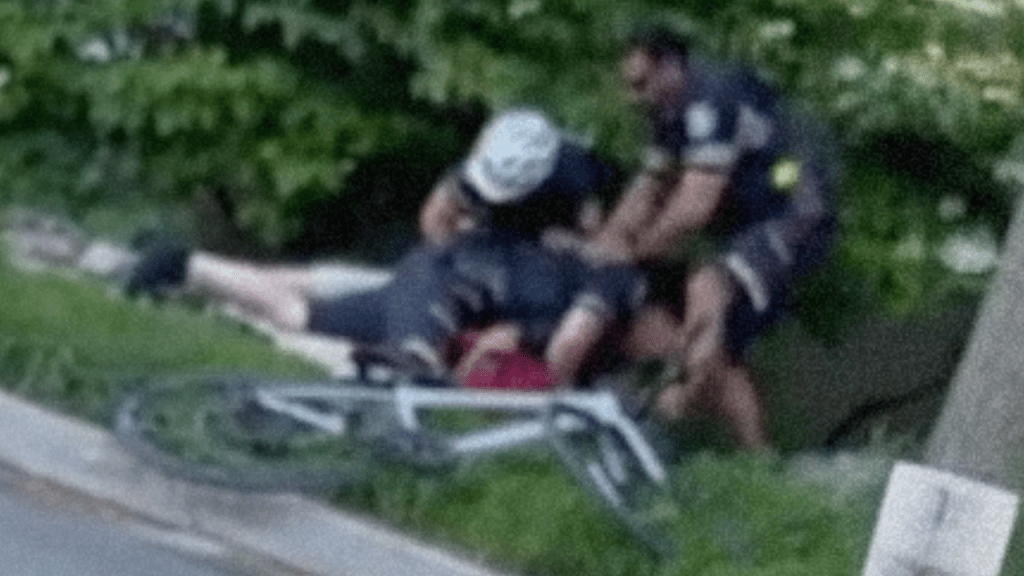
Toronto cyclist takedown shows how stop-sign enforcement became a force question after a rider was concussed by police.
A Toronto cyclist allegedly rolled through a stop sign near Queens Quay West, Little Norway Crescent, and the Martin Goodman Trail. CityNews reported that Toronto police were conducting a stop-sign enforcement blitz along the Martin Goodman Trail, responding to community complaints about cyclists failing to obey the posted sign. The cyclist was arrested and issued three provincial offence notices.
Police framed the operation as traffic enforcement in the name of public safety. The video that spread afterward changed the question. The public was no longer watching a stop-sign ticket — it was watching officers take a cyclist to the ground over a low-level traffic violation. Even if the cyclist rolled the stop sign, that does not answer whether a physical takedown was necessary, proportional, or safe. The target of the blitz was a cyclist accused of a minor traffic offence, not a driver creating a lethal threat.
The force mismatch
The video became explosive because the mismatch is visible. CityNews described officers tackling and arresting a cyclist during the stop-sign enforcement blitz, while Canadian Cycling Magazine reported that the footage raised questions about police use of force after the rider appeared to be knocked from his bike.
Police say more happened before the clip began. They say the cyclist failed to stop, shouted profanities at officers, rode through the intersection at a high rate of speed, refused directions to stop, and attempted to flee. CityNews reported that Chief Myron Demkiw defended the officers’ actions and said the cyclist’s conduct escalated the situation. The police account may describe the lead-up, but it does not settle the issue. The outrage is not about whether stop signs exist — it is about whether several officers turned a minor road-rule issue into a bodily harm event.
According to CityNews, David Shellnutt, the cyclist’s lawyer, said the rider was later diagnosed with a concussion, along with soft-tissue injuries, cuts, bruises, and psychological trauma. Canadian Cycling Magazine reported that the unnamed rider was referred to a head injury clinic and continued to experience concussion symptoms. A stop-sign ticket is supposed to punish noncompliance, not produce a head injury. The state’s claim is effectively that the cyclist’s conduct justified the force; Shellnutt’s argument is that the consequence was wildly out of scale with the alleged offence.
The duty after force
A second issue runs alongside the takedown itself. CityNews reported Shellnutt’s claim that the cyclist was not assessed or treated by officers at the scene despite what he described as an obvious head injury. The cyclist’s family later took him to hospital. Even if police insist the arrest was lawful, that does not answer the duty-of-care question. Once officers use force, they are responsible for its foreseeable consequences, not only the enforcement that triggered it.
A head impact, visible distress, pain, and a forceful takedown create a medical-risk situation. The critique is not only that police allegedly used too much force, but that they appear to have treated the cyclist first as an enforcement object rather than an injured person.
The escalation story
Toronto police and the Toronto Police Association have framed the cyclist as the escalator. CityNews reported that police said the cyclist failed to stop, swore at officers, attempted to flee, and was issued three provincial offence notices. The union defended the officers and argued that the viral video did not show the full context.
Police treat noncompliance as the explanation for escalation. But proportionality does not disappear just because someone disobeys an officer — swearing at police is not, in itself, a violence threat, and rolling a stop sign is not a grievous bodily harm threat. Fleeing a ticket stop may justify pursuit or identification efforts, but not force likely to injure someone. The missing question is simple: what was the actual threat? If the threat was that a cyclist might avoid a ticket, that is weak ground for a high-force intervention. If police claim the cyclist created an immediate danger to others, they need facts showing that danger, not a generic appeal to unseen context.
The legal test
Police in Canada can use force in certain circumstances, but that authority is not unlimited. Criminal Code Section 25 protects officers acting on lawful authority, but the force must be necessary for that purpose. Criminal Code Section 25(3) is especially important because it restricts force intended or likely to cause death or grievous bodily harm unless the officer reasonably believes it is necessary to protect themselves or another person from death or grievous bodily harm. Criminal Code Section 25(4) also limits force against a fleeing person to circumstances where the force is necessary and less violent means are not available.
The Supreme Court of Canada has also recognized that excessive police force can breach Charter-protected physical and psychological integrity. In R. v. Nasogaluak, the Court upheld findings that police used excessive force and breached the accused’s section 7 Charter rights. The debate cannot be reduced to whether the cyclist broke a rule. A person can break a traffic law and still be subjected to excessive force — a cyclist can deserve a ticket without deserving a concussion.
Why cyclists are protesting
The protest planned at Little Norway Park was not just about one cyclist. CityNews reported that cyclists and supporters planned to gather at 6 p.m. on June 4 to protest what organizers described as anti-cyclist violence. Shellnutt said the injured cyclist would not attend because police had doubled down on defending the force and because a large police presence could be triggering.
The injured rider is not being turned into a rally mascot. The protest is about the conditions that made the video legible to cyclists immediately: targeted enforcement, police defensiveness, unsafe infrastructure, driver aggression, and a road culture that treats cyclists as nuisances even when they are the vulnerable party. Queens Quay did not come out of nowhere. It landed inside a longer Toronto fight over how road safety gets defined, who gets disciplined, and whose danger counts as urgent.
High Park showed the pattern
High Park had already exposed the same contradiction. In May 2022, Global News reported on dashcam video appearing to show a driver swerving toward a cyclist in High Park more than once before getting out of the vehicle. Shellnutt described the incident as part of a broader problem of road violence, including cases where people had weaponized cars against cyclists.
When a cyclist rolls a stop sign, the public conversation turns moralistic — cyclists as reckless, entitled, in need of discipline. When a driver uses a car to intimidate or trap someone on a bike, the danger is not theoretical: a car is a heavy machine capable of killing or permanently injuring a vulnerable road user.
By the summer of 2022, High Park had become a symbolic battleground. CityNews reported that cyclists and advocates were angry about Toronto police targeting riders in the park. Shellnutt said it was unfortunate that police were targeting cyclists who were exercising and trying to get through the park safely. The complaint was not that cyclists should be above the law, but that police resources were inverted: low-level cyclist infractions were treated as a visible enforcement priority while the larger structure of road danger remained ordinary, normalized, and under-addressed.
The cruiser collision
In August 2022, CityNews reported that a cyclist said he was struck by a Toronto police SUV in High Park while riding through a four-way stop. The same officer, the cyclist said, had been ticketing cyclists earlier that day. The rider was not hurt, but his bike was damaged. According to CityNews, the cyclist said the officer rolled the stop sign and turned while he was in the middle of the intersection. He called it ironic that the most damage done in High Park came from the officer who was supposedly there to improve safety.
Shellnutt later put the incident in a broader sequence. In a letter to the Toronto Police Services Board, he listed the police SUV collision alongside other High Park incidents, including a racialized cyclist allegedly harassed by a plainclothes officer and a cyclist allegedly hit off her bike by a person reported to be an off-duty officer. The institution enforcing cyclist compliance had allegedly failed to comply with the same basic road-safety duty itself. The official purpose was safety; the visible harm came from enforcement.
The same logic now appears at Queens Quay. Police claim to be improving safety, but the harm people can see is a cyclist on the ground, allegedly concussed, after a stop-sign blitz.
The data problem
Toronto’s own Vision Zero plan says road safety should focus on reducing traffic deaths and serious injuries. The City of Toronto says the plan prioritizes vulnerable road users through targeted and data-driven initiatives, including pedestrians, school children, older adults, and cyclists. That framework should push enforcement toward the behaviours and conditions most likely to kill or seriously injure people. High Park and Queens Quay suggest a different reality: police respond to complaints about cyclist annoyance or rule-breaking while the more lethal structure of road violence remains background.
The data picture is also weaker than the city often admits. A 2024 study led by York University, ICES, and Toronto Metropolitan University found more than 30,000 emergency department visits for cyclist injuries in Toronto from 2016 to 2021. York University reported that Toronto Police data captured only 2,362 minor, major, and fatal cyclist injuries, representing about eight per cent of cyclist injury emergency visits. Police data does not fully show where harm is happening. If enforcement is driven by complaints and incomplete collision records, the city can mistake irritation for danger and miss the actual injury landscape.
The stop-sign problem
The stop-sign issue is more complicated than the police version allows. Cyclists should not blast through intersections without regard for pedestrians or other road users, but bicycles are not cars — they move differently, accelerate differently, occupy less space, and create a different risk profile than motor vehicles. Cycling advocates have long supported versions of the “Idaho Stop,” or stop-as-yield model, where cyclists may treat stop signs as yield signs when safe. Cycle Toronto says it supports rolling stops as a safe and effective way for people on bikes to approach stop-controlled intersections, requiring cyclists to slow down, stop when necessary, and yield to pedestrians and approaching vehicles.
Toronto cycling advocates have pushed this position for years. In 2015, Global News reported that advocates were calling for legal recognition of the Idaho Stop, arguing that cyclists should be allowed to roll through stop signs in residential areas when safe. Cyclists are not asking to be lawless; they are pointing out that car-based traffic rules do not always map cleanly onto cycling movement. At a place like Queens Quay, where a trail meets urban street design, the legal command may be simple, but the actual movement pattern is not.
The Queens Quay takedown shows what happens when the law treats a cyclist like a car for compliance and police then treat the cyclist like a fleeing suspect for force. A person on a bike is vulnerable enough to be told to ride defensively, yet threatening enough to be tackled by multiple officers over a traffic infraction.
Institutional car-brain
Shellnutt appears across these stories as more than a lawyer. He is the continuity figure in a years-long fight over cyclist safety, police priorities, and the meaning of road violence in Toronto — critic of High Park ticketing blitzes, voice after the police SUV collision, challenger of enforcement priorities, and now representative of the Queens Quay cyclist.
Cyclists are vulnerable, so they are told to be hyper-compliant. When drivers intimidate them, police SUVs hit them, bike lanes are blocked, or officers tackle them, institutional language turns defensive and procedural. There is always a phrase ready to absorb the harm: full context, community complaints, lawful enforcement, consistent with training. The result is a double standard — cyclists treated as dangerous when they inconvenience others, but responsible for their own vulnerability when others endanger them.
Toronto’s enforcement culture treats cyclists as disorderly intruders rather than legitimate road users. A driver weaponizing a car, a police SUV striking a cyclist, and officers tackling someone over a stop sign are not identical incidents, but they orbit the same politics: the person on the bike is treated as the problem, even when the greater physical danger comes from cars, police vehicles, infrastructure failure, and punitive enforcement. A road-safety regime built around injury risk would target the behaviours most likely to kill or seriously injure people, and treat cyclists as vulnerable road users rather than an unruly population to be managed. Toronto’s enforcement culture does the opposite.
On the evening of June 4, cyclists gathered at Little Norway Park to protest. The cyclist whose video had sparked the rally did not attend — Shellnutt said a large police presence could be triggering for someone still under concussion symptoms. The stop-sign blitz that produced him as a defendant produced him as a patient in the same afternoon, and the head injury clinic referral is now part of the same case file as the three provincial offence notices.



 Spark Solidarity