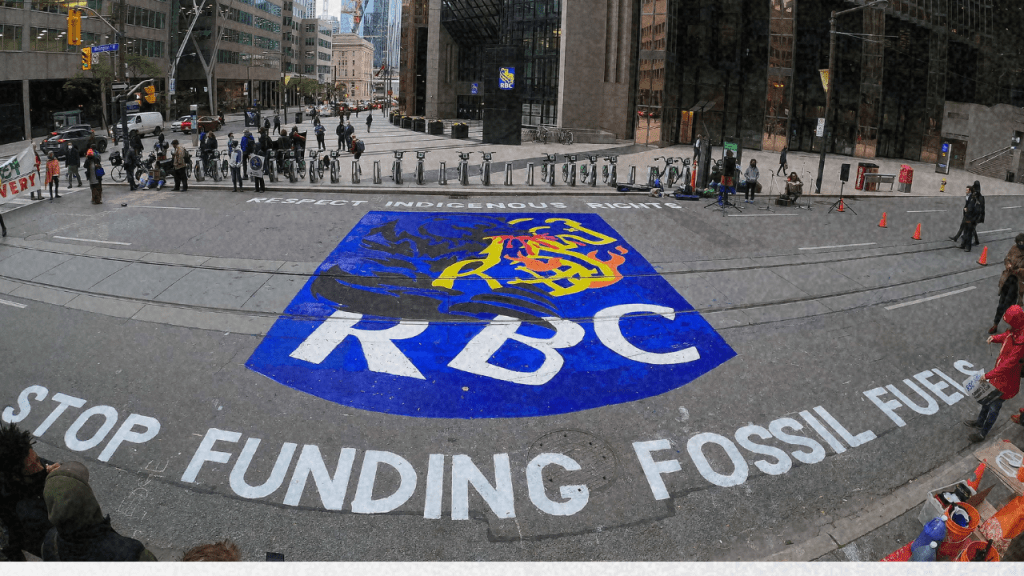
RBC helped finance Coastal GasLink. The limits of bank protest begin where finance is protected by courts, police, governments, and completed infrastructure.
Wet’suwet’en hereditary chiefs did not target RBC by accident. In February 2022, they met with the bank and demanded that it end its financing of Coastal GasLink. Two months later, they travelled to Toronto to confront RBC at its annual general meeting. The campaign followed the money because the pipeline could not become infrastructure without institutions willing to finance it through political controversy, Indigenous opposition, police raids, cost overruns and climate criticism.
That made RBC part of the project, not an outside sponsor with a loose connection to it. Banks decide which risks remain financeable. They decide whether a company can refinance, whether lenders remain willing to participate and whether controversy is treated as a warning or merely another cost to be priced into the deal.
But the fight over RBC also exposed a structural limit. Finance did not make Coastal GasLink durable by itself. Courts made injunction enforcement available. Police cleared access. Governments approved and defended the project. Companies continued construction until the pipeline became an operating asset. The bank’s capital worked inside a political system that protected the investment from being stopped by the people resisting it.
The limits of bank protest therefore do not begin with protest. They begin with the power surrounding the bank. RBC could absorb reputational damage because the project underneath the controversy remained legally authorized, physically protected and increasingly difficult to reverse.
RBC Was Part of the Project
Bank financing can look abstract beside a pipeline corridor, an injunction or an RCMP raid. It is not. Large infrastructure requires capital long before it produces revenue. Companies depend on lenders, underwriting, refinancing and relationships with financial institutions willing to remain involved when projects become politically contested.
Amnesty Canada’s 2022 account of the Wet’suwet’en campaign against RBC placed the bank inside that material chain. Hereditary chiefs met directly with RBC and later tried to confront CEO David McKay at the bank’s annual meeting. They were not asking a neutral institution to take a moral position on someone else’s project. They were challenging an institution whose financing helped make the project possible.
RBC’s broader fossil-fuel record made the target larger than one pipeline. Amnesty reported that the bank had provided hundreds of billions of dollars in financing to coal, oil sands, oil and gas companies since the Paris climate agreement. By 2026, Banking on Climate Chaos again placed major Canadian banks, including RBC, among the world’s most significant fossil-fuel financiers.
The political importance of that record is not only the volume of money. It shows that controversy has already been incorporated into the financial model. Climate opposition, Indigenous rights campaigns and public criticism do not automatically make a project unfinanceable. Banks can treat those pressures as risks to be managed while continuing to fund the sector that produces them.
The Bank Could Absorb the Protest
RBC was vulnerable to public pressure precisely because it was visible. A bank has branches, a logo, executives, shareholders and an annual meeting. Its climate language can be compared with its lending. Its leadership can be confronted. Its reputation can be made part of the political cost of a project that otherwise exists hundreds or thousands of kilometres from most of the people financing it.
That visibility gives bank protest real power. It can connect a distant pipeline to everyday institutions. It can force financial decisions into public debate. It can show that dispossession is not financed by anonymous markets but by identifiable companies and banks with names, offices and customers.
The problem is that reputational damage and material disruption are not the same thing. A bank can survive being condemned if the underlying relationships remain profitable and secure. It can absorb a protest, a difficult annual meeting or a round of bad press while continuing to lend if those events do not materially change the costs and risks of participation.
RBC therefore did not have to defeat the movement politically. It only had to remain capable of doing business through the controversy. The project’s wider institutional protection made that easier.
Finance and the State Were Not Separate Systems
The easiest way to misread Coastal GasLink is to divide the project into separate moral problems. The bank financed it. The company built it. The court issued an injunction. The police enforced the order. The government regulated the project. Each institution can then describe its own role as narrow and procedural.
Materially, those roles reinforced one another. Finance made construction possible. Regulatory approval made the investment legally viable. Injunctions protected access when opposition threatened the work. Police enforcement reduced the risk that resistance could physically stop the project. Continued construction increased the cost of reversal and made the investment more secure.
The bank was not financing Coastal GasLink despite the state’s coercive capacity. The availability of courts, injunctions and police enforcement was part of the environment in which the project could remain financeable. Investors could see that opposition was serious and still expect Canadian institutions to keep the route open.
This is why the rebuilt Coastal GasLink history centres jurisdiction and enforcement. Canada did not resolve Wet’suwet’en hereditary opposition before allowing the project to proceed. It moved the conflict into injunctions, policing and delayed accountability while construction continued. Finance benefited from that political arrangement.
State and capital did not need a formal conspiracy. Their interests converged through institutions doing exactly what they were built to do. The bank protected capital. The court protected legal access. Police protected the injunction. Governments protected the project’s political continuity.
Reputational Pressure Has a Material Threshold
Public shame can matter to a bank. Reputation affects customer relationships, institutional partnerships, recruitment, investor confidence and the credibility of corporate climate commitments. A campaign that forces a bank to repeatedly defend the same financing can make the business relationship more costly.
But financial institutions are built to translate controversy into risk calculations. If public anger does not threaten significant accounts, regulatory treatment, shareholder power, access to capital or the economics of the transaction, the bank may decide that absorbing the reputational cost is cheaper than leaving the project.
This is not an argument against branch actions, AGM confrontations or divestment campaigns. It explains the conditions under which those tactics become materially consequential. Pressure becomes harder to absorb when it travels across institutions that control money, contracts and legitimacy.
A city moving its banking relationship, a pension fund changing its mandate, a large institution withdrawing accounts, shareholders organizing around binding governance questions or regulators changing the cost of fossil exposure all reach a different layer of the bank than public embarrassment alone. The point is not that one tactic is real and another is symbolic. It is that capital responds most directly when political pressure changes material conditions.
The State Reduced the Bank’s Risk
Coastal GasLink shows why finance campaigns cannot be understood apart from state power. The bank’s exposure was not only to the possibility that a pipeline company might fail commercially. It was also exposed to the possibility that opposition could stop construction. Canadian institutions worked to reduce that risk.
When hereditary chiefs rejected the project’s authority over the yintah, the conflict did not become a binding obstacle to construction. When land defenders blocked access, courts issued enforceable orders. When those orders were resisted, police intervened. When police conduct generated complaints, oversight processes moved more slowly than the project itself.
That sequence protected more than the company’s construction schedule. It protected the financial assumptions behind the project. Capital becomes safer when governments and courts demonstrate that permitted infrastructure will remain buildable even through sustained political resistance.
RBC’s role therefore cannot be reduced to private greed separated from public authority. The profitability and durability of extraction are produced through both. The state creates conditions in which capital can remain invested, and the capital helps turn state-backed projects into economic facts that governments then cite as reasons they cannot be reversed.
The Pipeline Became Harder to Financially Dislodge
The terrain also changed as Coastal GasLink moved from construction into operation. Before completion, financing pressure could theoretically threaten whether the project would be built. After mechanical completion and commercial in-service, the asset entered a different financial category.
The pipeline now feeds an operating LNG export terminal. Contracts, tolls and physical infrastructure connect it to a wider system. By 2026, the companies involved were already discussing additional capacity tied to LNG Canada Phase 2.
That does not make pressure on financiers irrelevant. It changes what the pressure is confronting. The target is no longer only a proposed project seeking capital. It is an operating asset supported by sunk investment and a state policy that increasingly treats expansion as national economic strategy.
The state’s success in making Coastal GasLink materially difficult to reverse also protected the institutions that financed it. By July 2, 2026, Ottawa and British Columbia were no longer merely defending the existing system. The federal Major Projects Office said their new Cooperative Prosperity Agreement would accelerate the permitting, financing and construction of major energy and trade corridors including LNG Canada Phase 2, whose expansion path includes additional Coastal GasLink capacity. Once the pipeline became infrastructure, the official argument shifted from whether it should exist to how quickly governments could finance and expand what had already been built.
Bank Protest Reveals the Ownership Structure
The strongest case for targeting RBC is not that the bank was easier to protest than the state. It is that financial pressure makes ownership and dependency visible. A pipeline can be described as public infrastructure, national interest or economic development until the institutions financing it are named.
Following the money exposes relationships that official project language tries to separate. It shows which banks remained willing to finance fossil expansion. It shows how climate commitments coexist with lending decisions. It gives movements a way to connect local land defence to national and international capital.
The limitation appears only when the bank becomes the entire story. If anger stops at RBC, governments can present themselves as neutral referees between protesters and private business. Courts can disappear into procedure. Police can disappear into enforcement. The project can be reduced to a bad corporate choice instead of a political system that made extraction enforceable.
The bank should therefore be named as part of the structure, not used as a substitute for it. RBC mattered because capital mattered. The state mattered because it protected the conditions under which that capital could become infrastructure.
The Bank Should Not Become the State’s Alibi
RBC deserved to be targeted over Coastal GasLink because it helped finance a project built through unresolved Wet’suwet’en opposition. The existence of courts, police and government support does not reduce the bank’s responsibility. It explains why the bank could continue carrying that responsibility without being forced out of the project.
The deeper danger is allowing private finance to absorb all the political blame while public institutions present themselves as background. Canada did not merely permit a commercial dispute to unfold. Its legal system made access enforceable. Its police protected that access. Its governments treated the resulting infrastructure as energy policy.
Coastal GasLink survived because those forms of power reinforced each other. Capital financed the project. The state reduced the risks that resistance posed to capital. The completed project then became another reason for both to keep going.
Bank protest is most revealing when it makes that relationship harder to hide. The point is not to choose between confronting RBC and confronting the state. It is to show that the investment was never only private and the enforcement was never economically neutral.
The bank put money behind Coastal GasLink. Canada made sure that money could become a pipeline.
Sources
- LNG Canada Phase 2, Government of Canada Major Projects Office, updated July 2, 2026.
- RBC’s financing of the Coastal GasLink Pipeline, Amnesty Canada.
- Banking on Climate Chaos 2026, Stand.earth, June 9, 2026.
- Coastal GasLink Phase 2 advances step forward with new commercial agreements, TC Energy, March 2026.
- Coastal GasLink announces commercial in-service, Coastal GasLink, November 19, 2024.
- Coastal GasLink achieves mechanical completion ahead of 2023 year-end target, TC Energy, November 8, 2023.
- Canada ships first LNG export cargo from Pacific coast, Reuters, July 1, 2025.
- Removed from our land for defending it, Amnesty International, 2023.