Ford Fest turned politics into fandom, until striking workers entered the spectacle. The Ford dynasty shows how loyalty can carry class power.
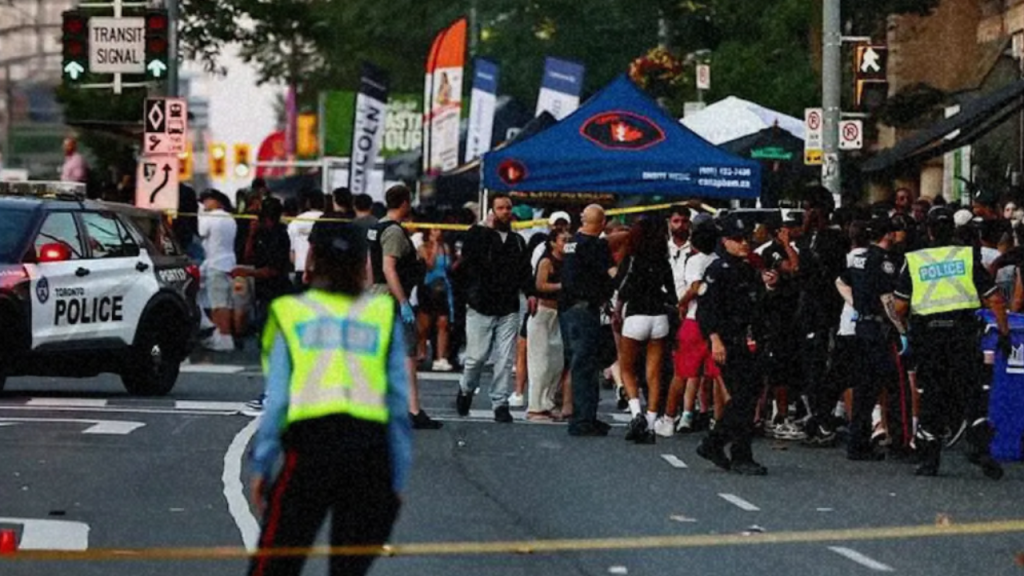
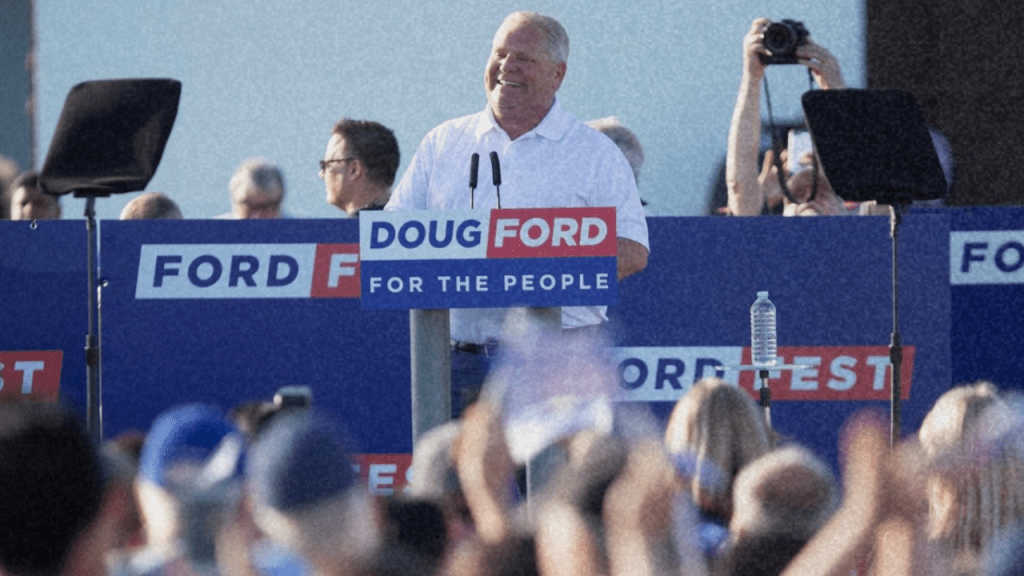
Ford Fest was built to look like politics without conflict. The Ford family barbecue offered free food, music, blue shirts, smiling photographs, and the performance of direct access to a premier who presents himself as closer to ordinary people than the institutions around him. On June 19, that script broke down. Hundreds of protesters entered the event in Scarborough, including roughly 850 striking OPSEU/SEFPO members wearing purple shirts, and repeatedly drowned out Doug Ford’s speech with chants.
The disruption mattered because it put class conflict inside a spectacle designed to absorb it. Ford Fest asks supporters to experience politics as belonging: come to the barbecue, wear the colour, cheer the leader, become part of the crowd. The striking workers arrived with a different relationship to the government. They were not there to consume the event. They were there because provincial policy, wages, and public-service funding had material consequences for their lives.
Days later, the struggle moved from the park to the image itself. Progressive Conservative MPPs posted an aerial photograph in which many of the protesters’ purple shirts appeared blue, visually blending them into the Ford-supporting crowd. The Premier’s Office said the photograph had undergone routine colour correction to remove an orange hue and denied any other manipulation. On June 25, AFP’s examination of the image concluded that it looked edited in a way that made the purple shirts resemble the blue worn by Ford supporters.
The image controversy captured the deeper politics of Ford Fest almost too neatly. A branded political crowd had been interrupted by workers whose presence contradicted the story the event was supposed to tell. Then, in one widely circulated image, the visual distinction between protesters and supporters became harder to see.
This is not just a story about one photograph. It is a story about a political form the Ford family has spent years building. Rob Ford turned scandal, grievance, media hostility, and suburban resentment into a form of loyalty that behaved increasingly like fandom. Doug Ford inherited that audience and attached it to the machinery of the provincial state. Rob made the spectacle emotionally durable. Doug made it governable.
Ford Fest Makes Politics Feel Personal
Ford Fest is more than a party barbecue. It is a recurring performance of political intimacy. The leader is not presented primarily as the head of a government that makes decisions over land, labour, health care, education, transit, housing, and public spending. He appears as a host. Supporters become guests. Politics is reorganized around a social relationship that feels personal even when the power being exercised is institutional.
That is why the June 19 protest disrupted more than a speech. Striking workers brought the government’s material conflicts into a space designed to temporarily suspend them. According to Global News reporting on the event, the purple-shirted protesters moved into the area around the stage and overwhelmed the planned spectacle with chants. The event could no longer present everyone in the park as part of the same political family.
Ford’s response followed the logic of the brand. He described protesters as having disrupted a family event, accused them of intimidating and insulting guests, and then turned on reporters who asked whether the scene reflected broader dissatisfaction with his government. “All you’ve done is attack me,” he told the media days later.
The structure is familiar. Criticism of policy becomes hostility toward the leader. Hostility toward the leader becomes hostility toward his supporters. The political conflict is translated into a social one in which the central question is no longer what the government has done, but whether the leader and the people around him are being treated fairly.
Rob Ford Built the Emotional Brand
Rob Ford’s years at Toronto City Hall often felt less like municipal politics than serialized television. The crack video scandal, the denials, shouted press scrums, council confrontations, allegations of public intoxication, legal controversies, and international ridicule arrived one after another until the mayor himself became an entertainment product.
The conventional assumption was that exposure would eventually destroy him. Every scandal was treated as the event that would finally make his supporters abandon him. Instead, the spectacle often strengthened the identity forming around him. Supporters did not need to believe every denial or approve of every incident. They only needed to believe that Ford remained their guy and that the people attacking him belonged to a political class that already looked down on them.
That was the deeper political innovation of Ford Nation. Rob Ford did not merely survive scandal. He helped convert politics into something closer to fandom, where loyalty can become strongest precisely when the team is under attack. The politician becomes a jersey. Criticism from outsiders becomes proof of persecution. Humiliation becomes a shared experience that strengthens the boundary between supporters and everyone else.
The spectacle mattered because there was a political project underneath it. Ford’s chaotic public persona fused suburban grievance, anti-tax rhetoric, hostility toward public workers, car politics, and resentment of downtown institutions into a durable conservative identity. The media focused on his personal disorder because personal disorder was spectacular. The politics underneath it was much more consistent.
Sports Fandom Supplied the Grammar
The sports connection is not a decorative analogy. It helps explain how a politician can become more politically durable as evidence against him accumulates.
Sports fandom trains people in a particular kind of loyalty. Supporters defend teams that lose. They defend players who embarrass them. They interpret attacks from rival fans as attacks on the group itself. A bad season does not necessarily weaken identification. Sometimes suffering becomes part of the identity.
The crucial question is no longer whether the team deserves support. The question is whether it is your team.
Ford Nation increasingly worked through the same emotional grammar. Rob Ford became something closer to a hometown franchise than an ordinary elected official. Every scandal could be experienced as another hostile away crowd. Every mocking television segment could reinforce the feeling that powerful outsiders were humiliating both Ford and the people associated with him.
This does not mean sports fandom causes reactionary politics. It means political movements can borrow habits of loyalty that people already understand elsewhere. The home team, the hostile commentator, the hated rival, the humiliation that deepens commitment, and the certainty that criticism from outsiders is never neutral all provide a ready-made grammar for political identification.
Toronto provided fertile ground for this conversion. The city’s political geography had already been shaped by amalgamation, unequal transit access, suburban car dependence, and longstanding resentment toward a downtown political culture that often imagined itself as representative of the entire city. Ford organized those real tensions into a simple political rivalry.
One side supposedly represented taxpayers, drivers, homeowners, and ordinary working people. The other represented bureaucrats, public-sector unions, cyclists, downtown professionals, and cultural elites. The categories were politically constructed, but the grievances underneath them were real. The political achievement was redirecting those grievances toward enemies that did not threaten concentrated private power.
The Spectacle Had a Class Politics
Rob Ford’s politics becomes almost meaningless if it is reduced to personality. The phrase “stop the gravy train” offered a class explanation of the city, but one turned upside down. Public institutions became the privileged class. Municipal workers became the beneficiaries of waste. Councillors became parasites. Taxes became evidence that ordinary people were financing a system designed for somebody else.
Ford’s politics did not invent suburban alienation. It identified where that alienation already existed and gave it enemies that did not challenge landlords, developers, banks, employers, or the larger economic structures making life more expensive. Resentment was directed toward public spending, public workers, bike lanes, municipal government, and the visible symbols of downtown liberalism.
His administration’s record showed the class content beneath the entertainment. Ford pushed contracting-out, attacked municipal labour costs, supported making transit workers an essential service, fought surface transit in favour of subway symbolism, and treated the private car as the authentic citizen of the amalgamated city. The spectacle did not replace policy. It sold policy through grievance.
The same inversion was visible at Ford Fest in June 2026. Workers striking over wages and public-service funding entered the political event as a material conflict with the government. Ford described their intervention primarily through the experience of his guests. The problem became disruption, vulgarity, and intimidation inside a family barbecue. The policies behind the strike moved into the background while the behaviour of the protesters became the story.
Spectacle politics does not make class conflict disappear. It changes which part of the conflict becomes visible.
Scandal Became Proof of Authenticity
Rob Ford also helped demonstrate how scandal changes once supporters stop evaluating a politician primarily through respectability.
The traditional scandal model assumes that exposure reveals hypocrisy or incompetence and therefore weakens political authority. Spectacle populism can reverse that relationship. The politician’s refusal or inability to behave according to elite expectations becomes part of the claim to authenticity.
Ford did not sound like a political consultant. He did not perform the smoothness expected from professional politicians. He appeared angry, impulsive, excessive, combative, wounded, and frequently out of control. For critics, those qualities demonstrated that he should not hold office. For supporters, they could demonstrate that he had not been absorbed by the people who supposedly ran the city.
The important transformation occurs when a political base stops asking whether the leader is respectable and begins asking whether the leader belongs to them. Once that happens, scandal can become another opportunity to demonstrate loyalty.
This is also why relentless media exposure can fail as a political strategy. Opponents repeatedly assumed that if people simply saw more of Ford, they would eventually reject him. But the spectacle had already changed the meaning of exposure. Seeing Ford attacked over and over could reinforce the belief that he was fighting an establishment determined to destroy him.
The question was no longer only what Ford had done. The question was which side you were on.
Trump Scaled the Same Political Form
Donald Trump’s rise did not originate in Toronto. The United States had its own machinery capable of producing him: reality television, cable news, billionaire celebrity culture, racial backlash, right-wing talk radio, social media, and a Republican Party increasingly organized around resentment.
But Rob Ford’s mayoralty offered an earlier demonstration of the scandal-proof political form that Trump later scaled nationally. Both men turned hostility from the media into evidence that the media feared them. Both benefited from opponents who assumed exposure would automatically produce political collapse. Both performed anti-elite authenticity while advancing conservative projects that did little to weaken economic elites.
The media systems were different, but the relationship was similar. Trump’s rallies could be carried live by cable networks. His insults could circulate instantly through social media. Every scandal became another distribution event. The attention economy did not merely report on Trump. It became part of the infrastructure through which his political identity was reproduced.
Ford had already demonstrated the smaller-scale version. Political authority could be built through conflict with the institutions traditionally responsible for defining who was respectable enough to govern. The politician did not need favourable coverage. He needed constant centrality.
The spectacle did not have to defeat the media. It only had to make the media incapable of looking away.
Doug Ford Made the Brand Governable
The most important part of the Ford story came after Rob. If Ford Nation had been nothing more than a personality cult around one chaotic mayor, it should have disappeared with him. Instead, Doug Ford inherited a political constituency, a vocabulary of grievance, and an established relationship between the Ford name and suburban conservative identity.
Doug’s political style is more controlled because it has to accomplish something different. Rob Ford’s spectacle was improvisational. Doug Ford’s spectacle is institutional.
The language remains familiar. Ordinary people are still positioned against elites, bureaucrats, and supposed ideological intrusions into everyday life. But the politics now moves through provincial legislation, budgets, land-use decisions, infrastructure planning, procurement, health care, education, and the administrative machinery of the Ontario government.
The Greenbelt scandal demonstrated the transformation. What appeared during Rob Ford’s era as personal disorder had become a form of state power capable of reorganizing land with enormous financial consequences. The political theatre remained populist, but the material beneficiaries existed far beyond the supposedly ordinary people invoked by the rhetoric.
The fight over bike lanes showed the continuity. A strip of road could become a symbol of elite domination. The driver became the authentic citizen. Municipal transportation planning became an ideological attack. The province could intervene directly in local street design while presenting the intervention as liberation from government overreach.
Ford Fest is the cultural expression of the same governing style. The leader performs proximity while the state acts at a scale no barbecue guest can match. Personal familiarity softens institutional distance. The premier appears as the guy serving burgers even while the government makes decisions over wages, hospitals, highways, land, and municipal authority.
That is institutionalized spectacle. The brand no longer depends on one man’s chaos. It becomes a governing technology.
The Image Tried to Restore the Spectacle
The controversy over the Ford Fest photograph matters because political spectacle depends on controlling what kind of crowd the public sees.
The live event contained a contradiction. Ford supporters were present in blue. Striking workers were present in purple. Protesters drowned out parts of the premier’s speech. The political community assembled in the park was visibly divided.
The aerial image circulated afterward appeared to reduce that distinction. AFP found that the purple shirts looked blue in the image shared by two Progressive Conservative MPPs, while other photographs and video showed the same protesters wearing purple. The Premier’s Office denied deliberate manipulation and attributed the change to standard colour correction.
Intent is not necessary to understand the political effect. The resulting image produced a cleaner spectacle than the event itself. A crowd fractured by labour conflict could be seen as a more unified sea of Ford blue.
That visual transformation mirrors the broader political project. Fordism works by absorbing material contradictions into a common identity organized around the leader. Workers, taxpayers, drivers, homeowners, and suburban residents are invited into the same political family even when government policy places their interests in conflict.
The spectacle does not resolve those contradictions. It changes how they are seen.
Spectacle Makes Material Power Disappear
Most discussions of spectacle politics stop too early. They describe politicians becoming celebrities, politics becoming entertainment, and citizens becoming audiences. The deeper question is what the spectacle allows political power to do while everyone is watching the spectacle.
Fordism redirects attention from ownership and class power toward cultural antagonism. Housing, transit, public services, wages, land, and labour remain material political questions, but they are filtered through identities such as taxpayer, driver, downtown elite, union activist, and ordinary person.
The categories give people enemies they can recognize without requiring them to confront the institutions actually governing their economic lives.
Rob Ford’s celebrity did not make austerity disappear. It helped make austerity feel like common sense. Trump’s endless outrage did not eliminate class politics. It reorganized class resentment around a billionaire-led project. Doug Ford’s folksiness does not make the provincial state less powerful. It gives state power the voice of somebody claiming to stand beside you while decisions are made over your head.
The same political form can mutate. Spark has already examined Brad Bradford’s polished adaptation of Fordism. The aesthetic does not always require Rob Ford’s chaos. The performance can be professionalized, managerial, or technocratic while retaining the same structure of grievance, media conflict, and personal identification.
The important inheritance is not the personality. It is the relationship between spectacle and power.
Fandom Makes Power Feel Personal
Sports fandom can create real community, memory, and collective identity across generations. But those same habits become politically dangerous when transferred into relationships with people who exercise state power.
A sports team cannot cut health-care funding, restructure labour law, open protected land to development, override municipal planning, or cap public-sector wages. A government can.
The emotional grammar of fandom obscures that difference. Once a political leader becomes a team identity, defending the leader can feel like defending yourself. Evidence of corruption becomes an attack from a rival. Criticism of policy becomes disrespect toward the community. Political accountability begins to resemble betrayal.
That was the deeper achievement of Ford Nation. Rob Ford converted politics into loyalty under siege. His supporters were invited to experience criticism of the leader as criticism of themselves. Doug Ford inherited that emotional infrastructure and attached it to something much more powerful than one mayor’s office.
He attached it to the provincial state.
The June 2026 Ford Fest confrontation showed what happens when the material conflict breaks back into the spectacle. Striking workers entered the branded family event and refused to play the role of a unified audience. For a moment, the political image fractured. The people in the crowd were no longer simply Ford Nation. Some of them were workers confronting the government that governed them.
Rob Ford made politics feel like fandom. Doug Ford showed what happens once the team takes power.
Sources
- Canadian politicians share edited image of Ontario festival, AFP Fact Check, June 25, 2026.
- ‘All you’ve done is attack me’: Ford clashes with media over poll numbers, Ford Fest protests, CityNews, updated June 25, 2026.
- Ford Fest photos colour corrected to remove ‘orange hue’: Premier’s Office, Global News, June 23, 2026.
- Annual Ford Fest met with protesters, CityNews, June 19, 2026.
- Doug Ford approval falls to ‘worst’ level since taking office, poll finds, Global News, June 11, 2026.
- Progressive Conservatives set Ford Fest for Scarborough ahead of key byelection, Global News, May 5, 2026.
- The Calculated Populism of Rob Ford, The New Yorker, November 2013.
- Toronto’s Rob Ford Problem, The New Yorker, May 2013.
- Bill 124, Protecting a Sustainable Public Sector for Future Generations Act, Legislative Assembly of Ontario.
- Special Report on Changes to the Greenbelt, Auditor General of Ontario, August 2023.