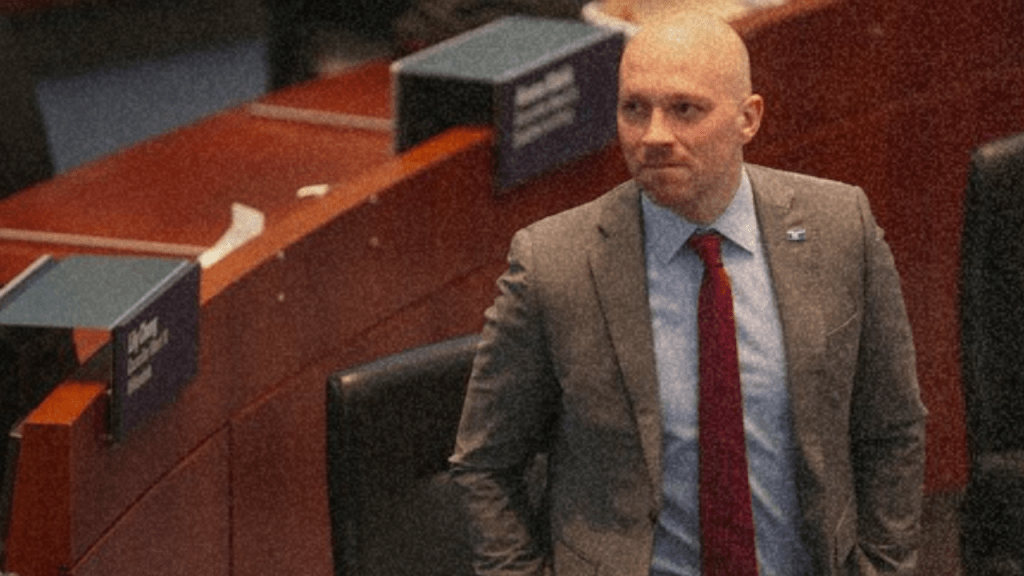
Brad Bradford is running for mayor of Toronto on a campaign against the city he has helped run for eight years — and his record shows what he means.
Brad Bradford has been a Toronto city councillor since 2018, representing Beaches–East York in the east end. He trained as an urban planner, holds a master’s degree in planning from the University of Waterloo, and chaired the city’s planning and housing committee under former mayor John Tory. He ran for mayor in 2023, finished eighth in a field of more than a hundred candidates, and watched Olivia Chow — a former NDP member of parliament — win the job.
On May 1 of this year, Bradford registered to run again, this time in a rematch with Chow. The election is October 26. His pitch is that Toronto is in a state of “managed decline,” that City Hall has stopped working, and that he is the candidate who would make it work again. He gives the current mayor a grade of C-minus. He has endorsed the strong-mayor powers granted by Doug Ford, the Ontario premier, that let big-city mayors push through major decisions without majority council support.
None of this looks unusual for a Canadian municipal politician with national ambitions. The detail worth noticing is the angle. Bradford talks like a man who has been kept out of City Hall and is finally going to fix it — a man whose best friend Paul rents his basement, who knows how regular people live. He has been in City Hall the entire time, chairing its housing committee and writing the bylaws that govern who is allowed to be in a Toronto park. His campaign is built on an idea about himself that the record does not support.
This does not make Olivia Chow the answer. Chow’s career runs through the same institutional ecosystem — school trustee in 1985, city councillor for thirteen years, federal NDP MP, widow of NDP leader Jack Layton. Her budgets have raised property taxes to record levels, met every Toronto Police Service funding demand after public lobbying, and presided over the encampment clearances now accelerated under the Bradford motion. Her housing plan is more humane in language and slower in its developer-friendly substance. She is the gentler version of the same arrangement, which is what a contested election inside this class looks like.
The class that hates being called a class
There is a name for the kind of politician Bradford is, and it explains the gap between his pitch and his record. In 1977 two American writers, Barbara and John Ehrenreich, coined the term “professional managerial class” to describe a layer of society that sits between the working class and the rich — the credentialed professionals, the lawyers and planners and journalists and managers and university administrators, whose income comes from training rather than from owning capital but whose interests usually end up aligned with those at the top.
The American critic Catherine Liu, in a 2021 book called Virtue Hoarders, argues that this professional class has come to dominate progressive politics in North America while leaving the material conditions of the people it claims to speak for fundamentally untouched. Its preferred language — process, expertise, dignity, civility — sounds reasonable because it usually is reasonable, but it also describes a politics that does not, in practice, redistribute much of anything. Bradford is a member of this class. So is Chow. The fight between them is an argument inside the class about how the class should govern.
What the Fords proved
To understand the second part of Bradford’s pitch — the populist register, the “regular Torontonians have been forgotten” line — you have to understand what happened in Toronto a decade ago. Rob Ford was mayor from 2010 to 2014. He was caught on video smoking crack cocaine. He stayed in office through the scandal, and when he registered for re-election in 2014 he was polling third — until cancer forced him to withdraw mid-campaign. He ran for his old council seat instead and won in a landslide. He died of liposarcoma in 2016 at 46.
What mattered politically was the constituency: a coalition of suburban voters so alienated from Toronto’s professional class that a sitting mayor caught smoking crack on video could not be made to lose them. The scandal did not move him out of contention. A tumour did.
His older brother Doug went on to become premier of Ontario, the office he still holds. Doug’s signature scandal came in 2023, when his government quietly opened parts of the Greenbelt — protected land around Toronto reserved from development — to specific developers who turned out to have ties to his inner circle. Two watchdogs found the process had improperly favoured those developers. The decision was reversed. The premier kept his job, kept the seat, and kept the constituency his brother built.v
What the Fords proved is that there was a Toronto-area electorate the city’s professional class had stopped speaking to, and that this electorate would not punish a politician who insulted that class openly, even when caught doing things that should have ended a career. Local socialist activist Mark Freeland has a word for what comes next: slopulism — populism rendered as slop, a mass-produced imitation of a politics of the people, manufactured for the audience the professional class walked away from. Doug Ford was the first version: the brother running the same play without the brother’s chaos.
Bradford is the next version. He talks like the Fords talk — about waste, about decline, about a City Hall that has forgotten ordinary people. He does not talk like the Fords look. He is a planner. He has the degrees. He is, in the press conference sense, a credible mayor. The Toronto right has spent a decade trying to engineer this combination, and Bradford is what they have so far: the slopulism the credential class produces when it has finished imitating the buffoon and started replacing him.
The motion that says what the campaign means
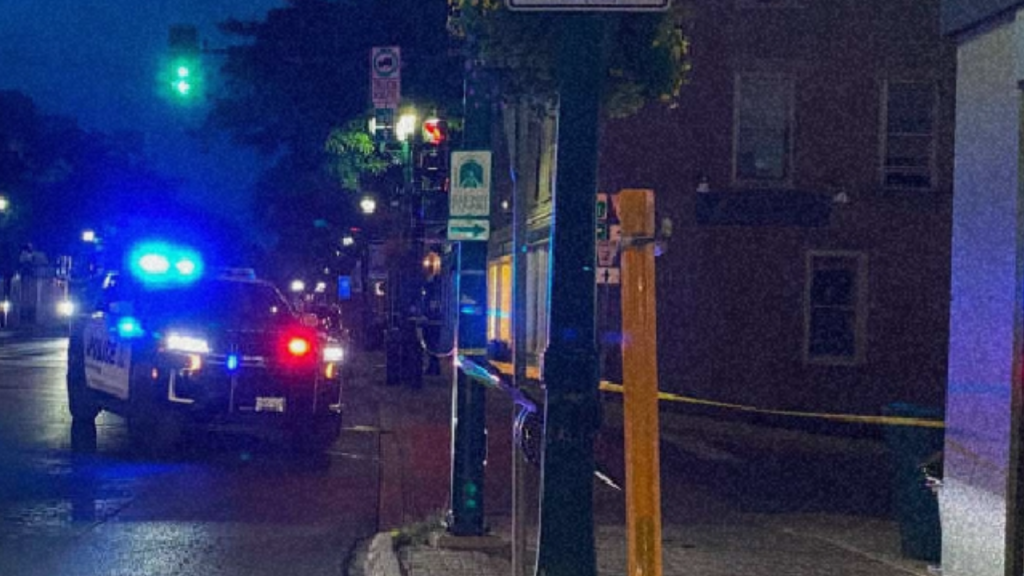
The clearest evidence of what a Bradford mayoralty would do is a motion he introduced last November. Toronto has thousands of people sleeping in public space because the city’s shelters are full and its rents are unaffordable. On November 13, 2025, Bradford put forward a motion — later amended by councillor Paula Fletcher — requiring the city to clear any encampment within 24 hours of being reported, if it sits within fifty metres of a school, playground, or daycare. A person living there must be offered shelter three times. If they refuse, they can be removed by force.
The problem with the motion is that the shelter the bylaw requires the city to offer does not exist. Diana Chan McNally, a member of the city’s housing-rights advisory committee, said there are not enough shelter spaces — let alone appropriate ones — to meet the requirement. Leslie Gash, head of the Toronto Shelter Network, said the same thing. The motion passed anyway. A rule that obliges the city to clear people who refuse a placement the city cannot provide is not a housing rule. It is a removal rule with a procedural fig leaf.
This is what the campaign sounds like in office. Not a speech about safety, not a debate-stage line about managed decline, but a bylaw that authorises Toronto police and city workers to drag people out of parks under colour of a process that cannot be completed. The same logic, scaled up and dressed for tourists, is what Toronto is now installing across Union Station ahead of the 2026 World Cup: clear the visible poor, call it safety, refuse to discuss the absent housing.
What October is actually about
The October election will be sold as a referendum on competence — whether Chow has run the city well, whether Bradford could run it better. That is the surface fight, and Bradford will win it more often than not, because complaining about a sitting mayor is easier than being one. The real fight is underneath. It is whether Toronto’s politics keeps arguing inside the professional class about better and worse versions of the same management, or whether the people that management lands on — renters, the unhoused, workers priced out of the city — get to organise as a constituency.
Bradford is betting they will not. His campaign is built on the assumption that the Toronto electorate that gave Rob Ford four years and Doug Ford eight is still there, still angry, still available to a candidate who sounds like he is on its side. The bet is probably right. What his record adds is the answer to a question the Fords were never asked clearly: once that constituency elects the man with the credentials and the planner’s vocabulary, who does the city actually work for. The motion he passed in November is the answer he has already given.
Sources
- CBC News — Brad Bradford registers as a 2026 Toronto mayoral candidate; expected rematch with Olivia Chow
- NOW Toronto — Brad Bradford on running for mayor, “managed decline,” and the C-minus for Chow
- Global News — Brad Bradford’s 2023 mayoral run; the basement-tenant story, the strong-mayor pitch
- Global News — Chow’s first budget passes with a record 9.5% property tax increase and full Toronto Police Service funding
- Catherine Liu — Virtue Hoarders: The Case Against the Professional Managerial Class (University of Minnesota Press, 2021)
- Jacobin — the professional managerial class debate; Ehrenreich origins
- CBC News — Doug Ford’s Greenbelt scandal; watchdogs find the process improperly favoured specific developers
- rabble.ca — Bradford’s November 13 2025 encampment motion; the 24-hour rule; Diana Chan McNally and Leslie Gash on absent shelter capacity
- Spark Solidarity — Toronto World Cup Security Is Sweeping the Unhoused Away (May 2026); the encampment-clearance logic at mega-event scale

 Spark Solidarity