Billy Bishop special economic zone lets Ford take Toronto airport land and turn waterfront planning into cabinet power.
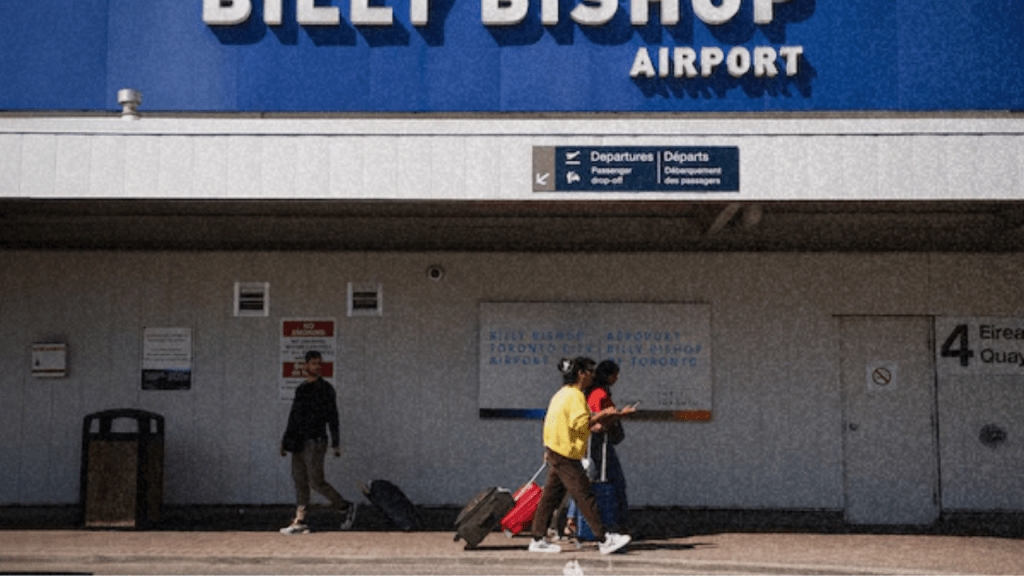
On May 29, 2026, the legal fight over Billy Bishop Toronto City Airport stopped being only an airport fight. Ontario had passed Bill 110 the day before, giving the province power to take over city-owned airport lands on the Toronto Islands and step into Toronto’s place in the agreement that governs the island airport.
The Canadian Press reported that Transportation Minister Prabmeet Sarkaria also planned to designate the airport a special economic zone. That tool, created through Bill 5, lets cabinet alter or suspend provincial and municipal rules for designated zones, projects, or trusted proponents.
Premier Doug Ford wants jets at the island airport and a passenger increase from roughly two million people a year to 10 million. The Toronto Port Authority supports the expansion. Mayor Olivia Chow has called the takeover a land grab without consultation. The federal government, one of the tripartite agreement signatories, has not rejected the plan.
The runway is the visible project. The special economic zone is the governing model. A waterfront asset is identified, local control is weakened, public consent is pushed behind the decision, and cabinet power is presented as the only way to make development move fast enough.
What Ontario passed
Bill 110, the Building Billy Bishop Airport Act, 2026, authorizes Ontario’s transportation minister to prescribe land connected to the airport and vest it in the Crown. The law applies not only to land, but also to interests in the land, buildings, structures, fixtures, additions, alterations, and improvements.
The bill defines the Tripartite Agreement as the 1983 agreement between Canada, Toronto, and the Toronto Port Authority governing the Toronto Island Airport. Section 5 lets Ontario take Toronto’s place under that agreement once prescribed land is vested in the province.
The legal structure matters because Toronto’s role was tied to land ownership and the agreement itself. The City was not just an outside critic of airport expansion. It was one of the formal parties to the governance arrangement that constrained jets, runway extensions, operating conditions, and waterfront impacts.
Bill 110 changes that relationship. The province is not merely lobbying Toronto to agree to expansion. It has created a legal path to remove Toronto’s land position, insert itself into the airport agreement, and make the city’s consent less decisive.
The city was not given a plan
The City’s May 28 planning report makes the democratic problem concrete. Toronto staff said the province and Toronto Port Authority had made expansion announcements through press conferences and media interviews outside the established Tripartite Agreement process. As of the report date, the City had not received a comprehensive plan, business case, or rationale for the proposed expansion.
The City report said Bill 110 enables Ontario to assume Toronto’s role in the Tripartite Agreement and take ownership of certain City-owned lands in Bathurst Quay and the Toronto Islands. It also said a special economic zone could allow the province to exempt the project from various municipal approvals.
The same report noted that both a runway extension and jets are currently prohibited without amending the Tripartite Agreement. It also recorded that federal consultations were expected in summer 2026, after the province had already passed the land-takeover law.
Consultation after a power transfer is not the same as consultation before a decision. Once Toronto’s role has been displaced, the public is no longer debating the same question. It is being invited to comment on a process already reorganized around provincial authority.
The land is larger than the runway
The airport is not an isolated strip of pavement. It sits inside Toronto’s central waterfront, near Bathurst Quay, Little Norway Park, ferry infrastructure, island communities, waterfront schools, parks, cultural sites, housing plans, and future Port Lands development.
The City report identified eight property identification numbers in Bill 110, including 434.4 hectares of Toronto Islands land and water lots, 3.75 hectares around Bathurst Quay, Eireann Quay, parking and pickup areas, waterfront promenade and dockwall parcels, and part of Little Norway Park.
The province has said it does not intend to take the entirety of the Toronto Islands. The legal text still gave the province a broad instrument. A law written broadly and administered narrowly remains a broad law. The public has to judge the power created, not only the assurance attached to it.
The immediate result is already real. Toronto staff said the bill limits the City’s ability to manage listed real-estate interests, including new leases and amendments to existing leases. Before runway design, aircraft type, passenger caps, or lakefill are settled publicly, the governance of the land has already changed.
Special zones were built for bypass
Bill 5 created the special economic zone machinery in 2025. Ontario framed it as a response to economic uncertainty, trade threats, and the need to build faster. Its official Environmental Registry notice says the law allows exemptions or modifications to provincial Acts, regulations, instruments, permits, processes, and approvals for designated projects or trusted proponents.
Ontario’s own notice says a special economic zone can range from a small parcel to a large area, and that regulations can identify which rules are exempted, altered, or continue to apply. The province describes this as streamlined permitting. The political effect is cabinet control over which ordinary protections survive.
The Association of Municipalities of Ontario summarized the same concern during Bill 5’s introduction: the province could designate special economic zones, projects, or trusted proponents that would be exempt from provincial legislation, regulations, and municipal bylaws.
On Toronto’s waterfront, that means an airport fight can become a test of whether municipal planning, local bylaws, environmental rules, public-health review, and waterfront protections remain binding when cabinet decides a project is economically strategic.
Bill C-5 is the federal twin
Ontario’s special economic zone model is not developing alone. The federal government has built a parallel fast-track structure through Bill C-5, the One Canadian Economy Act. The federal law gives cabinet power to designate projects in the national interest and accelerate approvals through ordinary regulatory barriers.
Carney’s Bill C-5 runs beside Ontario’s Bill 5 because both laws treat speed as the central political value. Ottawa clears national approvals. Queen’s Park clears provincial and municipal ground. The result is a two-level development machine built to move projects before opposition can force a full reckoning.
The Billy Bishop proposal arrives inside that machinery. Sarkaria’s national-scale language is not incidental. It places a downtown airport expansion inside the same governing vocabulary used for mines, ports, pipelines, transmission corridors, and resource routes. Once a project is named strategic, public process becomes something to compress.
The waterfront fight therefore sits inside a wider Canadian shift. Cabinet power is being rebranded as economic sovereignty. Legal shortcuts are being sold as nation-building. The question of who owns, governs, and inhabits land is being treated as a delay in the project schedule.
Ring of Fire made the model visible
The special economic zone tool was first understood through extraction. Ford’s government tied Bill 5 to the Ring of Fire, the mineral-rich region in the James Bay Lowlands that Ontario has long promoted as central to critical-minerals development, battery supply chains, and northern infrastructure.
The Ring of Fire shows why the tool is dangerous. Ontario presented the region as green development, while First Nations leaders warned that fast-tracking mining through special zones would weaken consultation, environmental oversight, treaty rights, and land stewardship.
Chiefs of Ontario said Bill 5 weakens environmental protections, reduces oversight of mining and development projects, and limits opportunities for First Nations consultation and consent. It listed the Ontario Heritage Act, Mining Act, Environmental Assessment Act, Environmental Protection Act, Endangered Species Act, and other laws among those affected by the omnibus legislation.
The Billy Bishop fight is not a northern mining fight. The mechanism is still the same. A law justified through extraction can be redirected toward an urban waterfront. A power sold through the language of critical minerals can be used against a city government. The tool travels.
Bill 5 weakens public protections
The Canadian Environmental Law Association warned in May 2025 that Bill 5 went beyond mining regulation and would amend or repeal key statutes in Ontario’s environmental law framework. CELA said the bill would weaken or eliminate safeguards protecting the environment, human health, and Indigenous rights.
CELA described Bill 5 as an attack on environmental law and the rule of law. Its concern was not limited to one mine, one region, or one airport. It was about the structure of a law that makes public protections conditional on cabinet’s development priorities.
For Billy Bishop, that concern becomes local and immediate. The project sits beside dense neighbourhoods, parks, schools, ferry routes, future housing, public waterfront investments, lake ecosystems, and one of Toronto’s most contested public landscapes. A special economic zone would not land on empty land. It would land on a place already full of public claims.
The province’s argument is administrative. The public’s problem is constitutional, municipal, environmental, and democratic. Once cabinet can decide that ordinary rules are too slow for a favoured project, every affected community is forced to fight on terrain cabinet controls.
Health warnings already existed
Toronto Public Health studied Billy Bishop expansion in 2013, when Porter Airlines requested changes to the Tripartite Agreement to permit jets. The report found that the airport, even in its existing form, contributed to air-quality and noise-related health concerns on the central waterfront.
The health report said traffic conditions were expected to worsen with expansion and could increase risks from air pollution, climate change, water quality, feelings of safety, and access to parks, cultural events, health services, and community services.
The report also evaluated noise impacts on children’s learning performance, annoyance, sleep disturbance, and cardiovascular outcomes. At Waterfront City School, airport operations added to noise levels that were already above a World Health Organization guideline for annoyance. At Island school, airport noise added to total exposure and deteriorated the learning environment.
The public-health record is therefore not speculative. Toronto has already studied the health burden of expanding aviation activity beside the waterfront. The current provincial sequence moves in the opposite order: take the land, alter the governance, propose the special zone, then promise later consultation and assessment.
No business case came first
The financial case remains incomplete in public. Toronto Port Authority CEO RJ Steenstra told a Queen’s Park committee the expansion could cost between $4 billion and $5 billion over 25 years. He said the project would be phased and that commercial airports are generally paid for by passengers and airlines.
CityNews reported that the committee also heard the Port Authority had not yet developed a business plan or completed health or environmental studies on the possible effects of expansion. Steenstra said the plan would be informed by public consultation and environmental assessment.
That is the wrong order for a project of this scale. A government asking the public to accept land transfer, municipal displacement, special-zone powers, jet operations, and a five-fold passenger increase should produce the business case before the legal takeover, not after.
The absence is not a clerical problem. It is central to the legitimacy of the project. The province is demanding speed before publicly proving need, cost, financing, risk, alternatives, health impact, environmental impact, or housing impact.
Climate arithmetic does not work
The Atmospheric Fund has already put the expansion against Toronto’s climate targets. Toronto has committed to net-zero greenhouse gas emissions by 2040 and a 65 percent reduction by 2030. Billy Bishop’s current aircraft activity generated about 64,000 tonnes of carbon-dioxide-equivalent emissions in 2024, excluding ground operations and surface traffic.
TAF estimated that a five-fold passenger increase could push aircraft emissions above 300,000 tonnes annually, roughly equivalent to more than 70,000 gasoline vehicles. The same analysis warned that Pearson’s own growth plans suggest regional aviation could grow rather than shift cleanly from one airport to another.
The province can point to newer aircraft, cleaner airport operations, electric shuttles, and future fuels. Those measures do not erase the arithmetic of multiplying passenger volume. A greener terminal does not neutralize a major increase in urban aviation emissions.
The regional-connectivity argument also hides the transit alternative. Many short-haul trips that airport boosters describe as economic necessities are exactly the trips that better intercity rail should absorb. Expanding downtown jet traffic while claiming climate seriousness keeps the region locked into the wrong infrastructure pathway.
Housing is in the flight path
Environmental Defence warned in March 2026 that the airport special economic zone could threaten approximately 14,000 planned non-market, market, and affordable homes in the Port Lands. The area sits southeast of downtown and has been unlocked by roughly $1.4 billion in public infrastructure investment from all three levels of government.
Environmental Defence argued that jet flight paths, runway requirements, and safety restrictions could undermine the building heights that make affordable and non-market housing viable. The concern is not abstract. Height, density, and financing are linked in the economics of mixed-income development.
The contradiction is sharp. Ford’s government presents the airport as growth, while the project could weaken one of Toronto’s most important opportunities for new housing near downtown. One form of development is accelerated through cabinet power. Another, more urgent form of development is put at risk by the flight path.
Ontario already has a record of using housing language while empowering the forces that restrict housing in practice. A waterfront airport expansion that threatens planned Port Lands homes continues that pattern. The project adds capacity for flyers while constraining capacity for residents.
Housing rules discipline the poor
Ontario’s housing politics often treats legality as proof of public purpose. In West Nipissing, John Ridge built a 250-square-foot shed home on land he owned after a fire destroyed the previous house. The structure was too small and wrongly classified under the existing code framework, even as supporters said the practical safety issues were narrow and fixable.
The threatened tiny home eviction showed how land-use rules can discipline people who produce shelter outside the approved development machine. The state can move aggressively against a small nonconforming home, while giving cabinet tools to bend the rules for megaprojects.
Billy Bishop belongs beside that example because both reveal the class content of legality. Small shelter is treated as a code problem. A multibillion-dollar airport expansion is treated as a strategic necessity. One resident is told the rules are immovable. One government is given power to decide which rules can move.
When law works that way, it does not simply protect safety. It sorts land use by power. The poor experience rules as walls. Capital experiences rules as negotiations.
The waterfront is being reordered
Billy Bishop is part of Ford’s broader waterfront agenda. Ontario Place redevelopment, the new science centre plan, the spa and waterpark project, concert infrastructure, public-space redesign, and now a proposed airport expansion all reorganize the waterfront around destination development and provincial control.
The Toronto waterfront is not empty land. It holds parks, ferry access, schools, island communities, public recreation, Indigenous history, ecological restoration, future housing, and decades of public investment. The fight is over which of those claims count when the province identifies the same space as an economic asset.
A parliamentary petition opposing jets at the island airport says the waterfront has received billions in public investment and that jets would conflict with affordable housing plans, add pollution and traffic, and harm birds and animals. The petition asks Ottawa to use its role in the Tripartite Agreement to say no.
The petition does not settle every technical question. It captures the political claim the province is trying to outrun: the waterfront is a public landscape, not a provincial inventory item waiting to be activated by cabinet.
Spectacle gets the money
Toronto has already seen public space reorganized around spectacle infrastructure. The 2026 World Cup has directed hundreds of millions of dollars into hosting, security, policing, transit control, and image management. Unhoused people around Union Station have faced removals and security violence while the tournament is framed as a civic opportunity.
Toronto World Cup security shows the same governing instinct in another form. Public money appears when the city needs to manage visitors, clear visible poverty, and protect a branded event. It disappears when public life requires housing, care, free festivals, or ordinary civic infrastructure.
The airport expansion sits in that same destination-development logic. A waterfront airport with jets, expanded passenger volumes, and provincial backing is not only a transportation facility. It is a prestige asset in a city increasingly governed around events, tourism, investor confidence, and image.
The question is what gets displaced so that spectacle can move freely. At Union Station, the displaced are unhoused people. On the waterfront, the displaced may be local planning, health review, housing capacity, environmental process, and public access to land.
The Ford model keeps returning
Ford’s development model is older than this airport proposal. The Greenbelt scandal showed how land-use decisions can be reorganized around favoured development interests. Ontario Place showed how public waterfront land can be pushed toward private destination infrastructure. The Ring of Fire showed how extraction can be sold as green progress while Indigenous jurisdiction is treated as a delay.
Toronto’s Ford politics also outlives Rob Ford as an individual figure. It survives as a governing style: resentment against process, suspicion of planning, hostility to social need, and constant deference to developers, police, property owners, and business constituencies.
Billy Bishop translates that model into airport law. City Hall becomes an obstacle. Waterfront residents become parochial. Environmental and health review become delay. Cabinet becomes the instrument of speed. Public land becomes a development asset, and the province calls the transfer modernization.
The model does not need to abolish democracy to weaken it. It only has to move the decisive steps upstream, where cabinet, legislation, land control, and special-zone powers have already narrowed what the public can stop.
The harbour still has to be altered
Even the narrower Runway End Safety Area project shows how physical changes at Billy Bishop involve lake and harbour impacts. The Impact Assessment Agency of Canada registry describes proposed work including landmass extensions, breakwater structures, road extensions, taxiway relocation, a new taxiway, and a noise wall.
The IAAC registry concerns safety-area work, not the full Ford jet-expansion vision. Its details still matter because the airport sits in a physically constrained lakefront environment. Any larger runway and jet plan would have to address lakefill, marine traffic, ferries, erosion, water quality, birds, fish habitat, and harbour use.
Those questions are not secondary. They are the project. How much landmass extension is required? Which aircraft are being planned for? Would flight caps change? Which buildings would face height limits? How would exclusion zones affect sailing, ferries, tourism, and island access?
A serious public process would answer those questions before the province changes land control. The current process has inverted the order. Power comes first. Technical disclosure comes later.
Consultation after control
The federal government remains central because the Tripartite Agreement cannot be transformed into a jet-expansion deal without federal involvement. Transport Minister Steven MacKinnon’s office has said consultations will launch and feedback will help guide future decisions. Prime Minister Mark Carney has described Ford’s idea as a vision with possibilities.
Federal consultation may still block, reshape, or delay the project. The political danger is that the consultation begins after Ontario has already changed the local power balance. Toronto is not entering the process from the same position it held before Bill 110.
The public should not be asked to evaluate a fait accompli. A real process would release the airport design, runway requirements, flight paths, height restrictions, lakefill assumptions, business case, health study, environmental review, traffic analysis, and list of laws the province wants suspended inside the special zone.
Until then, consultation is occurring in the shadow of a takeover. The city has been told to react to a project whose governing structure has already been rewritten.
The runway is political
Billy Bishop expansion is being sold through transportation language: more passenger choice, more regional connectivity, more economic activity, more convenience near downtown. The legal structure tells a harder story. The province is taking land control, replacing the city’s role, and preparing a special economic zone before the public has a full plan.
The airport may be the project. The runway is political. Ford is testing how far cabinet can move when public land, local democracy, and ordinary rules are reclassified as obstacles to economic urgency.
By May 2026, the documents on the table already showed the sequence: Bill 5 created the bypass tool, Bill 110 created the land-transfer tool, the City said it lacked the plan, public-health warnings remained unresolved, housing impacts remained live, and the waterfront was again treated as a development frontier.
The Toronto Islands still sit where they did before the law passed, between the harbour and the lake. The legal ground underneath them has shifted.
Sources
- Canadian Press report via Link2Build on Ontario’s plan to designate Billy Bishop a special economic zone after the land-takeover law, May 29, 2026.
- Legislative Assembly of Ontario text for Bill 110, the Building Billy Bishop Airport Act, 2026.
- City of Toronto report on Billy Bishop Airport proposed expansion, housing impacts, transportation impacts, Bill 110, and the proposed special economic zone, May 28, 2026.
- Environmental Registry of Ontario decision notice on the Special Economic Zones Act, 2025, and its exemption and modification powers.
- Legislative Assembly of Ontario text for Bill 5, the Protect Ontario by Unleashing our Economy Act, 2025.
- Canadian Environmental Law Association analysis warning that Bill 5 weakens safeguards for the environment, human health, Indigenous rights, and the rule of law.
- Chiefs of Ontario resource on Bill 5 and Bill C-5, including First Nations concerns over consultation, treaty rights, and environmental oversight.
- Toronto Public Health report on health impacts associated with Billy Bishop Toronto City Airport expansion, November 25, 2013.
- CityNews / Canadian Press report on the Port Authority’s projected $4 billion to $5 billion expansion cost, business-plan gap, and missing health and environmental studies, May 20, 2026.
- The Atmospheric Fund analysis of Billy Bishop expansion, passenger growth, aircraft emissions, Toronto climate targets, and net-zero conflict, April 14, 2026.
- Environmental Defence statement on the airport special economic zone, Port Lands housing, and approximately 14,000 planned homes, March 24, 2026.
- Impact Assessment Agency of Canada registry entry for the Billy Bishop Toronto City Airport Runway End Safety Area Project.
- House of Commons petition e-7404 opposing jets at the Toronto Island Airport and urging federal action through the Tripartite Agreement.