Carney’s Bill C-5 lets cabinet override existing law and fast-track extraction past the constitutional duty to consult First Nations. It is now in court.
Bill C-5 gives cabinet the power to override existing laws, suspend environmental assessments, and fast-track industrial projects without meaningful Indigenous consent. It is framed as an emergency response to Trump’s trade war. It is closer to a gift to the oil and gas lobby, dressed in the language of economic sovereignty — and built, above all, for speed. Everything about the bill is designed to get extraction locked into the ground before the courts can rule on who that ground belongs to.
The bill — the One Canadian Economy Act, carrying the Building Canada Act within it — passed Parliament last June after a compressed committee process that critics said gave the legislation nowhere near the scrutiny its scope demanded. Indigenous and environmental groups, opposition MPs, and the Canadian Bar Association all warned it was being railroaded through and that its sweeping cabinet powers had little precedent in Canadian law. The Liberal government passed it anyway.
Cabinet now has the authority to designate projects as being in the “national interest” and to fast-track their approval by overriding the regulatory frameworks that would otherwise apply — including the duty to consult Indigenous peoples guaranteed under Section 35 of the Constitution.
It does not stand alone. C-5 runs in tandem with Ontario’s Bill 5, the Protect Ontario by Unleashing Our Economy Act, which lets the provincial cabinet create “special economic zones” where it can suspend any provincial or municipal law — environmental rules, labour standards, health and safety — for companies it designates as “trusted proponents.” The federal bill clears the national approvals; the provincial bill clears the ground underneath them. Together they form one machine for getting shovels into contested land before anyone can stop them.
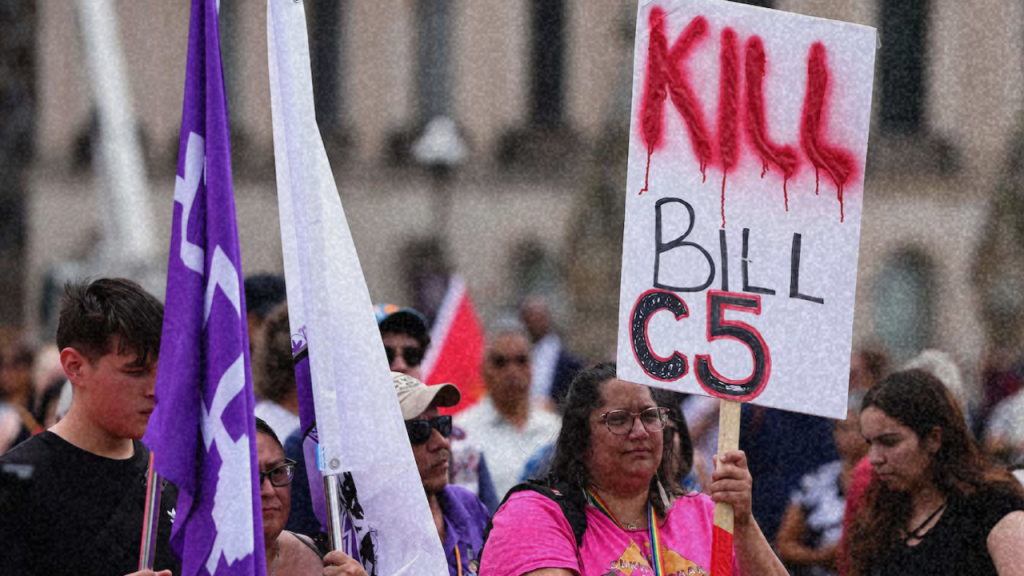
That machine is now in court. Nine First Nations filed a constitutional challenge in the Ontario Superior Court in July 2025, with five more joining by early 2026 — fourteen nations in total. The original nine are seeking an injunction to stop the two governments from using the laws’ powers while the case proceeds.
They describe the bills as a “clear and present danger” to their self-determination, and their senior counsel has framed the claim around the Crown’s constitutional obligation to act honourably — seeking declarations and one hundred million dollars in damages as a penalty for failing to. The challenge is live. The constitutional question is not hypothetical.
What the bill actually does
C-5 empowers cabinet to designate major projects — mines, pipelines, ports, power transmission lines — as projects of national interest. Once designated, those projects receive accelerated federal approvals and are shielded from the full environmental assessment that would otherwise apply. The bill requires consultation with Indigenous peoples whose Section 35 rights could be affected, but it does not require consent, and it does not define what counts as adequate consultation. The Canadian Bar Association warned that the requirement risks collapsing into a formality rather than the substantive process the Constitution demands.
In practice, the bill lets cabinet advance projects even where they cut across unresolved aboriginal title claims. The a UBC analysis has noted that for coastal First Nations in British Columbia — many with unresolved title to marine territories — C-5’s fast-tracking of LNG export infrastructure is not just a regulatory problem but a direct infringement of constitutionally protected rights. The legal reckoning over those rights is already underway in the courts. The bill is built precisely not to wait for it.
The Chiefs of Ontario have united in opposition. They reject the pan-Indigenous advisory council the framework proposes as inadequate, arguing that folding First Nations, Métis, and Inuit into a single advisory channel — and including groups whose Indigenous status is contested — flattens the nation-to-nation relationship the Constitution requires. Consultation, in their position, must be distinction-based and rooted in Section 35; it cannot be discharged through a body designed to blur the distinctions it is supposed to honour. The government has not answered the objection substantively.
The Alberta pretext is itself a foreign operation
A bill built for speed needs an emergency to justify it, and C-5’s emergency is Alberta. The political case rests on the manufactured Alberta separatism being treated as a genuine grassroots crisis demanding immediate federal accommodation. The province has had an independence current for decades, so the sentiment is not invented. But the machine currently driving it toward a referendum is, to a documented degree, a foreign operation — and the receipts are now a matter of public record and active investigation.
The clearest evidence is the voter-data scandal. The Centurion Project, an Alberta separatist group, deployed a voter-identification app built by 10xVotes, a Michigan-based right-wing outfit whose founder pitched the technology as the same tool that “helped Trump win Michigan” in 2024. On April 30, 2026, Elections Alberta obtained a court injunction forcing the group to take down a publicly searchable database containing the personal information of 2.9 million Alberta voters — names, addresses, identification numbers — sourced from a copy of the official electoral list that had unlawfully reached the group through the separatist Republican Party of Alberta.
The breach is now under investigation by Elections Alberta, the province’s Information and Privacy Commissioner, and the RCMP, and has been described as potentially one of the most significant privacy incidents in Canadian history. The app’s web runs straight into American power: it has links to ambassador Pete Hoekstra — Trump’s top envoy to Canada, who had previously promoted the app and is personally acquainted with its founder and the founder’s wealthy backer — along with MAGA influencers and Michigan Republican money.
The state-level involvement is just as open. The Financial Times reported that US State Department officials met repeatedly with the Alberta Prosperity Project, a separatist referendum group, whose leaders have discussed asking Washington for a $500 billion credit line to support an independent Alberta. Treasury Secretary Scott Bessent publicly called the province “a natural partner for the US.” A report by researchers on interference put it without hedging: US involvement in Alberta separatism is not covert but overt, alongside covert efforts attributed to Russian and Chinese networks working the same fault line.
Read materially, the picture is not mysterious. American capital is working to balkanize Canada so that its resource economy can be integrated more directly into the American imperial system, and the prize is specific: removing Canadian environmental law from well over a hundred billion barrels of reserves is worth far more to the US oil sector than any domestic deregulation.
The only real difference between Canada and the resource economies American capital has historically looted to the south is a higher standard of living. The structural relationship — resource hinterland serving the imperial core — is the same.
Carney’s response to this engineered crisis was to lower the carbon price in Alberta, suspend zero-emission vehicle sales minimums, and pass legislation handing cabinet sweeping power to fast-track exactly the extractive projects Alberta’s oil sector has demanded for years — all of it framed as a response to Trump’s trade threats. The framing barely matters next to the effect. Canada is doubling down on fossil extraction at the moment the structural case for it is weakest, and doing so by dismantling regulatory protections that were already thin.
Mark Carney was Governor of the Bank of Canada, then of the Bank of England, and before that a senior figure at Goldman Sachs. He is an architect of the financialized global order he now manages on capital’s behalf. His read of the Canadian economy is the read of someone whose career has been spent optimizing returns for the people who own it. C-5 is coherent with that career. It is not coherent with the claim that this is an economy being built to serve the people who live in it.
It also explains the haste, because the trade war is not the only clock running. The other one is in the courts, and it is the clock the whole bill is built to beat.
The constitutional time bomb
The 1997 Delgamuukw decision established that aboriginal title is an existing right protected under Section 35 — that it was not extinguished by Confederation, that it includes the right to the land itself, and that the Crown has a duty to consult and accommodate where that title may be affected. In 2014, the Tsilhqot’in decision went further, issuing the first court declaration of aboriginal title to a specific territory.
What neither case fully settled was the precise scope of title or the exact content of meaningful consultation. Those questions are being adjudicated now, and the answers are arriving faster than Ottawa would like.
This is not abstract. In 2024, the Haida Nation signed the “Rising Tide” agreement with British Columbia and Canada recognizing Haida title across the whole of Haida Gwaii, and in September 2025 the BC Supreme Court issued a declaration of that title on the consent of the Crown — the first declaration of its kind.
In New Brunswick, the six Wolastoqey Nations are seeking title over more than half the province, and a 2024 ruling confirmed that aboriginal title can continue to exist on land held in fee simple, even as a later decision struck the portions of their claim aimed at private landowners. That collision between title and fee-simple ownership is the same fault line running under a single contested shed in West Nipissing. The legal infrastructure for a real reckoning with the scope of Section 35 is being built case by case.
It is worth recalling that Canada legalized cannabis at a moment when continuing to criminalize Indigenous growers cultivating on unceded territory was beginning to look like a road toward a Section 35 challenge capable of unraveling far more than drug policy. Whether or not that calculation was explicit, the pattern it illustrates is real: the state moves to defuse the constitutional questions it cannot afford to have answered.
C-5 runs the opposite play. Rather than defuse the title question, it tries to outrun it — advancing projects over unresolved claims on a timeline built to get shovels in the ground before the courts can rule. The fourteen nations in court are not asking to negotiate. They are asking for a declaration that the law is unconstitutional, and that case will be heard.
Canada is the Hudson’s Bay Company in a Mountie uniform
The green-capitalism critique applies here in full. The electric-vehicle transition is not a clean break from extraction — it runs on rare-earth minerals, large-scale mining, and supply chains that reproduce the same colonial logic in new geographies. C-5 is not accelerating a green transition. It is accelerating the extraction of whatever cabinet designates as the national interest, which right now means LNG terminals, oilsands infrastructure, and Ring of Fire mining. The suspension of zero-emission vehicle minimums landed the same week as C-5’s passage. These are not contradictions. They are a coherent program.
None of this is new, and that is the point. The race to extract before the question of ownership can be settled is not a Carney innovation; it is the founding logic of the country, and Canada has never not been this.
The Hudson’s Bay Company held a royal charter over the territory for nearly two centuries before Confederation. The Mounties were created in part to suppress Indigenous resistance to that charter’s successor institutions. The copaganda baked into Canadian childhood — the Mountie as friend, as icon of benevolent order — is the cultural infrastructure for exactly this: a country organized around extracting resources from land whose ownership was never genuinely ceded, managed by whoever capital has installed in Ottawa, and sold to whoever capital has decided is the buyer.
Bill C-5 is not a departure from that history. It is its latest iteration, written in the language of economic sovereignty and national interest, passed through a committee process built for speed rather than scrutiny, and challenged in court by fourteen First Nations who understand exactly what it means. The question the case will force is the one the country has spent its whole existence avoiding: who the land actually belongs to, and what becomes of an economy built on never having to answer.
Sources
- The Narwhal — Bill C-5 explainer (what the One Canadian Economy Act does)
- CBC News — 9 Ontario First Nations seek injunction against Bill 5 and C-5, “clear and present danger,” July 2025
- CBC News — 5 more First Nations join the legal challenge (14 total), February 2026
- The Globe and Mail — Nine Ontario First Nations launch constitutional challenge against Bill 5 and Bill C-5
- Canadian Bar Association — submission on Bill C-5 (consultation risks becoming a formality)
- UBC Canada Climate Law Initiative — LNG, aboriginal title, and coastal BC under Bills C-5 and 15
- Chiefs of Ontario — opposition to the pan-Indigenous advisory council; distinction-based consultation
- Al Jazeera — Are Trump officials driving Alberta’s separatist movement? (State Dept meetings, Bessent, $500B credit line)
- PressProgress — Centurion Project voter-ID app links to US Ambassador Hoekstra, MAGA influencers, Michigan Republicans
- The Walrus — How an Alberta separatist group got the voter list (Centurion, 10xVotes, “helped Trump win Michigan”)
- The Globe and Mail — Foreign actors exploiting Alberta separatist debate; “US involvement is not covert — it is overt”
- The Globe and Mail — Haida Nation’s aboriginal title secured through court order (Rising Tide; Sept 2025 declaration)
- Olthuis Kleer Townshend — Wolastoqey Nations: aboriginal title can be declared over private lands (2024 NBKB 203)
- The Canadian Encyclopedia — Delgamuukw v. British Columbia (1997); Section 35 aboriginal title
- The Walrus — Carney’s major-projects bill and the rushed process (industry and legal concerns)