Alberta separation ruling hands First Nations the constitutional veto over secession — and quietly unravels Canada’s imperial legitimacy.
On Wednesday afternoon, May 13, 2026, Justice Shaina Leonard of the Alberta Court of King’s Bench issued two decisions that quashed Elections Alberta’s approval of the Stay Free Alberta separation petition. The group had collected 301,620 signatures, nearly double the 178,000 threshold required to trigger a referendum question under Alberta’s amended Citizen Initiative Act.
Leonard found that the chief electoral officer had erred in law by approving the petition without considering an earlier December 2025 ruling that said Alberta secession would violate Indigenous treaty rights. She also found that the Crown had failed in its duty to consult the Athabasca Chipewyan First Nation, Blood Tribe, Piikani Nation, and Siksika Nation before the petition was approved.
Premier Danielle Smith called the ruling “incorrect in law and anti-democratic” within hours and confirmed her government would appeal. Stay Free Alberta lawyer Jeff Rath called the decision “completely incomprehensible” and announced that the separatist movement would flood the United Conservative Party with new memberships to force Smith to put separation on the October 19 ballot under her own initiative.
Alberta NDP Leader Naheed Nenshi told reporters the petition was dead and the referendum should be called off. By Thursday morning, the appeal timeline at the Alberta Court of Appeal was reported as months past the October referendum date, with any further appeal to the Supreme Court of Canada extending well into 2027.
The Canadian commentariat read the ruling as a victory for federation and a setback for separatists. The Globe and Mail ran an opinion piece headlined as a look at “who’s trying to destroy” Canada.
The mainstream-liberal frame, in mid-May 2026, has converged on a single thesis: Canada must hold together against Alberta separatism, Quebec sovereignty, foreign disinformation, and Trump’s annexation talk by reaffirming federal authority and treaty respect in the same gesture. Justice Leonard’s ruling is being absorbed into that frame as the latest reassurance that the centre will hold.
That reading is wrong. What happened in Edmonton on May 13 is not the reaffirmation of Canadian unity. It is the procedural opening through which Canadian unity — as an imperial-colonial constitutional formation — is being unraveled.
From Coon Come to Crowfoot
The legal mechanism Leonard applied did not emerge from nowhere. It was built, over thirty years, by Indigenous nations facing the same question Alberta separatists are facing now — whether a province can split from Canada and take treaty land with it.
In the months before the October 1995 Quebec referendum, Grand Chief Matthew Coon Come of the Grand Council of the Crees built the international and legal case against Parti Québécois sovereignty taking Cree territory along with it. The Crees commissioned the legal study Sovereign Injustice, which argued that 150,000 square miles of Eeyou Istchee — Cree traditional territory across the northern two-thirds of Quebec — could not be transferred from one sovereignty to another without Cree consent. Coon Come took the case to Harvard, to Washington, to the United Nations.
On October 24, 1995, six days before Quebec’s referendum, the Crees of James Bay held their own vote. The question asked whether they consented to being separated from Canada by a Quebec yes vote.
Of the 77 percent of Crees who cast ballots, 96.3 percent voted to remain. The Inuit of Nunavik held a parallel vote and rejected Quebec sovereignty by an identical margin.
Coon Come’s framing for what those votes meant has been quoted in Indigenous self-determination cases ever since. The Cree people, he said, are not cattle or property to be transferred from sovereignty to sovereignty or from master to master.
The Quebec yes side lost by 54,288 votes. The PQ campaign did not collapse because of the Cree intervention alone. But the constitutional argument Coon Come built — that Section 35 treaty rights are not a wrinkle in the secession process but a structural prohibition of it — was carried into the legal infrastructure that grew in the following three decades.
The Haida Nation decision in 2004 established the Crown’s duty to consult on actions that may affect Indigenous rights. Mikisew Cree in 2018 extended the doctrine into legislative and ministerial decisions.
The 2007 UN Declaration on the Rights of Indigenous Peoples — ratified by Canada in 2021 — codified the principle that Indigenous peoples cannot be transferred between states without free, prior, and informed consent.
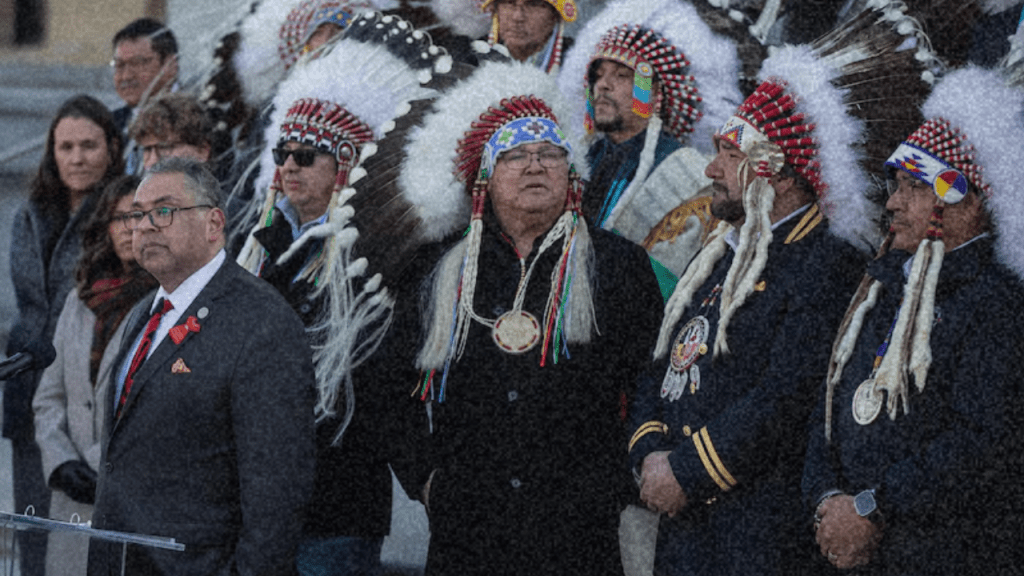
What the Alberta separatists ran into on May 13 was the thirty-year accumulation of that legal infrastructure landing on a new question. Chief Samuel Crowfoot of the Siksika Nation told reporters after the ruling that the decision was a reminder that treaties are not historical documents — they are living constitutional agreements between First Nations and the Crown. Grand Chief Trevor Mercredi of Treaty 8 territory put the structural relationship more plainly in earlier comments: Alberta, he said, is a tenant on this land, not the landlord.
The line from Coon Come in 1995 to Crowfoot in 2026 is direct. The constitutional argument has not changed. The legal infrastructure to enforce it has matured by an order of magnitude.
The mechanism: duty to consult eats the electoral process
What Leonard did legally was extend a doctrine. The duty to consult, before May 13, had been applied to administrative decisions, regulatory approvals, resource-extraction permits — Crown actions where the executive interfaces with Indigenous rights. Justice Colin Feasby in December 2025 ruled that the original Stay Free Alberta referendum question was unconstitutional on treaty grounds. The Smith government responded eleven days later with Bill 14, which amended the Citizen Initiative Act to neutralize the ruling and let the petition be refiled.
Leonard’s May 13 decision is the procedural response to that legislative workaround. She found that the chief electoral officer’s approval of the refiled petition is itself a Crown act that triggers the duty to consult — because that approval is the last administrative step before a binding referendum mechanism begins to run. The duty cannot be designed around by passing new legislation that strips constitutional review from the petition process, because the Crown still acts when it issues the petition.
This is the new application. Duty to consult has now been extended into the electoral process itself, on questions where the referendum result would affect treaty rights.
Constitutional scholar Emmett Macfarlane, writing on the precedent chain in April, was direct: the doctrine has evolved to the point where a province’s First Nations would have to consent to secession, even if the Supreme Court of Canada did not explicitly say so in its 1998 reference. It is not a formal veto. It flows from an application of the treaty system. And if a province cannot unilaterally tear up a treaty — which the courts have established it cannot — then it is at the very least indirectly prevented from secession.
The Canadian legal establishment is uncomfortable saying this plainly. Smith called the ruling anti-democratic because she understands what it means. Rath called it incomprehensible because the alternative reading is that the legal terrain has shifted under separatist feet without any prospect of being shifted back through provincial legislation alone. The appeal, even if Smith wins it at the Court of King’s Bench level, faces the same problem at the Court of Appeal and the Supreme Court of Canada. The treaty doctrine is the doctrine. The province has no constitutional authority to extinguish it.
Matthew Wildcat, University of Alberta scholar of Indigenous governance, put the point bluntly: the treaty issue is the number one obstacle to the legitimacy of Alberta entertaining a referendum on separation.
The same obstacle applies to Quebec, where Eeyou Istchee covers most of the province north of the 49th parallel and Treaty rights extend across territories the PQ has historically refused to acknowledge as anything other than provincial land.
Plamondon’s referendum-within-his-first-term promise runs into the same wall Parizeau ran into in 1995 — only now the wall has thirty years of Haida, Mikisew, UNDRIP, and Section 35 jurisprudence stacked behind it.
From veto to statehood
The procedural argument matters because it accelerates a substantive trajectory. Every successful invocation of duty to consult on a secession question pushes the constitutional terrain closer to nation-to-nation negotiation as the baseline relationship between Indigenous peoples and the settler state. That terrain shift does not require a single ruling that grants veto power. It requires a chain of rulings that makes provincial secession structurally impossible without Indigenous consent. That chain is now visibly forming.
Dené political theorist Glen Coulthard, writing in Red Skin, White Masks, argued that the Indigenous struggle goes nowhere if it does not become a wider anti-capitalist, anti-imperialist, and anti-colonial struggle. The substantive corollary of the legal trajectory now unfolding in Alberta is that Indigenous nations are not negotiating for a better deal within Canadian federalism. They are establishing, ruling by ruling, the constitutional fact that the federation exists at their consent, not the other way around.
The Mohawk Council of Akwesasne, the Wet’suwet’en hereditary chiefs, the Tyendinaga Mohawks at the 2020 rail blockades, and now the Athabasca Chipewyan and Siksika and Piikani and Blood Tribe in May 2026 are not seeking inclusion.
They are testing, in slow motion, whether the colonial state can be made to recognize them as what they already are — nations with their own legal orders, their own territorial jurisdiction, and their own right to determine which state they share land with, if any.
This is what the orthodox-progressive Canadian frame is built to obscure. The federalist position treats treaty rights as a feature of Canadian constitutional order, when the historical fact is that treaties predate Canada.
The 1763 Royal Proclamation established that the Crown could only enter Indigenous territory through nation-to-nation treaty. Alberta did not exist until 1905, thirty-eight years after Confederation and well after most numbered treaties were negotiated.
The province acquired jurisdiction over natural resources only in 1930 through the Natural Resources Transfer Agreements — agreements First Nations have argued for decades violated the treaties they were never party to.
Gina Starblanket and James Rowe, writing in the Tyee last week, put the relationship plainly: Alberta separatists rely on the ongoing denial of treaty, and Ottawa cannot lean on treaty selectively to protect its own nationalist aims while continuing to violate the same treaties when resource extraction requires it.
The Starblanket and Rowe argument runs as far as the limits of Tyee-progressive discourse will allow. The argument behind it — that the federation itself is the colonial structure, not just the bad-faith provincial actor inside it — is where the orthodox Canadian left will not go. That refusal is the analytical failure this piece is naming.
The PQ-APP alliance: capital sees the opening first
In September 2025, Parti Québécois leader Paul St-Pierre Plamondon flew to Calgary and met with three leaders of the Alberta Prosperity Project: Mitch Sylvestre, Jeffrey Rath, and Dennis Modry.
Plamondon’s office confirmed the meeting publicly in January 2026. He affirmed his support for an independent Alberta and indicated that a PQ government would support Alberta in separation negotiations with Ottawa if a provincial referendum succeeded.
Rath described Plamondon as like-minded on what he called federal overreach. Plamondon was direct on the strategic logic: he did not know whether Alberta or Quebec would achieve independence first, but the two movements could at least help each other.
The leader of a francophone-nationalist party whose project is rooted in cultural-linguistic survival sat down with the leaders of an Alberta separatist organization whose founding intellectual document invokes the World Economic Forum, opposition to what its authors called Marxist federal governance, and conspiracy material about mRNA injections.
These are not natural political allies. They agree on almost nothing except that Ottawa is the problem and exit is the answer. That is, it turns out, enough to be working on it together.
The right-sovereignist axis is doing in 2026 what the Canadian left refuses to do: it is reading the constitutional fault lines as they actually are, in the moment they are coming apart, and positioning accordingly.
The PQ stands at 32 percent in Quebec polling and 39 percent among francophones, tied with the Liberals for first place ahead of the October 5 election.
The APP has 301,620 signatures collected and a Republican-aligned U.S. State Department reportedly receptive to meetings about half-trillion-dollar credit facilities backed by Alberta’s oil reserves.
Treasury Secretary Scott Bessent called Alberta a natural partner for the U.S. at Davos. Tucker Carlson told his audience in April that Canada is not sovereign and the United States should consider coercive regime change. Steve Bannon has been platforming Alberta separatism for over a year.
The capital-friendly right-sovereignist project sees the opening. The Carney government, defending an imperial federation it inherited from a different geopolitical era, is publicly committed to holding the centre together as the visible strategy of national renewal.
The orthodox Canadian progressive position has converged on the Carney line — Jacobin in March 2025 described the prospects for a common democratic front in defence of a more sovereign Canada as never greater.
That defence is being conducted against U.S. imperialism, Alberta separatism, Quebec sovereignty, and foreign disinformation as a single composite threat. None of those positions name the federation itself as the imperial structure being defended.
The Quebec October 5 election and the Alberta October 19 referendum sit two weeks apart on the calendar by design, not accident.
The right-sovereignist actors are coordinating because they understand that the simultaneous-pressure narrative is more powerful than either movement on its own.
The Canadian left is not in those conversations, because the Canadian left has spent thirty years treating federation as the lesser evil and Indigenous sovereignty as a moral-rhetorical commitment rather than a structural-political fact.
Internationalismo, not Canadian nationalism
The structural opening Justice Leonard’s ruling creates — and that the PQ-APP alliance has already identified — does not run in the direction the right thinks it does.
An emancipatory exit from the Canadian-American hegemonic bloc does not look like Alberta as a vassal petro-state under U.S. credit lines and Trump-administration security guarantees.
It does not look like Quebec as a culturally-defensive ethno-state policing language law against immigrants while Indigenous treaty rights inside its territory are denied. Those are the Hayekian and ethno-nationalist exits, and they reproduce the imperial-extractive economy under smaller flags.
The emancipatory exit looks different. It looks like Indigenous nations occupying their actual position in the constitutional order — coordinating nation-to-nation, blocking unilateral provincial moves, negotiating land back and resource jurisdiction as living political practice rather than reconciliation theatre.
It looks like Quebec’s existing para-state apparatus — the délégations générales abroad, Hydro-Québec’s industrial capacity, the Caisse de dépôt’s investment pool — being redirected toward non-aligned positioning in a multipolar world rather than into the same NATO-and-U.S.-extraction grooves the federation already occupies.
It looks like Alberta facing the reality that its oil-and-gas economy was always going to be stranded by the energy transition, with or without Ottawa, and that exit into a U.S. vassal arrangement accelerates the stranding rather than escapes it.
The internationalist version of this is not theoretical. Mark Carney himself, speaking to the World Economic Forum at Davos in January 2026, openly admitted what the post-1945 imperial settlement no longer offers to middle powers like Canada.
The imperialist system, in Carney’s reluctant phrasing, no longer benefits the countries that built their economies as junior partners inside it.
That is a remarkable thing for a former Bank of Canada and Bank of England governor to say in public. It is the imperial-core’s own tell that the multipolar shift has already happened, and the only open question is which formations on the periphery of the old bloc will adjust to it and which will collapse trying to defend it.
The post-2008 reading was that BRICS and the Global South were where the multipolar opening would emerge. The 2026 reading is that the imperial-core itself is fragmenting from the inside. Britain has Scotland. Spain has Catalonia. Canada has Quebec and Alberta and the constitutional fact that Indigenous nations were never absorbed in the first place.
The left that wants to call itself anti-imperialist has to read those fault lines as openings, not threats, and to refuse the orthodox-Canadian instinct to defend a federation whose foundations were laid in 1867 in service of the same British imperial project the rest of the colonial world has spent eighty years exiting.
Why the imperial-core left misses this
For many Marxist-Leninist living within Canada and Quebec, there is an orthodox objection to everything written here, which should be addressed structurally rather than dismissed.
The objection runs: multipolarity is a smokescreen for the rise of rival capitalist powers, BRICS is an imperialist bloc-in-formation, Québec Solidaire is NATO-friendly social democracy with sovereignist branding, the PQ is an ethno-nationalist party that historically deployed anti-Indigenous racism, an independent Alberta would simply be a more openly extractive petro-state, and to celebrate any of this is to mistake inter-imperialist rivalry for emancipation.
The conclusion does not follow because the orthodox-ML position requires the federation to hold together as the precondition for organizing a real anti-imperialist alternative inside it.
That precondition has been false since at least the failure of Meech Lake. It is structurally false now. The federation is unraveling whether the left organizes inside its fault lines or refuses to engage with them.
The PQ-APP alliance is the operative example. The right-sovereignist project is already moving through openings the left has spent thirty years calling unprincipled to enter. The cost of refusing to engage is not analytical purity. It is irrelevance.
Coulthard’s argument is the bridge. The Indigenous struggle is not a side project of the wider anti-capitalist and anti-imperial fight. It is the structural ground on which that fight, in Turtle Island, is conducted. The May 13 ruling proves the point operationally.
Indigenous nations using the legal mechanisms they spent thirty years building did more to halt a right-wing petro-state secessionist project than the entire Canadian progressive establishment achieved in the same period through electoral and institutional channels.
The Tyendinaga rail blockades in 2020, the Wet’suwet’en resistance to Coastal GasLink, the Athabasca Chipewyan and Blackfoot Confederacy litigation in 2026 — these are not isolated incidents. They are the same movement applying the same constitutional argument across two decades.
What an internationalist Canadian left would do, if it existed in any coherent form, is recognize that the Indigenous-sovereignty trajectory, the Quebec-sovereignty trajectory, and the Alberta-petro-state crisis are symptoms of the same structural fact — that the federation is a colonial-imperial formation whose internal contradictions are surfacing simultaneously because the geopolitical conditions that held it together for 159 years have changed.
The task is not to defend the federation. The task is to engage with what is replacing it, with internationalist solidarity toward Indigenous nationhood and whatever non-aligned formations emerge from the fragments.
Material conditions move whether the political left is able to move with them. The conditions in Canada are moving now. The federation defenders are reading the same data the right-sovereignists are reading and arriving at opposite operational conclusions.
The Indigenous nations doing the actual constitutional work on the ground are reading the data and acting on it.
The Canadian left is the only major political tendency in this country still pretending this ruling was a victory for the centre. It was not. It was the centre conceding, in court, on the record, that the federation rests on a treaty foundation it has never honoured and cannot survive being held to.
Canadian legitimacy is being unraveled. It is being unraveled by the people whose nations the federation was supposed to extinguish, using the legal instruments the federation built to manage them. The unraveling is good.
The question is whether the rest of the political left in this country shows up for it, or keeps defending the colonial fiction until the right-sovereignist project replaces the federation with something worse.
Sources
- CBC News — Judge overturns Elections Alberta’s approval of separation referendum petition, May 13, 2026
- Global News — Danielle Smith rejects Alberta judge’s ruling against separation petition as ‘anti-democratic’, May 13, 2026
- The Globe and Mail — Legal experts weigh in on what’s next for Alberta’s proposed separation, May 16, 2026
- The Globe and Mail — Alberta judge throws out petition for separation referendum, May 13, 2026
- JURIST News — Alberta judge quashes separation petition for violating First Nations right to consult, May 15, 2026
- Prism News — Judge tosses Alberta secession petition, citing First Nations treaty rights, May 13, 2026
- The Tyee — Alberta Separatists Ignored the Power of Treaties. Take Heed, Carney, May 15, 2026 (Gina Starblanket and James Rowe)
- CBC News — First Nations’ court challenge may block Alberta separatism itself, not just petition drive, April 11, 2026 (Jason Markusoff)
- Matthew Coon Come — Harvard Center for International Affairs and Kennedy School of Government speech, October 28, 1996
- 1995 Quebec referendum — Cree and Inuit parallel referenda, October 24-26, 1995
- The Canadian Encyclopedia — Matthew Coon Come biographical entry
- The Canadian Encyclopedia — Coon Come Fights Separatists, Maclean’s, February 27, 1995
- Between the Lines Canada — Two Provinces, One Fault Line, May 12, 2026
- Wikipedia — Alberta independence movement (PQ-APP September 2025 meeting documentation)