
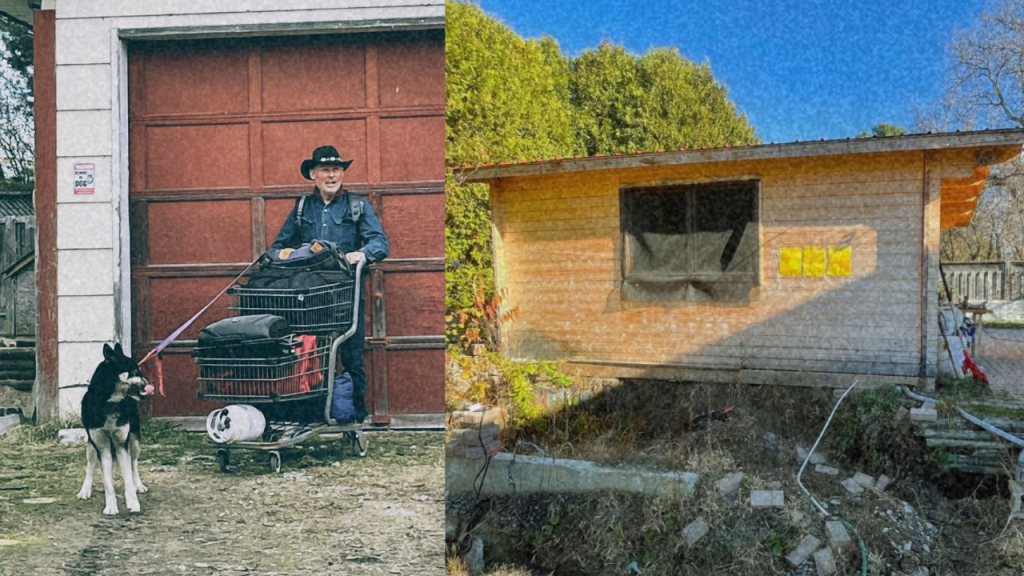
Ontario tiny home rules nearly made John Ridge homeless on his own paid-off land — not because his shelter was unsafe, but because it was too small.
John Ridge owns a small plot of land in Cache Bay, in the Municipality of West Nipissing, Ontario. He bought it in 2022, after the house that stood there had burned down, finding the lot listed at $85,000 and talking the price down to $70,000 for what was effectively a teardown order with a burned-out structure on it.
He cleaned up the property himself, and on the old foundation he built a 250-square-foot shed and made it his home, fitting it with heat, water, and electricity. His husky mix, Smoke, lives there with him.
The small scale is not a constraint Ridge resents. It is the point. He has a neurological condition that causes frequent seizures and affects his balance, and a compact, single-level space is what lets him feel safe in his own home.
He told BayToday he believes the condition dates to 2012, when police tasered him twice while he was checking on a suicidal friend, despite his not resisting. A man who associates his disability with police force built himself the smallest possible shelter to manage it, on land he owns outright. For most of a year, that was simply where he lived.
Then the Municipality of West Nipissing issued a final notice prohibiting occupancy. The structure had been permitted as a shed, not a dwelling, and a shed lived in as a home does not comply with the Ontario Building Code Act. Ridge was told he would be locked out on Friday, February 6, 2026, in the middle of a northern Ontario cold snap.
The day before the deadline, the municipality’s chief administrative officer, Mike Pilon, came to his door and invited him to talk. After community backlash — a friend’s social-media post about his situation drew over 400,000 views — Ridge was granted an extension and allowed to stay while he pursued a fix. The crisis was paused. What it exposed was not.
The problem was never safety
The municipality frames this as a building-code matter, and codes are sold to the public as safety instruments. The facts complicate that story. By the account of Ridge and the community members documenting his case, the shed’s electrical, plumbing, and structural systems are sound.
The concrete code shortfalls that surfaced were narrow and technical — his drainage vent runs thirty-two inches where the code wants forty-two, and he tied his drainage into the remnants of the burned house’s old system. These are real, and they are also exactly the sort of thing a variance and a weekend of work resolve. They are not a collapsing structure or a poisoned well.
The real disqualifier was simpler and harder to dress up as safety: the home was too small and zoned as the wrong kind of building. A 250-square-foot dwelling does not fit a framework written around a two-and-a-half-storey house with an attic and a basement, and Ridge said exactly that — you cannot take a very small space and measure it against a standard built for something many times its size. The dwelling was not dangerous. It was non-conforming. Those are different problems wearing the same uniform, and only one of them is about whether anyone gets hurt.
This is where the official mythology around Canadian housing comes apart. Every level of government insists it is gripped by a housing crisis, convening task forces on affordability and holding press conferences about supply and dignity. But when an individual produces a cheap, sound form of shelter outside the approved economic framework, the same system that cannot build affordable housing fast enough discovers it can act decisively after all — against the shelter. The contradiction is the tell.
Housing codes regulate obedience, not danger
The problem was never that John Ridge lacked shelter. The problem was that he produced shelter without sufficiently participating in the machinery around it — the permits, the contractor dependency, the mortgage, the inflated assessment, the development charges, the steady municipal revenue that conventional property generates. He housed himself for the price of a teardown lot and some inheritance money, and in doing so he stepped outside the circuit of debt and extraction the housing system is actually built to sustain.
That is what makes self-built and tiny shelter quietly threatening to a municipal model. It consumes less land, less energy, fewer materials, and far less debt, which makes the person living in it harder to discipline economically.
But the deeper threat is to value: a cheap, sound alternative to conventional housing puts downward pressure on the speculative price of everything around it, and that price is what the town’s revenue and its property-owning officials both depend on. Someone who can house themselves for the cost of a shed has less need for the banks, the developers, and the rising-assessment logic that funds the town. The hostility such homes attract is rarely about whether they are safe. It is about whether they are legible and profitable to the systems built around conventional housing.
You are permitted to live comfortably in this arrangement on one condition: that your existence stays taxable, financeable, and compatible with the speculative value of the surrounding land. Ridge’s shed failed that test not because it endangered anyone but because it did not consume enough — enough space, enough money, enough debt — to register as a proper participant in the property economy. The code is the instrument that makes participation mandatory, and the variance fee is the toll for having tried to opt out.
The violence of liberal bureaucracy
The instructive thing about the Ridge case is how reasonable everyone in it sounds. The CAO drove out to his property personally. Councillors and the local MP gave him hours of sympathetic attention at a community barbecue. The mayor has said a bylaw update to permit tiny homes could be only months away. Nobody in this story performs as a villain, and that is precisely the point, because the system did not need one to produce the outcome it produced.
This is how a liberal bureaucracy distributes its harm: responsibility is fragmented across institutions until no single actor feels accountable. Speaking to CTV News, CAO Mike Pilon said the municipality was bound by the provincial Building Code Act, which exists “for the protection of the actual resident” and “to assist with the liability of the municipality.”
Mayor Kathleen Thorne Rochon stressed that enforcement is a provincial mandate assigned to the chief building official, “distinct from municipal council’s role.” The bylaw officer enforces the code. Council says reform takes time. The province owns the Act. Everyone is sympathetic, and the disabled man still has to fund and navigate his own way back indoors.
The most candid phrase in the entire record is Pilon’s: the code assists “with the liability of the municipality.” The concern behind it is not invented. A municipality that knowingly lets someone occupy a dwelling that fails the code does expose itself if that person is later harmed by the very deficiency it ignored, and officials are right that this is a real exposure rather than a pretext.
But naming it states the function plainly all the same: the system is weighing its own liability, and a disabled man’s shelter is the variable being adjusted to reduce it. The cruelty, when it operates, is procedural rather than dramatic — it arrives as a deadline, a fee schedule, a foundation specification, a variance application.
Ridge was asked to pay $1,200 and file paperwork for special permission to keep living where he already lived, with no guarantee the permission would be granted. Being made to apply for the privilege of surviving on your own land is a soft form of domination, but it is domination, and the warmth of the people administering it does not change what is being administered.
Ontario’s housing crisis is manufactured
Ontario politicians discuss the housing crisis as though it were weather — something that descended from outside, affordability collapsing of its own accord, homelessness materialising from nowhere. It did not.
But reading it as the opposite — a coordinated plan, a room where officials agree to crush cheap housing — gets the mechanism just as wrong. There is no master plan. There is an economy that has turned housing from shelter into an investment asset, and a system that is fragmented, reactive, and shaped by lobbying and ordinary self-interest rather than directed from any center.
The crisis is the product of that: zoning restrictions, speculative real estate, development monopolies, and the long transformation of housing into a thing to hold rather than a place to live. The province insists there is not enough housing while its municipalities police some of the cheapest housing people can build for themselves.
West Nipissing supplies its own evidence. Two years before Ridge’s notice, a local outlet ran a piece headlined that tiny homes were “coming to West Nipissing.” Two years later the bylaw still had not been updated, and a man was facing a lockout and a $1,200 variance toll over precisely the form of housing that article promised was on the way. The reform is always arriving and never arrived. The gap between the press release and the bylaw is where people like Ridge fall through.
If anything, the town has been moving the other way. As Ridge’s case unfolded, council took up proposed by-law amendments to restrict trailers on private property and keep minimum square-footage rules for dwellings. At least one formal objection has been filed with the mayor and council, dated May 21, arguing that the restrictions exceed the municipality’s legal authority under Ontario’s Planning Act and additional-residential-unit rules.
The same objection argues that in a community with a significant Métis and Indigenous population, the restrictions engage Section 35 protections and a duty to consult. Those are arguments the objectors are advancing, not settled law — but they signal that the fight over Ridge’s shed is becoming a fight over the bylaw itself.
If the actual objective were ensuring people had safe shelter, a sound 250-square-foot home owned outright by a disabled man would be the easiest possible yes. Instead it became a file.
The reason is structural and unglamorous: municipal revenue is tied to rising assessments, development charges, and an expanding tax base, and the officials administering the system are themselves property owners, personally served by the same rising values the town depends on institutionally. A tiny home is a cheaper alternative to a conventional one, and a cheaper alternative threatens the speculative value of everything around it. A population that can house itself cheaply and independently is a population that threatens that model from both ends at once.
That is why governments tolerate vacant investment properties while policing self-built shelter, and why a town will more readily fund enforcement than legalise low-cost autonomy. No coordination is required for this. Each actor follows the incentive in front of them, and the incentives point away from cheap shelter. The suffering is not an accident of the system. It is useful to it.
Toronto already showed how this ends
Ridge is not an aberration. He is the latest instance of a pattern that the 2023 documentary Someone Lives Here captured at city scale. During the pandemic, the Toronto carpenter Khaleel Seivwright quit his job to build insulated “tiny shelters” — heated by the body warmth of the person inside — and distributed more than a hundred of them to people living in encampments through the city’s parks. They were never meant as permanent housing. They were meant to keep unhoused people alive through the winter, and they did.
The city’s response is the precedent for everything that happened to Ridge. After initially praising Seivwright’s work and floating a partnership — then reversing that within a week — Toronto filed an injunction to stop him and served eviction notices across the encampments. It then spent close to $2 million clearing the parks, sending police on horses and bikes to tear apart the shelters and the tents around them.
Three months after the evictions, by the figure the film puts on screen, ninety-two per cent of the people removed from those parks were still without permanent housing. The city spent two million dollars to make people no less homeless than before, because the goal was never to house them. It was to clear them.
The standard objection to Seivwright was that the shelters sat on public land he did not own — that this was the real problem, not the shelter itself. John Ridge dismantles that objection completely. He owns his land outright, harms no one, pays his taxes, and is still forbidden to live in a small home on it.
Strip away the public-versus-private distinction and the same logic stands in both cases: self-built shelter is intolerable to the system whether it sits on a city park or a paid-off lot in Cache Bay. What is being protected is not property rights — Ridge has those, and they did not save him. What is being protected is property relations: the order of value, debt, and compliance that cheap, independent shelter threatens from any direction.
When that order is threatened, the response in Toronto and the response in Cache Bay rhyme exactly, because in both the final instrument is the same. The police do not protect the property owner. They protect the arrangement, and they arrive when the arrangement is questioned.
Then the town came back
The extension held for about three months. Then, in May, it broke the wrong way. According to comments made by Corrin Smith, the local resident whose posts first carried Ridge’s case to a national audience, the collaborative process Ridge had been promised gave way to enforcement. Smith wrote that Ridge and his dog Smoke were “suddenly and roughly removed from their small house,” and that a neighbour stepped in to collect the dog so he would not be in danger.
The exact sequence of what happened in May is not fully settled in the public record, and the accounts that exist come from Ridge and the people supporting him rather than from the municipality or any news outlet. What follows is drawn from those accounts, attributed as such.
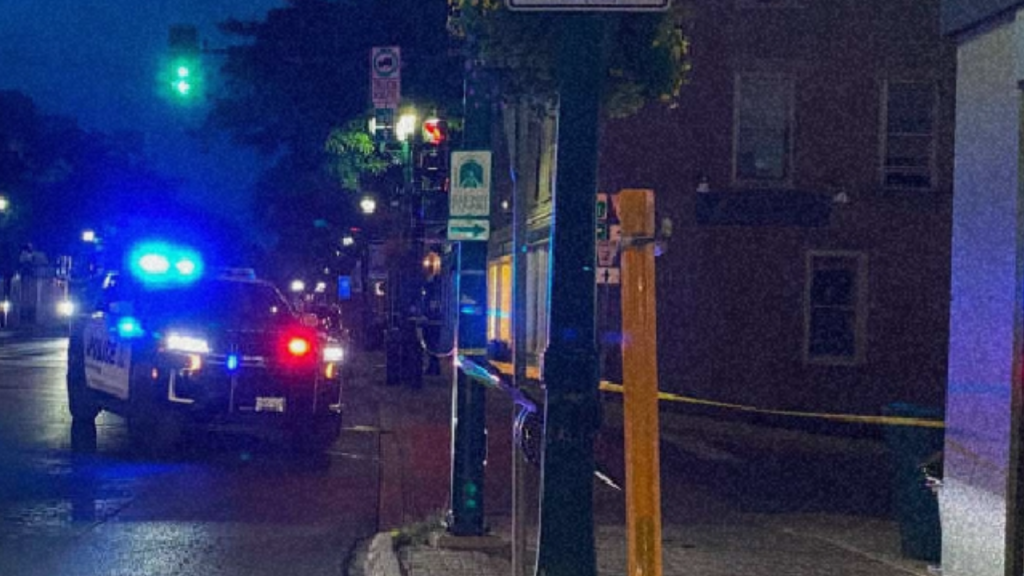
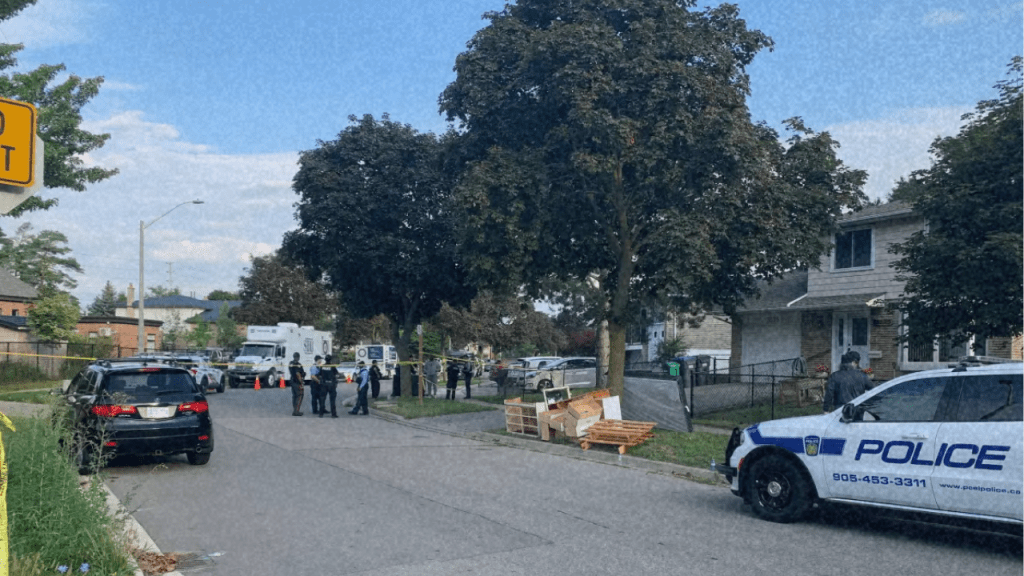
Ridge did not leave quietly. By Smith’s account he “chose to stand his ground” and argued with the officers who came to remove him, asking them for “a chance in court” and a hearing before a tribunal. Instead, she wrote, “they dragged him to the ground and cuffed him,” and “removed him from his property,” while town employees “boarded up his windows and put a padlock on his door.” West Nipissing is policed by the Ontario Provincial Police, so any removal would have been carried out by OPP officers acting on a municipal order.
Smith described the aftermath in plain terms: a property owner “loved by all his neighbours,” who keeps his yard, pays his taxes on time, and covers his utilities, “turned out of his home because it is too small.” Ridge and Smoke, she wrote, were left “huddled up on his property, with only a sleeping bag,” on a night under a frost advisory. Ridge has since indicated the community pressure is the only reason he is not in custody — “without you,” he wrote to his supporters, “I would likely be in jail.”
Ridge’s own account, posted publicly, centers on a different act by the town — and whether it came before, during, or after the removal Smith describes is not clear from what either of them has said. In his words, the municipality acted “without warning, no letter, explanation, nothing,” and “removed the perfectly functioning drain, and the waterline.” The consequence he named was small and total at once: “I can’t even fill my dogs water bowl.”
Cutting off a dwelling’s water is the quieter instrument of the same enforcement. A man cannot be made to stay somewhere that has no water, and a vacancy produced that way arrives without a headline.
Ridge’s anger in that post is the anger of someone who watched the collaborative language collapse into action. He asked whether “a new constitution” had been “written over night” allowing “unqualified people to make life changing decisions with zero oversight,” and pointed to what the fight had already cost the town in effort and money to make one disabled man homeless.
He also relayed that the CAO had told him the public has “only one side of the story,” and that there is “a side to this story that hasn’t been told.” West Nipissing is welcome to tell it.
The symmetry is its own indictment. A man who believes police force gave him the condition that requires a small, safe home was, by these accounts, removed by police from exactly that home over its size, and then had its water cut so he could not return. That is not a story about one stubborn bylaw officer or one cold municipality. It is the ordinary machinery of property enforcement reaching its end point, where every sympathetic conversation and every collaborative press line resolves, finally, into an officer, a padlock, and a severed waterline.
What makes the outcome damning rather than merely sad is that it happened against the plain weight of local opinion. The response in West Nipissing and beyond has run overwhelmingly in Ridge’s favour — the anger filling the comment sections and the reach of the posts carrying his case make that obvious.
This is the detail that breaks any tidy story of officials manipulating a compliant public. The public was not manipulated and was not compliant; it was furious, loudly and in plain view, and the enforcement came anyway. A system that proceeds against a disabled man over square footage while the people around him beg it to stop is not answering to public will. It is answering to something else, and the gap between the two is the whole argument.
What the rules are actually for
At some point a society has to decide what its laws are for. If regulations exist to improve human life, then a disabled man living quietly in a sound, self-built home on his own paid-off land should not become a file, a fee, and a frost-advisory night. If instead they exist primarily to preserve property regimes, institutional authority, and an expanding tax base, then cases like Ridge’s are not malfunctions. They are the system arriving at its designed conclusion.
Ridge’s own demand has stayed modest throughout. He has not asked for codes to be abolished; he has said, and the people supporting him have repeated, that the rules should be updated so that safe shelter on one’s own property is not regulated into homelessness over square footage alone. That is a small ask, and West Nipissing’s two-year-old promise of tiny-home bylaws suggests the town already agrees in principle. The distance between agreeing in principle and changing the bylaw is the whole problem, and a man and his dog have been living in that distance.
A country facing mass housing insecurity decided to police one of the cheapest forms of shelter a person can make. A municipality that says tiny homes are coming kept the rule that forbids them. And a man who built himself the smallest safe place he could imagine learned that the smallness was the offence.
The instinct so many people felt reading his story — that something here is fundamentally wrong — is correct, and it does not stop at one bylaw or one town. It points at what the rules were quietly written to protect, and at who is expected to pay when they protect it.
Sources
- CTV News Northern Ontario — Ont. man battles eviction from self-built shed home (Pilon and Rochon quotes), February 7, 2026
- BayToday (David Briggs) — John Ridge may be forced out of tiny home due to building code; source for Ridge’s account that his seizure condition followed being tasered twice by police in 2012 while not resisting, February 9, 2026
- BayToday — Cache Bay man allowed to stay in shed home as talks with municipality continue (extension, variance path), February 13, 2026
- CP24 — Northern Ont. man defies eviction threat, vows to remain in self-built dwelling, February 7, 2026
- Corrin Smith — community advocate’s public account of John Ridge’s case, including the removal (witness testimony, quoted directly), May 2026
- John Ridge — first-person public statement that the municipality removed his drain and waterline without notice (“I can’t even fill my dogs water bowl”), quoted directly, May 2026
- The Globe and Mail — Canadian doc Someone Lives Here seeks tiny shelter from the storm of homelessness (Seivwright, Toronto encampment evictions)
- The Queen’s Journal — Someone Lives Here review (the $2M clearance cost and the 92%-still-homeless figure)
- Toronto Life — Q&A with Khaleel Seivwright, who built 109 tiny shelters; city injunction February 2021
- West Nip Voice — Tiny homes coming to West Nipissing (the unrealized bylaw promise, ~2024)




 Spark Solidarity