Toronto World Cup security is clearing unhoused people from Union Station before a match is played — and the province is advertising the sweep as safety.
On May 27, members of the Toronto Underhoused and Homeless Union gathered at Berczy Park, a short walk from Union Station, to report what has been happening inside Canada’s busiest transit hub. Over six weeks the group interviewed roughly 45 unhoused people who shelter there. Around 90 percent said they had witnessed or experienced what the union calls security violence: beatings by guards, people dragged from bathroom stalls, verbal abuse, forced removals. One man said he was turned away from a shelter, returned to the station, and was assaulted by a security officer, leaving him barely able to walk.
The people doing this are special constables, private security agents, and Toronto police, working a station the city wants emptied of visible poverty before hundreds of thousands of World Cup visitors arrive. The union stated the logic plainly in its report: unhoused people are not being removed because they are dangerous, but because their presence conflicts with the image the tournament demands. That is the whole of it. The violence at Union Station is not a malfunction of World Cup preparation. It is the preparation.
The state is not hiding this
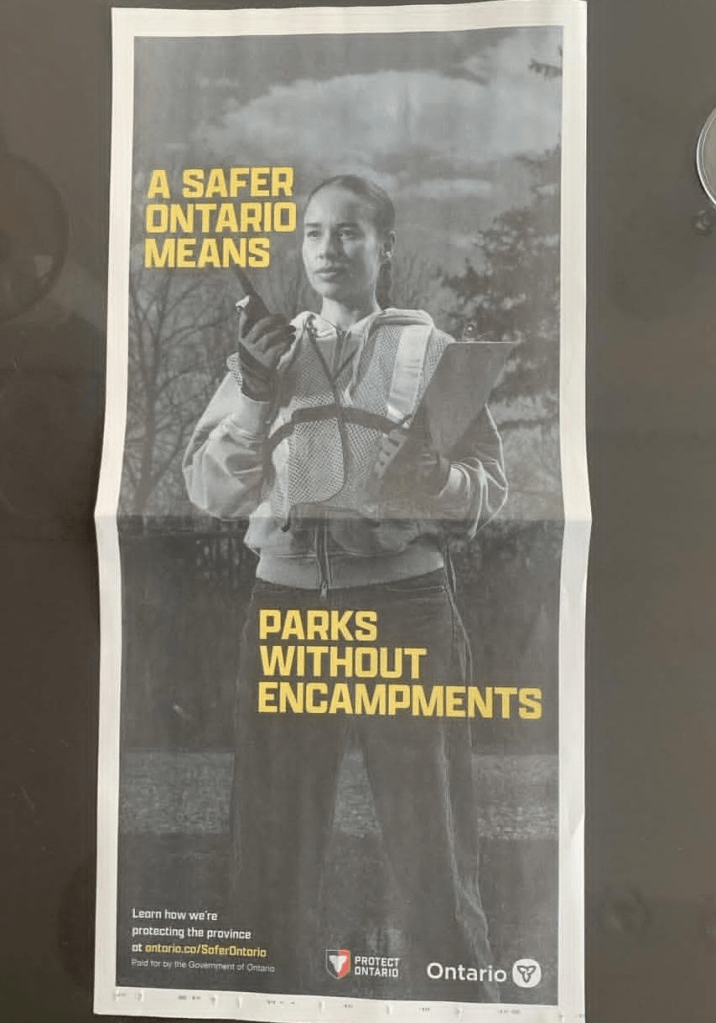
The clearest account of what Toronto is doing comes from the government doing it. A full-page newspaper ad running this spring shows a uniformed officer with a radio and a clipboard under a single line of copy: a safer Ontario means parks without encampments. It is paid for by the Government of Ontario, part of the “Protect Ontario” campaign, and it directs readers to a provincial web page. There is no euphemism to decode. The state has bought advertising space to tell the public that removing poor people from public view is what safety means.
The page the ad points to is just as direct. Ontario describes itself as protecting its neighbourhoods by clearing encampments, shutting down drug injection sites near schools, strengthening the bail system, and building more jails — over three billion dollars of new cells across the province. Homelessness, addiction, and poverty appear there not as conditions to be addressed but as threats to be cleared, alongside auto theft and bail reform. The framework is announced, funded, and advertised. Visible suffering is a public-safety problem, and the response to a public-safety problem is force.
This costs money the province otherwise claims it does not have. Ontario spent a record $111.9 million on government advertising in the year ending March 2025, during a $13.8-billion deficit. The auditor general has reported that several of these campaigns serve no purpose beyond improving the public’s view of the government.
The “parks without encampments” ad is that spending doing its job: not informing anyone, but training the public to read a sweep as protection.
Control is affordable; care is not
Toronto’s six World Cup matches at BMO Field carry a price tag that has grown to roughly $380 million, split across $104 million from Ottawa, $97 million from the province, and $170 million from the city. According to Mayor Olivia Chow, about a third of that total — in the range of $127 million — goes to policing and security. The money for surveillance, crowd management, transit enforcement, and the guards now working Union Station was found without difficulty.
The money for public life was not. This month the Toronto Waterfront Festival, a free event with a sixteen-year run, cancelled its 2026 edition. For the first time in its history it received no grant from any level of government, and organizers said the World Cup had drained the corporate sponsorship that might have replaced it. A city that located $127 million to police a month of football could not find a grant to keep a free public festival alive in the same summer. The contrast is not an oversight. It is a statement of what the spending is for.
The reflex runs to the top of the province. In April the Ford government bought a $28.9-million private jet for the premier’s use, a figure that passed $30 million with tax. After public backlash it sold the jet back, but the round trip still cost the public roughly $200,000 for an aircraft never used. The instinct to spend on the comfort of power is immediate and the resistance to spending on anyone else is permanent. The same government runs both reflexes at once.
Who gets swept next
The unhoused are first because they are easiest. They hold the least institutional protection, draw the least public sympathy, and can be moved without most residents noticing or objecting. This is what makes them a test population rather than a final target. Ontario already passed the legal instrument in 2025: the Safer Municipalities Act, an anti-encampment law that handed police new powers to clear public space, which the province’s own municipalities warned would punish homeless people without addressing why they are homeless. The province paired it with $75 million flowed to cities specifically to remove encampments.
Lorraine Lam, an outreach worker with the Shelter and Housing Justice Network, calls the result a cruel game of whack-a-mole — people pushed from one public space into another, losing the connections and resources that kept them safe. She has seen the pattern before. Toronto ran the same operation for the 2015 Pan American Games, clearing the streets for visitors under the same language of safety, and the homelessness it cleared from view is still here a decade later because removal was never meant to end it.
Mega-events accelerate this because they supply political cover. Researchers studying host cities from Rio to London describe the mega-event as a way of remaking a city into a brand-managed zone, its tourist-facing space cleared of the populations that puncture the image. Once the surveillance, the coordinated policing, and the private-security contracts are installed under cover of temporary necessity, the categories they apply do not stay fixed. Loitering, gathering, vending, and protest are already legible to the apparatus as disorder. The same force already reads its scandals as exceptions.
Nothing about this is temporary
The argument offered for all of it is that the World Cup is exceptional and the measures will pass with it. They will not. Cameras are not uninstalled. Policing budgets, once raised, set the new baseline. The coordination now being built between Metrolinx, the transit commission, Toronto police, and private security firms is an institutional relationship, and institutional relationships persist. The tournament is the occasion for building permanent capacity, not the reason it will be used. When the visitors leave, the infrastructure stays, pointed at whoever the city decides next does not belong in public.
Toronto cannot solve homelessness inside the economy it has built, and it cannot allow homelessness to be seen during a global event it has staked its image on. Management through policing is the resolution of that contradiction. It is cheaper than housing, faster than care, and it photographs as order. The World Cup did not create this logic. It revealed how much money and coordination the city can mobilize the moment elite priorities are threatened, and how little it will mobilize for anything else.
What the people being swept are asking for
The union at Berczy Park did not ask for better policing. It asked for the guards at Union Station to be replaced with harm-reduction workers, for 24-hour respite spaces to be opened during and before the tournament, and for the city to stop closing the shelters and supervised consumption sites whose closure pushed people into the station in the first place. These are not abstract demands. They are a description of safety that does not run through force — care delivered by people trained to keep others alive rather than to remove them from view.
That description is the answer the spending refuses. A government that can find $127 million to police a tournament and $30 million for a jet it never flew is not short of resources. It is short of the will to direct them at people who generate no brand value. Abolish the apparatus that treats poverty as a security threat, and fund the capacity that treats it as a human condition. The people dragged out of Union Station have already said what that looks like.
Sources
- CBC News — Unhoused people harassed at Union Station by security and police, advocates say (May 27 2026); TUHU interviewed 45 people over six weeks, ~90% reported witnessing or experiencing security violence
- The Globe and Mail — Security at Toronto’s Union Station targeting homeless people ahead of World Cup, advocates say (May 27 2026)
- CP24 — Union Station security targeting homeless people ahead of World Cup: Toronto group (May 27 2026); Lorraine Lam “human whack-a-mole” and Pan Am 2015 precedent; TUHU demands
- Government of Ontario — Safer Ontario page; province describes clearing encampments, shutting injection sites near schools, building more jails ($3B+), strengthening bail; the “Protect Ontario” framework in the government’s own words
- Global News — Government won’t say how much it is spending on ‘Protect Ontario’ commercials; auditor general found Ontario spent record $111.9M on advertising in year ending March 2025 during a $13.8B deficit
- CBC News — Ottawa commits $104M to help Toronto host 2026 World Cup games; total cost ballooned to $380M, roughly a third to policing and security per Mayor Chow; province $97M, city $170M
- CP24 — Toronto Waterfront Festival cancelled for 2026; 16-year run receives no government grant for the first time, FIFA competition for sponsorship cited
- Global News — Critics lambast Doug Ford for $200K in extra costs for private jet; $28.9M (over $30M with HST) Bombardier Challenger 650 bought and resold, public left with ~$200K in costs
- De Lisio, Silk & Hubbard — “Contested Terrains: Mega-Event Securities and Everyday Practices of Governance,” Social Sciences (2024); sport mega-events remake cities as brandscapes reliant on securitization to render “abject” populations invisible
- Spark Solidarity — Toronto Police Scandal Is Structural, Not Three Bad Apples (May 2026); the same force treating its own pattern of conduct as a series of individual exceptions
- Spark Solidarity — Windsor Police Shooting Is the Latest in a Lethal Pattern (May 2026); policing of people in crisis as structural rather than aberrant