
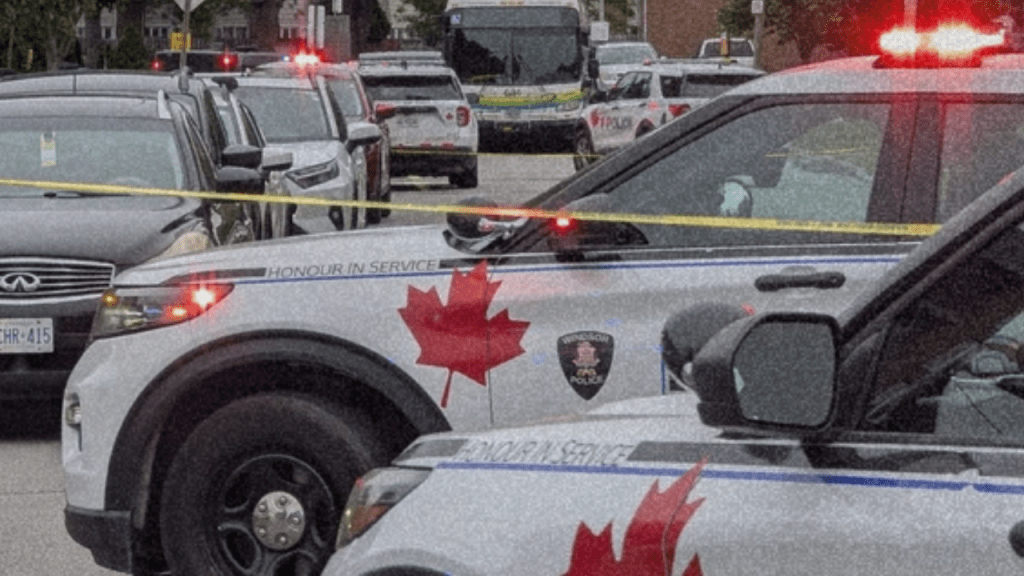
Windsor police shooting killed a 35-year-old man on May 22 — the latest death in a city where the same lethal script repeats against people in crisis.
A 35-year-old man is dead after Windsor police shot him on the evening of May 22, and the institutional script began running before his body had left the scene. Officers were called to Roseville Garden Drive around 6:30 p.m. for a report of an altercation involving a man with a knife. A taser was deployed. Officers opened fire. The man was pronounced dead in hospital. The Special Investigations Unit invoked its mandate, assigned its investigators, scheduled a post-mortem, and the killing became, as every Windsor police killing eventually does, an administrative process.
A group of young men playing cricket in a nearby field heard it happen. One of them, who declined to give his name, told the Windsor Star they heard ten shots — fired in two waves, with several rounds, then a pause, then the “pops” resumed. “We ran. We didn’t know what to do,” he said.
The detail matters because of what a pause means. A pause is time. Officers who stop firing and then start again are not caught in a single involuntary reflex; they have had the interval in which a decision gets made, and they have made it twice.
The phrases that follow a killing like this arrive almost instantly, because their function is to manage the public before the evidence does. Man with a knife. Officer safety. Threat assessment. They are not descriptions so much as pre-emptive permissions, conditioning the audience to absorb the death as regrettable but necessary before anyone has examined whether it was either. And in Windsor, the public has been conditioned this way before, more than once.
The same death keeps happening here
This is not a metropolitan force policing millions. Windsor is a city of roughly 230,000 people, and in under four years it has produced a record of police killings that reads less like a series of accidents than like a method. The victims were not interchangeable threats. They were specific people, most of them in crisis, and the manner of their deaths rhymes with a precision that should be impossible if each were truly the isolated tragedy the institution claims.
In March 2026, Windsor police shot and killed a 40-year-old man after a reported robbery involving a knife on Sandwich Street. Officers located him, deployed a conducted energy weapon, and then two officers fired. He was pronounced dead in hospital that night. The structure of it — knife call, taser, bullets, SIU, closure — is the same structure that produced the May 22 death two months later.
In September 2025, a 58-year-old man called for help because he wanted to harm himself. By the SIU’s account he was armed and discharged a firearm before three officers shot him; he died two days later. The state’s own version concedes the origin: a man in a suicidal crisis dialed the number that is supposed to bring help, and what arrived was a response that ended with him dead. The threat the SIU describes is real, and so is the fact that the encounter began as a cry for help and was resolved with lethal force.
In September 2024, Windsor police shot and killed 57-year-old Jason West at a downtown Beer Store after a report of a man with knives. West was an Indigenous man and a survivor of the Sixties Scoop, taken from his family as a child under the state’s program of removing Indigenous children. According to the SIU’s report, he repeatedly told the officers, “Kill me. Kill me.”
He was, by every account of the people who knew him at the Downtown Mission, profoundly unwell and profoundly kind. The officers were cleared. His death came during a two-week stretch in which six Indigenous people were killed in encounters with police across Canada, enough to force an emergency debate in Parliament.
In August 2022, officers killed 70-year-old Allan Andkilde who was wielding a machete he had bought that day at a downtown pawn shop. A taser was used, then he was shot. The SIU later found he had been “of unsound mind” and contemplating suicide; the original 911 caller was Andkilde himself, who told the operator he had not yet had a chance to swing the weapon. He struggled with addiction and mental illness and was known to the same Downtown Mission that knew West. No charges were laid.
Read together, the cases stop looking like coincidence. An elderly man of unsound mind, an Indigenous Sixties Scoop survivor begging to die, a suicidal man who called for help, a man with a knife on a Friday evening. Windsor police are not repeatedly stumbling into uniquely dangerous people. They are repeatedly converting crisis, disability, mental illness, and poverty into corpses, and then converting the corpses into case files.
Dominance replaced de-escalation
What connects these killings is a model of policing that no longer organizes itself around de-escalation but around dominance. Once a person is identified as a threat, the encounter becomes a procedure for restoring control through overwhelming force, and the question the institutional narrative is built to bury is the obvious one: how many armed officers does it take to contain a single man in crisis before containment stops being the goal?
A taser was used in nearly every one of these cases before the guns came out, which means a less-lethal option was right there in the officers’ hands and the lethal one was chosen anyway.
When the force ends a life, the institution simply translates the death into procedural language afterward. The translation is the point. It moves the event out of the realm of politics, where someone might be held responsible, and into the realm of administration, where an outcome is reviewed, a protocol is consulted, and the matter is closed. A man becomes an incident, and an incident becomes a finding, and a finding becomes silence.
The watchdog exists to close the file
The SIU presents itself as civilian oversight, and on paper it is. In practice its output is the quiet machinery of legitimation. Ontario’s watchdog closes the overwhelming majority of its investigations without laying any charge against an officer, and police forces understand this perfectly well, because they operate inside one of the most insulated accountability structures in Canadian life.
A teacher accused of misconduct is scrutinized publicly. A nurse can lose accreditation. An ordinary worker is fired on an allegation. An officer who kills someone is suspended with pay while the investigation runs for months or years and then, far more often than not, resolves into no charges at all.
The function of that process is not primarily justice. It is the stabilization of legitimacy after the fact — a ritual that absorbs public anger, runs out the clock, and returns the institution to operation. Andkilde’s officer was cleared. West’s officers were cleared. The pattern of clearance is not a series of separate evidentiary conclusions so much as the predictable output of a system designed to find that lethal force, deployed by its own members, fell within policy.
The media completes the circuit. The first version of every one of these deaths is the police version, reproduced as neutral fact: man with a knife, officer-involved shooting, the passive grammar that hides who pulled the trigger. The dead lose their voice instantly while the institution that killed them narrates the opening account, and by the time witnesses or families are heard, the frame is already set. State violence has been pre-translated into administrative normalcy, and the public has been trained to read these killings not as political events but as unfortunate technical outcomes.
The threshold keeps dropping
The bad-apple explanation collapsed long ago, and Windsor is the proof. A force does not repeatedly find itself cornered into killing vulnerable people by chance. It produces these outcomes because of how it is built — around coercive authority, force escalation, legal insulation, and an officer-first logic with no external mechanism strong enough to compel it to behave otherwise. Nationally the picture is the same: research tracking police-involved deaths across Canada documents hundreds of fatalities over the past two decades, with Indigenous and Black people disproportionately represented among those killed.
Underneath all of it is the ugliest movement of modern policing: the threshold for what counts as a justifiable killing keeps dropping. The mere allegation of a knife now functions as a kind of permission slip, sufficient on its own to make a death defensible regardless of how many officers were present, whether containment was possible, or what condition the person was in. Once the police declare that they were afraid, the conversation is treated as finished before it has begun.
That is the real crisis in Windsor, and it is not confined to Windsor. It is not simply that another man is dead on Roseville Garden Drive. It is that the entire apparatus — the police statement, the watchdog, the press release, the cleared finding — already expects the public to absorb his death as routine. The pattern is the institution working exactly as designed, and the only thing capable of breaking it is a public that refuses to accept the translation of a killing into a closed file.
Sources
- AM800 CKLW — Fatal officer-involved shooting on Roseville Garden Drive, SIU invokes mandate (35-year-old pronounced dead, May 22–23, 2026)
- CBC News — Man shot by Windsor police in east-end incident; SIU takes over (May 22, 2026)
- Windsor Police Service — SIU notified after officer-involved shooting, Sandwich Street (March 18, 2026)
- CBC News — Man, 40, shot by two Windsor police officers has died, SIU says (March 19, 2026)
- CBC News — 58-year-old man shot by Windsor police in Remington Park dies; SIU says man was armed and had fired (September 2025)
- CBC News — Memorial honours Jason West, Indigenous man and Sixties Scoop survivor killed by Windsor police (September 2024); national cluster of Indigenous deaths
- CBC News — SIU clears Windsor police in Jason West shooting; West repeatedly said “Kill me” (August 2025)
- CBC News — SIU clears officer who fatally shot Allan Andkilde, 70; found to be “of unsound mind” and suicidal (December 2022)
- APTN News — SIU seeks witnesses in death of Indigenous man Jason West (September 2024)



 Spark Solidarity