BlogTO’s Black Bloc story turned unverified social media chatter into a public threat narrative, echoing a pattern Toronto has seen before.
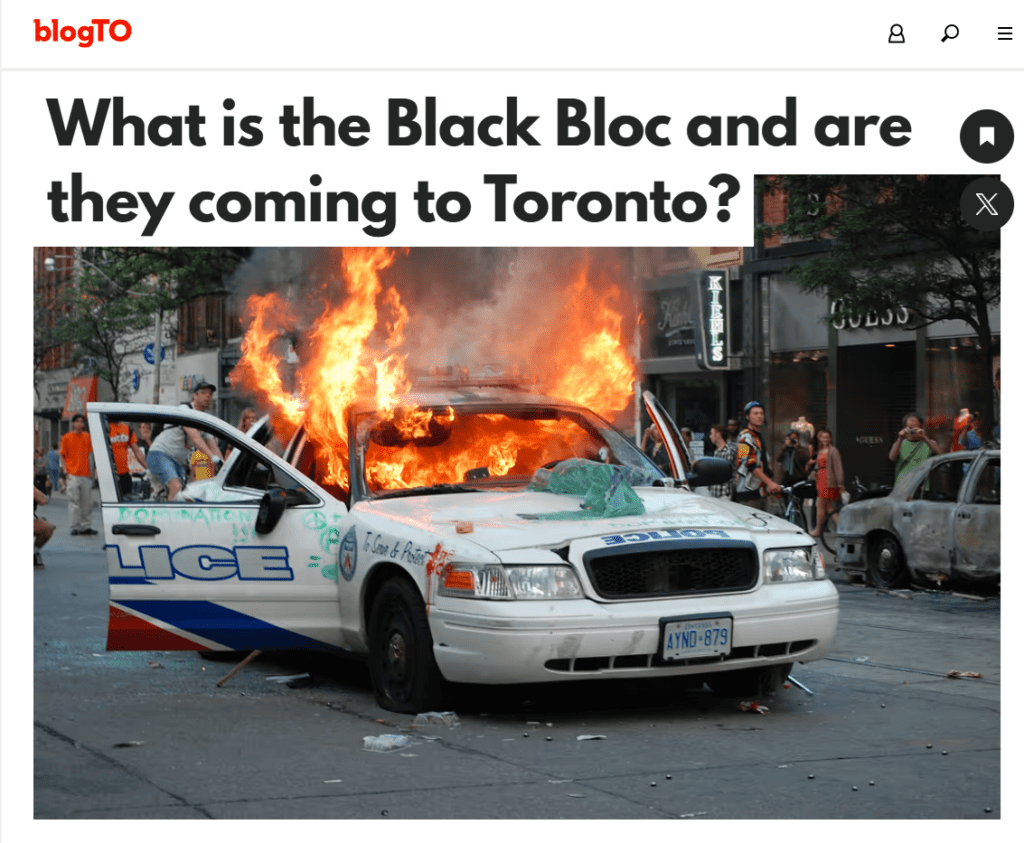
On June 5, 2020, BlogTO published an article titled “What is the Black Bloc and are they coming to Toronto?” In it, readers were warned that “rumours are swirling” about Black Bloc members descending on the city from Montreal to “raise hell” during anti-racism protests planned for the following day.
At first glance, the article presents itself as an explainer. In reality, it participates in a familiar and dangerous pattern: transforming online speculation into a public threat narrative at precisely the moment when restraint, verification, and clarity are most needed.
This is not simply a case of sloppy reporting or exaggerated headlines. It reflects a deeper failure to understand how fear narratives around protest, “extremism,” and so-called outside agitators have historically functioned in Toronto and across Canada.
From “Online Chatter” to Civic Alarm
The article opens by citing “a lot of online chatter” about riots breaking out downtown, chatter significant enough, it claims, to prompt hundreds of business owners to board up storefronts. Mayor John Tory is quoted referencing “unspecified threats” from people who “want to wreak havoc downtown,” while stressing that they are not affiliated with legitimate protest organizers.
This framing establishes anxiety as a given. But rather than interrogating where this fear originated or whether it was justified, the article accepts panic as its starting point. The question posed is not whether the threat is real, but who the threat is.
“So who are these mystery d*ckheads?” the article asks, before pivoting toward the Black Bloc narrative.
Rumours Without Evidence, Panic Without Sources
The core claim appears midway through the piece:
“Rumours are swirling that ‘Black Bloc members’ or ‘a group called the Black Bloc’ will be descending upon Toronto from Montreal this weekend to raise hell under the guise of protesting.”
This is a serious allegation. It implies coordination, intent, and violence. Yet it is supported by no named sources, no corroboration, and no reporting beyond embedded social media posts.
The primary tweets cited come from unverified accounts making sweeping claims about imminent looting, brick stockpiles, and police foreknowledge. Another embedded thread includes a reply featuring an image of extreme violence from Mexico, shared beneath a James Woods tweet, entirely disconnected from Toronto in time or place.
This is not verification. It is narrative reinforcement. Social media rumor is treated as evidence simply because it circulates.
Journalism’s role is not to echo anxiety, but to test it. Here, the rumors are allowed to stand on their own authority.
Explaining Black Bloc While Reproducing the Myth
BlogTO correctly notes that Black Bloc is “more of a ‘what’ than a ‘who’” and describes it as a tactic rather than an organization. But this clarification is undermined by how the article proceeds.
Black Bloc is repeatedly framed as something that “infiltrates” protests, hijacks movements, and causes violence and looting. Past events are invoked — Seattle 1999, Toronto’s G20, Trump’s inauguration — not to distinguish between documented facts and disputed narratives, but to suggest continuity and inevitability.
The result is a contradiction. Black Bloc is acknowledged as decentralized and amorphous, yet treated narratively as a coherent, mobile force capable of “descending” on cities.
This ambiguity is not incidental. It is precisely what makes the term so useful in panic reporting. When responsibility is diffuse and identity is vague, fear fills the gaps.
What the G20 Taught Us and What Was Ignored
This matters deeply in Toronto, because the city has already lived through the consequences of this narrative.
In the aftermath of the 2010 G20 summit, court documents and plea agreements revealed that at least 12 undercover police officers infiltrated protest and anarchist groups ahead of the demonstrations. Some of these officers did not merely observe. They actively helped organize actions, including identifying vandalism targets later used as criminal evidence.
Police had advance knowledge of when and where a small group of Black Bloc protesters would break away and engage in vandalism. Despite this, officers were conspicuously absent during the hour-long spree that produced the iconic images of burning police cars. Those images dominated media coverage for days.
What followed was mass repression. Nearly 1,200 people were arrested, overwhelmingly peaceful protesters and bystanders. Most were released without charge. The violence was limited. The crackdown was not.
This history matters because it demonstrates that Black Bloc panic is not just descriptive. It is instrumental. It provides spectacle, justification, and cover.
Media’s Role in Laundering Panic
Against this backdrop, BlogTO’s reliance on unverified tweets and speculative framing takes on greater significance.
The article does not accuse protesters directly. It does something more subtle. It legitimizes fear by presenting it as widespread and reasonable, while embedding the most inflammatory claims without scrutiny.
Police statements are included, but they are notably restrained. Toronto Police Services say they are “aware of various social media posts” and will respond “if necessary.” The police chief emphasizes that protests to date have been peaceful and refuses to speculate.
These quotes quietly undercut the sense of imminent threat. But they are buried beneath paragraphs of conjecture and historical association.
The effect is not balance. It is amplification.
How Panic Narratives Criminalize Protest
When media outlets frame protests as potential riots driven by shadowy outsiders, they narrow the space for democratic expression. They justify preemptive policing. They blur distinctions between peaceful demonstrators and hypothetical bad actors.
This has real consequences. Protesters are treated as suspects. Racialized communities are surveilled. The substance of protest is eclipsed by fear of disorder.
In this case, the protests were explicitly against anti-Black racism and police violence. Elevating unverified fears about looting and anarchist infiltration shifts public attention away from why people are protesting and toward a narrative that historically precedes repression.
Journalism Has Consequences
BlogTO did not invent the anxiety surrounding June 6, 2020. But it helped structure it. By transforming rumor into narrative, by embedding speculation without verification, and by recycling a historically loaded frame without context, the outlet participated in a well-worn panic cycle.
This is not about suppressing information or ignoring risk. It is about understanding function. In Toronto, “Black Bloc” panic has precedent. It has outcomes. And it has been used before to justify measures later acknowledged as unjustifiable.
Responsible journalism does not accelerate fear. It slows it down. It distinguishes evidence from speculation. It remembers history, especially when history warns us what comes next.
Toronto deserves reporting that informs rather than inflames. Our communities deserve better than recycled panic masquerading as concern.