Canada war on Iran: Carney backs strikes he admits violate international law, refuses to rule out military involvement, and calls it regret.
Carney Admits Illegality, Backs Strikes
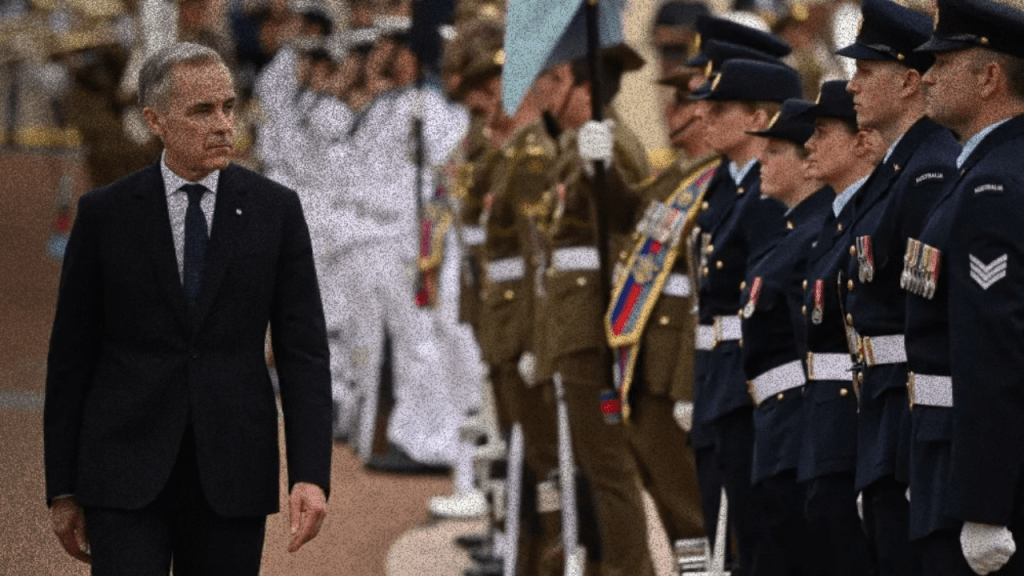
On March 3, 2026, Prime Minister Mark Carney stood before reporters in Sydney and called U.S.-Israeli airstrikes on Iran “another example of the failure of the international order.”
His PMO official statement acknowledged plainly that “the United States and Israel have acted without engaging the United Nations or consulting with allies, including Canada.”
Asked whether the strikes violated international law, Carney said they “prima facie appear to be inconsistent with international law” — then immediately added that whether they actually broke international law “was a judgment for others to make.” The Canadian government recognized, in plain language, that Operation Epic Fury — launched on February 28, 2026 — bypassed the legal architecture Canada claims to uphold. Then it endorsed the strikes anyway.
Carney expressed support with regret as a necessary response to Iranian nuclear escalation and regional destabilization. He affirmed Canada’s support for efforts to prevent Iran from obtaining nuclear weapons and condemned Iranian attacks on civilians. He stated that Canada’s support was “not a blank cheque.”
The contradiction was total: the strikes are illegal, but Canada supports them. The international order has failed, but Canada will reinforce that failure. This was not cognitive dissonance. This was imperial doublespeak functioning exactly as designed — legal acknowledgment without legal consequence, moral objection without political cost.
Canada Won’t Rule Out Joining an Illegal War
On March 4, Canadians for Justice and Peace in the Middle East (CJPME) issued a statement expressing alarm that Carney refused to categorically rule out Canadian participation in the war on Iran. During a press conference in Australia on March 5, Carney was asked directly whether Canada would join military operations.
His answer: Carney’s Canberra statement — “One can never categorically rule out participation. We will stand by our allies.” General Jennie Carignan, Chief of the Defence Staff, reinforced the hedge — denying direct participation in offensive strikes but leaving open Carignan Gulf hedge — defensive support should Iranian retaliation reach allied Gulf states.
This hedging strategy is deliberate. Canada maintains plausible deniability while keeping the door open for escalation. The phrasing mirrors Canada’s posture during the 2003 Iraq invasion, where Prime Minister Jean Chrétien publicly opposed the war while quietly allowing Canadian officers to participate in U.S. command structures. The legal gymnastics are identical: criticize American unilateralism, affirm alliance obligations, avoid formal declarations of war, and participate through technical channels. The result is Canadian complicity without Canadian accountability.
Former Liberal foreign affairs minister Lloyd Axworthy drew the comparison directly in an op-ed, noting that like Iraq, the attack on Iran cannot be justified under the UN Charter and warning that this is “the seventh country against which President Trump has ordered unilateral use of force while in office.” For how multilateral frameworks were used in the same week to enable a lethal operation the legislature never authorized, see the IRIS Dena torpedoes piece.
2,000 Canadians Stranded, Carney Backs War
Canada’s Foreign Affairs Minister Anita Anand confirmed that 2,000 Canadians stranded — over 2,000 requested government help leaving the Middle East since February 28. The Global Affairs advisory urged citizens to avoid all travel to Bahrain, Iran, Iraq, Israel, Kuwait, Lebanon, Qatar, Syria, the UAE, and Yemen.
Canadian Armed Forces personnel assigned to U.S. exchange programs have been moved to “other duties” outside the Iran campaign — a maneuver that creates technical separation from the offensive operation while maintaining personnel integration within U.S. command structures. These are not abstractions. These are the material consequences of a conflict Canada claims to oppose but refuses to exit.
The Canadian public is split, but the ruling class is not. Anti-war activists have mobilized across major cities, drawing direct parallels to the 2003 Iraq War protests. The NDP’s Alexandre Boulerice condemned the government for “blindly supporting this dangerous venture by Israel and Donald Trump’s administration.” Liberal MP Will Greaves broke with his own caucus to call for consistency and restraint. Conservative foreign affairs critic Michael Chong attacked Carney’s position as “utterly incoherent.” The criticism from the right is that Carney is not hawkish enough. The criticism from the left is that he is complicit in war crimes. Both are correct.
Canada’s Imperial Doublespeak on Iran
Carney’s contradictions are not personal failures. They are structural features of Canadian foreign policy. Canada positions itself as a “middle power” committed to multilateralism and international law, but this rhetoric serves as ideological cover for alignment with U.S. imperialism. As The Conversation’s analysis notes, Canada’s law asymmetry exposes exactly how the rules-based order functions — with vigour when adversaries break the rules, with regret when allies do.
The playbook is consistent: publicly criticize American unilateralism to maintain domestic legitimacy, privately support American objectives to maintain alliance credibility, and deploy technical language to obscure direct participation. Canada’s foreign interference narrative and its weaponized diaspora strategy follow the same pattern: invoke the rules-based international order while subordinating Canadian sovereignty to U.S. strategic interests. The rhetorical commitment to peace and law functions as legitimation for participation in imperial projects.
Illegal War, Canadian Backing, No Accountability
Operation Epic Fury launched on February 28, 2026, targeting Iranian infrastructure under the pretext of countering nuclear proliferation. Iran responded by deploying missile systems against U.S. bases across the region, striking Al Udeid in Qatar, Ali Al Salem in Kuwait, Al Dhafra in the UAE, and the Fifth Fleet headquarters in Bahrain.
Carney has acknowledged the strikes appear inconsistent with international law. He has refused to rule out Canadian military involvement. He has affirmed support for U.S.-Israeli objectives. There is no ambiguity here. Canada is backing an illegal war while pretending to oppose it.
The Canadian ruling class has perfected the art of imperial complicity through liberal rhetoric. They will condemn American aggression in press conferences while authorizing logistical support in classified briefings. They will call for de-escalation while increasing military spending to meet NATO spending targets. They will urge Canadians to flee a conflict zone while refusing to withdraw from the alliances that produced it. This is not hypocrisy. This is how empire functions when dressed in the language of multilateralism. Carney’s position on Iran is the clearest expression of Canadian foreign policy: criticize American imperialism, then participate in it, then deny responsibility for the consequences.
Sources
- Statement by Prime Minister Carney on the Middle East — PM of Canada, March 3, 2026
- Carney backs Iran strikes with some regret — NPR, March 4, 2026
- Canada PM Carney unable to rule out military role in Iran war — Al Jazeera, March 5, 2026
- Carney: support for Iran war is not a blank cheque — CBC News, March 3, 2026
- Canada could be called on to help defend Gulf states — CBC News, March 5, 2026
- Canada’s asymmetric application of international law — The Conversation, March 5, 2026
- Canada abandoning international law — The Hill Times, March 1, 2026
- Canada Middle East travel advisory — Global Affairs Canada, March 2026
- Canada’s role in Iraq War — The Globe and Mail
- Canadians protest Iraq War — CBC Archives
- NATO defence expenditure — NATO
- Foreign interference false narrative — Spark Solidarity
- Weaponized Diaspora and the Witnesses Empire Needs — Spark Solidarity
- U.S. Torpedoes Iranian Ship After Joint Naval Exercises — Spark Solidarity