A Chinese firm published detailed satellite imagery of U.S. military deployments before the Iran strikes — using images from American commercial providers.
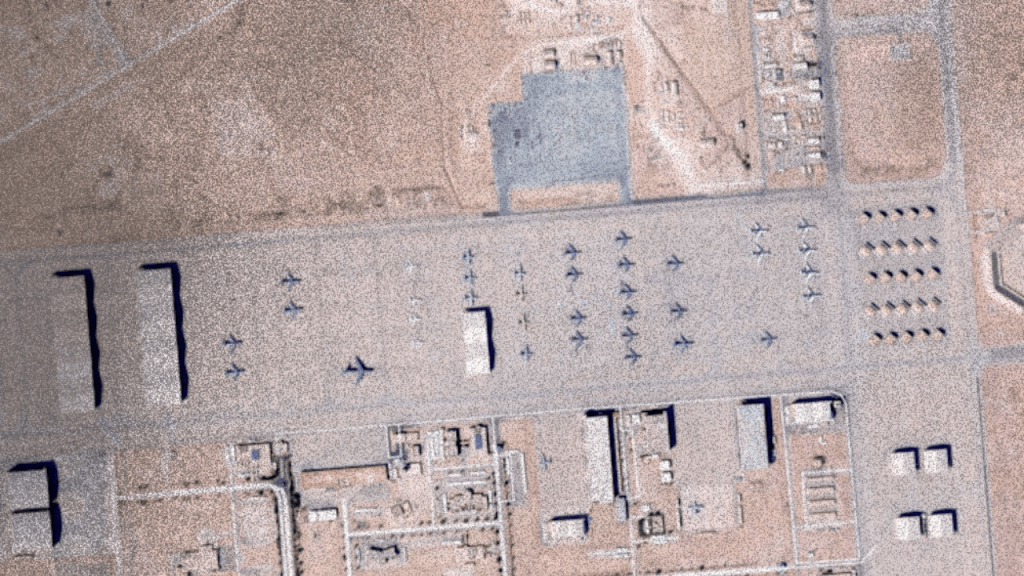
In late February 2026, a Chinese company called MizarVision began circulating annotated satellite imagery on Weibo showing U.S. military deployments across the Middle East in precise detail. F-22s at Ovda — eleven stealth fighters on the runway at Ovda Air Base in Israel. Eighteen F-35s and six EA-18G Growler electronic warfare aircraft at Muwaffaq Salti Air Base in Jordan. Prince Sultan assets — KC-135 refueling tankers, C-17 transports, E-3C early warning aircraft in Saudi Arabia. Patriot batteries. Logistics depots. Naval positioning. Change detection over days.
The framing that went viral was predictable: China had handed Iran a targeting map. It spread because it confirmed a story people already had. It was also, in its most alarming details, wrong. Hu Bo’s sourcing analysis — Hu Bo, Director of the South China Sea Probing Initiative at Peking University, says he is “100 percent sure” the images came not from Chinese satellites but from U.S. and European commercial providers. At high resolution, the source appears to be Vantor, formerly Maxar Intelligence, a U.S. company. Wide-swath maritime imagery came from Planet, another U.S. firm.
What MizarVision contributed was not access to classified Chinese reconnaissance. It was AI-driven object detection, annotation, change tracking, and theatrical repackaging for Weibo distribution. The underlying imagery was commercially sold, globally available, and in significant part American in origin. This is the actual story. And it is more consequential than the espionage narrative.
What MizarVision Actually Did
MizarVision is a five-year-old Hangzhou-based firm. MizarVision’s stated mission — “Finding answers, shaping tomorrow” — appears in English on its website. It has been tracking U.S. force movements in the Middle East since the pre-strike buildup began, publishing regular updates on aircraft types, air defense system positions, and logistics patterns across Qatar, Jordan, Saudi Arabia, Israel, Diego Garcia, and Crete.
The PLA amplified separately, releasing a video titled “Siege of Iran: where will the US military launch its attack in the Middle East?” — featuring high-resolution imagery of eight U.S. bases it described as under surveillance, with Patriot air defense systems at Al Udeid, Al Dhafra, and Prince Sultan Air Bases highlighted as pointed toward Iran.
Notably, Al Dhafra omitted — MizarVision left out the UAE base hosting the U.S. 380th Air Expeditionary Wing, one of the most significant U.S. air power hubs in the region. Aviation Week noted the omission without explanation. A retired Chinese colonel described MizarVision’s monitoring as representing China’s development as “an intelligence powerhouse.” That framing — capability demonstration and advertising — is more accurate than the espionage framing. This was performance as much as intelligence.
The Western Companies Selling the View
The most important fact in the viral story is the one the viral story omitted: the imagery that exposed U.S. deployments came from American and European commercial satellite companies. The commercial remote sensing industry — dominated by U.S. firms like Planet and Maxar — sells high-resolution imagery of the entire earth’s surface to anyone who will pay. That market was built under U.S. regulatory decisions that progressively permitted higher resolution imagery for commercial sale, driven by economic interest and industry lobbying.
The U.S. military is itself a major customer of these commercial providers. It funds them, contracts with them, and relies on their imagery for its own situational awareness. The infrastructure that enabled MizarVision to document American F-22 deployments in southern Israel is, in substantial part, infrastructure that American capital built and American policy permitted. Imagery capability was commercialized because it was profitable. The downstream consequence — that adversary states can purchase detailed documentation of U.S. military posture — was accepted as a trade-off. That trade-off is now visible in the Middle East, in real time, during an active war.
Why the Annotations Matter Even If the Secrets Don’t
The espionage framing is wrong, but the “nothing to see here” counter-narrative is also incomplete. Open-source intelligence has a practical floor and a practical ceiling. The floor: anyone with a credit card and analytical patience can approximate what MizarVision produced. Le Monde’s Planet analysis independently identified U.S. fighter deployments in Jordan using the same commercial imagery. Hobbyist OSINT accounts track aircraft carrier movements in near-real time. The raw capability is genuinely democratized.
The ceiling: not all actors can do what MizarVision does at speed and scale. AI-driven object detection that counts aircraft types in minutes, tracks asset changes across a dozen bases over days, identifies Patriot battery configurations — that is a productized analytical pipeline, not hobbyist work.
The SCMP’s China framing asked whether China is “flexing its intelligence muscle.” The honest answer: it is demonstrating the productization of a capability that Western commercial infrastructure made possible, redeployed for information warfare purposes. What changed is not that the information became available. What changed is that it became structured, packaged, and amplified through a state-affiliated distribution network during the week before a war began.
Visibility as a Strategic Instrument
The function of what China did is not primarily informational. Iran’s military planners have their own surveillance capabilities and access to the same commercial imagery markets. They did not need MizarVision to know that F-22s were at Ovda. The function was signaling — to multiple audiences simultaneously. To Iran: you are not alone in monitoring this buildup. To the United States: your force movements are being tracked, documented, and published. To the broader international audience: the infrastructure of American military projection is not a secret. It is a visible, documented, global infrastructure of coercion.
This is deterrence through exposure. Not deterrence through weapons, but deterrence through documentation. When military buildup becomes globally trackable and socially shareable, the political cost of that buildup increases — not because the weapons become less lethal, but because the infrastructure of empire has to be defended in public rather than obscured in secrecy.
The Surveillance Ecosystem and Who It Serves
The same commercial satellite and AI annotation industry that enabled documentation of U.S. military deployments enables documentation of everything else: protest movements, refugee flows, agricultural collapse, industrial emissions, mining operations in occupied territories. The tools do not respect the politics of who is being observed. What determines their use is who has the resources to purchase imagery, build the analytical pipelines, and distribute the results. Right now, that skews toward states, large intelligence organizations, and well-funded firms. But the floor is dropping.
The hobbyist OSINT community has already documented war crimes in Gaza, settlements in the West Bank, and environmental destruction in the Amazon using free and low-cost commercial imagery. The military significance of the MizarVision episode is real but limited. The political significance is larger: the claim that American military power projects invisibly and without accountability is harder to sustain when a Chinese company is publishing annotated aircraft counts on Weibo before the bombs fall.
Sources
- Ynet News — New Satellite Images Show US F-22 Jets at Ovda Air Base, February 28, 2026
- Aviation Week — U.S. Military Buildup For Iran Tracked By Chinese Space Company, February 27, 2026
- Pekingnology — Viral Satellite Imagery NOT Taken by Chinese Satellites: Hu Bo, February 27, 2026
- South China Morning Post — PLA, Chinese Firm Release Satellite Images of US Military Build-Up, February 27, 2026
- Strat News Global — China Satellite Images Show US Military Build-Up Around Iran, February 27, 2026
- Global Times — Satellite Images Reveal Accelerating US Military Presence in Middle East, January 30, 2026
- Ynet News — Find the F-22: The Chinese Firm Tracking US Force Movements, February 27, 2026