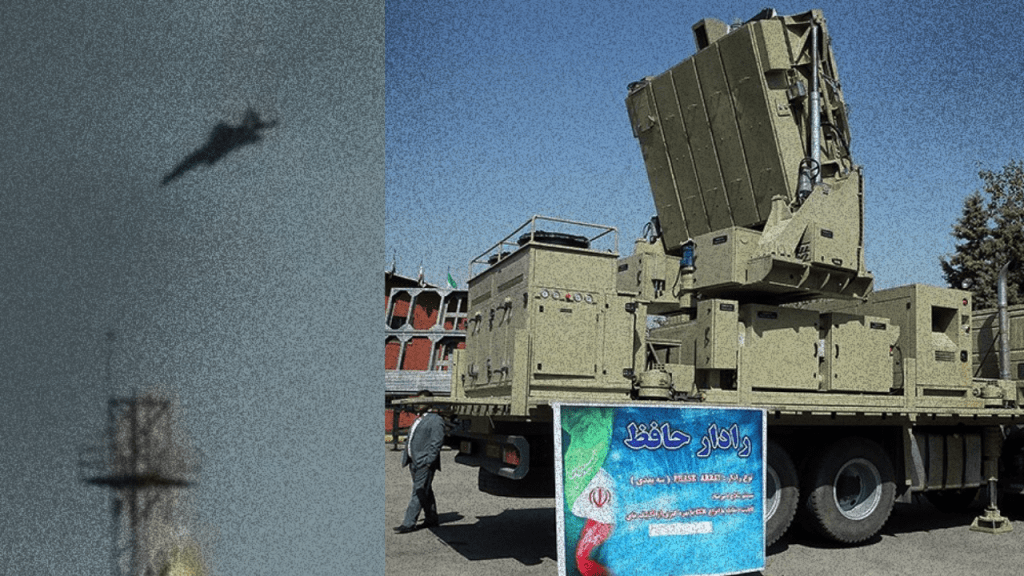
Three F-15s fell near their own base with no visible incoming fire. The official story doesn’t hold up — and the real explanation is about electromagnetic warfare.
Three American F-15E Strike Eagles fell from the sky over Kuwait on the night of March 1. All six crew members ejected safely. The official explanation arrived quickly: friendly fire, Kuwaiti air defenses, misidentification in a chaotic missile environment. Move along.
But the official story, examined against what is actually known, raises more questions than it answers — and the questions point toward something the coverage of Operation Epic Fury has almost entirely ignored: the electromagnetic dimension of this war, and what American dependence on electromagnetic infrastructure means for how long and how effectively that war can be fought.
The Story That Doesn’t Quite Add Up
Start with the basic facts as reported. U.S. Central Command confirmed at 11:03 p.m. ET March 1 that three F-15Es went down over Kuwait, shot down by Kuwaiti air defenses in “an apparent friendly fire incident.” All six aircrew ejected safely and were recovered in stable condition. The cause is under investigation.
That last sentence is doing a lot of work.
The videos that circulated before the official statement showed aircraft descending in flat spins, on fire, with tailfins missing — but no incoming missile visible, no explosion consistent with a proximity-fused SAM detonation. The Aviationist noted that one aircraft appeared to be “flying straight and level before an explosion takes place.” CNN geolocated one crash site to within 10 kilometers of Ali Al Salem Air Base — the aircraft’s own base of operations. The pilots were recovered alive by local Kuwaiti civilians in relatively good condition.
Three aircraft downed in the same engagement. All six crew out safely. Aircraft falling near their own base. No visible incoming fire. Former U.S. Air Force colonel Jeffrey Fischer told Military.com that Iran downing these jets with air defense missiles was “nearly impossible” given the distances involved. Retired Air Force veteran Denver Riggleman, who described himself as someone who mission-planned F-15Es for a living, called the official account operationally implausible and suggested it pointed to either incompetence or something not being disclosed.
The friendly fire narrative may be partially accurate. But it is far from self-evident, and even if accurate, it obscures the more important question: what actually made the IFF systems fail?
What IFF Is, and Why It Matters
Identification Friend or Foe is not a secondary system. It is the nervous system of coalition airpower. Every military aircraft operating in a contested airspace transmits encrypted transponder signals to ground-based radar systems, which read those signals and mark the aircraft as friendly rather than as a threat track. Without a valid IFF response, an automated air defense system has no electronic basis for distinguishing an F-15E from an inbound Iranian cruise missile.
Kuwait’s air defenses are linked to CENTCOM’s IFF command center in Qatar, and Kuwait has been in the process of upgrading its Patriot IFF hardware and software. In principle, American aircraft operating in Kuwaiti airspace would not fly unless the local air defense network had current IFF codes. In principle.
What CENTCOM’s investigation is now actively examining, according to former U.S. Deputy Under Secretary of Defense Stephen Bryen writing in Asia Times, is whether Iran jammed Kuwait’s IFF systems — effectively blinding the air defense network to the friendly status of the aircraft it then engaged. If IFF signals are degraded or severed, a Patriot battery tracking aircraft under saturation conditions does not hesitate. It defaults to threat.
There is direct precedent. The Aviationist documented a strikingly similar failure mechanism in a 2003 friendly fire incident at the same base — Ali Al Salem, Kuwait — involving a British Tornado GR4. That aircraft’s IFF transponder passed preflight checks but stopped working mid-flight due to a power system malfunction. The Patriot battery, receiving no IFF response, automatically flagged the returning aircraft as an incoming Iraqi missile and engaged. The crew were killed. The investigation found the identification criteria programmed into the Patriot were far too broad — built around a generic anti-radiation missile threat profile rather than the specific known threat environment.
Twenty-three years later, the same base. The same aircraft type. The same failure mode potentially in play. Whether by technical degradation or electronic attack, the IFF layer broke down and the automated system acted on what it saw: an unidentified track in a saturation event.
Iran’s Three Electronic Warfare Systems
Bryen’s Asia Times analysis identifies three Iranian electronic warfare platforms reportedly active at the time of the shootdowns, all operating from Iranian territory. The Cobra V8 is a truck-based system based on the Russian Krasukha-4 platform, deployed near coastal regions including Bandar Abbas. It operates across a roughly 250-kilometer radius, targeting X-band radar frequencies — the same range used by air defense acquisition and tracking radars — to generate an interference field that degrades airborne sensors and satellite signals. Iran unveiled it in September 2023 and has since deployed multiple units alongside S-300 and Bavar-373 missile batteries around strategic facilities, indicating deliberate integration of kinetic and non-kinetic air defense layers into a unified architecture.
The second system is the Sayyad-4 radar, repurposed from standard surface-to-air operation to broadcast interference that disrupts navigation and identification signals. The third is the Avtobaza-M, a Soviet-derived electronic intelligence system designed to track and jam the control links of drones and aircraft.
Bryen assesses that these systems, positioned on Iranian territory, were likely too far from Kuwait to jam IFF at the distances involved — Bandar Abbas sits roughly 1,000 miles from the crash sites. His analysis raises the possibility explicitly: is the jamming narrative being advanced in part to protect Kuwait from a “reckless operation” finding? Shooting down one allied aircraft in a high-tempo engagement is an accident. Shooting down three in the same incident is a pattern that demands either a technical cause or a very uncomfortable operational explanation. The political incentive to attribute the loss to Iranian non-kinetic interference rather than Kuwaiti operator failure is clear: Kuwait is a critical basing partner whose cooperation is not optional. The coalition narrative requires Kuwait to appear as a capable, reliable ally.
Whether the IFF jamming hypothesis is operationally accurate or diplomatically convenient, it has the effect of making the story about Iranian capability rather than coalition fragility. The deeper problem is that those may be the same story — that Iran’s non-kinetic capability and American coalition fragility are not separate facts but a single structural relationship.
The EPAWSS Gap
There is a second electronic warfare failure in this incident that has received almost no attention. The F-15Es that went down were not equipped with EPAWSS — the Eagle Passive/Active Warning Survivability System, an advanced electronic warfare and jamming suite providing active countermeasures and enhanced signal protection. Military.com reported that even the newer F-15EX variant carries EPAWSS only as an add-on at additional cost, pushing fully equipped unit costs toward $117 million per airframe.
More directly: The Aviationist confirmed that the F-15E carries no Missile Warning Sensors for infrared-guided missiles. If Kuwaiti SHORAD batteries fired infrared-guided rounds — consistent with early unconfirmed reporting — the crews received no onboard warning. They were flying over their own base, in friendly airspace, with no expectation of a surface-to-air engagement, and with no electronic signal to tell them one was coming. From an aircraft survivability perspective, the jets were flying partially electromagnetically blind into the precise threat environment they encountered.
This is not incidental. The United States chose to open its first major regional war in a decade with airframes lacking both the advanced EW self-protection suite designed for contested spectrum environments and the specific sensor for the most operationally relevant infrared SHORAD threat. That choice reflects procurement and readiness failures accumulated well before Operation Epic Fury, not a tactical error on the night.
The Doctrine Iran Has Been Building
These Cobra V8 deployments are not improvisational. Iran’s approach to electronic warfare has been developing over years as a deliberate response to American military doctrine, and the Kuwait incident sits inside a pattern that official commentary has consistently underweighted.
Iranian officials have publicly claimed the Cobra V8 functions not merely as a jammer but as an emission intelligence platform — capable of cataloguing electronic “fingerprints” of individual enemy aircraft. Defence Security Asia’s analysis reported Iranian defense officials claiming the ability to identify individual F-35s by their unique radar emission signatures — not just detecting that an F-35 is present, but distinguishing which specific airframe based on subtle waveform variations between units. Whether that specific claim is operationally validated, the doctrinal shift it represents is significant: moving from brute-force jamming toward signal intelligence exploitation, building emission libraries that could enable predictive tracking and mission pattern analysis across an entire conflict.
The system’s reported interference with U.S. Navy P-8 Poseidon maritime patrol aircraft during earlier Persian Gulf operations gave Iran practical performance data against active American platforms in real operational conditions. The deliberate co-deployment of Cobra V8 units alongside missile batteries reflects a doctrine designed to fuse kinetic and non-kinetic air defense — not simply to jam, but to degrade the electromagnetic picture in ways that force errors into allied systems and then exploit those errors with missiles or, as may be the case over Kuwait, let coalition automation do the work without firing a single Iranian round.
The Invisible Infrastructure of American Power
American military power is habitually discussed in terms of carriers, sorties, munitions stockpiles, and kill chains. What the Kuwait incident forces into view is the electromagnetic infrastructure beneath all of those things — the invisible layer of signals, transponders, datalinks, identification codes, and spectrum management on which every kinetic capability depends.
That infrastructure is not invulnerable. It operates across spectrum that adversaries have spent years learning to disrupt, exploit, and corrupt. It runs through sovereign allied systems — Kuwait’s Patriot network, Qatar’s IFF command center, Jordan’s radar picture — that the United States does not control and cannot fully harden. It relies on code synchronization, update protocols, and integration procedures that under saturation can fail, degrade, or fall out of sync in ways that produce no forensic signature a press release can name.
The GPS jamming piece published earlier in this series documented how Iran has been contesting navigation and positioning signals in and around the Strait of Hormuz — what spectrum denial looks like as a strategic tool. That analysis treated non-kinetic warfare as a distinct layer of the conflict. The Kuwait incident is the kinetic consequence of the same doctrine applied at the identification layer rather than the navigation layer. GPS jamming and IFF jamming are different mechanisms producing the same strategic effect: an ally that cannot be certain what it is looking at, in airspace it believed it understood, under conditions that force engagement before verification is possible.
The American way of war after 1991 was premised on electromagnetic dominance — on the assumption that U.S. and coalition systems would have a cleaner, more reliable battlespace picture than any adversary could. Desert Storm held that assumption. Iraq held it. Afghanistan held it. The Gulf battlespace of 2026 does not hold it. Iran has spent years contesting the electromagnetic environment precisely because it cannot match the United States in airframes, carriers, or precision munitions. Non-kinetic warfare is the asymmetric response of a state that understands what the American way of war actually requires to function — and has invested in attacking that requirement directly, at the infrastructure level, below the threshold of what gets counted as combat.
The Question the Investigation Won’t Answer
Retired Air Force veteran Riggleman’s response to the official account — “operational incompetence” — is probably partially right, and more interesting for being partially wrong. What it misses is that the competence question and the structural question are not separable. Operators become incompetent under conditions that exceed the design parameters of their systems and training. When IFF fails, or is jammed, or loses synchronization during a saturation event, the most highly trained operator in the world is making decisions with degraded information. Automation accelerates that degradation by removing human hesitation from the engagement loop.
The United States can replace three F-15Es. It can deploy more squadrons. It can generate more sorties and issue updated IFF codes and fly the next mission. What it cannot manufacture on demand is electromagnetic integrity in a contested spectrum environment across a coalition of sovereign states operating partially independent systems under active Iranian non-kinetic pressure. That integrity is the precondition for everything else — for IFF to work, for datalinks to function, for the shared air picture to be accurate, for allied operators to trust what their screens tell them.
When that precondition is degraded, aircraft fall near their own bases. Not necessarily from enemy missiles. From the failure of the invisible architecture that makes coalition war possible in the first place.
The investigation is ongoing. The IFF codes are classified. The jamming range is disputed. The aircraft are in the desert outside Ali Al Salem. And the war continues, on a spectrum nobody is talking about.
For related coverage, see GPS Jamming at Hormuz: What Satellite Warfare Actually Is and The THAAD Depletion Crisis, examining the interceptor burn-rate problem alongside the electronic warfare dimension of the current conflict. For analysis of the oil market logic underpinning the war, see Oil Rose 2%. Then the War Came. That Was the Point. and Not an Accident: 9/11, the Iraq War, and the Strategy of Oil Value Control.
Sources
- U.S. Central Command. “Three U.S. F-15s Involved in Friendly Fire Incident in Kuwait; Pilots Safe.” CENTCOM Press Release, March 2, 2026. https://www.centcom.mil/MEDIA/PRESS-RELEASES/Press-Release-View/Article/4418568/three-us-f-15s-involved-in-friendly-fire-incident-in-kuwait-pilots-safe/
- D’Urso, Stefano. “Three U.S. F-15E Strike Eagles Shot Down In Apparent Friendly Fire Incident in Kuwait.” The Aviationist, March 2, 2026. https://theaviationist.com/2026/03/02/f-15-crashing-in-flames-middle-east/
- Bryen, Stephen. “Why Did Kuwait Shoot Down 3 U.S. F-15s?” Asia Times, March 2, 2026. https://asiatimes.com/2026/03/why-did-kuwait-shoot-down-3-us-f-15s/
- Sands, Geneva, et al. “Three US Fighter Jets Accidentally Shot Down by Kuwaiti Air Defenses, Military Says.” CNN, March 2, 2026. https://www.cnn.com/2026/03/02/middleeast/us-kuwait-aircraft-crash-iran-intl-hnk
- Myers, Meghann, et al. “U.S. F-15 Friendly Fire Incident in Kuwait, All Pilots Safe.” Military.com, March 2, 2026. https://www.military.com/daily-news/2026/03/02/us-f-15-friendly-fire-incident-kuwait-all-pilots-safe.html
- Defence Security Asia Staff. “Iran Cobra V8 Electronic Warfare System: F-35 ‘Fingerprint’ Claim Escalates US-Iran Power Confrontation.” Defence Security Asia, February 2026. https://defencesecurityasia.com/en/iran-cobra-v8-electronic-warfare-uss-gerald-ford-strait-of-hormuz-f35-p8-poseidon/
- Trevithick, Joseph, et al. “Three USAF F-15E Strike Eagles Shot Down By Friendly Fire.” The War Zone, March 2, 2026. https://www.twz.com/air/f-15-spins-into-the-ground-while-on-fire-in-middle-east
- PBS NewsHour Staff. “U.S. Says Kuwait Mistakenly Downed 3 American Jets During Iranian Attacks; All Crew Safely Ejected.” PBS NewsHour, March 2, 2026. https://www.pbs.org/newshour/world/u-s-says-kuwait-mistakenly-downed-3-american-jets-during-iranian-attacks-all-crew-safely-ejected
- Muessig, Ben, et al. “Trump’s Iran Attack Was Illegal, Former U.S. Military Officials Allege.” The Intercept, March 1, 2026. https://theintercept.com/2026/03/01/trump-iran-attack-war-powers-resolution-united-nations-charter-legal/
- Wikipedia contributors. “Avtobaza.” Wikipedia, last updated July 2024. https://en.wikipedia.org/wiki/Avtobaza