
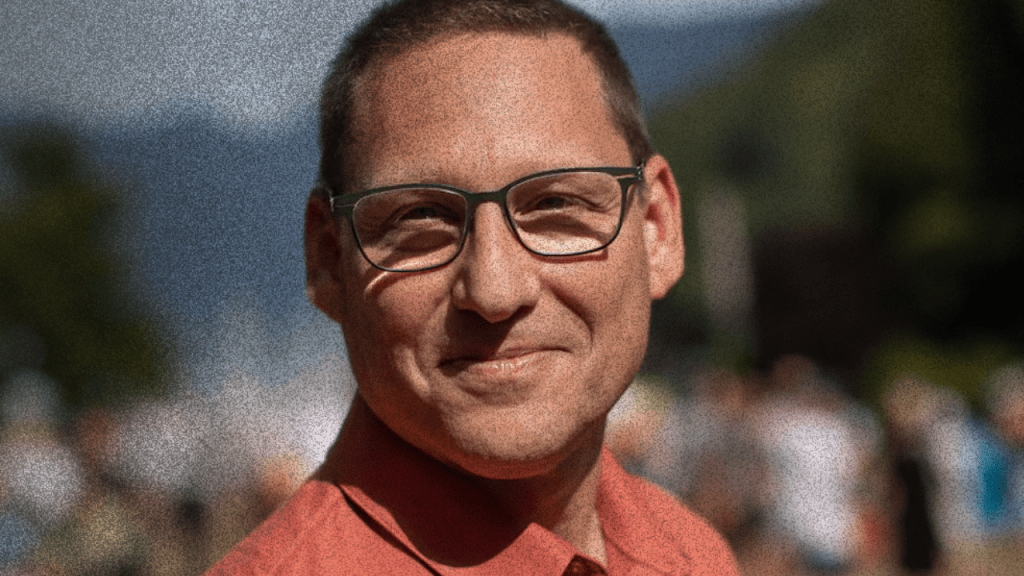
Avi Lewis NDP leadership is framed as left renewal — his record on Palestine solidarity tells a different story.
Leadership Defines What’s Thinkable
The NDP arrives at this convention having suffered its worst federal election result in the party’s history. The NDP’s electoral collapse under Jagmeet Singh left behind an identity crisis with no clean resolution. In that vacuum, leadership becomes something more than administrative. It becomes interpretive. Whoever wins doesn’t just lead the party. They define what the party means, what it stands for, and what kinds of politics are allowed to exist within it. Policy platforms are downstream of that. A leader doesn’t just implement ideas — they determine which ideas are even thinkable inside the party. The real power isn’t what they propose. It’s what they make sayable.
The same question was posed earlier in this race by Yves Engler’s insurgent candidacy — covered in July 2025 — which functioned as a stress test exposing what the party was willing to tolerate at its edges. Lewis’s response to that stress test is itself part of the record.
Three Days After October 7
Lewis presents himself as a principled advocate for Palestinian rights. His BDS support and anti-Zionist identity are real and documented. But so is this: on October 11, 2023 — three days after the Hamas attack, before Israel had launched its full-scale ground offensive, while the solidarity movement was just beginning to organize — Lewis posted on X accusing “some sectors of the left” of “callously celebrating vengeance against Israel, playing right into the hands of rightwing Zionists and others who weaponize antisemitism.”
Three days. The bodies in Gaza were not yet being counted in the tens of thousands. The encampments had not yet formed. The student movement had not yet emerged. And Lewis’s first public intervention aimed not at the genocide beginning to unfold, but at the left’s response to October 7 — framing solidarity expression as a gift to the right and a vector for antisemitism. This is not the record of a Palestine solidarity ally. It is the record of someone whose first political instinct, at the precise moment when the movement most needed cover, was to police it.
The Selina Robinson Protest
In February 2024, Lewis returned to X to attack a protest of former BC NDP cabinet minister Selina Robinson — who had publicly described Gaza as “a piece of land that was pretty much empty” before October 7 — as “childish and gross,” warning journalists not to cover it and suggesting it was intended to “discredit the movement to #StopGenocideInGaza.” Engler responded publicly the following day, noting that the protest had in fact been quite respectful, and asked Lewis directly whether an apology was forthcoming. None came.
The pattern is consistent. When the solidarity movement takes visible action, Lewis’s instinct is to distance from it, frame it as a liability, and invoke the antisemitism charge — not against Israel’s defenders, but against the protesters themselves. That is not an ally. That is a gatekeeper operating within the movement’s own institutional spaces.
What He Did to Engler
Lewis’s relationship to internal party democracy is equally instructive. When Yves Engler ran for the NDP leadership on an explicitly anti-imperialist, pro-Palestine platform, Lewis was the only candidate willing to defend what the party did. His record is documented in detail at Engler’s own account — including Engler’s exclusion from a party social open to the public, at which Engler’s three-year-old child was also turned away. Lewis justified it on record to the Globe and Mail. He was asked repeatedly by Engler’s campaign to clarify his position and never responded.
Eventually — in late December 2025, after sustained protest pressure outside his events, including a dozen people rallying outside a Toronto forum demanding he speak on the exclusion — Lewis emailed a statement to supporters who had previously contacted his campaign. He said he was “disappointed by the way this vetting process was handled” and committed to a formal review if elected leader. He empathized with Engler’s supporters. He also made clear he “profoundly disagrees” with Engler’s positions. What he did not say — the one thing that would have constituted a principled stand — was that Engler should be allowed to run. Engler himself noted this directly: “I think Yves should be allowed to run. That would have been a simple, principled statement.” It was not made.
The statement was also not a press release. It was a private email, circulated to people who had already contacted his campaign. It arrived after protest pressure made silence untenable, stopped precisely short of the one thing that mattered, and was repurposed as a campaign pitch — closing with an appeal to stay involved “until the Winnipeg convention and beyond.” When Bianca Mugyenyi entered the race as Engler’s replacement and was blocked as an “explicit proxy,” there was no equivalent statement. No protest pressure on his events, no statement. The correlation is precise.
This matters because of what Lewis consistently says about grassroots organizing, movement solidarity, and expanding democratic space inside the party. The gap between the rhetoric and the conduct is not incidental. It is the point. Lewis’s grandfather David Lewis and father Stephen Lewis expelled the leftist Waffle from the NDP in 1972. Avi Lewis cites their legacy regularly. He has never distanced himself from that expulsion. The family business, historically, has been containing the left inside the party — and doing it with left-sounding language.
When Solidarity Costs Something Concrete
The contrast between Lewis and Engler becomes sharpest when you look at what each actually did for Palestine solidarity activists facing institutional attack. Halifax-based community organizer Rana Zaman has been targeted three times in six years by coordinated Zionist lobby campaigns — her NDP nomination for Dartmouth-Cole Harbour stripped in 2019 under pressure from B’nai Brith and the Atlantic Jewish Council, a Nova Scotia Human Rights Commission award rescinded ten days later under the same pressure, and in November 2025, a YMCA Peace Medal rescinded eight days after it was awarded after the same organizations mounted another campaign against her. In a podcast interview for Blueprints of Disruption, Zaman was asked which leadership candidates had been there for her. She was direct: “Guess who defended me in 2019? Yves. Who approached Jagmeet Singh and called him out in 2019 about me? Yves. Even now recently with the Y, guess who just posted about me and what’s being done to me? Yves.” On the other candidates, including those now running as the left alternative: “Where were all these candidates in 2019 when it came to me personally, but more importantly, when it came to Palestine? Running very safe campaigns. Saying very safe things.”
Lewis ran his entire leadership campaign in British Columbia — his home province — during one of the most significant periods of BC public sector labour conflict in recent years. The BCGEU launched a strike in September 2025 involving 34,000 public sector workers, running for seven weeks into mid-October. The BC Teachers’ Federation was simultaneously in the most contentious round of bargaining in years, with talks reaching impasse in January 2026 over classroom conditions and workload. These were not distant disputes. They were happening in the province where Lewis lives, campaigns, and built his political identity. There is no documented record of Lewis on a picket line, no public statement of solidarity with striking BC public sector workers, no engagement with the BCGEU or BCTF disputes during the months his campaign was running. Union members reported he showed no solidarity for teachers — including in his own neighbourhood.
The pattern across all of these instances is identical. When solidarity is symbolic — when it costs nothing, when it aligns with the party’s institutional interests, when it can be photographed and circulated — Lewis is present. When it costs something concrete — when a Palestine activist is being stripped of awards by lobby pressure, when an excluded candidate needs defending, when workers on a picket line need a leadership candidate to show up — Lewis is not there, or arrives only after external pressure makes absence untenable, and even then stops precisely short of what the moment requires. Engler, the candidate Lewis justified excluding from the race, is the one who actually did the solidarity work Lewis claims as his identity.
The NDP’s Structural Contradiction Doesn’t Disappear
Lewis sits between two irreconcilable logics that have defined the NDP for decades: an electoral logic focused on viability and public perception, and a movement logic focused on pressure, disruption, and solidarity. Left analysts noted that internal NDP reforms under Jack Layton concentrated power in the leader’s office and weakened riding associations — meaning a Lewis win puts him at the helm of a party structurally weighted toward parliamentary manoeuvering over grassroots building, regardless of his stated intentions.
A leader doesn’t eliminate that tension — they resolve it in one direction. Lewis’s record shows which direction that will be. The October 11 tweet. The Selina Robinson post. The Engler exclusion and the belated, private, carefully limited statement that followed only after protest pressure. The silence on Mugyenyi. The absence from BC public sector picket lines during his own leadership campaign. The absence from Rana Zaman’s story while Engler showed up. These are not isolated failures of judgment. They are a consistent answer to a consistent question: what does Avi Lewis do when being left costs him something concrete? The record answers that, and it answers it the same way every time. For the full account of how those exclusions played out at the convention itself, see the Winnipeg convention piece. For the structural logic that makes these patterns predictable, see social democracy as management.
Sources
- NDP leadership candidates make final pitches — CBC News
- NDP leadership race: Who are all the candidates? — CP24/CTV News
- Some glaring contradictions in the Avi Lewis campaign — Yves Engler
- Avi Lewis breaks with NDP bureaucracy over Engler vetting — Global Green News, December 2025
- Avi Lewis is right to (belatedly) challenge vetting process — Yves Engler
- Twice Betrayed: The NDP, The YMCA, and Rana Zaman — Blueprints of Disruption
- ‘It’s not about me’: Rana Zaman speaks after YMCA rescinds her award — Halifax Examiner
- BC’s civil service union launches strike — The Globe and Mail, September 2025
- BC teachers contract negotiations — Global News, September 2025
- Out of the Impasse? The Avi Lewis Campaign and Left Strategy — Palestine Uncensored
- Jagmeet Singh Swings Too Late as NDP Fades Into Political Irrelevance — Spark Solidarity
- Yves Engler Leadership Campaign to Test Values of the NDP — Spark Solidarity
- Winnipeg 2026: What the NDP Convention Actually Revealed — Spark Solidarity
- Social Democracy Is Imperial Management, Not Socialist Transition — Spark Solidarity



 Spark Solidarity