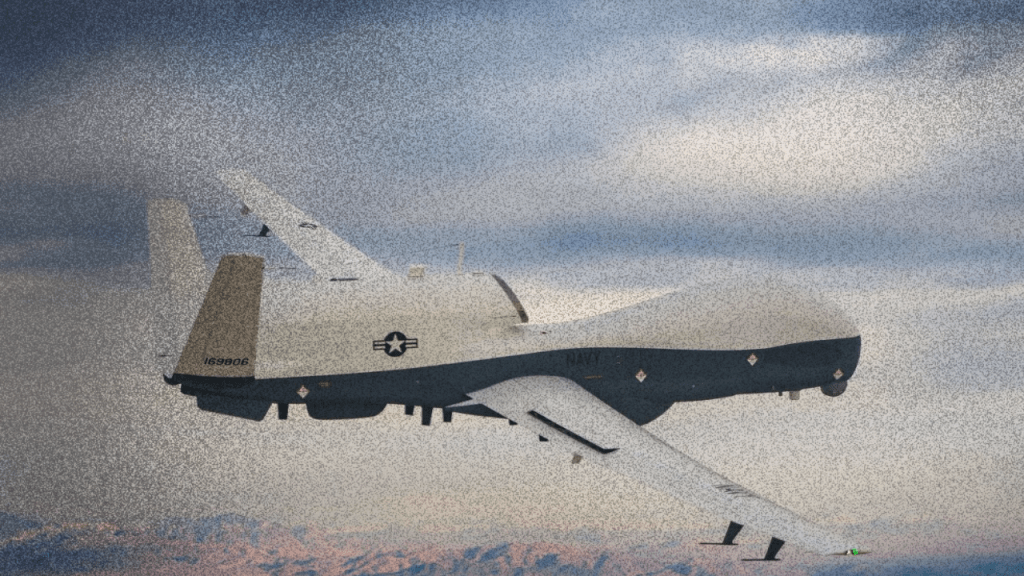
MQ-4C Triton drone Persian Gulf: a $200 million surveillance platform squawked emergency, turned toward Iran, and vanished. No statement issued.
At approximately 14:00 UTC on April 9th, ADS-B tracking data published by the War Zone showed a U.S. Navy Northrop Grumman MQ-4C Triton broad area maritime surveillance drone squawking transponder code 7700 — the universal aviation emergency signal — over the Persian Gulf. The aircraft was tracked on a heading pointing toward Iranian territory. It then disappeared from all available tracking data. No distress call has been reported. No wreckage has been publicly located. No statement has been issued by the Pentagon, U.S. Central Command, or any named U.S. official.
The MQ-4C Triton carries a unit cost of approximately $200 million. It is a high-altitude, long-endurance platform purpose-built for broad area maritime reconnaissance — the exact mission profile the U.S. Navy would be running over the Persian Gulf during an active ceasefire monitoring period. Its disappearance on April 9th — the day after the ceasefire was announced — has produced complete official silence from every U.S. military and government channel.
The Claim This Silence Has to Coexist With
The silence sits directly against a specific claim Pete Hegseth made at the April 8th Pentagon briefing. Hegseth told reporters that the U.S. owned Iranian skies — that Iran no longer had any comprehensive air defense system. The War Zone’s tracking data shows an emergency transponder activation over that same airspace less than 24 hours later, on a heading toward Iran, followed by disappearance.
Either the airspace was not uncontested, or the aircraft was lost to a non-hostile cause that the Pentagon has chosen not to explain. Both options damage the briefing’s credibility. The silence preserves ambiguity between them. As documented in the fuller record of the campaign’s material outcomes, the gap between Hegseth’s claims and the operational record is not minor. It is the difference between the briefing room version and what the data shows.
Every Available Explanation Costs Something
If the aircraft was shot down by Iranian air defenses, Hegseth’s uncontested airspace claim was false and Iran retained meaningful capability after forty days of strikes. If it malfunctioned and crashed, a $200 million surveillance asset was lost the day after the ceasefire — raising operational readiness questions the Pentagon has not addressed. If it landed safely somewhere classified, the emergency squawk and the Iran heading require an explanation that has not been offered.
If the tracking data was erroneous, the War Zone — which has a long record of accurate ADS-B reporting on sensitive military movements — has not said so, and no U.S. official has claimed it. Four possible explanations. Each one costs something the administration has not been willing to pay. The silence is cheaper than any of them.
What “Uncontested Airspace” Actually Means
the War Zone that U.S. Navy F/A-18s operating from carrier strike groups in the region were downed by Iranian fire during the campaign. CNN confirmed losses American aircraft losses. The administration has not provided a full public accounting of air combat losses. For an asset that size, in that location, on that day, the silence is itself a statement. The the narrative apparatus declared uncontested airspace. A $200 million surveillance drone disappeared over that airspace the following day. The declaration and the disappearance cannot both be true.
Sources
- The War Zone — MQ-4C Triton disappears over Persian Gulf, April 9, 2026
- The War Zone — U.S. Navy jets downed during Iran campaign, April 2026
- CNN — American aircraft losses confirmed, April 6, 2026
- Defense One — MQ-4C Triton incident, Persian Gulf, April 2026
- Spark Solidarity — The Iran War America Lost While Declaring Victory
- Spark Solidarity — Iran War Narrative Inverts Who Struck First