Second Sons used Sudbury’s overdose memorial as racial propaganda. The civic response rejected the hate but left the crisis itself unresolved.
On May 31, at least 10 members of Second Sons Canada filmed themselves moving through Greater Sudbury in matching black clothing, with all but two covering their faces. They visited the Grotto, the Energy Court encampment and Crosses for Change, the memorial to people killed by the region’s toxic drug crisis. At the memorial, they installed a six-foot white cross carrying the words Silent Slaughter. Neither the city nor memorial manager Denise Sandul had authorized it.
The same video placed the group beside the word Remigration on Sudbury’s legal graffiti wall. Its speaker blamed Canada’s “senseless border policies” and “foreigners” for the opioid crisis, turning a poisoned drug supply and a housing emergency into evidence for racial exclusion. The people memorialized at Crosses for Change, and the people still living through the crisis at Energy Court, became scenery inside a recruitment video.
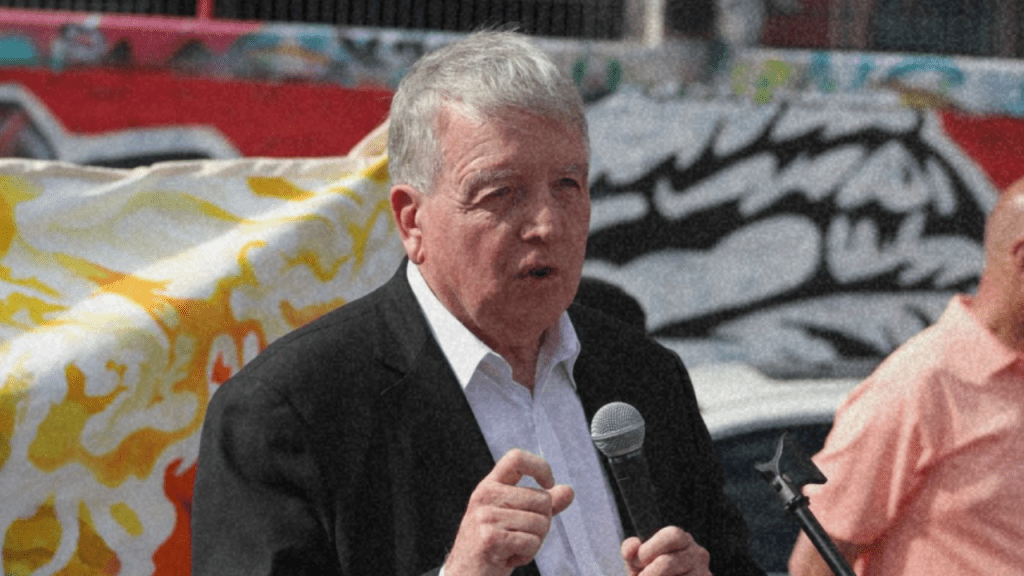
After Sudbury.com first reported the action, the cross was removed and the graffiti was covered. Local teacher Alisha Ravi then organized a solidarity rally where community representatives, politicians and Greater Sudbury Police Chief Sara Cunningham rejected the racist message. The response mattered. People targeted by white nationalism have every reason to make clear that the group does not speak for their city.
But the episode also revealed a second political process. Second Sons converted a public-health failure into racial propaganda. The civic response converted the far right’s appearance into a public ritual of institutional unity. The people whose deaths and living conditions made the entire spectacle possible remained much harder to hear.
The Cross Was a Political Prop
The Silent Slaughter cross was not a memorial contribution made in good faith. Crosses for Change already existed because families and community members had created a place to remember people lost to the toxic drug crisis. Second Sons entered that space without permission, installed its own object and used the grief attached to the memorial to carry a different political message.
The cross did several things at once. It wrapped the group in Christian imagery and mourning. It let masked activists present themselves as defenders of abandoned Canadians. It suggested that governments had chosen immigrants over citizens dying from toxic drugs. Most importantly, it allowed white nationalism to approach the public through the language of care rather than beginning with the racial destination of its politics.
That tactic depends on confusing care with possession. Second Sons did not arrive with housing, treatment, medical support or resources for people using drugs. Its members used the memorial, filmed the scene and left. The dead became politically valuable because their deaths could be made to accuse a racial enemy.
The use of Remigration completed the message. Someone encountering the term casually can hear stronger immigration enforcement. A committed racial nationalist can attach a much wider project to it. Our March investigation documented how Second Sons uses respectable public branding while its leaders have expressed far more explicit ideas about racial removal and conflict elsewhere.
The Crisis Was Already There
Second Sons did not need to invent suffering in Sudbury. It arrived at one of the city’s most visible wounds and supplied a racial explanation for conditions already produced by policy, markets and an unregulated toxic drug supply.
Public Health surveillance data covering January through May 2026 recorded 420 suspected opioid-related paramedic calls in Greater Sudbury, compared with 162 over the same period a year earlier. Preliminary surveillance also recorded 60 suspected drug-poisoning deaths across the Sudbury and Manitoulin districts during those five months.
The city once had a supervised consumption service at Energy Court. The Spot opened with temporary municipal funding while local officials waited for provincial support that never arrived. In December 2023, city council rejected a proposal to continue operating support. Donations kept the service running for several more months, but the site closed on March 29, 2024 when that temporary funding was exhausted.
Energy Court later became the centre of the city’s effort to concentrate homelessness services and encampment management in one location. That arrangement brought supports closer together, but it also gathered people already living with extreme vulnerability into a tightly managed space without solving the shortage of permanent housing. By June 13, seven people had died at the city-sanctioned encampment since it opened.
This is the material terrain Second Sons entered. The group did not create the poisoned supply, the housing shortage or the service gaps. It replaced their causes. Foreigners became easier to put on camera than provincial funding decisions, property relations, public-health capacity or the political choice to manage homelessness through temporary sites rather than guaranteed housing.
Grief Became a Recruitment Medium
The contemporary far right often works by beginning with a real injury. It identifies people who are visibly suffering, removes the institutional history that produced the conditions, then supplies a population to blame. The political work is not inventing the crisis. It is redirecting the anger generated by it.
In Sudbury, immigrants did not close The Spot. They did not decide how much governments would spend on supportive housing, treatment or public health. They did not build an illicit drug market where potency and contamination are impossible to regulate. Yet the Second Sons video collapsed those relationships into a story about borders and foreigners because racial blame can be communicated in three minutes more easily than a political economy of abandonment.
The cross made that substitution emotionally useful. The organization did not begin by asking viewers to endorse a complete program of racial removal. It began with death, neglect and grief. The suffering created moral access. The racial explanation followed.
This is why a material response to the toxic drug crisis is also part of confronting far-right recruitment. Ontario overdose policy already shows what happens when supervised care is removed and risk is displaced into libraries, encampments and other public spaces. Every unresolved crisis creates opportunities for movements willing to explain social failure through race.
The Civic Ritual Answered the Racism
The June 23 solidarity rally should not be dismissed as empty theatre. Ravi organized it because a white-nationalist group had targeted the city and specifically blamed immigrants for a deadly local crisis. Representatives from Black, Indian and Vietnamese communities publicly rejected that scapegoating. People facing racial hostility need collective visibility and the knowledge that others will stand with them.
The rally also created a familiar civic image. Community organizations, politicians, education officials and the police chief appeared inside the same public response, joined by a common declaration that racism had no home in Greater Sudbury. That message was morally clear, but the photograph could not show the differences in power, responsibility and institutional history among the people standing together.
This is what makes the response a civic ritual. A real community reaction becomes a ceremony through which institutions also present themselves as members of the moral community. The event says something necessary about who belongs in the city, while making it easier to postpone a different question: which institutions have power over the conditions that made the far-right intervention politically available?
The answer cannot be reduced to cynicism. Elected officials at the rally do not all have the same record, and community organizers should not be flattened into the institutions they invited onto the stage. The point is that a shared anti-racist message can temporarily conceal conflicts over housing, policing, harm reduction and public spending that would immediately divide the same civic coalition.
Solidarity Does Not Erase Unequal Power
A police service is not simply another community organization. It possesses coercive authority and plays a direct role in how cities manage public drug use, encampments and poverty. The presence of Police Chief Sara Cunningham at an anti-racist rally can express a legitimate rejection of white nationalism while still placing the police service inside a public image of protection rather than outside it as an institution subject to political scrutiny.
The city’s 2026 budget helps locate that institutional position. The approved city budget listed $92 million for the Greater Sudbury Police Service and a $10.1 million municipal service-partner allocation for Public Health Sudbury & Districts. These are different service envelopes and are not directly interchangeable, but the same budget also created a mobile security-enforcement team to support municipal housing operations.
Those choices place enforcement inside the social terrain Second Sons exploited. The organization filmed at an encampment created by housing failure and a toxic drug crisis. The civic response then featured police as defenders of a multicultural community against the racial politics attached to that suffering. No secret relationship between police and the far right is required for the institutional benefit to be visible.
A white-nationalist group can give policing a progressive public role precisely because the racism is real. The problem begins when that role shields the wider management system from examination. Removing a racist cross is not the same thing as reopening supervised consumption, building permanent supportive housing or reducing the need for police and bylaw officers to manage the public consequences of poverty.
The People at the Centre Were Missing
The most revealing part of the civic image was not only who appeared, but who was not publicly identified as speaking. The published rally coverage named community organizations, politicians, education officials, police and a prominent local volunteer. It did not identify a speaker currently living at Energy Court, a person who uses drugs, a harm-reduction worker or a family member represented at Crosses for Change.
That does not prove none attended. It does show who was publicly positioned as authoritative in the story that followed. The rally defended immigrants against being blamed for the overdose crisis, which was necessary. The people whose deaths and living conditions had supplied the original propaganda remained less visible as political subjects capable of explaining what they needed.
For Second Sons, people who use drugs became suffering Canadians whose condition could be blamed on foreigners. In the institutional response, their suffering became evidence that racism had exploited a local tragedy. In both narratives, the crisis was largely spoken about by other people.
The two appropriations are not morally equivalent. One advances white nationalism and the other opposes it. But the memorial can still become a stage in both cases. First the far right claims the dead for racial politics. Then the city symbolically reclaims the space through a public ceremony that leaves the people closest to the crisis at the edge of the frame.
Removing the Symbol Leaves the Opportunity
Sudbury was right to reject Second Sons. The cross was removed. The graffiti was covered. Community members refused to let white nationalists define immigrants as the cause of the city’s suffering. Those actions denied the organization uncontested ownership of the public image it had tried to create.
But a city does not defeat racial propaganda simply by removing the object carrying it. The opportunity remains wherever housing is unavailable, harm-reduction infrastructure is absent, the drug supply is unregulated and people living through the crisis are treated primarily as a problem to be managed.
A serious anti-fascist response has to work on both levels at once. Second Sons must be confronted as an organized white-nationalist project using real suffering to recruit and racialize public anger. Immigrant communities must be defended without placing police or political institutions beyond criticism. People using drugs and experiencing homelessness must be treated as political participants rather than scenery for either side.
Materially, that means permanent supportive housing, restored harm-reduction capacity, adequately funded public health, income security and a regulated alternative to the toxic illicit supply. Those policies would not eliminate white nationalism by themselves, but they would remove some of the suffering the far right converts into racial grievance while keeping more people alive.
Second Sons placed a cross at a memorial and tried to claim the dead for white nationalism. The civic response reclaimed the space symbolically and rejected the racial story. The political task left behind is harder: change the conditions that made the memorial necessary, and return authority over the crisis to the people living through it after the cameras leave.
Sources
- White nationalist group places ‘Silent Slaughter’ cross at Sudbury’s opioid memorial, Sudbury.com, June 12, 2026.
- White nationalist group cross removed from Sudbury’s opioid memorial site, Sudbury.com, June 15, 2026.
- ‘This is wrong’: Solidarity rally pushes back against white nationalist message, Sudbury.com, June 24, 2026.
- Drug Surveillance, Public Health Sudbury & Districts, data for January through May 2026.
- City council rejects plea to save supervised consumption site, Sudbury.com, December 18, 2023.
- Réseau harm reduction community grieves as funding ends, Sudbury.com, March 29, 2024.
- Council OKs plan to centralize social services downtown, Sudbury.com, October 7, 2025.
- Seven people have died since opening of Energy Court encampment, Sudbury.com, June 13, 2026.
- City Approves 2026 Budget Investing in Safety, Infrastructure and Community Growth, City of Greater Sudbury, December 2025.