Second Sons Canada shows how the contemporary far right hides a violent racial project behind heritage, fitness and fraternity. The institutions exposing that project can be right about the threat without becoming politically neutral authorities over hate, extremism or legitimate dissent.
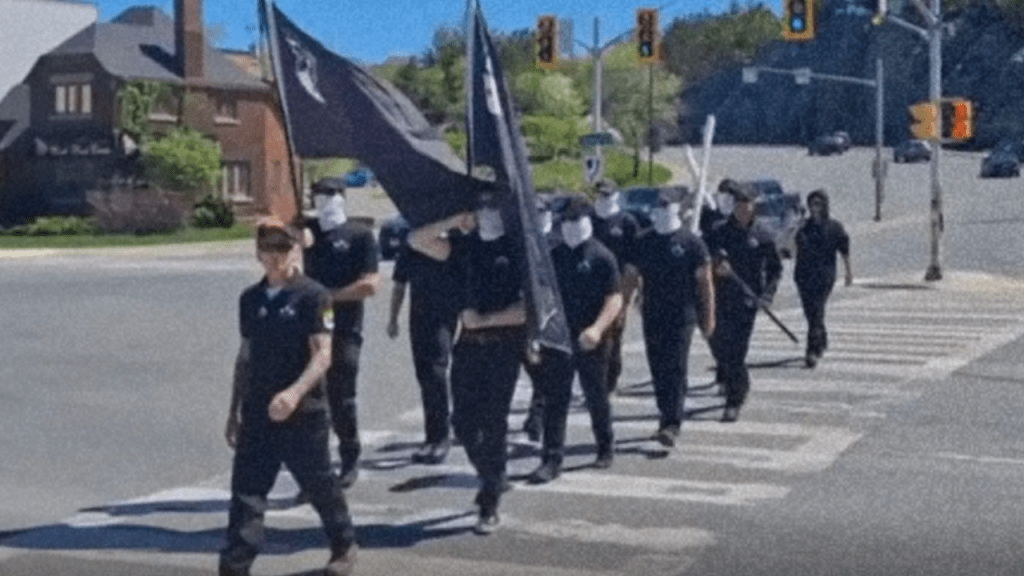
Second Sons Canada presents itself as a nationalist men’s organization built around Canadian heritage, physical training, camaraderie and community. Its public imagery is disciplined and deliberately respectable: masked men exercising together, commemorating military history and posing beside national symbols while talking about ancestry, belonging and the restoration of collective confidence. The pitch is designed to look less like a neo-Nazi organization than a social answer to alienated men who feel weak, isolated or displaced.
That presentation is not separate from the politics underneath it. It is the mechanism that makes those politics easier to reach. A December 2025 CBC investigation examining hundreds of podcast and livestream transcripts associated with Second Sons leaders documented racist and antisemitic conspiracy theories, sympathy for National Socialism, discussion of racial conflict and support for political violence. The contrast between that material and the organization’s polished public brand is therefore not evidence that one side has been misunderstood. It is evidence of a political funnel.
By March 2026, the Institute for Strategic Dialogue described Second Sons as one of the central Canadian examples of the Active Club model, a decentralized form of white-supremacist organizing that uses fitness, combat sports, male bonding and outdoor activity as a “big front door” into extremist networking and political mobilization. The point is not that exercise or male friendship is inherently fascist. The point is that ordinary human needs can be organized toward a fascist destination.
Understanding that destination matters. So does understanding who receives authority to name it, monitor it and build institutions around managing it. Second Sons is a genuine white-nationalist formation. CBC can produce valuable journalism about it. ISD and the Canadian Anti-Hate Network can produce useful research about it. Government agencies can identify legitimate security risks around it. None of those facts requires pretending that the institutions doing the classification exist outside politics.
The front door is the strategy
Open neo-Nazi branding has obvious organizational limits. Swastikas, explicit Hitler worship and racial slurs make the ideological destination immediately visible, repelling most potential recruits before any social relationship has been established. The Active Club model solves that problem by beginning somewhere more familiar. White identity becomes heritage. Political organization becomes community. Physical preparation becomes self-improvement. A theory of racial decline enters through conversations about immigration, social breakdown and the loss of national confidence.
ISD’s March 17 report describes this as part of a broader “White Nationalism 3.0” strategy. The model is less interested in recreating an old party structure than in building durable local networks through social activity and shared discipline. In a 2025 livestream cited by ISD, a Second Sons leader explained that “tribe and train” was not fundamentally about exercise but about learning how to organize people. The workout is therefore valuable to the movement precisely because it produces relationships, habits, hierarchy and collective capacity that can later be redirected toward demonstrations and political action.
This helps explain why the public and private languages of the organization can differ without contradicting each other. A new participant does not need to arrive prepared to defend every statement made by Jeremy MacKenzie or Alex Vriend. The organization can offer something tangible before demanding full ideological commitment: exercise, friendship, purpose, recognition and a place inside a disciplined group. The racial explanation is introduced through the community that has already begun meeting those needs.
The funnel then deepens. Canada is presented as an inheritance belonging to a particular ancestral population. Immigration becomes dispossession. Housing scarcity, precarious work and strained public services are detached from property, investment, austerity and class power, then reorganized into a story about demographic replacement. “Remigration” can circulate publicly as a harder immigration policy while more committed audiences encounter a much more expansive racial meaning. ISD’s research notes that some leaders using the term have openly described removing non-white populations regardless of citizenship or legal status and have contemplated violence in carrying it out.
The euphemism works because it has more than one audience. A general listener can hear border enforcement. A committed racial nationalist can hear expulsion. The ambiguity is not a communications failure that disappears once journalists reveal the hidden meaning. It is an organizational asset that allows a politics of racial exclusion to travel farther than explicit neo-Nazi language normally could.
The leadership supplies the destination
The question is not whether every person who attends a workout has accepted an entire white-nationalist doctrine. A graduated recruitment model depends on many participants not having done so yet. The more important question is what political destination the leadership has built around the organization.
Second Sons was founded in 2024 by MacKenzie and other figures who emerged from the Diagolon network. By the time the organization presented itself publicly as a nationalist men’s club, its leadership did not arrive without a political history. CBC’s December investigation and ISD’s subsequent analysis both describe a large gap between the sanitized public-facing material and the leaders’ more explicit rhetoric. ISD summarizes the underlying record as repeated support for white supremacy, neo-Nazism and violence, while noting that Second Sons has accepted people who openly identify as Nazis.
The organization’s relationship with other Active Clubs reinforces that direction. In October 2025, the Quebec-based Frontenac Active Club merged with Second Sons. ISD places both Second Sons and openly neo-Nazi Nationalist-13 inside the same wider organizing model while emphasizing that the groups differ in branding and tactics. That distinction matters. The contemporary far right does not need every organization to use the same symbols. A sanitized organization can reach people an openly Nazi organization cannot, while still operating within an ecosystem where members, tactics and ideas cross between networks.
This is why evidence must be ranked rather than flattened. Second Sons’ own public branding tells us how it wants to be encountered. Its leaders’ recorded statements tell us what they say to audiences who remain inside their media environment. The documented relationships between groups tell us who trains, appears and organizes together. Research organizations then interpret those facts and place them into larger models. The first three layers are evidence about the movement. The fourth is analysis, and it should remain identifiable as analysis.
The same caution applies to numbers. Second Sons leaders have repeatedly claimed thousands of applications, and those figures have circulated through media and anti-hate reporting. ISD explicitly notes that the organization’s exact membership is difficult to determine. A propaganda movement has an obvious incentive to exaggerate its scale. Reporting its numbers as organizational claims preserves the evidence without allowing the movement to manufacture an image of mass growth through the institutions covering it.
Fitness builds political capacity
The martial culture surrounding Active Clubs should also be analyzed precisely. Fitness, combat sports and outdoor training are not politically suspicious by themselves, and treating every gym or male friendship network as a potential extremist cell would reproduce exactly the kind of indiscriminate security logic that deserves criticism. The political significance comes from what a specific organization uses those practices to build.
In Second Sons, training sits beside hierarchical membership, masked formations, public demonstrations and repeated rhetoric about racial conflict. It produces organizational capacity: people who know one another, follow leadership, develop physical confidence and learn to act collectively. ISD’s report treats this long-term movement building as more important than looking only for an immediate plot. The risk lies not simply in whether a particular workout has an operational objective, but in the construction of a disciplined political network whose leaders describe racial struggle as inevitable or necessary.
The military dimension makes that question more serious without justifying speculation about every veteran involved. Official Department of National Defence records have documented previous cases involving Canadian Armed Forces personnel connected to the Proud Boys, La Meute and the Three Percenters, among other far-right networks. The record does not prove that the military directs the civilian far right. It demonstrates that the boundary between military experience and extremist organizing has repeatedly required institutional attention.
Veteran identity can therefore serve several functions inside a group like Second Sons. It provides patriotic legitimacy and practical experience, appeals to men attracted to military culture, and makes hierarchy or drilling easier to frame as ordinary discipline. Again, the point is not to declare all veterans suspect. It is to recognize that an organization already structured around white-nationalist politics can convert military experience into social authority and organizational skill.
The state understands this problem primarily as a security problem. By March 2026, a Public Safety Canada brief obtained by CBC was describing Active Clubs as a public-safety concern with a risk of extreme violence and calling for an integrated operational response. That assessment may be justified. But once the problem enters institutional form, a second question begins: what kind of authority is produced by the act of managing the threat?
Evidence does not make classifiers neutral
CBC, ISD and the Canadian Anti-Hate Network occupy different institutional positions. They should not be collapsed into a single apparatus. CBC is a public broadcaster carrying out journalism. ISD is an international counter-extremism organization whose work is designed in part for policymakers, practitioners and law enforcement. CAHN is an advocacy and research organization that investigates the far right and campaigns for stronger responses to it. Their evidence can overlap while their mandates, funding and political relationships differ.
Those relationships matter because classification is a form of power. Naming an organization as white nationalist may be accurate. Describing particular speech as antisemitic may be accurate. Identifying a genuine risk of violence may be necessary. But the institutions making those determinations also shape which categories become authoritative, how widely they are applied and which policy responses become imaginable.
CAHN provides a useful example of why institutional location should be disclosed without turning biography into conspiracy. Its own website identifies Bernie Farber as its founding chair emeritus and notes his previous leadership of the Canadian Jewish Congress. Federal records show that CAHN received a $200,000 Public Safety Canada grant running from April 2024 through March 2026 to create an ethical framework for research on far-right organizing. A separate Canadian Heritage agreement provided $440,000 from December 2023 through November 2025 for anti-hate work. These are public facts about where the organization sits. They do not prove that its reporting is false or that the government dictates its conclusions.
CAHN’s October 2025 report is strongest when its organizational claims are kept in that evidentiary frame. It describes Diagolon as a propaganda arm, Second Sons and related fitness groups as a militant street-level formation, and the Dominion Society of Canada as a more optics-conscious political operation. That model is analytically significant, especially because the report includes statements from participants describing the organizations as complementary. It should still be presented as CAHN’s interpretation of a wider ecosystem rather than as a formally proven command chart.
The distinction is not pedantry. A serious critique of the far right cannot afford to reproduce the evidentiary habits it criticizes. Every claim should be traced to what actually supports it. Second Sons should not receive the benefit of artificial ambiguity when its leaders’ own statements establish the political direction of the movement. At the same time, anti-hate organizations should not receive automatic neutrality simply because they are exposing people whose politics are worse.
Real antisemitism and broader authority
The Second Sons case is especially useful to anti-hate institutions because its antisemitism is not difficult to identify. The rhetoric documented around the organization invokes Jews as a collective and conspiratorial enemy, circulates Nazi ideas and places racial violence inside a broader vision of political conflict. Calling that antisemitism does not require a controversial theory about criticism of Israel. It fits longstanding understandings of racial and religious hatred.
The problem begins when the clarity of an obvious case becomes authority for a much wider framework. Canada adopted the International Holocaust Remembrance Alliance working definition of antisemitism in 2019. The federal government’s own handbook is clear that the definition is non-legally binding, does not supersede existing law and does not itself criminalize expression. The same handbook is also explicitly designed to encourage practical use of the definition across government programming, workplaces, civil society, education and law enforcement.
That dual character matters. A framework does not need to be criminal law to shape institutional decisions. Funding rules, workplace procedures, police training, university policy and administrative judgments can all influence the boundaries of legitimate expression without creating a new criminal offence. Independent Jewish Voices and more than thirty civil-society organizations warned in 2023 that using IHRA within Canadian Heritage granting and vetting procedures could chill speech about Palestinian dispossession and Israeli state violence. Their warning does not prove that every institutional use of IHRA suppresses Palestine solidarity. It establishes a documented political conflict over how the definition travels through institutions.
This is where the existence of unmistakable neo-Nazi antisemitism becomes politically consequential beyond the people producing it. Second Sons gives anti-hate institutions their easiest case: a movement whose leaders can be documented discussing Nazi ideas, racial hierarchy and violence. The danger is not in naming that hatred accurately. The danger is treating the authority gained from naming it as transferable without limit to political speech that is materially different.
Hatred of Jewish people and opposition to Zionism are not interchangeable. One constructs Jews as a racial or conspiratorial enemy. The other can describe and oppose a political ideology, a state project, occupation, apartheid or settler colonialism. Political expression can certainly become antisemitic while talking about Israel, but the categories cannot simply be collapsed in advance. Treating Jewish people as interchangeable with the Israeli state reproduces a political identification demanded by both antisemites and some Zionist institutions, though for opposing purposes.
This is why Spark’s earlier analysis of Hamilton NS13 and the institutional uses of the far right matters here. The reality of fascist antisemitism cannot become a blank cheque for institutions claiming final authority over every dispute involving antisemitism, Israel or Zionism. The correct position is not to deny the hatred in front of us. It is to refuse the idea that accurately exposing one threat automatically settles the politics of everyone empowered by the exposure.
Managing the threat leaves the terrain intact
The professional response to white nationalism tends to emphasize identification, monitoring, classification, criminal thresholds and intervention. Each can be necessary in particular cases. None explains by itself why the Active Club model attracts people or why its recruitment strategy can succeed.
Second Sons offers something real before attaching a racial explanation to it. It offers friendship to socially isolated men, physical activity to people who feel stagnant, discipline to people who feel directionless and identity to people who experience the world as decline. None of those needs belongs naturally to the far right. The political failure is allowing fascist organizations to become one of the places where those needs are organized collectively.
The racial story then converts material insecurity into demographic conflict. Housing scarcity becomes the fault of immigrants rather than landlords, investors, financialization and deliberate underbuilding. Deteriorating services become evidence that outsiders are consuming resources rather than evidence of political decisions about taxation, staffing and public capacity. Precarious employment becomes demographic replacement rather than a labour system designed to weaken bargaining power and make workers more disposable.
Class relations disappear, and race becomes the explanation for everything. A state that enters only through surveillance arrives after this translation has already succeeded. It may disrupt the resulting organization while leaving the recruitment terrain largely intact.
The visible far right can also become institutionally useful without anyone needing to create or secretly direct it. A genuine threat validates counter-extremism budgets, professional research sectors, expanded surveillance and stronger anti-hate mandates. Political leaders receive an enemy they can condemn without confronting concentrated property, collapsing public capacity or economic abandonment. Media institutions receive a recognizable spectacle of danger. The far right itself receives publicity and a narrative of persecution.
These interests are not identical, and the institutions are not secretly on the same side. The relationship is more ordinary. Each actor can derive something from the cycle while the social order producing alienation remains substantially unchanged. The threat is opposed morally while managed structurally.
Authority rarely stays with the obvious case
Powers built around an obvious enemy rarely remain confined to that enemy. The categories used to identify violent neo-Nazis can expand through elastic concepts such as extremism, radicalization, hate, public safety and social cohesion. Once broader authority is established, institutions decide how those terms are operationalized.
That does not mean every expansion is inevitable or that every disruptive movement will be treated like Second Sons. It means the political boundary cannot be assumed simply because the original case was clear. A system constructed to identify people openly preparing for racial conflict can also develop tools, partnerships and administrative habits that later reach unauthorized demonstrations, radical journalism, Indigenous land defence, anti-war organizing or Palestine solidarity.
The more frightening the original threat, the easier it becomes to treat the institutional response as neutral. Second Sons helps make surveillance and anti-extremism infrastructure appear self-evidently necessary because the organization’s own leaders supply evidence of racial hatred and political violence. The harder question begins after that necessity has been accepted: who controls the categories, who funds the institutions, what political histories shape their definitions and what happens when the target is no longer an obvious white-nationalist formation?
This is not an argument for abandoning anti-fascist investigation or treating every anti-hate organization as an enemy. CBC’s reporting is valuable because it went behind the public brand and showed the ideological funnel. ISD’s research clarifies how apparently benign social activities can become movement-building infrastructure. CAHN has documented networks that would otherwise remain harder for the public to see. The work can be useful precisely because evidence should be judged on what it establishes rather than accepted or rejected according to institutional loyalty.
The same standard has to apply to the institutions themselves. Their funding, mandates and political relationships do not automatically invalidate their findings. They do explain why authority should be examined rather than presumed. The classifier is part of the political field it is classifying.
Follow both chains at once
A serious analysis of Second Sons has to resist two convenient conclusions. The first is that the organization is merely a patriotic fitness club being smeared by hostile media. The documented record surrounding its leadership makes that position indefensible. The second is that every institution exposing the group should therefore receive neutral authority over hate, extremism and acceptable political speech.
The evidence points in two directions at once. Experienced far-right organizers have built a more effective vehicle for ideas they already held. Heritage attracts people who would reject explicit Nazi imagery. Fitness creates relationships and discipline. Euphemisms carry racial objectives into ordinary political conversation. More committed media spaces reveal the destination to audiences already brought inside the network.
At the same time, the institutional response converts a genuine danger into professional, legal and security authority. Journalists gain public importance by exposing the network. Counter-extremism organizations gain mandates and funding. Anti-hate groups gain influence over how threats are named. Governments gain frameworks that can extend beyond the original case. None of this makes the far right less dangerous, and none of it requires a conspiracy.
The answer is to oppose Second Sons without surrendering political judgment to the institutions that manage it. That means following the chain from sanitized heritage propaganda to racial nationalism and contemplated violence. It also means following the chain from legitimate exposure of that violence to the expansion of institutional authority over extremism, antisemitism and dissent.
Second Sons and the anti-hate establishment are not equivalent forces. One is building white-nationalist organization. The other is building systems for defining and managing threats. Their purposes, powers and consequences are different. But they exist in a relationship, and understanding only one side leaves the political structure incomplete.
The far right should be confronted before it can turn isolation into racial solidarity and material insecurity into ethnic conflict. The institutions confronting it should also be subject to the same evidentiary discipline they demand from everyone else. Anything less sees only half the story.
Sources
- Rai, Steven. “‘Tribe and train’: Examining Canada’s new model of white supremacist mobilization.” Institute for Strategic Dialogue, March 17, 2026. https://www.isdglobal.org/digital-dispatch/tribe-and-train-examining-canadas-new-model-of-white-supremacist-mobilization/
- CBC News Visual Investigations. “The true nature of Canada’s largest white nationalist group.” December 2025. https://www.cbc.ca/news/canada/second-sons-leaders-livestreams-9.7022853
- Institute for Strategic Dialogue. “The true nature of Canada’s largest white nationalist group.” December 23, 2025. https://www.isdglobal.org/media-mentions/the-true-nature-of-canadas-largest-white-nationalist-group/
- Canadian Anti-Hate Network. “White Nationalism in Canada: Organized, Emboldened, and Growing.” October 30, 2025. https://www.antihate.ca/white_nationalism_in_canada_organized_emboldened_and_growing
- Canadian Anti-Hate Network. “About Us.” Accessed by the historical cutoff of March 17, 2026. https://www.antihate.ca/about
- Government of Canada. “Creating an Ethical Framework for Research on Far-Right Organizing in Canada.” Public Safety Canada grant record, April 1, 2024 to March 31, 2026. https://search.open.canada.ca/grants/record/ps-sp%2C088-2023-2024-Q4-00051%2Ccurrent
- Government of Canada. Grants and Contributions database results for the Canadian Anti-Hate Network, including the 2023 Canadian Heritage agreement. https://search.open.canada.ca/grants/?page=1&search_text=%22Canadian+Anti-Hate+Network%22&sort=agreement_start_date+desc
- Government of Canada. “Canadian Handbook on the IHRA Working Definition of Antisemitism.” https://www.canada.ca/en/canadian-heritage/services/canada-holocaust/antisemitism/handbook-definition-antisemitism.html
- Independent Jewish Voices Canada. “30+ Civil Society Groups to Canadian Heritage: Ditch Controversial Antisemitism Definition from Granting Procedures.” February 7, 2023. https://www.ijvcanada.org/30-civil-society-groups-to-canadian-heritage-ditch-controversial-antisemitism-definition-from-granting-procedures/
- Department of National Defence. “Personnel.” Government of Canada, 2020. https://www.canada.ca/en/department-national-defence/corporate/reports-publications/proactive-disclosure/supp-estimates-a-2020-21/other-issues/personnel.html