Canada is moving from funding and training Ukraine to manufacturing battlefield systems at home. The war is becoming domestic industrial policy.
On June 10, Russia’s Foreign Ministry called Canada a “warmonger” and threatened to publicize the address of an Ontario company involved in a new Canada-Ukraine drone-production deal. Defence Minister David McGuinty rejected the threat and said Ottawa would continue supporting Ukraine.
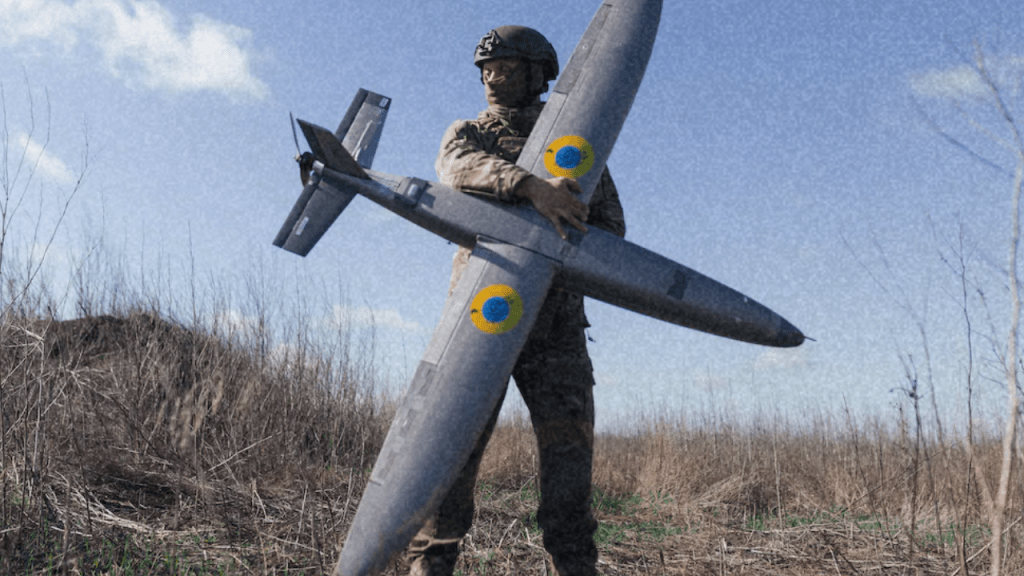
The threat was intimidation. The material dispute underneath it was still real. Two weeks earlier, the Canadian government had announced an arrangement to support the production of Ukrainian uncrewed aerial systems in Canada. The project brings together Ukrainian drone company Airlogix and Canadian manufacturer Sentinel R&D to build Ukrainian systems on Canadian soil for the Armed Forces of Ukraine.
This is a meaningful change in form. Canada has funded Ukraine, trained its forces, supplied military equipment and sanctioned Russia for years. The new arrangement places part of Ukraine’s military production chain inside Canada itself. Ottawa is not merely transferring resources into the war. Canadian industrial capacity is being organized to manufacture systems for one side of it.
The government’s own language makes the domestic logic explicit. The project is supposed to accelerate equipment deliveries to Ukraine while strengthening Canada’s defence industrial capacity. Support for Ukraine and the expansion of Canadian military production are being presented as the same policy.
Russia Put the Canadian Production Chain in Its Sights
Russian Foreign Ministry spokesperson Maria Zakharova responded to the deal by arguing that Ukraine was moving important military production into a third country. She said Moscow would take the arrangement into account in its military and political planning and threatened to publicize the location of the Canadian company involved.
That threat should not be romanticized as strategic insight. Publicizing the location of a civilian workplace in a NATO country is intimidation, and the possibility of military targeting cannot be treated casually. But dismissing the entire Russian response as propaganda would also avoid the material question the deal raises.
Canada has agreed to help manufacture military systems for Ukraine’s armed forces inside Canada. The systems are intended for a military fighting Russia. The production site is geographically removed from the battlefield and protected by the territory of a NATO state. Moscow does not have to be morally or legally correct about the war for that supply-chain fact to be true.
The sharper question is therefore not whether Russia approves. It is what Canada is becoming through the arrangement. A country that describes its role primarily through solidarity and support is increasingly building military production into its own industrial strategy.
The Drones Will Be Built for Ukraine’s Military
The May 29 announcement was direct. Canada’s Department of National Defence and Ukraine’s Ministry of Defence signed an arrangement supporting production of Ukrainian uncrewed aerial systems in Canada. The Airlogix-Sentinel partnership will manufacture Ukrainian drone systems in Canada for the Armed Forces of Ukraine.
The announcement did not describe the project as humanitarian reconstruction or civilian technology transfer. It placed the deal inside a defence partnership and said the systems would go to Ukraine’s military. Airlogix said its purpose was to deliver effective systems to the armed forces as quickly as possible. Sentinel described the project as an effort to deliver critical capabilities that could make a difference in the war.
The distinction between reconnaissance and direct attack does not remove the project from the war. Modern drone systems can locate troops and vehicles, collect battlefield intelligence, support operational planning and feed information into a wider targeting process without carrying explosives themselves. Military production does not become non-military because one component of the system gathers information rather than detonates on impact.
Canada’s role is therefore becoming more industrially embedded. The state is supporting a Canadian-Ukrainian corporate structure that will manufacture military systems domestically for use by Ukraine’s armed forces. The battlefield remains in Ukraine. Part of the production network is moving into Canada.
Ottawa Is Building Its Own War Industry Too
The Canadian government has been unusually open about the second purpose of the project. It says the arrangement will accelerate delivery of equipment to Ukraine while strengthening Canada’s defence industrial capacity. McGuinty described the collaboration as support for Ukraine that would also drive economic growth and resilience at home.
That domestic payoff is not incidental. Military production creates factories, contracts, research partnerships, skilled jobs, procurement relationships and companies whose future revenues become tied to continued defence spending. Once that infrastructure exists, military policy is no longer only a foreign-policy question. It becomes an employment policy, an industrial policy and an investment strategy.
The timing is important. The arrangement was announced during CANSEC, Canada’s largest defence-industry trade show, days after Mark Carney became the first sitting prime minister to keynote the arms fair. The same political moment that presented military spending as a route to Canadian industrial renewal also produced a concrete mechanism for bringing Ukrainian war technology into Canadian manufacturing.
The government can therefore sell the policy in two directions at once. Internationally, the drones are solidarity with Ukraine. Domestically, the same project is growth, manufacturing capacity and technological development. The battlefield requirement and the industrial opportunity become mutually reinforcing.
This is how war production develops its own constituency. The longer the conflict and the broader the military buildup, the more companies, workers, research institutions and governments become materially invested in defence expenditure. The political question shifts from whether military production should expand to how Canada can capture more of the economic benefit from its expansion.
The Production Deal Was Already Policy
The Airlogix-Sentinel partnership did not emerge as an improvised response to one battlefield shortage. Canada and Ukraine had already placed defence-industrial integration inside their long-term relationship.
The ten-year security agreement signed in February 2024 committed both countries to deeper cooperation across military assistance, training, intelligence, cyber security and defence production. Its defence-industry section called for closer corporate partnerships, joint production, technology exchange, investment and expanded manufacturing of military capabilities.
The agreement went further. Canada committed to support, where possible, Ukraine’s efforts to integrate its defence industry into NATO defence and security frameworks. The project announced in May 2026 is therefore not a break with previous policy. It is an implementation of a strategy already written into a bilateral agreement.
That strategy treats military production as part of Ukraine’s long-term Western integration. Training Ukrainian forces to NATO standards, connecting Ukrainian firms to allied manufacturers and relocating parts of the production chain into partner countries all move in the same direction. The goal is not simply to ship weapons during an emergency. It is to build a durable military-industrial relationship that can survive beyond individual aid packages.
The Canadian factory is therefore a physical expression of policy already in place. What had existed as commitments to cooperation, interoperability and joint production is becoming machinery, contracts and output.
Canada’s Role Did Not Begin With the Factory
The drone project matters because it extends an existing material relationship. Canada launched Operation UNIFIER in 2015 and says the mission has trained tens of thousands of members of Ukraine’s security forces. In February 2026, Ottawa extended the operation to 2029 and announced roughly $2 billion in military assistance for the coming fiscal year.
Canada has also imposed sanctions on Russian individuals, firms, financial institutions and other entities since 2014. By February 2026, the federal government said it had sanctioned more than 3,300 individuals and entities connected to Russia’s actions against Ukraine. Ottawa also participates in multinational military-support structures, including a drone capability coalition and NATO mechanisms coordinating equipment and training.
None of this makes Canada legally identical to a battlefield combatant. It does make the image of Canada as an external observer impossible to sustain. Canada’s military trains Ukrainian forces. Canadian funds buy military equipment. Canadian sanctions apply economic pressure to Russia. Canadian officials support Ukraine’s integration into NATO structures. Canadian industry will now manufacture Ukrainian military systems.
Canada’s role in Ukraine already predated the 2022 invasion. The new drone arrangement does not begin that history. It moves the relationship into another phase by tying Canadian production capacity directly to Ukraine’s military needs.
War Production Creates Its Own Constituency
Governments rarely describe military-industrial expansion as militarization. They describe it as capacity, resilience, innovation and jobs. The vocabulary is not false in the narrow sense. A drone plant can create employment. Defence contracts can support research. Military procurement can expand manufacturing capacity.
The problem is what disappears when those benefits become the dominant frame. The customer is still an armed force. The product is still military equipment. The demand exists because a war is consuming systems faster than they can be produced. Economic growth is being attached to the expansion and continuation of military capacity.
That creates durable political incentives. Companies that enter the sector seek future contracts. Governments that subsidize production want domestic facilities to remain viable. Workers become dependent on military orders. Research institutions build expertise around defence applications. The military-industrial base stops being an emergency response and becomes a constituency with its own interest in continued procurement.
The Ukraine war is therefore helping reorganize Canadian industrial policy. Ottawa is not only spending more on defence. It is building relationships that make foreign military commitments economically productive for domestic firms. The Airlogix-Sentinel project turns support for one war into infrastructure that can serve a much larger defence economy.
The Threat Is Real. So Is the Supply Chain.
Russia’s response demonstrates why the industrialization of military support carries consequences beyond a government press release. Zakharova’s threat against the Canadian company was an attempt to intimidate a firm operating inside a country that is not legally at war with Russia. McGuinty was right to reject the idea that Moscow gets to dictate Canadian policy through threats.
But Ottawa’s answer should not become another reason to obscure what the project is. Canada is helping move Ukrainian military production into a protected allied country. The systems are being manufactured for Ukraine’s armed forces. The partnership is backed by both governments and connected to a broader policy of defence-industrial integration.
Those facts do not justify Russian threats. They explain why Russia considers the project strategically relevant. A supply chain can be part of a war even when every factory is not located on the battlefield. Production, training, financing and logistics are part of how modern wars are sustained.
The Canadian debate becomes less honest when the only available positions are to celebrate the deal as solidarity or repeat Moscow’s rhetoric. The material analysis is simpler. Canada has chosen a side in the conflict and is increasing the depth of its support. The new element is that Canadian territory and Canadian industrial capacity are becoming more directly incorporated into the production system sustaining Ukraine’s military.
Canada Is Building the Infrastructure of War
The drone deal does not prove Canada controls the war in Ukraine, and it does not erase Russia’s responsibility for launching the full-scale invasion. It shows something more specific about Canada’s own role.
Canada is not a neutral mediator between Moscow and Kyiv. It trains Ukrainian forces, funds military assistance, sanctions Russia, supports Ukraine’s integration with NATO and now backs the manufacture of Ukrainian military systems on Canadian soil. The state has moved from supporting a war effort abroad to helping build part of its production infrastructure at home.
That shift also changes the domestic stakes. The war is no longer only something Canada finances through aid packages. It is becoming a source of contracts, industrial expansion and defence-sector growth. Support for Ukraine is being connected to the long-term enlargement of Canada’s own military-industrial base.
This is the policy hidden beneath the old peacekeeper mythology. Canada does not have to deploy combat troops to become materially integrated into a war. It can train one side, finance it, help organize its supply chains and manufacture systems for its armed forces while continuing to describe each step as support from outside the conflict.
The Airlogix-Sentinel deal makes the contradiction harder to hide. The battlefield is in Ukraine. The production line is being extended into Canada. Ottawa is not standing outside the machinery of war. It is helping build it.
Sources
- Canada and Ukraine Sign Arrangement on Drone Production, Department of National Defence, May 29, 2026.
- Russia calls Canada a ‘warmonger’ for new deal with Ukraine on drone production, The Canadian Press via CityNews, June 10, 2026.
- Agreement on Security Cooperation Between Canada and Ukraine, Government of Canada, February 24, 2024.
- Operation UNIFIER, Department of National Defence.
- Government of Canada Reaffirms Unwavering Support for Ukraine Four Years Into Russia’s Full-Scale Invasion, Department of National Defence, February 24, 2026.