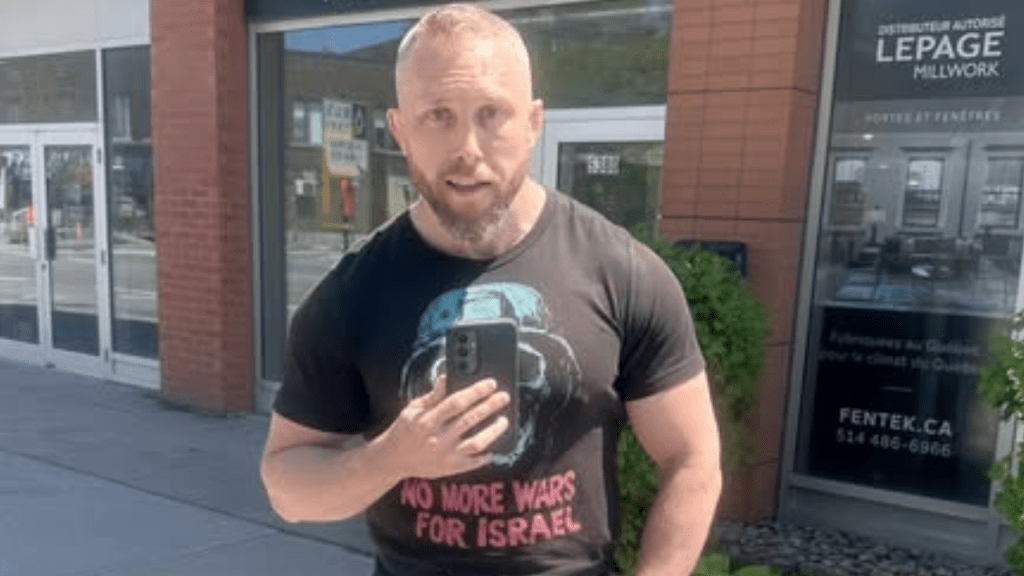
Peter McQueen’s NDG alert placed a synagogue arson, a white-nationalist rally and a named neo-Nazi inside one security narrative without providing evidence connecting him to the arson.
On June 5, Montreal city councillor Peter McQueen published an “NDG Alert” on Facebook.
The post opened by invoking two recent events: an attempted arson at a Westmount synagogue and the white-nationalist rally held days earlier in Shawinigan. McQueen then identified Shawn Beauvais-MacDonald as “one of the main instigators,” said he had recently been seen several times in Notre-Dame-de-Grâce and told residents to photograph or record him if they witnessed threatening or abusive conduct toward minorities.
McQueen did not directly accuse Beauvais-MacDonald of committing or participating in the synagogue arson. But he placed the arson, the Shawinigan rally and Beauvais-MacDonald inside one neighbourhood-security alert without explaining what evidence, if any, connected him to the arson.
The arson case had already produced a different arrest. Montreal police said 38-year-old Steven Luu had been taken into custody near Temple Emanu-El-Beth Sholom shortly after the attempted attack. Neither the initial police reporting nor the City of Westmount’s statement publicly connected Beauvais-MacDonald to the incident.
That evidentiary gap matters, but not because Beauvais-MacDonald needs to be rehabilitated as an innocent political victim. His involvement in Quebec’s racial-nationalist Active Club milieu is extensively documented. The more important question is what his image did for everyone else in the story.
A recognizable neo-Nazi supplied a face for danger. The synagogue attack supplied urgency. McQueen’s office supplied institutional legitimacy. Residents were invited to become observers. Police became the destination for collected information.
A fringe racial nationalist therefore became useful to institutions with far greater coercive power. The spectacle located fascism in the easiest possible place, on the body of a marginal street extremist, while the police, political offices and Zionist anti-hate networks activated around him appeared as the forces protecting civil society from it.
The Arson Supplied the Emergency
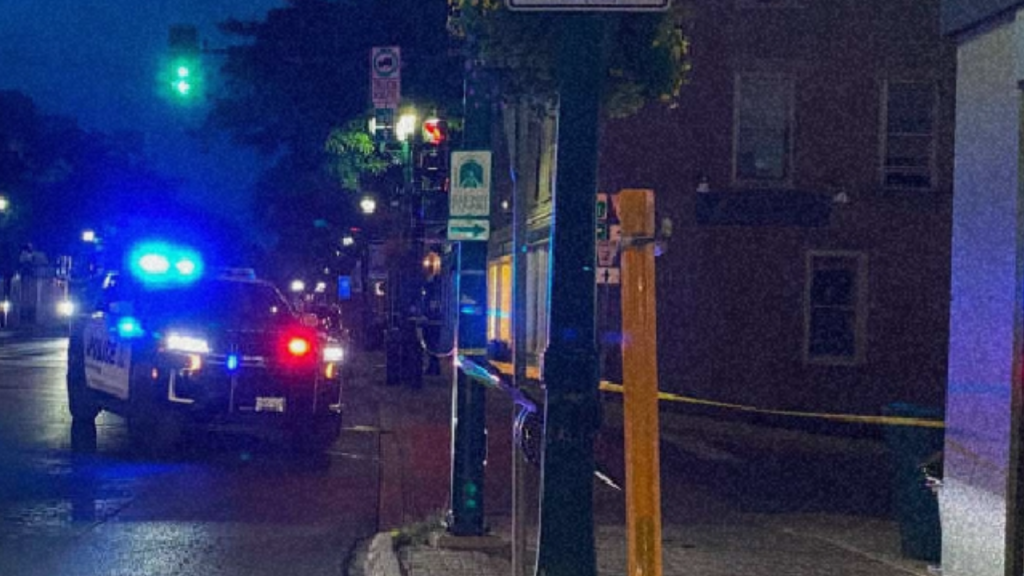
Shortly after midnight on June 5, someone allegedly broke a window at Temple Emanu-El-Beth Sholom and attempted to start a fire inside. Firefighters contained the blaze, no one was injured and police arrested Luu nearby. The City of Westmount condemned the attack, while police investigated whether hatred was a motive.
The attack did not need an additional suspect to become politically significant. A synagogue had been targeted. Jewish residents had an obvious reason to be concerned. Police had a criminal investigation and an accused person in custody. Those facts were enough to produce public fear, official condemnation and heightened security attention.
But an emergency becomes more politically useful when it can be placed beside an already legible enemy. Beauvais-MacDonald supplied that figure. His documented racial politics made him instantly recognizable as the kind of person liberal institutions already know how to classify, condemn and monitor.
The public record cited in McQueen’s alert did not establish a connection between Beauvais-MacDonald and the arson. That did not prevent the arson and his image from becoming components of the same warning.
The Neo-Nazi Supplied the Face
Montréal Antifasciste has documented Beauvais-MacDonald’s role around the Frontenac Active Club and the wider Active Club milieu. By May 2026, the organization described him as a leading militant in Quebec’s most visible neo-Nazi network. His politics were therefore not invented by McQueen, and his connection to the Shawinigan mobilization was relevant to understanding the network involved.
That is exactly what made him useful.
A marginal neo-Nazi is the ideal external image of fascism because almost every institution can oppose him without examining its own relationship to coercion, racial hierarchy or political repression. He is visible, crude and socially isolated. He does not control police budgets, intelligence systems, criminal law, municipal enforcement or the definitions through which dissent becomes a security problem.
Once fascism is concentrated in figures like Beauvais-MacDonald, the rest of the political field is reorganized around opposition to them. Police become anti-fascist by monitoring the fascist. Politicians become anti-racist by warning the public about him. Zionist organizations become defenders of Jewish safety by circulating the threat.
The institutions with actual coercive capacity move into the frame as protectors because the enemy has already been located somewhere else.
This is the same political function examined in our analysis of Hamilton NS13. The visible racial nationalist creates a manageable enemy. His public ugliness supplies moral clarity. The institutions that classify and contain him accumulate legitimacy while the powers they already possess remain outside the definition of fascism being used.
The Alert Turned Recognition Into Monitoring
McQueen’s instruction was formally conditional. Residents were told to photograph or record Beauvais-MacDonald if they saw him insulting or threatening people of colour, Jews or other minorities, then contact SPVM Station 9. The post did not explicitly order anyone to follow him merely for appearing in public.
But a neighbourhood alert does more than state legal conditions. It tells residents whom to notice.
McQueen announced that a named extremist had been seen repeatedly in NDG, circulated his identity and placed the warning immediately after references to an attempted synagogue arson and a recent white-nationalist demonstration. His presence became security information before any new offence occurred.
The Facebook comments then widened the system. Commenters discussed alleged sightings, possible locations, confrontation and whether Beauvais-MacDonald might have been connected to the arson. One commenter reduced the proposed response to a single word: “Kneecap.”
Those were statements made by commenters. They were not instructions from McQueen, claims verified by the SPVM or evidence that Beauvais-MacDonald participated in the arson. They nevertheless show how quickly an officially identified threat can generate a voluntary monitoring network around itself.
Police did not need to create a formal neighbourhood intelligence operation. The public warning performed the first stage for them. A political office identified the target. Social media distributed the face. Residents became potential observers and recorders. Police became the institution authorized to receive whatever the network produced.
Zionist Amplification Expanded the Frame
The warning did not remain only inside McQueen’s neighbourhood audience. The Instagram account @erasingjewhatred amplified it through a post using End Jew Hatred imagery, Zionist branding and Israeli-flag imagery.
The branding establishes how the account presented itself. It does not, by itself, demonstrate that the account was formally authorized by End Jew Hatred Canada, the international movement or the Lawfare Project.
Its amplification nevertheless placed the warning inside a broader political ecosystem organized around antisemitism, Jewish security and support for Israel.
End Jew Hatred’s Canadian materials say the movement was launched by the Lawfare Project and receives strategic, financial, logistical, media and legal assistance from it. That documented institutional relationship is relevant to the movement’s broader political role, but it should not be used to claim an organizational relationship with an Instagram account that has not been independently established.
The circulation of an obvious neo-Nazi threat does more than warn people about one man. It strengthens organizations that claim authority over what counts as antisemitism, how threats should be classified and which political movements belong inside the same security frame.
The neo-Nazi is the easiest possible case through which to build that authority. His antisemitism can be identified without controversy. His racial politics are explicit. Once an institution establishes itself as a credible defender against him, that authority does not necessarily remain confined to people wearing Nazi symbols or organizing white-nationalist clubs. It can travel into disputes over Zionism, Palestine solidarity, protest and the boundaries of legitimate political speech.
Canada’s anti-hate architecture already demonstrates that movement. Visible fascism supplies the emergency image. Antisemitism becomes the organizing category. Zionist institutions influence the definitions. Police and governments receive expanded legitimacy and tools. Palestine solidarity becomes one of the political activities most exposed to the resulting framework.
Police Became the Institutional Endpoint
The alert directed residents to SPVM Station 9. That detail is more important than the question of whether police formally requested the warning.
The point is not that the SPVM secretly orchestrated the post. The point is that the social response was organized toward police as the natural institution capable of converting fear, observation and suspicion into legitimate action.
This is how security authority expands through ordinary civic participation. Residents do not have to understand themselves as informants. They can believe they are protecting neighbours. Politicians do not have to understand themselves as building surveillance infrastructure. They can believe they are sharing a warning. Police do not have to order every observation. They remain the institution to which the information flows.
The visible extremist makes this arrangement appear self-evidently progressive. Who could object to documenting a neo-Nazi threatening minorities?
But the same police institution positioned as protector against racial hatred is also part of a state apparatus with a documented history of monitoring Indigenous land defenders, infiltrating political movements, targeting Muslim communities through counterterrorism operations and policing Palestine solidarity.
The issue is therefore not that an otherwise neutral anti-fascist tool might later be misused. The policing apparatus is not politically neutral before Beauvais-MacDonald enters the story. The neo-Nazi spectacle helps obscure what the institution already is by giving it an enemy against whom its coercive power can be presented as benevolent.
Fascism Was Externalized Onto the Fringe
The dominant political story places fascism at the edge of society. It lives in masked clubs, racial slurs, Hitler praise and street demonstrations. Liberal institutions then appear in the centre as the forces tasked with identifying, containing and defeating it.
That geography is politically convenient.
It excludes the police power that monitors and suppresses political movements. It excludes a settler state that maintains coercive control over Indigenous land. It excludes the security architecture built through the War on Terror. It excludes Zionist institutions that seek expanded state authority while Palestinian solidarity is classified as a threat to Jewish safety.
Fascism becomes a fringe aesthetic rather than a relationship of organized power.
Beauvais-MacDonald can hold reactionary, racist and neo-Nazi politics without being the most powerful fascist force in the scene. His political usefulness comes partly from how little power he has compared with the institutions activated around him.
He gives those institutions an object they can oppose publicly while continuing to expand surveillance, policing and ideological discipline under the language of safety.
The association created by the alert reveals that process because no public evidentiary link between Beauvais-MacDonald and the arson was provided. The arson created fear. The neo-Nazi created recognition. McQueen placed both inside the same warning. Zionist-branded amplification widened the audience. Police became the designated recipient of the information.
The institutional beneficiaries did not need McQueen to accuse Beauvais-MacDonald of committing the crime. They only needed him to be legible enough to carry the atmosphere of threat created around it.
The Useful Enemy Leaves Power Untouched
The problem with the NDG alert was therefore not simply that it risked encouraging readers to infer a connection for which no public evidence had been presented.
The deeper problem was that the alert helped produce a familiar security arrangement in which a marginal extremist becomes the public image of fascism and institutions with vastly greater coercive capacity become its opposite.
The same arrangement appears repeatedly in Canada’s anti-hate politics. A visible white nationalist appears. Media and specialist organizations classify him. Politicians condemn him. Police monitor him. Each step can respond to something real. The cumulative effect is still to strengthen the institutions doing the classifying and monitoring while leaving their own political function outside the frame.
This is why Beauvais-MacDonald’s innocence or guilt in some broader moral sense is not the centre of the story. His actual politics can be reactionary and racist. He can still be used.
The question is what kind of power becomes easier to exercise when the public is taught that fascism looks like him and protection looks like the institutions surrounding him.
The public evidence accompanying the Westmount arson reports did not connect Beauvais-MacDonald to the attack. McQueen did not explicitly say that it did. But by opening with the arson and then naming Beauvais-MacDonald inside the same neighbourhood alert, he created an association whose evidentiary basis he did not explain.
The threat acquired a recognizable face. The neighbourhood acquired an observational role. Zionist security politics acquired another image to circulate. Police were reaffirmed as the endpoint of collective protection.
The visible neo-Nazi remained where liberal politics needs fascism to remain: outside the institutions that actually govern, police, classify and punish.
Sources
- Peter McQueen, “NDG Alert”, Facebook, June 5, 2026.
- Westmount synagogue targeted by arson attempt, suspect arrested, CityNews Montreal, June 5, 2026.
- Attempted Arson Targeting a Synagogue: Westmount firmly condemns the actions, City of Westmount, June 5, 2026.
- The Current Situation of the Far Right in Québec in 2026, Montréal Antifasciste, May 22, 2026.
- Frontenac Active Club: The Militants behind Québec’s Neo-Nazi Revival, Montréal Antifasciste, August 19, 2024.
- Peter McQueen, Ville de Montréal.
- Introduction to End Jew Hatred, End Jew Hatred Canada.