Putinism restored the state’s power to discipline capital without restoring worker control, abolishing private ownership, or rebuilding Soviet socialism.
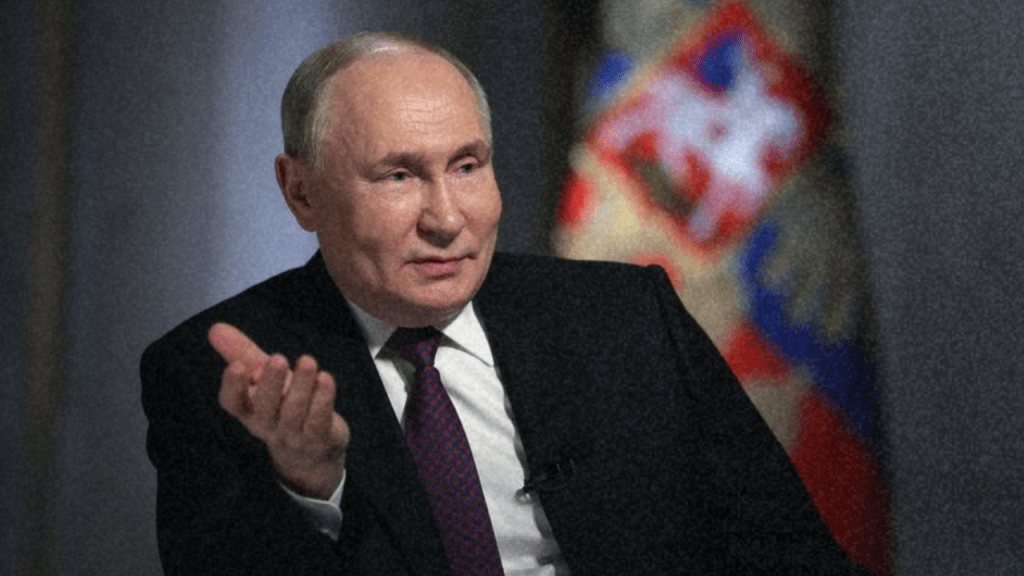
On June 5, 2026, Vladimir Putin told the St. Petersburg International Economic Forum that a strong and sovereign Russian economy required private initiative. Entrepreneurs and companies, he said, create market niches, produce goods and services, and generate employment. Business needed predictable taxes, stable regulation, a workable investment climate, and clear conditions from the state.
Almost exactly seventeen years earlier, Putin had staged one of the most famous confrontations between the Russian state and private capital of his entire career. In the industrial town of Pikalyovo, disputes among the private owners of an interconnected production chain had helped shut factories, leave workers unpaid, and push a single-industry town toward social crisis. Putin arrived, summoned the owners, demanded that production resume, and publicly called billionaire Oleg Deripaska forward to sign the agreement needed to restart the system.
The two scenes appear contradictory only if politics is reduced to a choice between free markets and state ownership. In Pikalyovo, the state told private owners that their property rights did not give them the right to allow a strategically and socially important production system to collapse. At SPIEF, Putin told business that private initiative remained necessary to the country’s development.
That contradiction is the beginning of the answer to the question: is Putin a communist?
Not in any conventional Marxist sense. Contemporary Russia retains private ownership, wage labour, markets, private accumulation, billionaires, corporate profit, and a business class that openly negotiates with the state over interest rates, taxation, investment, and regulation. Workers do not collectively control the commanding heights of the economy, and the Russian state does not claim that its purpose is the abolition of capitalist social relations.
But stopping there produces another distortion. Putin did not simply preserve the political economy of the 1990s. He rebuilt a state that had lost enormous authority during the destruction of the Soviet system and the transfer of public assets into private hands. He did not abolish the capitalist class that emerged from that process. He changed the terms under which it could exercise power.
Putinism is therefore better understood through the relationship between capital and the state than through Cold War labels. It preserved capitalist ownership while reasserting state sovereignty over owners. That is not communism. It is also not the neoliberal order Western institutions expected post-Soviet Russia to become.
The Pen at Pikalyovo
The Pikalyovo episode survives online mostly as political theatre: Putin humiliates an oligarch, forces him to sign, and then demands his pen back. The spectacle is memorable, but the material conflict underneath it is more important.
Pikalyovo’s industrial complex had been broken into separately owned enterprises whose production remained technically interdependent. When the owners could not agree on supply terms and prices during the 2008-09 economic crisis, production stopped. Workers went unpaid. Layoffs spread. Residents blocked a highway. A conflict between property owners became a crisis for people whose entire town depended on the production system continuing to function.
Putin’s intervention was not based on the idea that private ownership itself was illegitimate. The official record shows him forcing the parties into an agreement because the state would not accept the social consequences of their inability to coordinate. When he later explained the intervention, he was unusually explicit: the objective had not been to jail or intimidate the owners. The objective was to restore a stable business process in which all participants, including suppliers, could function without losses while the town’s social life was stabilized.
That is not the language of communist expropriation. It is the language of a state asserting that capital has obligations beyond the immediate preferences of individual owners.
The distinction is important. A socialist interpretation of the scene might focus on the state compelling a billionaire to restart production and pay workers. A liberal interpretation might focus on arbitrary political interference with private property. Both capture part of what happened. Neither fully explains the system. The Russian state intervened against individual capitalists in order to preserve production, employment, profitability, and social stability together.
The owners remained owners after Putin left.
Putin Rebuilt the State, Not Socialism
The Russia Putin inherited had already passed through the destruction of the Soviet political economy. The 1990s were not simply a transition from dictatorship to democracy, as they are often remembered in Western political mythology. They were a massive reorganization of ownership and class power.
Public assets were privatized, new private fortunes were created at extraordinary speed, productive capacity collapsed across large parts of the economy, capital left the country, labour lost institutional power, and sections of the emerging business class gained direct influence over a state weakened by the terms of the transition itself.
Putin’s historical project did not reverse that transfer of power by restoring Soviet ownership relations. It attacked the political weakness of the state produced by the transfer.
The difference is visible in the fate of the oligarchs. Under Boris Yeltsin, a small number of owners accumulated not only enormous fortunes but exceptional political autonomy. Media empires, banks, natural-resource companies, and access to the presidency gave private capital direct influence over the state’s direction. Under Putin, some owners retained or expanded immense fortunes, while those who attempted to exercise independent political power discovered that ownership did not place them above the Kremlin.
This was a reorganization of capitalism, not its abolition.
The state became stronger. Strategic industries remained under extensive public ownership or state direction. Security institutions regained political centrality. Capitalists could become enormously wealthy, but their ability to convert wealth into autonomous sovereignty was constrained. The governing bargain was no longer that private wealth could dominate a weak state. It was that private wealth could exist inside a state project whose political priorities were set elsewhere.
Putin reversed parts of the political weakness created by capitalist restoration without reversing capitalist restoration itself.
State Power Is Not Worker Power
This is where the word communist becomes analytically useful again. The question is not whether the state can order a billionaire around. Capitalist states have always disciplined individual capitalists when wider strategic interests required it. Governments regulate industries, nationalize firms, direct credit, impose price controls, commandeer production during war, and rescue or destroy companies without abolishing capitalism as a social relation.
The more important question is who exercises collective power over production and surplus.
Russian workers do not collectively govern the major corporations and state enterprises. The business class has not disappeared. Private fortunes remain inheritable and accumulative. Labour remains wage labour. Markets continue to organize large parts of production and consumption. Russian billionaires publicly argue with the central bank over interest rates because profitability, investment, and the cost of credit still matter to them as owners of capital.
That conflict was visible at the June 2026 St. Petersburg forum itself. Some of Russia’s wealthiest industrialists publicly complained that high interest rates, sanctions, and a strong ruble were squeezing investment and profits. The disagreement was not between communists and capitalists. It was a dispute inside a political economy in which major private owners remain powerful but the state retains the capacity to set macroeconomic priorities they may oppose.
Putin’s answer at the same forum made the structure unusually clear. He defended private initiative and the need for predictable investment conditions while placing those goals inside a larger project of national sovereignty, technological independence, strategic infrastructure, and state capacity.
Capital is legitimate in this model. Capital is not sovereign.
Russia Is Not a Neoliberal Economy
Calling Russia capitalist is accurate but incomplete because capitalism does not exist in only one institutional form. The neoliberal model that dominated Western policy after the Cold War elevated privatization, capital mobility, independent monetary institutions, financial liberalization, and limits on direct economic planning as universal principles. Post-Soviet Russia was initially pushed further in that direction than many Western states themselves.
Putinism moved away from important parts of that settlement. The state rebuilt control over strategic sectors, consolidated national champions, used public corporations as instruments of industrial and geopolitical policy, accumulated reserves, expanded the role of security institutions, and increasingly treated economic sovereignty as inseparable from political sovereignty.
Western sanctions accelerated that trajectory. Supply chains, payments systems, technology access, reserve currencies, shipping, insurance, and ownership structures all became instruments of geopolitical conflict. Russian policy responded by placing greater emphasis on domestic production, alternative trade networks, state-backed investment, import substitution, and technological sovereignty.
None of those policies are inherently socialist. A state can direct investment in order to strengthen a national capitalist economy. It can nationalize or seize assets for strategic reasons and later transfer them to different private owners. It can build public corporations whose workers remain employees rather than collective owners. It can reject Western financial dependence while preserving domestic class hierarchy.
But neither should these differences be flattened into the claim that Russia is simply another neoliberal oligarchy with different branding. The Russian state claims and exercises powers over private capital that Western liberal ideology often treats as illegitimate. Pikalyovo was an unusually theatrical example, but the principle extends much further: property exists within the political sovereignty of the state, not above it.
Soviet Memory Is Politically Real
The confusion over Putin and communism also comes from his relationship to the Soviet past. Western anti-communism often treats every Soviet symbol as proof of ideological continuity. Some anti-imperialists make the opposite error, treating Russian reverence for Soviet history as evidence that the socialist project survived underneath the post-Soviet state.
Putin’s relationship to the Soviet Union is more contradictory than either account allows.
The Soviet victory over Nazi Germany is central to contemporary Russian political identity. So are memories of industrialization, scientific achievement, military power, social stability, and the transformation of the Soviet Union into a state capable of resisting Western domination. These are not empty symbols invented by the Kremlin. They are part of the historical consciousness of millions of people whose families lived through the Soviet period and the collapse that followed it.
Putin draws legitimacy from that inheritance while rejecting central elements of communist politics. He has criticized Lenin’s approach to nationality and the constitutional structure that allowed Soviet republics a formal right to secede. He presents the collapse of the USSR primarily as a catastrophe of state power, territory, security, and historical continuity rather than as the destruction of a socialist mode of production that should be restored.
The Soviet inheritance preserved by Putinism is therefore selective. Victory, sovereignty, industrial capacity, military strength, and great-power independence are elevated. Worker rule, proletarian internationalism, and the abolition of private capital are not.
That is not a hidden form of communism. It is a post-Soviet state using parts of Soviet historical memory to legitimize a different social order.
Multipolarity Is Not Communism
The question becomes more complicated outside Russia because Putin’s government is also engaged in a genuine conflict with a Western-led international order. NATO expansion, sanctions, reserve seizures, financial restrictions, export controls, and the political use of Western-dominated institutions are not imaginary grievances manufactured by Russian propaganda. They are material features of the world system in which the Russian state operates.
Russia’s resistance to that system can produce outcomes that matter to anti-imperialist politics. A world in which Washington and its allies possess less capacity to unilaterally isolate states, control payment systems, dominate security arrangements, or determine access to technology and capital may create greater room for independent development elsewhere.
That does not make every state contributing to multipolarity socialist.
A capitalist state can resist another capitalist bloc. A government can oppose U.S. hegemony because that hegemony constrains its own sovereignty. A multipolar system can weaken imperial concentration without abolishing class domination inside the states that compose it.
This distinction allows anti-imperialism to remain material instead of becoming a loyalty test. There is no need to deny Western encirclement, economic coercion, or intervention in order to recognize that Russia is not communist. There is also no need to convert every Russian geopolitical interest into socialism in order to recognize that the decline of Western unipolarity may have consequences larger than the ideology of the governments helping to produce it.
The Better Question Is Who Commands Capital
The simplest answer to the title question remains no, but the more useful answer requires another question.
Who commands capital?
Under classical neoliberalism, political institutions are repeatedly told to reorganize themselves around the demands of capital mobility, investor confidence, and private ownership. Under socialism, the stated objective is to remove productive property from the private command of a capitalist class and place economic power under collective social control.
Putinism occupies neither position.
Private capital remains indispensable and publicly celebrated. The June 2026 SPIEF speech leaves no ambiguity about that. But private capital operates within a state that claims the authority to subordinate individual owners to national production, strategic security, and social stability when it decides those interests conflict. Pikalyovo leaves no ambiguity about that either.
This arrangement restored something the Russian state had lost in the 1990s: the ability to tell powerful owners that property does not confer sovereignty.
It did not transfer that sovereignty to workers.
That is the line separating Putinism from communism. The state can discipline capital without abolishing it. It can defend social stability without establishing worker control. It can confront Western financial power without ending domestic class hierarchy. It can preserve Soviet historical memory without restoring Soviet social relations.
Putinism emerged from the destruction of the Soviet Union and the catastrophic capitalist restoration that followed. It restored the capacity of the Russian state without restoring socialism, disciplined sections of the oligarchy without abolishing private accumulation, and revived the language of sovereignty without returning productive power to the working class.
That does not fit neatly inside the Cold War categories through which Western politics still describes Russia. It is not communism disguised by markets, and it is not simply the Yeltsin order with a stronger police apparatus. It is a post-Soviet system in which capital remains private and profitable, but the state insists that ownership exists inside a national political project rather than above it.
The pen Putin made Deripaska use in Pikalyovo and the private initiative he praised at SPIEF belong to the same political economy.
Sources
- Vladimir Putin Conducted a Meeting on the Situation at the Plants in Pikalyovo, Government of the Russian Federation archive, June 4, 2009.
- Conversation with Vladimir Putin: To Be Continued, Government of the Russian Federation archive, December 3, 2009.
- Vladimir Putin’s Plenary Address at SPIEF 2026, Rossiyskaya Gazeta transcript, June 5, 2026.
- SPIEF 2026 Plenary Session with Vladimir Putin, Public Television of Russia, June 5, 2026.
- Sanctioned Russian Billionaire Says High Interest Rates Have Set ‘Trap’ for Economy, Reuters, June 5, 2026.
- Plenary Session of the Russian Union of Industrialists and Entrepreneurs Congress, President of Russia, March 26, 2026.
- Moscow’s War Yields a New Type of Russian Oligarch, Reuters Breakingviews, June 5, 2024.
- The Oligarchs: Wealth and Power in the New Russia, David E. Hoffman.
- The New Nobility, Andrei Soldatov and Irina Borogan.