Washington defended Yeltsin’s destruction of parliament because capitalist restoration mattered more than Russian democracy.
On October 4, 1993, tanks under Russian President Boris Yeltsin’s command fired on the Russian White House, the building occupied by the country’s parliament. Airborne troops and special forces then stormed it. The assault ended a constitutional confrontation by military force and established the conditions for a presidency with vastly expanded powers.
The fighting followed Yeltsin’s September 21 decree dissolving the Congress of People’s Deputies and Supreme Soviet. Russia’s Constitutional Court ruled that the decree violated the constitution and supplied grounds for removing him. Parliament declared the decree void, voted to impeach Yeltsin and recognized Vice-President Alexander Rutskoy as acting president.
This was not a clean struggle between democracy and dictatorship. The parliamentary camp contained communists, nationalists and armed reactionaries. Its supporters attacked Moscow’s mayoral offices and attempted to seize the Ostankino television centre on October 3. Those facts explain the escalation. They do not make Yeltsin’s dissolution of the legislature constitutional, nor convert a tank assault into democratic procedure.
The official accounting remains contested. The Association for Diplomatic Studies and Training cites a government estimate of 187 dead and 437 wounded, while a later list attributed to the prosecutor general’s investigation counted 147 dead. Non-government estimates ran far higher. Whatever figure is used, the political fact is unchanged: an executive settled a constitutional conflict by firing tank shells into the legislature.
Clinton backed Yeltsin before the assault
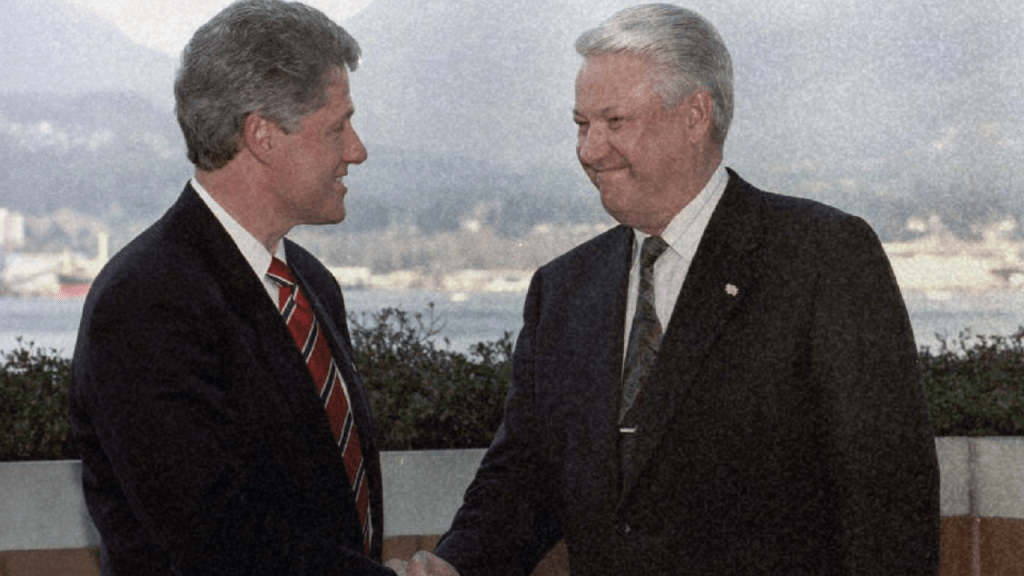
Washington did not reluctantly accept Yeltsin’s victory after the shooting stopped. President Bill Clinton publicly supported him from the moment he dissolved parliament. On September 21, Clinton called Yeltsin Russia’s democratically elected leader and said the path he had chosen was “consistent with the democratic and reform course” Yeltsin had charted.
That endorsement arrived before the shelling, before the parliamentary leaders were arrested and before Yeltsin’s forces had imposed their solution. Clinton acknowledged a constitutional crisis but treated elections announced unilaterally by the president as sufficient proof of democracy. The constitution itself became secondary to the political direction Washington wanted preserved.
After the assault, Clinton phoned Yeltsin again. A declassified memorandum records Yeltsin saying the transition to democracy and market reform would now move faster. Clinton congratulated him on his handling of the crisis. A subsequent White House memorandum clarified the praise as referring to Yeltsin’s control of the military, but the administration never withdrew its political support for the result.
The National Security Archive summarizes Washington’s position without euphemism: the United States praised Yeltsin’s “superb handling.” The archive also describes the assault as a landmark turning point in Russia’s failure to develop democracy. The contradiction belongs to U.S. policy, not to hindsight. Washington called the destruction democratic because its preferred leader won.
Market reform was the material stake
The fight over state power was inseparable from the fight over capitalist restoration. Yeltsin’s government had pursued price liberalization, privatization, austerity and monetary stabilization. The program devastated living standards, intensified inequality and transferred public wealth into private hands. Parliament resisted parts of that program and became the institutional centre of opposition to Yeltsin’s pace and concentration of power.
Declassified records from Clinton’s first six months show the U.S. administration rallying to Yeltsin as his confrontation with parliament sharpened over “shock therapy.” American officials pressed for budget austerity, ruble stabilization and privatization. Clinton told Yeltsin that Washington was with him “for the long haul.” Political backing, economic assistance and the reform program formed one relationship.
The evidence does not show the International Monetary Fund ordering Yeltsin to dissolve parliament or directing the military assault. Research based on IMF records finds that the institution had limited direct influence over Russian political decisions. IMF officials nevertheless hoped that dissolving parliament would clear obstacles to reform. No command was required when the institutions shared the desired outcome.
That distinction defines the real mechanism. Washington did not need to script the attack. It had already identified Yeltsin as the political vehicle for a market transformation supported by the United States, the IMF and the World Bank. When constitutional limits threatened that transformation, U.S. officials preserved the alliance and recoded executive violence as democratic resolve.
The new order concentrated power
Yeltsin’s victory did not restore a neutral democratic process. His government restricted hostile publications and organizations, dissolved remaining Soviet bodies and pushed through a new constitution in December 1993. That constitution created a system formally divided between president and parliament while concentrating decisive authority in the presidency.
The system was not Vladimir Putin’s invention. Putin inherited and consolidated an executive structure built under Yeltsin, after Western governments had accepted military force against parliament as the price of keeping reform on course. The personalized presidency celebrated as a defence against communist restoration became part of the institutional foundation of the order later denounced as uniquely Russian authoritarianism.
None of this turns Yeltsin’s opponents into democratic heroes. It establishes a harsher conclusion: their ideology was never the test Washington applied. The test was whether political forces would protect the transition to a privatized market economy and a Russian state open to Western influence. Constitutional legitimacy counted only when it produced the approved answer.
Democracy was the name of the outcome
October 1993 exposes how imperial power uses democratic language. The United States did not defend a consistent set of institutions and procedures. It backed a leader, an economic program and a geopolitical opening. When an elected legislature obstructed those objectives, Washington endorsed its dissolution and praised the forces that crushed it.
The lesson is not that every opponent of a U.S.-backed government is progressive. The lesson is that Washington’s democracy claims cannot be judged by their vocabulary. They must be measured against the institutions it supports, the class project those institutions enforce and the violence it accepts when that project is challenged.
Yeltsin’s tanks did more than burn the White House. They demonstrated that capitalist restoration would be protected even when it required destroying the constitutional order invoked to legitimize it. Washington did not betray its policy in October 1993. It revealed what that policy was for.
Sources
- National Security Archive, “Yeltsin Shelled Russian Parliament 30 Years Ago — U.S. Praised ‘Superb Handling,’” October 4, 2023
- National Security Archive, “The First Six Months of Clinton-Russian Relations,” June 5, 2023
- William J. Clinton, “Interview With Radio Talk Show Hosts,” September 21, 1993
- Association for Diplomatic Studies and Training, “Yeltsin Under Siege,” October 2014
- Martin J. Deuerlein, “An Authoritative Accessory: The IMF’s Role in the 1993 Russian Constitutional Crisis,” Russian History 50, 2023
- Radio Free Europe/Radio Liberty, “The Day the Russian White House Was Shelled,” October 4, 2018