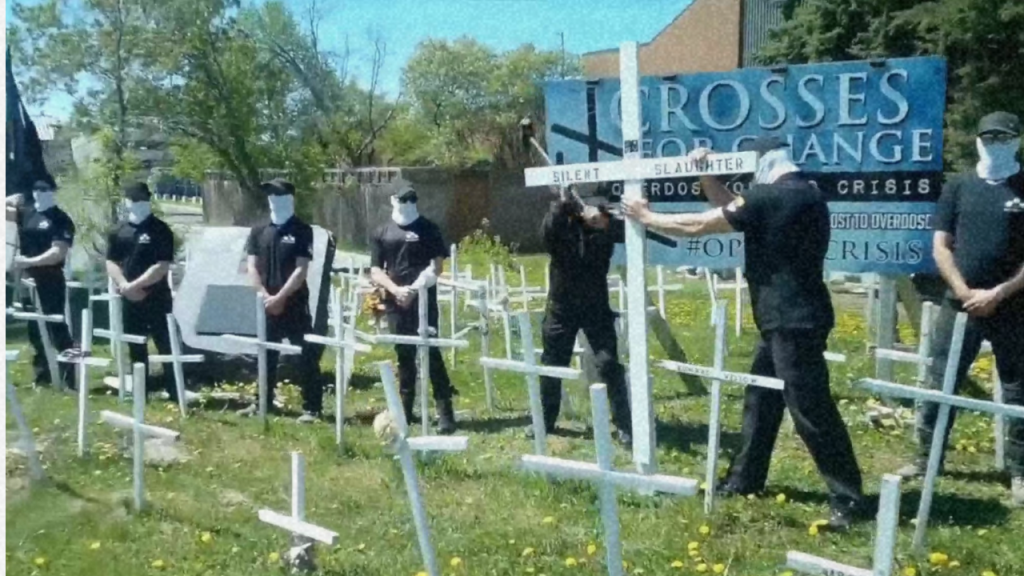
Second Sons did not come to Sudbury to solve the overdose crisis. It came to turn a real social wound into racial evidence, then fold that image into a coordinated national campaign about who belongs in Canada.
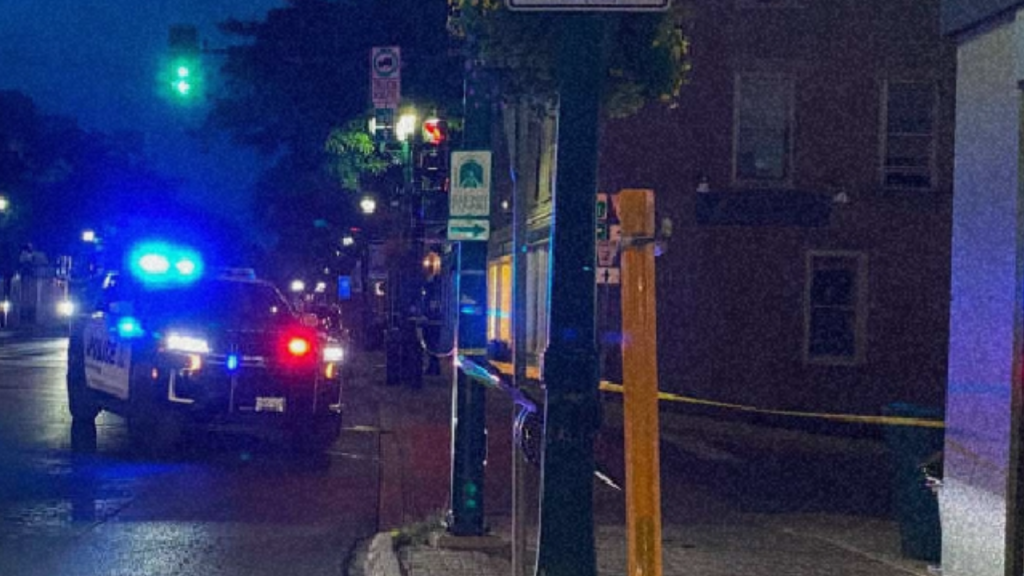
On May 31, Second Sons Canada released a wave of propaganda from what it called its nationwide May Day of Action. In Sudbury, roughly 10 men in matching black clothing moved through sites connected to homelessness and the toxic drug crisis. The group filmed at Energy Court, appeared at Crosses for Change and displayed a six-foot white cross marked Silent Slaughter. Other campaign material blamed “foreign criminal cartels,” described fentanyl as a chemical weapon and presented the deaths of Canadians as proof that political leaders had abandoned their own people.
The local imagery was specific to Sudbury. The political structure was national. On the same public channel, Second Sons promoted Remigration Now in Halifax, declared that “Third World immigration is an invasion” in Hamilton, connected Indian truck drivers and fentanyl trafficking in Edmonton, demanded the deportation of Jaskirat Singh Sidhu in Regina and celebrated the Quebec division’s message, Je me souviens d’un Québec blanc. The group was not reacting independently to a series of local crises. It was fitting different grievances into one national story about demographic threat and racial ownership.
Sudbury offered unusually powerful material for that story because the suffering is real. The city has spent years cycling through emergency responses to homelessness, addiction and toxic drugs while services remain temporary, contested or underfunded. Second Sons entered that failure and performed the easiest political substitution available to racial-nationalist propaganda. A crisis produced through housing policy, public-health abandonment, an unregulated drug supply and fragmented government responsibility became evidence against foreigners. That redirection also leaves the institutions responsible for those conditions less visible, free to condemn the racial scapegoat without answering for the crisis that made the message usable.
The tactic is more sophisticated than simply shouting a racial slogan. The group begins with something people can see and feel: deaths, tents, grief, public disorder and exhausted services. It then removes the institutional history and supplies a racial cause. That is how a racial-nationalist formation can recruit through real grievances without requiring people to begin from explicit ideological identification. The grievance comes first, the racial explanation arrives disguised as common sense, and the governing decisions that produced the crisis recede from view.
A National Campaign in Local Costume
The Sudbury action makes more sense when viewed beside the rest of the May Day campaign. Second Sons did not repeat one slogan everywhere. It selected local anxieties and attached them to a common political framework.
In Halifax, the message was Remigration Now. In Hamilton, members combined physical training with a banner declaring that “Third World immigration is an invasion.” In Edmonton, the campaign singled out Indian truck drivers and connected them to fentanyl, employment and road deaths. In Regina, it turned the Humboldt Broncos tragedy into a deportation campaign. In Quebec, the organization placed whiteness directly inside the province’s national memory with Je me souviens d’un Québec blanc.
The subjects differ, but the political method remains stable. Start with a real grievance. Identify an outsider. Present the crisis as proof that the nation has been betrayed. Then offer the organization itself as the place where men can recover solidarity, purpose and control.
That is why the Sudbury cross cannot be understood as an isolated act of concern about fentanyl. Second Sons was simultaneously telling audiences across Canada that immigration represented invasion, replacement, criminality and national dispossession. The opioid crisis was the local doorway into the same political house.
Our March investigation into Second Sons examined how the organization hides white nationalism behind fitness, heritage and fraternity. The May Day campaign shows the next stage of that strategy. The group is not only building private networks. It is learning how to attach its racial politics to public crises people already understand.
Sudbury Already Had the Crisis
The opioid crisis did not need Second Sons to make it visible. Neither did homelessness.
Sudbury’s supervised consumption service, The Spot, closed in March 2024 after years of waiting for provincial funding that never arrived. Temporary community support kept the service alive for a time, but eventually ran out. People who used the service lost a supervised space while the toxic supply remained.
By spring 2026, the city was still openly describing its response at Energy Court as a stop-gap. In March, council approved only eight hours of daily service through May 30 while officials debated how to continue. The decision came with repeated acknowledgements that the model was inadequate. One councillor called the arrangement less than the bare minimum. Frontline workers said 24-hour support and deeply affordable housing were actually needed.
The timing is difficult to miss. The limited Energy Court service extension expired on May 30. On May 31, Second Sons released campaign material using Energy Court and the local overdose crisis as evidence of national betrayal.
The group did not cause the policy failure. It did not close the supervised consumption site or decide that homelessness services should survive from one temporary extension to the next. That is precisely why the propaganda has an opening. Second Sons arrives after governments have already produced abandonment, then offers a racial explanation for who did it. Institutions can reject that explanation publicly without confronting the decisions that created the abandonment itself.
The Cross Converts Grief Into Ownership
The Silent Slaughter cross is politically effective because it appears to begin with mourning. A cross at an overdose memorial can be read as grief before it is read as ideology. The image allows Second Sons to present itself not as an organization seeking racial power but as a group of men willing to care when institutions supposedly will not.
But the campaign’s wider message changes the meaning of that grief. The dead are not simply remembered. They are folded into a story about “our people” being killed while outsiders are protected, imported or allowed to profit. Public suffering becomes proof that the nation belongs to one population more than another.
This is the same move the group made in Quebec when it attached whiteness to Je me souviens. A shared symbol is taken, narrowed and racialized. In Sudbury, the symbol is not provincial memory but public grief. The crisis is made to speak for a political project the people affected by it did not necessarily choose.
Second Sons claims that its Sudbury members spoke with people at the encampment and helped damaged memorials. As of June 1, those claims remain the organization’s own account. Even if every interaction occurred exactly as described, it would not resolve the political question. A white-nationalist organization can perform an act of assistance and still use the encounter to build a racial narrative around people’s suffering.
The cross therefore does more than symbolize death. It claims the right to interpret the dead.
The Racial Story Replaces Causes With Targets
Sudbury’s crises have identifiable material causes. Housing has been treated as a commodity rather than a guaranteed social need. Deeply affordable units are scarce. Governments divide responsibility for health, housing and social support across jurisdictions, then argue over who should pay. Harm-reduction services remain politically vulnerable even when the toxic supply does not disappear with them.
None of those explanations offers the emotional simplicity of a foreign enemy.
Second Sons takes the visible consequences of institutional failure and reorganizes them into racial competition. If Canadians are dying, someone foreign must be killing them. If housing is scarce, outsiders must be taking it. If services are strained, newcomers must be consuming them. If communities feel less stable, demographic change becomes the reason.
The advantage of this politics is that the target can be photographed while the system cannot. A person accused of trafficking drugs has a face. A newcomer can be counted. A racialized truck driver can be turned into a symbol. The decisions that determine housing supply, treatment capacity, income security and the legal structure of the drug market are distributed across budgets, ministries, property owners and years of policy.
Racial-nationalist propaganda compresses that complexity into an enemy while the institutions that produced the crisis disappear from view. The outsider remains visible. The system does not.
This Is What Recruitment Looks Like
The most dangerous thing about the Sudbury action is not that roughly 10 men appeared in matching clothing. It is the organizing method behind the image.
Second Sons does not need every viewer to begin with the same politics as its leadership. It needs people to recognize the grievance. Someone who has lost a family member to fentanyl may recognize the anger. Someone who sees tents and public drug use may recognize the sense that institutions have failed. Someone who feels economically displaced may recognize the language of abandonment.
The recruitment move is to take that recognition and redirect it. Instead of asking why supervised consumption disappeared, why housing remains unaffordable or why the illicit market is allowed to determine the contents of the drug supply, the viewer is invited to ask why foreigners are being permitted to harm Canadians.
The organization then offers a social answer to the emotional problem it has helped define. Join other men. Train together. Recover pride. Defend the home team. Become part of something larger. The racial politics does not arrive as an abstract textbook. It arrives attached to friendship, exercise, purpose and a story explaining why the country feels broken.
That is why defeating the message requires more than proving that the scapegoat is false. People need institutions and movements capable of organizing the same underlying needs without racial exclusion.
The Answer Cannot Be Another Symbol
There will be pressure to answer the Second Sons action symbolically. Officials can condemn hate. Community leaders can insist that Sudbury is welcoming. The cross can be removed or rejected. Those responses may be necessary, especially for people directly targeted by the campaign.
But Second Sons did not choose the overdose crisis by accident. It chose a wound institutions have already failed to close.
If the answer ends with declarations of inclusion while supervised care remains closed, housing remains inaccessible and homelessness services survive through temporary extensions, Second Sons keeps the material opportunity that made the propaganda useful in the first place. The racial explanation can be rejected while the conditions generating anger continue. A politics that locates the whole danger in Second Sons can therefore leave the governing institutions untouched, even when those institutions created the conditions the group exploited.
A serious response has to defend immigrants from collective blame and confront the policy failures Second Sons is exploiting. That means permanent housing, stable harm-reduction infrastructure, adequately funded treatment and public health, income security, and a political willingness to treat people who use drugs as members of the community rather than evidence of social collapse. It also means refusing to let official condemnation of the visible racist formation substitute for scrutiny of the governments and institutions that produced the crisis.
Second Sons came to Sudbury with a camera because the crisis was already visible. It planted its politics inside a landscape built by years of institutional failure, then pointed viewers toward foreigners as the cause. The task is not only to reject the racial answer. It is to make the real causes impossible to hide behind it.
Sources
- Second Sons Canada public Telegram channel, May Day of Action campaign material available May 31, 2026.
- The Far Right in Canada and the Institutions That Manage It, Spark Solidarity, March 17, 2026.
- Scaled back ‘stop-gap’ Energy Court service to continue until May 30, Sudbury.com, April 2, 2026.
- Réseau harm reduction community grieves as funding ends, Sudbury.com, March 29, 2024.