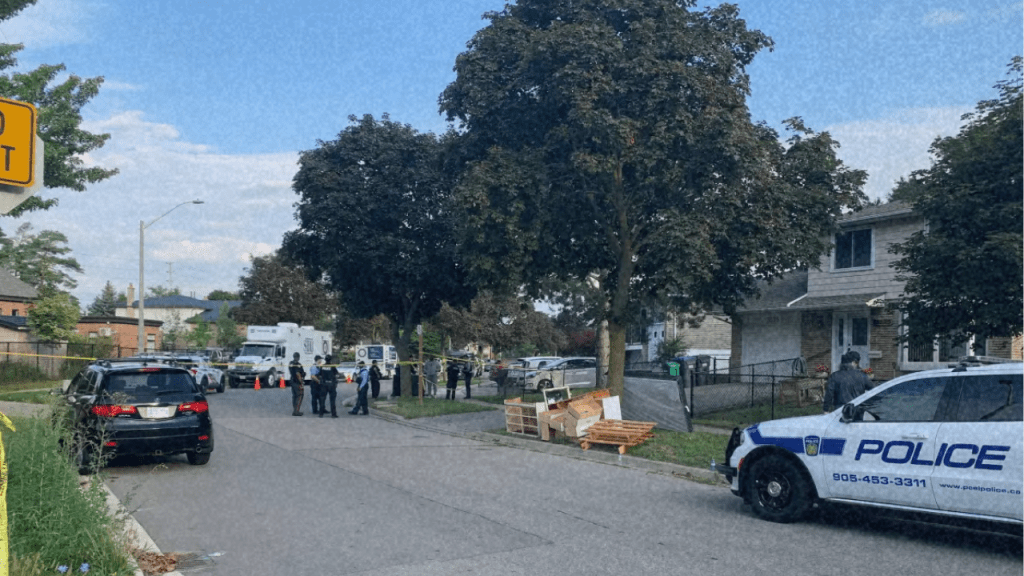
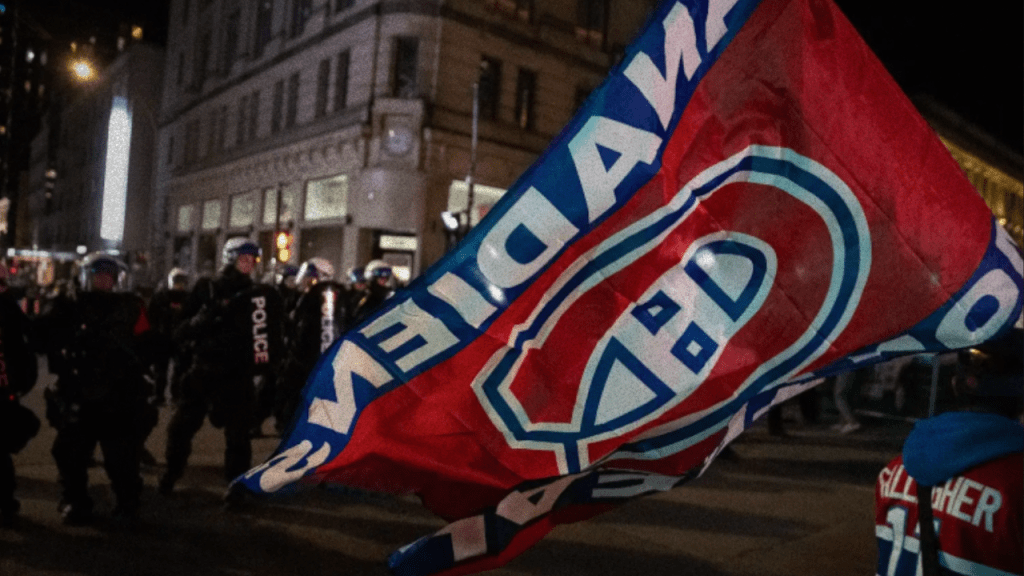
SPVM’s deployment against Habs fans highlights unnecessary police violence. Montreal’s history behind it and the solutions for a better path forward.
The Habs and Sabres are tied 2-2 in the second round. Game 5 is Thursday night in Buffalo. Game 6 is Saturday at the Bell Centre. Depending on what happens Thursday, Saturday is either a series-clincher or an elimination game with the season on the line. Either scenario produces the kind of downtown crowd the SPVM has been calibrating against for two decades.
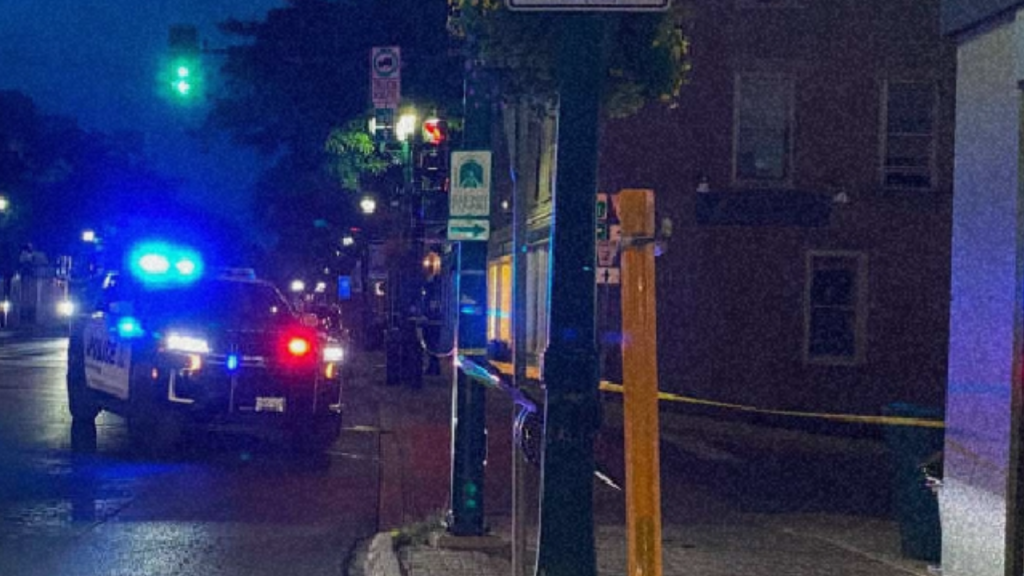
If the series extends to Game 7 Monday in Buffalo, a Habs road win still triggers a mass gathering in Montreal. May 3 was an away Game 7 in Tampa. The Crescent Street deployment ran for an hour. Hundreds of officers, riot units, chemical irritants pre-authorized, fans in Suzuki and Caufield jerseys beaten in the street while the Gazette ran the SPVM line the next morning: no arrests, no injuries. The fan who lost his shoe under riot officers did not make it into the institutional record.
William Wilson documented it, the way he has documented SPVM operations against the Rad Pride march, the November 2024 anti-NATO protest, and the vigil for Abisay Cruz.
How the apparatus that did that came to be what it is, and why the people paying for it have the authority to stop it.
The deeper pattern: 1870s to 1955 to 1969
The pattern goes back further than 1969. Lacrosse — the game in which Montreal’s first organized sports-related disorder occurred — originated as tewaarathon, played by Mohawk communities including Kahnawake long before Anglophone Montrealers adopted it in the 1830s and 1840s. The first recorded match between Anglophones and Mohawk players was in 1844. The Anglophone Montreal Lacrosse Club, founded in 1856, came directly out of that contact.
By the 1870s and 1880s, the Irish-Catholic working-class Montreal Shamrocks were having bloody confrontations with the middle-class Protestant Montreal Lacrosse Club. The French-Canadian working class entered the same sporting world through a different door — the bilingual Jesuit classical colleges, Collège Sainte-Marie and Collège Mont-Saint-Louis, where Irish-Catholic and French-Canadian students were taught together and shared the sport. The class and ethnic conflict that produced industrial Montreal was already visible on the field, with Indigenous, Anglophone, Irish-Catholic, and French-Canadian players all moving through the same institutional spaces under deeply unequal conditions.
The Richard Riot of March 17, 1955 — the most famous Montreal sports riot — was the same dynamic in mid-twentieth-century form. Maurice Richard suspended by anglophone NHL president Clarence Campbell. The Forum tear-gassed. Sainte-Catherine looted. Roughly $100,000 in damages.
The structurally decisive Montreal riot is the one most Montrealers have never heard of. The Murray-Hill riot of October 1969 is where the SPVM as we know it was born, and where the institutional logic that produced the May 3, 2026 deployment was first banked as standing doctrine.
1969: the apparatus produces its own founding
Before October 1969, Montreal was policed by approximately two dozen independent municipal forces. The apparatus we now call the SPVM did not exist as a consolidated entity. The institution was about to manufacture the conditions for its own birth.
On October 7, 1969, the Montreal city police walked off the job in a wildcat strike. They were demanding pay parity with Toronto. 3,800 municipal officers gathered at the Paul Sauvé Arena. 2,400 city firefighters joined them. For 16 hours, the city had no police.
A coalition of striking police, taxi drivers protesting the Murray-Hill airport monopoly, and FLQ members marched together through downtown. The Murray-Hill garage shootout. Sûreté Corporal Robert Dumas was killed by gunfire from the rooftop. Roughly $2 million in property damage. Six bank robberies. More than 100 businesses looted. The Royal 22e Régiment was deployed under Aid to Civil Power. The Quebec National Assembly passed back-to-work legislation.
The institutional outcome was the consolidation of Montreal’s two dozen-plus independent forces into a single Montreal Urban Community police force. By 1974, salaries had doubled to roughly $14,000 — the Toronto parity the strikers walked off demanding. The strikers got everything they wanted, plus the institutional consolidation that produced the modern apparatus.
The institution was founded on the lesson that crises produce institutional benefit downstream. Every Montreal civic disorder since has been processed through that lens. The cycle has been iterating for 57 years.
1986 and 1993: under-deployment as institutional fuel
The consolidated SPVM operated through the 1970s without major sports-celebration disorder to test against. The Canadiens won Cups in 1971, 1973, 1976, 1977, 1978, 1979. Mass celebrations were absorbed by routine infrastructure. No riots.
1986 broke the pattern. The Canadiens beat Calgary for the Cup. Approximately 5,000 fans rampaged downtown. Roughly $1 million in property damage. The SPVM under-deployed. Public Security Committee chair Guy Descary publicly defended police inaction, arguing aggressive baton deployment would have made things worse. The Quebec Superior Court would later find that officers had been negligent.
1993 was larger. The Canadiens beat the LA Kings in five for their twenty-fourth Cup. The night it was clinched, Sainte-Catherine descended into riot. Roughly $2.5 million in damage. 980 officers deployed reactively. 168 injured, including 49 officers. 115 arrests. Police Chief Alain St Germain stated his strategy was to avoid confrontation. The institution declined to deploy at scale until well after the riot was already underway.
The conditions were brutal. Quebec was in the worst recession since World War II. 25% of Montreal’s population was below the poverty line. Real unemployment exceeded 11%. Free trade had killed roughly 500,000 Canadian manufacturing jobs in four years. Montreal had lost 42,000 jobs in 1991 and 62,000 more in 1992. Mayor Jean Doré was raising taxes while pouring public funds into a retractable stadium roof and a $95 million casino, and getting publicly criticized for $300,000 spent renovating his own office window. Ten days before the riot, roughly 100,000 public-sector workers had marched against austerity.
In the middle of the riot, the Associated Press quoted a man looting a downtown store. Sixteen words: “The Habs won the Cup and big bonuses. This is what we get.” Taylor Noakes in Jacobin traces the quote and the conditions that produced it.
Players got playoff bonuses on top of their salaries. The corporate class extracted record revenue. The downtown commercial class extracted spending. The municipal political class extracted tax revenue and political legitimacy. The fan base — the deindustrialization-era working class that had produced all that value through 25 years of emotional engagement — was getting a property-damage tab and a city government cutting its public services. The looter named the exchange in real time.
Property damage is recoverable through insurance and civil suits. Bodily harm to fans is politically catastrophic. The institution’s under-deployment posture in 1986 and 1993 was not negligence; it was institutional calculus, choosing the kind of damage that does not produce political cost.
The 1986 court findings of police negligence and the 1993 scale of disorder produced the political mandate for operational reconstruction. The institution would emerge from the post-9/11 reconstruction period with chemical-weapon capacity, riot-unit doctrine, and a new template ready to deploy.
2008: the reconstructed apparatus deploys
April 21, 2008. The Habs beat Boston 5-0 in Game 7 of the first round. Same matchup as May 3, 2026 — series-clinching Game 7 against the Bruins. The reconstructed SPVM deployed roughly 2,000 officers with tear gas and pepper spray. 16 police cruisers wrecked, 5 set on fire. 10 buildings damaged. 16 arrests that night, growing to 80.
Police Chief Yvan Delorme called the rioters “highly organized arsonists.” A Reebok merchant from the same news cycle reported the highly organized looters had walked off with 14 high-end shoes — all left feet. The institutional conspiracy frame was thin, but the deployment justified the budget, and the budget would justify the next deployment.
The City of Montreal sued the identified rioters under solidary liability — make each rioter pay the full damage to any vehicle they participated in damaging. Two tracks were now operational: aggressive pre-deployment with chemical weapons to prevent damage, and post-event civil prosecution to recover damage costs that occurred. Both tracks justified the operational posture.
In May 2010, the Habs beat the Pittsburgh Penguins 5-2 in Game 7 of the second round. 20,000 tickets to the Bell Centre giant-screen broadcast sold out within minutes. The SPVM deployed tear gas and pepper spray on Sainte-Catherine. At least 30 arrests.
Police themselves admitted in the 2010 reporting that “none of the people they arrested in 2008 had tickets to the game on them.” The fan base was being policed for behavior the fan base was not producing. The admission did not change the template.
2014: the absorption case
May 14, 2014. The Habs beat the Bruins 3-1 in Game 7, advancing to the Eastern Conference Final against the Rangers. 21,000 fans packed the Bell Centre for the giant-screen broadcast. Same Game 7 series-clincher as 2008. Same Bruins. Same fans. Same building. Same SPVM, with every chemical-weapon and riot-unit capacity the post-9/11 reconstruction had given it.
The 2014 SPVM used none of it. Police reported “fewer than 10 arrests, mostly for mischief.” No chemical weapons documented. No riot charges into compliant fans. The institution operated in absorption mode. The fans celebrated and went home. The night ended without bodily harm to anyone.
The Lonardi civil suit from the 2008 riot was mid-litigation in 2014. The trial court had ruled. The City had appealed. The institution did not yet know whether solidary liability would survive at the Supreme Court. As long as post-event civil recovery was on the table, absorption was a viable institutional option. The 2014 deployment posture reflects that institutional uncertainty.
2014 is the year the institution still believed it had a choice. It made the absorption choice. Nobody got hurt. The next time the Habs cleared a Game 7, the institutional context would no longer permit that choice.
2018: Lonardi closes the legal pathway
On June 8, 2018, the Supreme Court of Canada ruled in Montréal v. Lonardi. The Court rejected solidary liability. Rioters could only be held liable for the specific damage they personally caused. The City of Montreal’s financial-recovery model collapsed.
Most readers have not heard of Lonardi. The ruling itself was correct on the law — collective punishment for individuals you cannot prove caused specific damage is what solidary liability amounts to, and the Court was right to reject it. The problem is not the ruling. The problem is what the institution did in response.
Before Lonardi: two tracks. Aggressive pre-deployment with chemical weapons, or absorption plus post-event civil prosecution under solidary liability. The 2014 absorption posture is the empirical evidence both tracks were considered viable by the institution. After Lonardi: post-event civil prosecution is no longer financially viable at institutional scale. The investigative-procedure model the Toronto Police continues to use under common-law tort principles is no longer available to the SPVM under Quebec Civil Code articles 1480 and 1526.
The institution had a choice about how to respond. It could have moved toward absorption infrastructure — transit rerouting, public watch parties, investigative-procedure response after the fact. It moved the other way. The chemical-weapon track had been operational since 2008. After June 2018, the institution chose to make it the only track. That was a discretionary institutional choice, not a legal necessity. The fans absorb the cost.
2021: the post-Lonardi posture as standing protocol
Three years after Lonardi, the Habs made the Stanley Cup Final for the first time since 1993. The post-Lonardi posture got tested across multiple deployments in a four-week window. June 24, 2021 — Saint-Jean-Baptiste Day. The Habs clinched the Western Conference Final against Vegas. Team owner Geoff Molson publicly asked spectators to stay indoors. The SPVM deployed tear gas anyway. 15 arrests. 8 police vehicles vandalized, 1 flipped.
SPVM Inspector David Shane to the Globe and Mail the next morning: “We’re satisfied with the way things went last night.” This is the same David Shane who pre-announced the 2026 deployment five years later. The institutional self-justification template was already running at full velocity in 2021.
July 5, 2021. Stanley Cup Final Game 4. The Habs beat Tampa 3-2 in OT to stave off elimination. The SPVM deployed tear gas without first ordering the crowd to disperse — the second time in less than two weeks the institution skipped the dispersal warning. Human rights lawyer Vincent Wong on the 2021 deployments: “Tear gas cannot distinguish between the young and the elderly, the healthy and sick, the abled and disabled, and, of course, the peaceful and violent.”
City Council documents obtained via Cult MTL reporting showed the SPVM used chemical irritants 172 times in 2021, compared with 36 times in 2020 — a five-fold increase, directly attributable to the Habs playoff run. The SPVM’s own framing claimed that out of roughly 2,000 celebrators, 500 to 600 were displaying “hostile and aggressive behavior.” On the institution’s own numbers, 70-75% of those affected by the chemical-weapon deployments were not engaged in the behavior the institution claimed to be responding to.
Montreal city councillor Marvin Rotrand introduced a motion in December 2020 calling for tear gas to be withdrawn from the police arsenal. An amended motion passed asking the public security committee to study removing tear gas. The institution kept deploying. The 2021 four-deployment window established the post-Lonardi posture as standing operational protocol. The May 3, 2026 Crescent Street deployment is that protocol delivering on schedule.
Montreal is not the only city doing this
The SPVM’s posture is not unique to Montreal. It sits inside a broader divide in European and North American crowd policing, and Montreal is consistently on the wrong side of it.
France is the closest international parallel. At the 2022 UEFA Champions League final at the Stade de France, Liverpool and Real Madrid supporters were crushed against fences and indiscriminately tear-gassed by French riot police. UEFA and French authorities blamed the supporters. Independent investigations later confirmed the failures were operational and policing-related, not fan-caused.
Last May, after PSG qualified for the Champions League final, French authorities responded to celebrating crowds with tear gas, mass arrests, and the framing that has become standard from French Interior Ministers: the crowd contains “a few hundred individuals who come to cause trouble” who deserve “a very firm response from the State.”
French police carry flash-balls, GM2L tear gas, sting-ball grenades, and water cannons — equipment some of which is classified as war materiel — and deploy them across sports celebrations, protests, and pension reform demonstrations alike. The Yellow Vests period alone produced documented permanent mutilations from flash-ball injuries. Researcher Mathieu Rigouste calls it “a regime of police violence in France.” The pattern is identical to the SPVM’s: pre-announced operational posture, predictable pretext, mass deployment, institutional framing that places the threat on the public rather than the apparatus.
Germany is the structural opposite. Since the 1980s, German cities have built out Fanprojekte — socio-educational fan-work institutions funded through public child and youth welfare law, embedded in cities including Hamburg, Bremen, Berlin, and beyond.
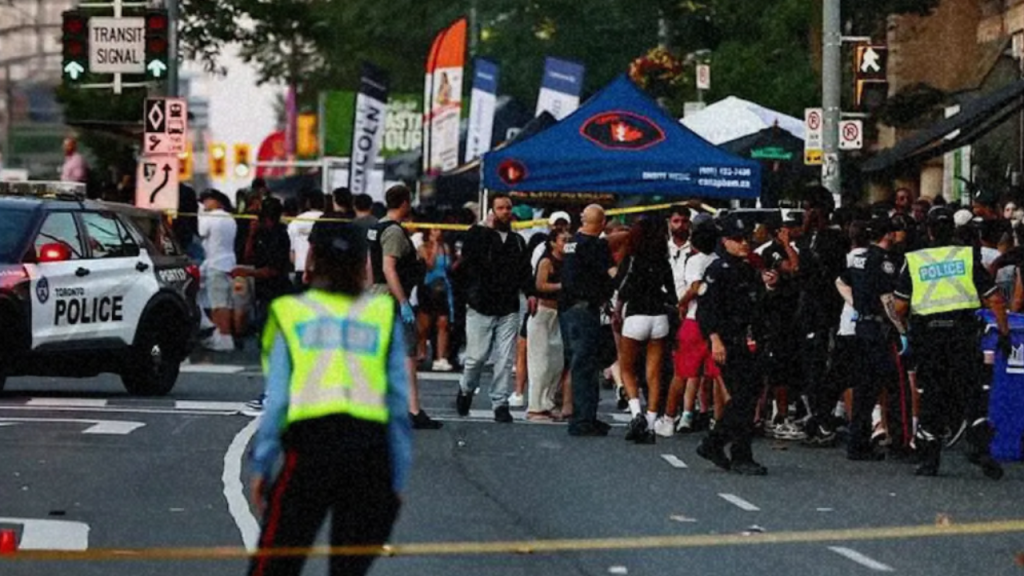
Social workers operate alongside police and clubs through the National Concept Sports and Safety (NKSS) framework. The model is preventive, dialogue-based, and explicitly positions the fan base as a constituency to engage rather than a threat to suppress. Belgium runs similar Fan Coaching projects. The German absorption model is the European version of what the Toronto Police Service does on a championship night, scaled up across decades of institutional investment.
The contrast is not theoretical. In 2010, twelve European countries — including Sweden, Germany, the UK, Denmark, and Austria — participated in the EU-backed GODIAC project (“Good practice for dialogue and communication as strategic principles for policing political manifestations in Europe”). The project established dialogue-and-communication as continental best practice, with three years of field studies, training, and reports feeding into police education across the participating countries.
France did not participate. Researcher Sebastian Roché attributes the French refusal to a policing culture shaped by colonial-era practices, the institutional trauma of 1968, and what he calls a “superiority complex” in the leadership of French police. Quebec sits inside the French civil-law tradition, the French-influenced policing register, and the same institutional culture that has refused the European best-practice consensus. The SPVM is not an anomaly within that lineage. It is operating on a known continental track.
This matters for the argument because the question “could it be different?” has an empirical answer. Hamburg can. Bremen can. Toronto can. The German Fanprojekt model has 40 years of operational evidence behind it. The fact that Montreal does not have anything resembling absorption infrastructure is a discretionary institutional choice, made and remade through every budget cycle since 2018. The SPVM is on the French track. Nothing about Quebec’s legal or cultural inheritance requires it to stay there.
The pre-announced loop
The SPVM and the city are running a closed loop. The institution announces in advance that “decisive matches” will produce “scaled up” operations with chemical irritants “always a possibility.” Chief-Inspector David Shane gave that interview to Canadian Press on May 1 — two days before Game 7. The Bell Centre opened a third outdoor watch-party screen for Round 2, and the venue operator’s communications explicitly named the prohibited objects: fireworks, pyrotechnics, flares, smoke bombs. The institution names the pretext in advance.
The fans show up to celebrate. Someone — possibly a fan, possibly not — sets off a firework. The institution deploys against the entire crowd because the pretext has appeared on schedule. The deployment justifies the budget. The budget justifies the next deployment. The next deployment requires the next pretext, so the institution pre-announces what counts as one, and the pretext arrives when needed.
William Wilson called it a method, not a moral failing. “The events subsequent to others which they escalated are always bad. They find a way to get there.” That is the cleanest description of the loop the apparatus is running. Pre-announced operational posture. Predictable fan behavior the apparatus has named in advance. The deployment the institution wanted to run anyway. The fans absorb the cost. The institution captures the benefit. The city ratifies the cycle by signing the next budget.
The public is treated as a passive variable in this loop. The institution sets the terms. The fans show up. The deployment happens. Civic response, if any, is offered after the fact and immediately absorbed back into the self-justification machine.
The Rotrand motion is the rehearsal. It went to committee. An amended version passed asking for a study. The institution kept deploying. That is what civic input looks like when the institution sets the terms: input becomes a study, the study becomes a delay, the delay becomes the next deployment.
The institution is supposed to be accountable to the public. The public is not supposed to be a managed input into an institutional process that has pre-decided its own outcome. The deployment terms are supposed to be dictated by the people paying for them, not by the apparatus that benefits from them.
Four levers, and who each one actually serves
Four levers will be offered in the public conversation about what to do next. They will not be offered as equally serving the public. They will be offered as if they are. The question is who actually pays under each one.
The first lever is the one Liberal and PQ politicians will reach for the moment this issue gets enough oxygen to require a response. Quebec’s National Assembly amends Civil Code articles 1480 and 1526 to restore solidary liability for riot damage — reversing Lonardi. It will be sold as “ending the SPVM’s excuse for chemical weapons.” If the city can recover damage costs from rioters after the fact, the argument goes, the city does not need to pre-deploy with tear gas to prevent damage in the first place.
This sounds like limiting police power. It is not. Restoring solidary liability puts the financial exposure for any riot damage back on individual working-class fans — and not just on the specific person who broke a specific window, but on every identifiable participant, jointly, for the full damage to anything they were near. That is a tough-on-crime expansion dressed as police reform.
The Liberals and the CAQ will love it. The PQ will love it. It will let a future Premier give a press conference about “holding rioters accountable” while quietly preserving the SPVM’s deployment posture, because nothing about restoring solidary liability actually restrains the chemical-weapon track. Both tracks just get reactivated. The fans absorb the cost twice — first from the chemical weapons, then from the civil judgments.
This is the lever that looks like a leftist win and is actually a carceral expansion. Watch for it. Reject it when it shows up.
The second lever is also provincial, and at first glance closer to what a left position should be advocating for. Applied in the current socio-economic context, it runs into problems of its own. The National Assembly legislates a parallel statutory scheme outside the Civil Code — a public-disorder damage recovery fund, financed by mandatory contributions from leagues, broadcasters, and venue operators. Property owners in designated celebration zones get a no-fault backstop. The municipal balance sheet stops carrying the property-damage exposure. In principle, the institutional incentive for chemical-weapon pre-deployment as risk management evaporates.
This is closer. It puts the cost on the beneficiaries rather than the fans. But it introduces a new institutional incentive that has its own public-safety problem. Once damage is covered by an insurance-style recovery fund, police gain a financial reason to stand down and let property damage happen, because the fund pays out either way. The 2010 G20 in Toronto is the cleanest North American example — police cruisers were abandoned and allowed to burn on Bay Street while officers stood back, and the destruction served the institutional argument for the next budget cycle.
A provincial recovery fund in Quebec changes the dollar mechanics. It does not eliminate the standing institutional incentive to let property damage happen when letting it happen serves the apparatus. The mechanism that allows the SPVM to pre-emptively brutalize Habs fans is institutional, not legal — which means it is also reformable, but not through a fund that pays out whether the apparatus does its job or doesn’t.
The coalition for this reform has not assembled. Even if it did, the fund would be administered through a provincial bureaucracy with its own institutional incentives — often expressed through non-enforcement, which may be acceptable in the language of insurance claims but is its own threat to public safety.
It is a real reform, and it puts the cost on the right actor. It is not a reform any Quebec government has shown appetite for, and it requires trusting a provincial agency to push back against the same corporate actors that fund its enabling legislation. File it under “would be better, requires a political alignment that does not currently exist, and brings its own institutional risks.”
The third lever is municipal. The City of Montreal already has the legal authority to legislate the SPVM’s operational posture directly through binding bylaw — restricting chemical-irritant deployment to defined imminent-threat conditions, requiring civilian sign-off before deployment, requiring documentation submitted to council within 48 hours, attaching budgetary penalties to deployments later found unjustified.
This is a real lever. It targets the apparatus directly rather than displacing the cost elsewhere. The Rotrand 2020 motion was the rehearsal. A binding bylaw is the production. The 137% chemical-irritant escalation in 2024 is happening partly because there is no institutional cost to the SPVM for deploying. Attach a cost. The cadence changes.
The barrier is political will, not legal authority. The current Plante administration has demonstrated it will not. A future administration could.
A binding bylaw also runs into the limit any municipal restraint on police runs into in Quebec — the SPVM operates under provincial police law, the police union is one of the most aggressive in the province, and any binding restriction will be challenged on every front. The third lever is genuinely good policy. It also faces the maximum institutional resistance the apparatus can generate. The fight is worth having, but it is not a fight that gets resolved in a single council cycle.
The fourth lever is the one the City of Montreal can pull this council, this budget cycle, under existing authority. Cost reallocation. The Cayer statement on May 1 already conceded that “many of the costs are borne by the event promoters.” The city is already acknowledging the cost-allocation question is live.
Push it further. Groupe CH, Quebecor, and the downtown BIA are extracting hundreds of millions in revenue across a deep playoff series. They can be made statutorily liable for the public-realm costs of the celebrations that produce their revenue. Policing line included. Cleanup included. Transit disruption included. Medical response included.
This is the move that makes sense from a leftist position. No Civil Code amendment required. No Supreme Court intervention. No parallel provincial scheme. Quebec municipal law already permits cost-recovery from event promoters for predictable public-realm impacts. Concert venues pay. Festival organizers pay. Construction sites pay. The legal architecture exists. What is missing is the political decision to apply it to the actor whose revenue the entire celebration architecture serves.
The reason this is the leftist move is structural. The first lever puts the cost on the working class. The second lever puts the cost on the corporations but routes it through a provincial bureaucracy with its own institutional incentives, and requires waiting for a political alignment that does not exist. The third lever targets the apparatus directly but faces the apparatus’s maximum institutional resistance. The fourth lever puts the cost on the actor that profits from the celebration in the first place. The Molsons. Quebecor. The downtown BIA. The fans produce the value. The beneficiaries get the invoice.
The downstream effect is immediate. Once the Molsons are paying the SPVM deployment line out of Bell Centre playoff revenue, the Molsons start advocating for the cheapest operational posture. Absorption is cheaper than aggressive deployment. The Toronto template — pre-emptive transit rerouting, free public watch parties, investigative-procedure response to property damage — becomes the Bell Centre template overnight. Not because the Molsons developed a conscience about chemical weapons. Because they developed an invoice.
This is also why it is the lever the beneficiaries are most invested in keeping out of the public conversation. The first lever they will champion publicly while it expands carceral exposure for the public. The second lever they will tolerate quietly because they will negotiate the contribution rates down. The third lever they will oppose through the police union and the police-friendly press. The fourth lever is the one they cannot allow on the agenda at all, because it is the one that ends the extraction.
The fans get to celebrate without cops bashing people in jerseys. The apparatus loses the incentive to deploy because the actors funding it lose the incentive to demand it. The 1993 looter named the exchange in 16 words. Nothing has changed in 33 years. Fans produce the value. Corporations capture it. Fans get the property-damage tab and the chemical-weapon dispersal. Until the invoice flips, the cycle iterates.
None of this is to say that the operational question is whether fans get brutalized or whether property gets protected. That framing is what the SPVM and the city want the conversation to be, because it lets them present the deployment as the only available answer. The framing is false.
A 4’x8′ sheet of plywood from Home Depot costs roughly $35. Storefront windows can be boarded preemptively before predictable celebration events the way they are boarded for hurricanes. The G20 in Toronto, the Raptors championship run in 2019, the Blue Jays World Series run in 2025 — every major Canadian gathering in the past 15 years has seen plywood deployed by businesses that wanted protection. The plywood works.
You can buy thousands of sheets of plywood for what it costs to deploy 250 cops in riot gear for a single night. Sanitation cleanup is routine. Street closures cost overtime for traffic-control workers. Bus shelters and traffic lights are replaceable infrastructure. The economic argument for aggressive deployment falls apart on contact with the actual numbers.
There are methods of protecting property that do not include physically assaulting Habs fans on Crescent Street, and those methods are cheaper than the apparatus the city is currently funding. The four levers are arguments about who pays and how the institutional incentives line up. The underlying premise that brutality is necessary at all is the SPVM’s framing, not the public’s reality. The deployment is not necessary to protect property. The deployment is necessary to protect the institutional posture.
The public dictates the terms, or the apparatus does
The loop depends on the public being a passive input. Pre-announce the operational posture. Wait for the predictable behavior the posture has named as the trigger. Deploy. Justify. Bank the next budget increase. Pre-announce the next operational posture.
The loop breaks the moment the public refuses to be a passive input. The municipal authority exists. The legal architecture exists. The fiscal case exists — $821 million a year for an apparatus whose closest Canadian peer demonstrates the alternative is operationally viable, while the actors actually profiting from the celebrations pay zero into the public-realm costs those celebrations produce. The variable is institutional will. Institutional will follows political pressure. Political pressure follows the people paying for the apparatus deciding they want different terms.
The fans on Crescent Street on May 3 did not consent to be the test case in someone else’s institutional self-justification cycle. The fans who will pour out of the Bell Centre after Game 6 Saturday — whether to celebrate a series win or to drown out an elimination loss — will not consent to it either. The institution has pre-announced its terms. The question is whether the public continues to accept those terms as the only ones on offer.
Saturday is the next test
The third outdoor screen added for Round 2 is already up. The venue operator has already named the prohibited pretexts. The apparatus is waiting for its opportunity. Saturday at the Bell Centre is when it gets one.
The empirical record predicts what happens if the apparatus is given that opportunity. The May 3 photographs predicted it. The 2021 four-deployment window predicted it. The 137% chemical-irritant escalation in 2024 predicted it. The pre-announced May 1 operational posture predicted it. None of this is hypothetical.
What is hypothetical is whether the public, between now and the next celebration night, decides it has any say in the matter. The municipal authority to flip the invoice exists. The political infrastructure to make that authority operational does not. That is what would need to change. Not the law. Not the court. The political infrastructure that decides whose interests the apparatus actually serves.
Go Habs go.
Sources
- CBC News / Canadian Press, “How Montreal police and the city prepare for Habs playoff gatherings,” May 1, 2026
- William Wilson Photography — Editorial archive, SPVM documentation
- William Wilson, “The SPVM Has a Police Brutality Problem,” The Rover, June 20, 2025
- Mirren Bodanis, “SPVM increase in chemical irritant usage sparks outcry,” The Link, February 24, 2026
- Taylor C. Noakes, “The 1993 Montreal Hockey Riot Raged Against Political Dysfunction and Deindustrialization,” Jacobin, April 2023
- Cult MTL, “The SPVM’s use of chemical irritants has soared in 2021,” August 2021
- Supreme Court of Canada, Montréal v. Lonardi, 2018 SCC 29
- Associated Press wire reporting, June 1993 — “The Habs won the Cup and big bonuses” quote (no archived URL; cited via Noakes / Jacobin)
- CBC News, “Police cars burned, stores looted in Montreal hockey riot,” April 22, 2008
- CBC News, “Montreal police brace for overzealous Habs fans,” April 22, 2014
- CBC News, “Montreal on alert as Habs-Bruins series comes home for Game 3,” May 4, 2014
- CBC News, “Montreal police use tear gas to disperse Habs fans after series victory,” June 24, 2021
- Globe and Mail / Canadian Press, “Canadiens’ Game 4 Stanley Cup final win followed by arrests, tear gas in Montreal,” July 6, 2021
- CBC Sports, “Montreal police defend tear-gassing Habs fans without warning after Game 4,” July 6, 2021 — Vincent Wong quote, Rotrand motion