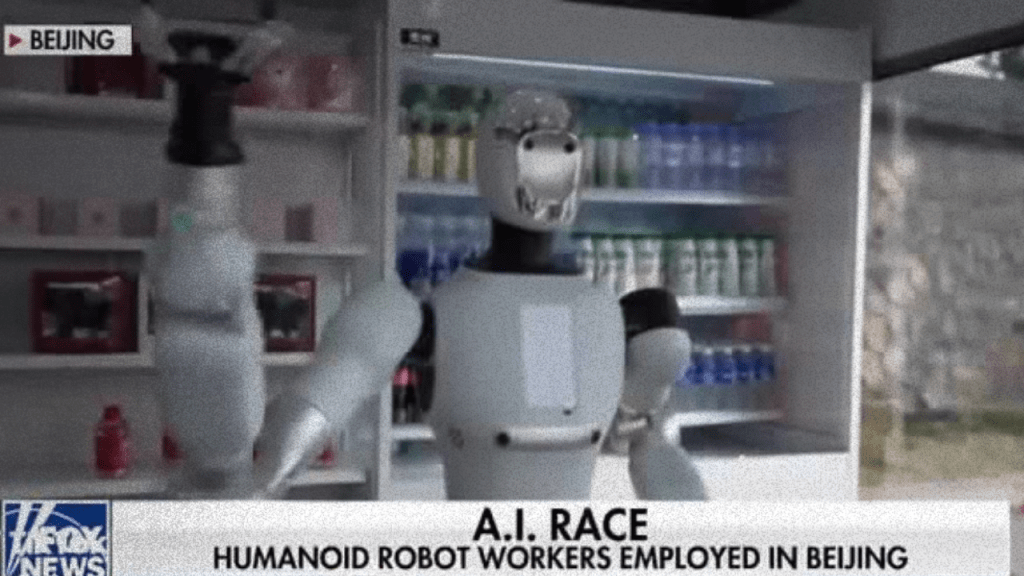
While China is breaking fusion records, scaled humanoid factories, and built massive infrastructure, US media fixated on a Beijing robot serving sausage.
Bret Baier stood inside a Beijing convenience store on May 14th, wearing a navy blazer, and ordered a sausage from a humanoid robot.
The clip has since circulated across American social media within hours, reposted by the Fox account, picked up by RT, picked up by every aggregation account looking for the day’s Trump-Xi summit spectacle.
This is what millions of Americans watched while tuning in to learn what their president was doing in China.
What the segment did not say is that the humanoid robot dispensing the sausage to Baier is part of a Chinese robotics industry that produced approximately 12,800 humanoids in 2025, roughly ninety percent of total global output.
It did not say that a Guangdong facility launched in March 2026 capable of producing 10,000 humanoid units annually, one robot every thirty minutes, while Unitree pursues a parallel factory targeting 75,000 units per year.
It did not say that embodied AI has been designated a national priority under China’s 15th Five-Year Plan, supported through provincial action plans, state-backed industrial coordination, standardization committees, and deployment targets exceeding 100,000 humanoid systems by year’s end.
It did not say any of that because saying it would require a vocabulary American broadcast media no longer maintains: the vocabulary of developmental states, industrial policy, coordinated planning, and measurable material output.
The Baier segment is not a media failure. It is the genre American television news now operates in. Eight-second novelty clips are what gets aired when the actual story is the structural displacement of American industrial capacity by a planning system the network cannot coherently describe.
What Beijing Was Actually Doing
In January 2025, China’s Experimental Advanced Superconducting Tokamak in Hefei sustained a high-confinement fusion plasma for 1,066 seconds, tripling its previous world record and crossing the 1,000-second threshold fusion researchers view as a practical benchmark for future power generation.
In January 2026, the same EAST tokamak accessed the long-theorized “density-free regime” beyond the Greenwald density limit, a barrier that had constrained tokamak operation for decades.
The breakthrough was published in Science Advances by researchers from Huazhong University of Science and Technology and the Hefei Institutes under the Chinese Academy of Sciences.
By the end of 2025, China operated more than 50,400 kilometers of high-speed rail, exceeding the combined total of every other country on Earth.
The network carried 4.26 billion passenger trips in a single year and connected 97 percent of cities with populations above 500,000.
The 14th Five-Year Plan added 12,000 kilometers of additional HSR track between 2021 and 2025, while the 15th Five-Year Plan targets 60,000 kilometers by 2030.
Construction is already underway on projects including a 14-kilometer underwater tunnel beneath the Yangtze River.
In the EV battery sector, Chinese manufacturers now control roughly 69 percent of global installations. CATL alone commands over 40 percent of the global market, making it the only battery manufacturer on Earth with market share above thirty percent. BYD ranks second globally. Together the firms anchor an industrial ecosystem composed of hundreds of suppliers and thousands of subcontractors coordinated through state-supported industrial policy and localization programs.
China’s Tiangong space station completed its core assembly phase in under two years and has already hosted nine astronaut crews. Chang’e 7 launches this year to survey the lunar south pole for water resources, Chang’e 8 follows in 2028, Tianwen-3 targets a Mars sample-return mission, and Chinese astronauts are scheduled to land on the Moon by 2030 as construction advances toward an International Lunar Research Station by 2035.
Meanwhile DeepSeek’s January 2025 release disrupted global assumptions surrounding frontier AI development costs, forcing Silicon Valley firms and Western analysts to recalculate long-standing narratives about computational scale, training expense, and the structure of AI competition itself.
What American Television Shows Instead
What the American broadcast audience sees instead of all of that, is Bret Baier ordering a sausage from a robot.
The night before, CBS anchor Tony Dokoupil broadcast from Taipei rather than Beijing while Paramount pursued an $81 billion merger requiring Trump administration approval. The summit itself was framed through arrival shots of American CEOs descending Air Force One into Beijing seeking access to Chinese markets on behalf of the corporations financing the political system they operate inside.
None of these broadcasts contained the phrases “Greenwald density limit,” “fusion confinement record,” “five-year plan,” “industrial coordination,” or “50,400 kilometers of high-speed rail.” None of them could have. The conceptual vocabulary required to describe a developmental state operating in real time no longer exists inside American television journalism.
Five-year planning is not a category in American broadcast framing. Coordinated industrial policy is not a category. State-directed supply chain integration aimed at public developmental goals is not a category. What exists instead are categories like “A.I. race,” “special report spotlight,” founder personalities, stock fluctuations, mergers, earnings calls, and novelty consumer experiences.
Even Chinese infrastructure enters American coverage primarily as inconvenience. Fox personalities and visiting American correspondents have complained about digital ticketing systems, QR-code payment platforms, and the difficulty of navigating transportation infrastructure built around integrated mobile ecosystems rather than foreign television crews carrying American credit cards.
A rail network moving billions of passengers annually across continental distances became, in broadcast framing, a story about whether an American anchor found the app interface annoying.
The developmental achievement disappears behind the consumer experience of the visitor observing it.
This is because the framing categories embedded in American television news describe an entirely different political economy.
American broadcast media reports venture capital rounds, individual product launches, founder rivalries, stock valuations, and speculative hype cycles because that is what a financialized economy produces.
When that same media system encounters China, it cannot interpret developmental planning through those categories. So it substitutes novelty, friction, and spectacle.
The Collapse of Developmental Vocabulary
This is not primarily a problem of individual intent. The Fox News producer choosing the robot-sausage clip is not consciously attempting to suppress coverage of fusion research in Hefei. The producer is operating within framing structures American media institutions no longer possess the intellectual infrastructure to move beyond.
American broadcast journalism once maintained a vocabulary for describing developmental competition. During the Cold War, networks devoted sustained coverage to Soviet industrial output, Japanese manufacturing coordination, German technical training systems, and state-directed economic competition.
The American media system and it’s public, once understood that infrastructure, industrial policy, energy systems, and manufacturing capacity were geopolitical categories.
That institutional muscle memory is gone.
What replaced it over the past forty years was a media system reorganized around financialization. Structural analysis gave way to brand-management narratives centered around CEOs, firms, personalities, celebrities and speculative consumer markets.
Industrial capacity ceased being understood as a political category and became background scenery for business reporting.
Inside that framing structure, China cannot be described accurately. A state-led developmental project operating through long-term planning horizons does not map cleanly onto categories built around quarterly earnings reports and venture-capital speculation.
So Chinese fusion breakthroughs become isolated science headlines. Chinese high-speed rail becomes a tourism segment. Chinese EV dominance becomes a Tesla competitor story. Chinese humanoid production becomes an amusing chyron about robots serving snacks in convenience stores.
The structural reality never enters the frame: one state is operating a coordinated developmental system producing measurable industrial outputs while the other increasingly organizes itself around financial extraction, media spectacle, and corporate consolidation.
This is why the same week that produced millions of views for Bret Baier ordering a sausage produced effectively zero serious American broadcast discussion explaining what the Greenwald density limit is, why surpassing it matters for fusion commercialization, or what it means geopolitically that the breakthrough emerged from Hefei rather than Princeton or Livermore.
American audiences are not as much stupid, as they are uninformed. Those are different conditions, and the second is a production output of the media system functioning exactly as designed.
What This Costs
A media system incapable of describing developmental states cannot generate political pressure to build one.
American viewers who never hear about China’s fusion breakthroughs cannot demand comparable public R&D investment. Viewers taught to interpret humanoid robotics as novelty spectacle cannot mobilize behind industrial policy capable of rebuilding domestic manufacturing capacity. Citizens watching CEOs conduct diplomacy in Beijing through the mediation of television spectacle cannot imagine alternatives because the alternative framework never enters the conversation.
This is the function of spectacle. It is not malfunctioning. It is operating exactly as intended by occupying the cognitive space where political demands for material development might otherwise emerge. Eight seconds of robot sausage on cable television fills that space without informing it.
By the time the segment ends, the audience believes it has consumed the China story for the night. The viewer will not go searching for plasma-density papers published in Science Advances. The system has already informed them what counts as knowledge and what counts as entertainment.
Meanwhile in Hefei the plasma remains stable beyond the density threshold. In Foshan a humanoid robot rolls off an assembly line every thirty minutes. Beneath the Yangtze River a new high-speed rail tunnel advances through the earth. In Beijing American CEOs negotiate access to markets their own political economy increasingly struggles to compete with. On American television Bret Baier orders another sausage.
The China Development Race is already happening. The American media system is choosing not to describe it.
Sources
- Physics World — China’s EAST Tokamak smashes fusion confinement record
- SciTechDaily — China Advances Toward Fusion Ignition With Major Plasma Breakthrough
- World Nuclear News — Chinese tokamak achieves progress in high-density operation
- Live Science — China’s artificial sun reactor shatters major fusion limit
- Merics — Embodied AI: China’s ambitious path to transform its robotics industry
- Interesting Engineering — China’s new humanoid robot factory can make 10,000 units a year
- Interesting Engineering — Agibot humanoid robots with embodied AI work in Chinese factory
- CnEVPost — Global EV battery market share
- Carbon Credits — China controls 69% of the global EV battery market
- Global Times — China extends railway network to 165,000 km
- Railway News — China high-speed rail expands to 50,000 km
- Newsweek — China’s high-speed rail network surpasses rest of world combined
- Global Times — China space achievements in 2025