
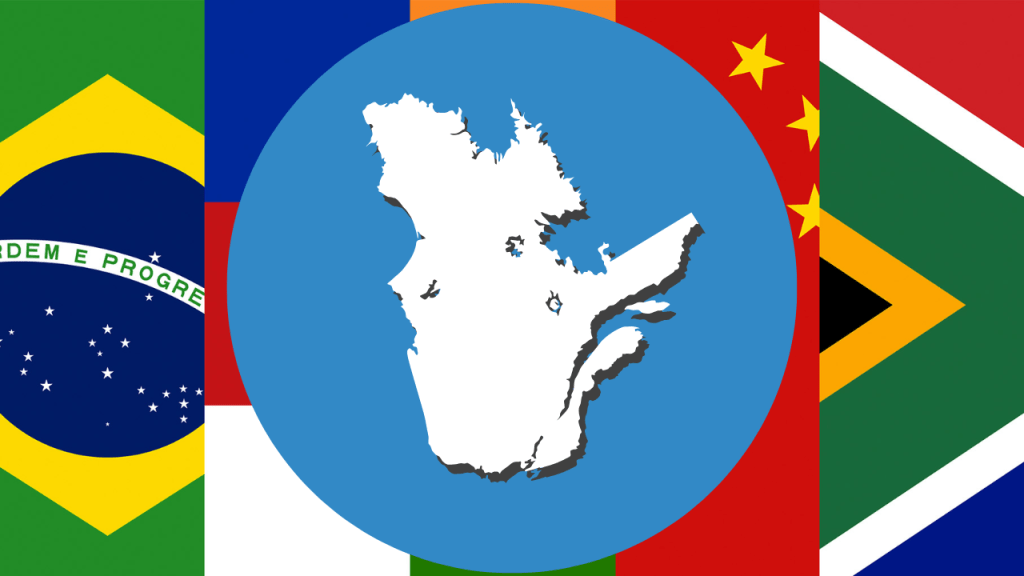
Quebec in BRICS is not a hypothetical — the machinery already exists. Here is what reorienting it toward the multipolar world looks like in practice, with or without independence.
Quebec already has the productive forces to begin this reorientation toward a multipolar world now, within its existing provincial powers, without a referendum. Independence does not create that capacity — it extends it. Each section below addresses both: what is possible now, and what independence unlocks specifically. The two tracks are not sequential. The work on Track 1 is the work that makes Track 2 viable.
Navigating the BRICS Contradiction
Before the mechanisms, one operational point that shapes all of them. BRICS is not internally coherent and no honest account of orienting toward it can pretend otherwise. Russia is currently accused of war crimes in Ukraine. Iran executes political dissidents. The UAE operates a labour system that functions as indentured servitude for the migrant workers who constitute the majority of its population. India and China are engaged in active territorial disputes. Brazil vetoed Venezuela’s BRICS membership on democratic grounds that Russia and China rejected. These are real contradictions. They do not disappear because the institutional case for BRICS is strong.
The operational principle here is not to avoid contradictions but to navigate them — which requires being clear about which contradiction is primary. The primary question for Quebec is not whether every BRICS member meets a consistent democratic standard. It is whether the bloc’s principal function — development financing without austerity conditionality, trade relationships outside dollar hegemony, institutional weight outside the US-dominated order — resolves Quebec’s structural dependency in the right direction. It does. A Quebec that refuses BRICS alignment because of Russia’s conduct while remaining integrated into NATO — whose members include Turkey, with its own documented record on political prisoners and press freedom — is not applying consistent principles. It is performing Western credibility. Navigating the contradiction means naming it clearly, maintaining independent positions on the secondary contradictions, and staying oriented toward the primary one.
The Caisse de Dépôt: Redirecting the Capital Flow
The Caisse de dépôt et placement du Québec manages approximately $450 billion in assets — the pension and insurance savings of Quebec workers, directed by a provincially controlled institution with an explicit mandate to invest in Quebec’s economic development. This is the single most powerful productive force Quebec controls right now, no independence required.
Currently, the Caisse invests like any major institutional investor in the imperial core: global equity markets, private equity, real estate, infrastructure — diversified across the same asset classes as Ontario Teachers’ or the CPP, with a Quebec development tilt that has shrunk as the institution has professionalized and globalized. A reorientation does not require dismantling that — it requires redirecting a portion of the allocation with explicit political intent. A 5% reallocation of AUM toward NDB co-investments, cooperative housing development, worker-owned enterprise financing, and provincial green infrastructure represents roughly $22 billion in capital pointed at collective social development rather than market returns.
That is not a symbolic gesture. That is a transformation of the material conditions of working-class life in Quebec — cooperative housing at scale, community-owned renewable energy, financing for enterprises structured around worker control rather than shareholder value.
Without independence, this requires a provincial government with the political will to appoint a Caisse board that treats the development mandate as binding rather than advisory, and to legislate investment criteria that reflect collective social priorities rather than pure risk-adjusted return. The legal framework permits it. The bijural civil law system is structurally more amenable to cooperative ownership and collective investment arrangements than common law — the legal infrastructure for what the Caisse could finance already exists in Quebec’s own legal tradition. With independence, the constraint of federal oversight over pension fund regulation disappears entirely, and the Caisse’s mandate can be rewritten at the constitutional level to reflect the priorities of a sovereign state oriented toward collective development.
Hydro-Québec: Extending the Model
Hydro-Québec is the proof of concept. Publicly owned since 1963, it provides among the lowest electricity rates in North America, generates approximately $3 billion annually in dividends to the provincial government, and has positioned Quebec as one of the few jurisdictions in North America with genuine green energy abundance at the moment when the rest of the continent is scrambling to decarbonize. The left-sovereignty argument is not that Hydro-Québec is perfect. It is that its logic has never been extended — it has been managed as an exception rather than used as a model.
The extension looks like this: the public ownership model applied to advanced renewable energy technology development, to nuclear fusion research infrastructure, and to health care technology as a public good rather than a commodity. Quebec’s research universities — McGill, Université de Montréal, Université Laval, UQAM — are publicly funded and produce world-class research in life sciences, materials science, and energy systems. That research currently flows into private platforms and multinational pharmaceutical and technology companies.
A left-Quebec captures that value through public ownership of the downstream infrastructure: a provincially owned life sciences development corporation, state equity in the battery and critical mineral processing chains that Quebec’s lithium resources make possible, public computational infrastructure for the AI and advanced manufacturing research base that federal and provincial grants have built.
Without independence, the Quebec government can move on public equity stakes in strategic industries through the Caisse and through direct provincial investment — the 2015 Bombardier equity stake is the precedent. With independence, the federal foreign investment review framework disappears, and Quebec can structure its strategic industry relationships — including with BRICS partners — without federal approval. The NDB becomes available as a co-financing partner for public infrastructure that the federal framework currently routes through Ottawa’s priorities rather than Quebec’s.
Trade Reorientation: Breaking the 75% Concentration
Roughly 75% of Quebec’s exports go to the United States. That concentration is not a natural condition — it is the accumulated result of NAFTA and CUSMA integration, infrastructure oriented toward US markets, and the absence of institutional trade relationships with non-American partners. It is also Quebec’s single biggest structural vulnerability: it means the US can apply devastating economic pressure without military force, as Trump’s tariff threats have already demonstrated. Reducing that concentration is the material prerequisite for genuine economic independence, with or without political independence.
The reorientation begins with the sectors that already have international reach. Quebec’s aerospace sector — Bombardier, CAE, Pratt & Whitney Canada — sells globally and has supply chains that extend through Europe, Asia, and Latin America. The question is whether those supply chains deepen toward BRICS partners specifically. Brazil’s Embraer is a direct competitor in regional aviation and a potential state-to-state industrial partner — Quebec aerospace expertise and Brazilian manufacturing scale, structured as a joint venture with public equity on both sides, is a concrete alternative to exclusive dependence on Boeing and Airbus supply chains that run through US and EU regulatory environments. India’s aviation expansion requires aircraft, simulation equipment, and maintenance infrastructure at a scale that Quebec’s existing industrial capacity can supply.
These are not aspirational relationships — they are markets that exist now and that Quebec’s existing industrial capacity can serve.
Agricultural trade follows the same logic. Quebec’s agri-food sector — dairy, pork, maple products, grain — currently sells overwhelmingly to US and EU markets. BRICS partners are large food importers with growing middle classes and expanding food import demand. The infrastructure for diversification requires port development on the St. Lawrence oriented toward Atlantic routes rather than exclusively toward US border crossings — exactly the kind of long-horizon public infrastructure that NDB financing is designed to fund, on terms that don’t require privatization as a loan condition.
Without independence, the Quebec government can begin the port and logistics infrastructure investment now through the Caisse and provincial investment vehicles. With independence, bilateral trade agreements structured outside CUSMA become available, and Quebec can negotiate market access directly rather than through Ottawa’s trade priorities.
Monetary Sovereignty and NDB Access
Quebec currently has no monetary policy. The Bank of Canada sets interest rates for the entire country, calibrated primarily to the Ontario and Alberta economic cycles that dominate national output. This is the constraint that provincial powers cannot fully resolve — monetary sovereignty requires independence. But the preparation for monetary sovereignty begins now.
The New Development Bank, founded by BRICS members in 2014, provides developmental financing in member currencies rather than US dollars. This is structurally significant: dollar-denominated debt exposes borrowing states to US monetary policy cycles and the sanction risk that comes with dollar-system dependence. NDB financing in non-dollar currencies breaks that exposure. For a newly independent Quebec managing its first years of monetary sovereignty — whether it establishes its own currency, enters a currency arrangement with BRICS partners, or negotiates a transitional framework — NDB access means infrastructure financing on terms that do not require IMF conditionality, privatization, or austerity as the price of admission to development capital markets.
Trump’s threat of 100% tariffs on countries pursuing BRICS currency arrangements is a preview of the pressure an independent Quebec would face. It is also an argument for preparation rather than hesitation: the pressure will come regardless of whether Quebec moves toward monetary sovereignty, because the decision to orient the Caisse, Hydro-Québec, and provincial trade relationships toward the multipolar world is already a challenge to dollar hegemony. The question is whether Quebec faces that pressure having built the institutional relationships and financing alternatives that make it navigable, or having deferred the work until the pressure is already being applied.
Immigration Selection: Building the Coalition
The Canada-Quebec Accord gives Quebec independent control over its immigration selection — it chooses its own immigrants within federal numerical limits, runs its own integration programs, and has operated a de facto provincial immigration system since 1991. This is one of the most underused productive forces in Quebec’s existing arsenal, and it is available now.
As Spark Solidarity’s analysis of the national bourgeoisie after liberation argues, francophone control is not the same thing as popular control. The national bourgeoisie uses Quebec’s immigration powers to manage French cultural anxiety — selecting immigrants on francophone language criteria, orienting integration toward cultural assimilation, and turning restriction into a political instrument for the cultural-conservative wing of the sovereignty coalition. A left-Quebec would use those powers differently: to build the diverse, multilingual, class-conscious political community capable of sustaining material independence and the trade and diplomatic relationships a BRICS reorientation requires.
Engineers and researchers from Brazil, India, and China selected specifically to develop the institutional relationships that Quebec’s aerospace, life sciences, and energy sectors need with BRICS partners. Agricultural and logistics expertise from the Global South to develop the supply chain infrastructure for trade diversification. A Quebec that arrives at BRICS partnership with an existing population of citizens with deep ties to member states is a more credible partner than one that arrives with a cultural-nationalist immigration policy and requests for financing.
With independence, the federal numerical limits disappear and Quebec controls its immigration system entirely — which means it can scale this orientation as its institutional relationships develop, rather than operating within Ottawa’s national immigration targets.
NATO Exit: The Budget and the Signal
An independent Quebec inherits no NATO obligations. It would need to actively choose to join — which a left-sovereignty project refuses. Military non-alignment is both the clearest available signal of the break from the imperial core and a material budget mechanism that funds everything else described in this article.
Canada currently spends approximately 1.4% of GDP on defence, under sustained US pressure to reach the NATO 2% target. Quebec’s share of that expenditure, redirected toward the Caisse reorientation, the Hydro-Québec model extension, port infrastructure development, and public research ownership, represents several billion dollars annually pointed at collective social development rather than military alliance obligations. Non-alignment also removes Quebec from the liability of NATO’s collective defence commitments — missions in Afghanistan, Libya, and the ongoing eastern flank deployment that a left-Quebec has no basis for participating in.
Non-alignment is also the clearest available BRICS-alignment signal. Most BRICS members — India, Brazil, South Africa, China — have maintained independent positions on the Ukraine conflict rather than aligning with either NATO or Russia. A non-aligned Quebec is legible to those partners in a way that a Quebec that exits Canada but joins NATO is not. The signal matters for the financing and trade relationships that make economic independence viable: a Quebec that claims multipolar orientation while maintaining NATO membership is not making a break. It is making a rebranding. On what the multipolar order is actually being built toward, see China’s 2050 project and why China is not imperialist.
The Timeline: What Is Possible When
The two tracks are not sequential but they have different timelines. The work that can begin now — Caisse reorientation, Hydro-Québec model extension, immigration selection reorientation, provincial trade infrastructure investment — operates on a 5-10 year horizon. These are policy decisions that a government taking office in October 2026 can begin implementing in its first mandate. They do not require a referendum. They require political will and a Caisse board, a Hydro-Québec board, and an immigration ministry pointed in the same direction as the government that appointed them.
The independence track operates on a longer horizon — 10-20 years for the monetary sovereignty transition, the full NDB membership framework, the bilateral trade agreement structure, and the NATO exit to produce their full material effects. But that horizon begins now, with the Track 1 work. A Quebec that arrives at independence having already reoriented the Caisse, deepened its BRICS partner relationships through immigration and trade infrastructure, and established the public ownership precedents that independence will extend — that Quebec is not starting from zero. It is completing a transition that is already underway.
The machinery exists. It is operative now. The question that this article has tried to answer is not whether the orientation is correct — that question is settled. The question is what turning the machinery looks like, gear by gear, in the current moment. The answer is: slower than a referendum, faster than waiting for one, and entirely within reach of a government that understands what it has inherited and decides to use it.
This reorientation depends on political power built before independence, not delivered automatically by it. Spark Solidarity’s account of Quebec’s existing institutional terrain develops what can be done now, while its history of the sovereignty movement’s contradictions explains why changing the flag without changing class power would reproduce the dependency this article proposes to break.
Sources
- Spark Solidarity. “Quebec Independence and the Question the PQ Cannot Answer.” March 2026. sparksolidarity.ca
- Spark Solidarity. “Quebec Election 2026: Balance of Power.” March 2026. sparksolidarity.ca
- Caisse de dépôt et placement du Québec. Annual Report 2024. cdpq.com
- New Development Bank. About the NDB. ndb.int
- MR Online. “BRICS expands with 9 new partner countries. Now it’s half of world population, 41% of global economy.” January 2025. mronline.org
- Geopolitical Economy Report. “BRICS grows, inviting 13 new ‘partner countries’ at historic Kazan summit.” October 2024. geopoliticaleconomy.com
- Statistics Canada. “Provincial and territorial economic accounts, 2024.” statcan.gc.ca
- Canada-Quebec Accord. 1991. canada.ca
- Global News. “Support for Quebec sovereignty at 30-year low, according to new poll.” March 4, 2026. globalnews.ca
- The Walrus. “Trump’s Tariffs May Do the Impossible: Make Quebec Love Canada.” April 2025. thewalrus.ca
- Spark Solidarity. “China: Socialism by 2050.” December 2025. sparksolidarity.ca
- Spark Solidarity. “Why China Is Not Imperialist.” August 2024. sparksolidarity.ca






 Spark Solidarity