The Trump China CEO delegation stepped off Air Force One in Beijing on May 13, and the choreography did the talking.
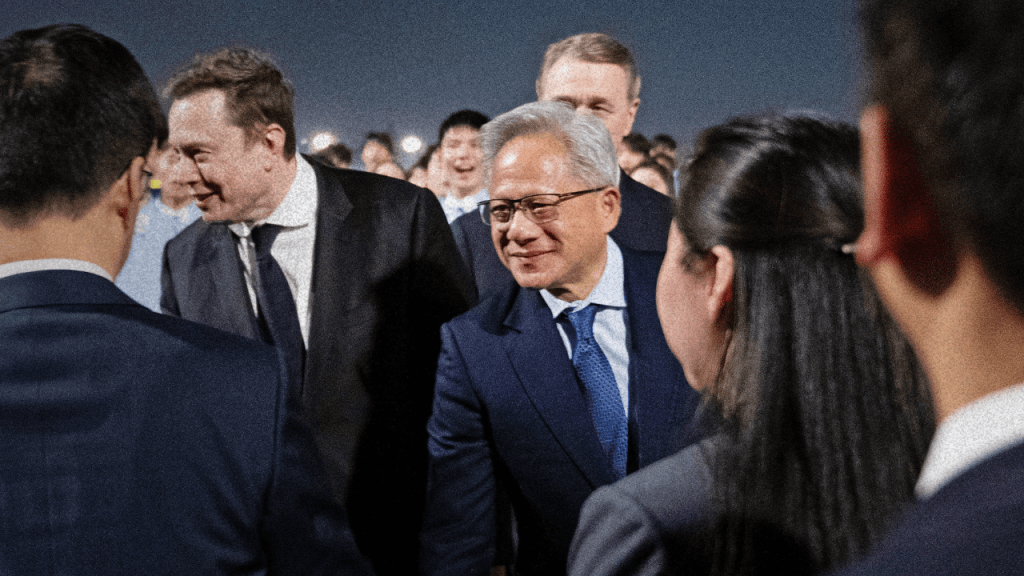
Han Zheng, China’s vice president and Xi Jinping’s designated envoy for ceremonial diplomacy, greeted Trump at the base of the aircraft steps at Beijing Capital International Airport. On the tarmac alongside the US ambassador, in the welcoming photographs that ran on every wire service: Elon Musk and Jensen Huang. Behind them in the delegation: Tim Cook, Larry Fink, Stephen Schwarzman, Kelly Ortberg, Brian Sikes, Jane Fraser, Larry Culp Jr., David Solomon, Sanjay Mehrotra, Cristiano Amon.
Apple, BlackRock, Blackstone, Boeing, Cargill, Citigroup, GE Aerospace, Goldman Sachs, Micron, Qualcomm. Twelve men who answer to no electorate, conducting foreign policy with the second-largest economy on Earth, while Trump played host. The president advocates, in his own words on Truth Social, “so that these brilliant people can work their magic.”
That sentence is the entire American posture in one line. The elected official is the agent. The principals are sitting in first class. Trump is brokering access for a private delegation whose interests are not coterminous with the American working class, with American manufacturing, with American food security, or with anything that could be honestly called a national interest.
They are coterminous with the share prices of twelve corporations whose China exposure ranges from significant to existential. CNBC reporters in Beijing capture the framing without irony: experts anticipate Trump and Xi may announce large Chinese orders of American planes and soybeans. Boeing and Cargill brought their CEOs. The deals will involve their products.
Who Sent Whom
The American press, with rare clarity, has not pretended otherwise. The Washington Post opened its coverage by noting Trump “jetted to Beijing alongside a phalanx of leaders of the nation’s top tech and finance companies.” The phalanx, not the cabinet.
Treasury Secretary Bessent, Trade Representative Greer, and the White House delegation are present, but the visual story is the CEOs. Musk and Huang flew on Air Force One itself. Huang was not on the original invite list and joined at the Alaska refueling stop, after a sustained lobbying campaign to relax US export controls on Nvidia’s advanced AI chips. He boarded mid-flight because his quarterly earnings depend on a state visit.
This is not new in form. American presidents have brought business delegations to Beijing for decades. Trump’s 2017 trip carried twenty-nine executives. What has changed is the relative weight of the actors.
In 2017, the executives followed the president to extract market access from a position of American leverage. In 2026, the executives precede the president into a room where the leverage runs in the opposite direction. Rare earth export controls, semiconductor manufacturing, the Strait of Hormuz, the Iran ceasefire timeline — every file on Xi’s desk this week is one Beijing controls and Washington needs. The CEOs are not there to extract concessions. They are there to receive them.
The Legal Tools Beijing Holds
Every executive on that plane is mechanically subject to Chinese anti-corruption law the moment they enter Chinese airspace. The 2025 revision of the Anti-Unfair Competition Law, which took effect October 15, 2025, extended explicit extraterritorial jurisdiction over commercial bribery committed outside China that disrupts the domestic market.
Article 164 of the Criminal Law criminalizes bribery of foreign public officials, a provision added in 2011 to align China with the UN Convention Against Corruption. Amendment XII to the Criminal Law, which took effect in March 2024, strengthened bribery penalties more broadly and closed liability gaps for executives in foreign-invested enterprises. The 2020 Hong Kong National Security Law applies, by its own text, to non-residents abroad.
The Data Security Law and Personal Information Protection Law govern data Tesla, Apple, or Micron handles relating to Chinese citizens. The Surveying and Mapping Law restricts geospatial data collection by foreign firms. Each of these is its own potential lever in the hands of a regulator who chooses to use it.
Beijing has used these tools before. In the GSK case, the British pharmaceutical firm was fined approximately $489 million in 2014 after a Chinese investigation found systematic bribery of doctors and hospitals. The China CEO, a UK national, received a suspended prison sentence and was deported. Four Chinese executives were convicted.
The GSK case was not about pharmaceutical bribery being uniquely egregious. Chinese pharma firms spent more on bribes, as a percentage of revenue, than the multinationals did. The case was about discipline. Beijing wanted the foreign pharmaceutical sector to understand the terms of operation. It got the message across with one prosecution.
Musk as the Test Case
Musk is the executive whose Chinese exposure is most visible because he has been the loudest about it. In October 2022, he told the Financial Times that Taiwan should become “a special administrative zone” with an arrangement “more lenient than Hong Kong.”
In September 2023, speaking remotely to the All-In Summit, he called Taiwan an “integral part of China,” comparing it to Hawaii.
Both statements drew formal rebukes from Taiwan’s foreign ministry. Both were welcomed by the PRC Foreign Ministry. Musk has stated, in interviews and on tape, that Beijing’s policy of reunification is the legitimate framing.
The reading on the Western liberal side is that Musk is a sycophant compromised by Tesla’s Shanghai Gigafactory, which produces more than half of Tesla’s global vehicles. The reading is not wrong but it is incomplete.
The Gigafactory exists because Beijing approved Tesla as the first wholly foreign-owned automaker in China. Musk pays his rent in public political alignment with PRC sovereignty claims.
He is not a CEO who tiptoes around Chinese red lines. He is a CEO who has figured out that the cheapest insurance policy on a fifty-billion-dollar factory is being publicly, ostentatiously useful to the host state.
This is the relationship the entire delegation has, in varying degrees of explicitness. T
im Cook does not say it on tape because Apple’s revenue model does not require him to. Cook simply structures Apple’s manufacturing footprint, App Store moderation in mainland China, and corporate political donations to keep the room comfortable.
Schwarzman bought his way in through Schwarzman Scholars at Tsinghua. Fink and Solomon are running the financial scaffolding of US sovereign exposure to Chinese state banks and state-supervised enterprises. Each man has a different version of the same posture: deferential, useful, and aware that the legal sword exists in the scabbard.
Strategic Patience as Policy
Beijing does not unsheathe the sword. This is the part of the analysis Western leftist commentary on China tends to mishandle, by reaching for moral framings that the Chinese state does not operate on.
The CCP is not insufficiently anti-imperialist for declining to prosecute Sanjay Mehrotra over Micron’s licensing arrangements, or Larry Culp Jr. over GE Aerospace’s engine sales to Air China.
The CCP is acting in the developmental interests of the Chinese state and, above all, the Chinese people, in accordance to its mandate.
A long competition in which American capital remains structurally dependent on Chinese manufacturing, Chinese rare earths, and Chinese consumer markets is materially better for China than a short confrontation in which a billionaire goes to a Chinese prison and every multinational pulls its supply chains in a panic.
The contrast with the state on the other side of the diplomatic table is what makes this argument legible.
In January 2020, the United States killed Iranian General Qasem Soleimani in a strike at Baghdad airport as he arrived on an official diplomatic visit at the invitation of the Iraqi prime minister.
The strike also killed Abu Mahdi al-Muhandis, deputy commander of Iraq’s state-recognized Popular Mobilization Forces. A state actor in another country, killed on third-country soil, during a diplomatic mission.
In January 2026, the same administration captured Venezuelan President Maduro in a military raid on Caracas, flew him to a US warship, and announced from Florida that Washington was “going to run the country.”
A sitting head of state abducted from his capital and transported across international waters to face US criminal indictment. The same year as the Beijing CEO trip, the same administration.
In February 2026, with US-Iran nuclear negotiations active in Oman and a follow-up meeting set for Vienna, the United States and Israel killed Iranian Supreme Leader Khamenei in his Tehran office.
UN Secretary-General António Guterres said the chance for diplomacy had been “squandered.” Omani mediators reported a peace deal had been within reach. The state targeted the head of state with whom it was negotiating, while it was negotiating.
The on going Iran war, the ongoing bombing of Gaza, the strikes on Caribbean fishing vessels declared narco-boats without trial — the state with which Beijing is conducting business this week is the state that does these things. Beijing has done none of them.
The state with mechanical legal jurisdiction over twelve American CEOs sitting in a Chinese hotel right now has not abducted a head of state, has not killed a religious leader mid-negotiation, has not bombed a population to dispossession, has not droned a diplomat at an airport.
The American left should not be writing pieces that ask Beijing to use its legal apparatus against American oligarchs in the name of global justice.
That argument projects Western ethical frames onto a state operating on different terms. It asks China to take on exactly the posture — extraterritorial moral discipline of foreign capital — that the anti-imperialist case against the United States is built on critiquing.
China’s principle of non-interference is load-bearing. Suspending it for a satisfying outcome would discredit it.
The Asymmetry Is the Story
What is worth naming, and what the May 13 photo on the tarmac shows, is the asymmetry itself. In February 2025, Trump signed an executive order pausing enforcement of the Foreign Corrupt Practices Act for 180 days.
In June 2025, the Justice Department lifted the formal pause but issued new guidelines redirecting enforcement away from “routine business practices” of American multinationals and toward foreign companies, especially Chinese ones.
China spent the same period building the opposite framework: extraterritorial reach, personal executive liability, and the legal infrastructure to discipline any foreign multinational it chose to make an example of.
One state narrowed the corporate criminal law that constrained its own oligarchs. The other built the toolkit.
That asymmetry does not require China to act for it to be the story. The story is that twelve American corporations have organized the American state into a delivery vehicle for their China exposure, and the state on the receiving end could end any of them with one prosecution and a press release, and chooses not to because choosing not to is more useful.
The American oligarchy is not standing on equal ground with a peer competitor. It is standing on Chinese forbearance. It walked through customs at Beijing Capital International Airport because Xi let it through.
Boeing’s Chinese orders will not employ workers in Wichita at the rates that make Wichita livable. Cargill’s soybean contracts will not raise prices for farmers in Iowa. Apple’s continued access to Chinese assembly will not bring iPhone manufacturing to Texas.
The deals are intra-elite transfers across an oligarchic boundary that runs through, not around, the American state.
Han Zheng greeted Elon Musk on the tarmac because Han Zheng knows who Musk reports to, and it is not the President of the United States.
Sources
- CNBC — Trump invites Musk, Cook, Fink and other CEOs to join China trip (May 11, 2026)
- CNBC — Trump arrives in Beijing with CEOs ahead of Xi meetings (May 13, 2026)
- Washington Post — Trump jets to China with gaggle of CEOs (May 13, 2026)
- CNN — Trump arrives in China for summit with Xi Jinping (May 13, 2026)
- NPR — Trump lands in China as Iran war smolders (May 12, 2026)
- Harris Sliwoski — China’s 2025 Competition Law creates executive liability and extraterritorial reach
- Hogan Lovells — China’s 2025 Anti-Unfair Competition Law revision: a new era of enforcement and accountability
- Covington — China amends Criminal Law related to bribery and corruption (January 2024)
- GSK China scandal — Wikipedia summary
- Council on Foreign Relations — Three take-home messages from China’s Glaxo verdict (2014)
- CNN — Taiwan hits back at Musk’s Taiwan-Hawaii comments (September 2023)
- CBS News — Elon Musk draws rebuke for Taiwan special administrative zone comments (October 2022)
- Executive Order 14209 — Pausing FCPA Enforcement (February 10, 2025)
- Jenner & Block — Trump administration lifts FCPA pause with new guidelines (June 2025)
- Spark Solidarity — Why China is Not Imperialist or a Capitalist State (August 2024)
- Spark Solidarity — Iran War Began While the Diplomats Were Still Talking (March 2026)
- Spark Solidarity — Iran War Narrative Inverts Who Struck First (March 2026)
- Spark Solidarity — US Venezuela Normalization Is the Occupation’s Paperwork (March 2026)
- Al Jazeera — Iran confirms Supreme Leader Ali Khamenei dead after US-Israeli attacks (February 2026)
- Al Jazeera — How the US attack on Venezuela, abduction of Maduro unfolded (January 2026)
- Al Jazeera — Iran’s Qassem Soleimani killed in US air raid at Baghdad airport (January 2020)