Iran’s Pahlavi, Cuba’s hardliners, China’s dissidents — Trump is managing all three exile networks simultaneously. Here’s what the contradictions reveal.
The pattern of weaponized diaspora — how Western states build exile political infrastructure, fund and amplify selected voices, and deploy those communities at moments of crisis — has been documented across decades and countries. What is less often examined is the current operational state of those networks: what they are doing right now, where their contradictions are sharpest, and what the Trump administration’s simultaneous management of all of them reveals about how the machinery actually works.
This is not a historical argument. It is a description of what is live, documented, and visible in early 2026.
Iran: The Client Who Wasn’t Called
The most instructive case at this moment is Iran, because the gap between the exile infrastructure and its intended function has become impossible to ignore in the days since US and Israeli forces launched strikes that killed Supreme Leader Khamenei.
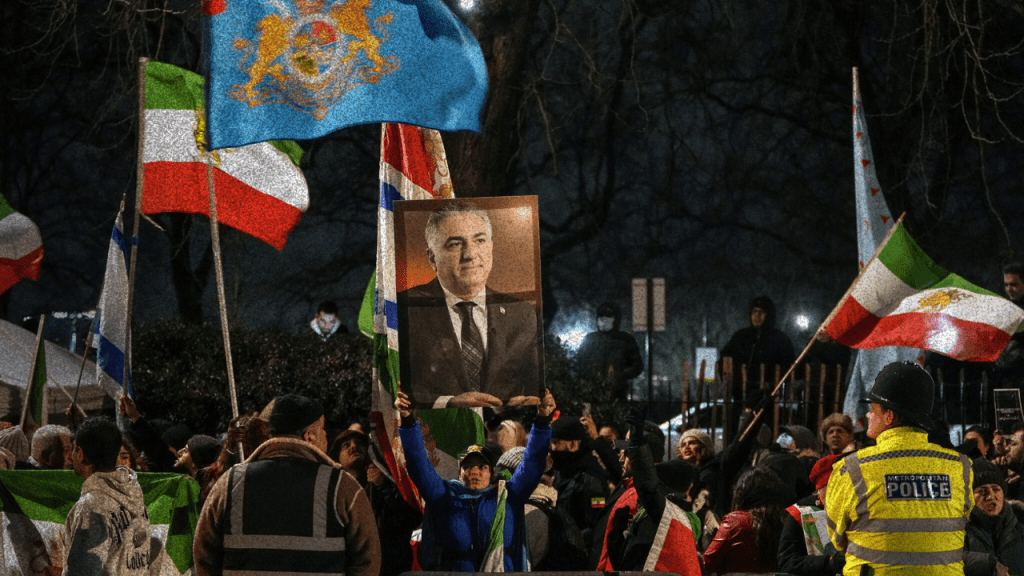
Reza Pahlavi, the son of the Shah deposed in 1979, has spent decades positioning himself as the legitimate transitional leader of a post-Islamic Republic Iran. He has cultivated relationships with Western governments, appeared before European security conferences, and in 2023 made his first official visit to Israel, where he met with Netanyahu. By January 2026, as mass protests shook Iran, he was Pahlavi’s Trump meetings — in direct communication with the Trump administration, meeting secretly with special envoy Steve Witkoff to discuss what a post-regime Iran might look like with Pahlavi in a transitional role.
When the strikes came on March 1, Pahlavi described them as a “humanitarian intervention” and assured Iranians that his forces were ready. He released an updated governance plan for the first six months following regime collapse and appeared on 60 Minutes to explain that he wanted to be a “transitional leader, not the future king or future president.” He expressed public support for the strikes and for the killing of Khamenei. He said nothing about the 165 Minab victims — the schoolgirls and staff killed when U.S.-Israeli strikes hit the town.
Then Trump was asked about him directly, and offered Trump’s dismissal quoted: “He looks like a very nice person, but it would seem to me that somebody from within, maybe, would be more appropriate.”
That single sentence ended, at least for now, whatever prospect Pahlavi had of being installed as the face of a new Iran. The man who had spent years cultivating the relationship, who had publicly cheered the bombing of his own country — was told, politely, that he was not actually needed. Nobel Peace Prize laureate Narges Mohammadi, herself imprisoned in Iran, had already described Pahlavi’s supporters as opposition within opposition. The Kurdish feminist currents that actually built the 2022 Woman, Life, Freedom uprising — the movements that produced the slogan Jin, Jîyan, Azadî and explicitly chanted “Neither Shah nor Supreme Leader” — were never part of the Western exile infrastructure, and remain marginal to Western coverage.
What that infrastructure did produce, in concrete and documented terms, is a digital influence operation. In October 2025, a joint investigation by Citizen Lab investigation — Haaretz, TheMarker, and the University of Toronto’s Citizen Lab — revealed that Israel had been running a large-scale Persian-language campaign to amplify Pahlavi’s image and promote monarchy restoration using networks of fake accounts, AI-generated content, and deepfake videos. The campaign was funded through a private entity with Israeli government backing, coordinated with Israeli military actions — accounts began posting about the Evin Prison strike before international media had confirmed it — and used native Persian speakers posing as ordinary Iranian citizens to spread content across X and Instagram.
Citizen Lab researcher Alberto Fittarelli noted that Fittarelli’s documented assessment was clear: while autocracies routinely deploy such tactics, democratic governments should refrain from them — a point the Israeli government declined to comment on. Raz Zimmt, a researcher at the Tel Aviv-based Institute for National Security Studies, observed that the entire operation “reinforces Ayatollah Khamenei’s narrative that Israel and the US want to turn Iran back into a monarchy and client state.” The infrastructure designed to produce a democratic opposition ended up making the Islamic Republic’s argument for it. For the specific mechanism by which Netanyahu’s video address on Day 1 functioned as a doctrine, not just propaganda, see the Netanyahu AI Video piece.
Cuba: The Hardliners and the Deportation Shock
The Cuban exile political infrastructure is the oldest and most institutionally entrenched of the cases. Secretary of State Marco Rubio is its product and its most powerful current representative — a Cuban American politician from Miami whose entire foreign policy worldview is organized around the destruction of the Cuban government. Under his influence, the Trump administration has intensified the embargo, threatened countries that supply Cuba with energy, and is pursuing a broader economic warfare campaign that Left Voice Cuba report documented in January 2026 as deliberately targeting Cuba’s ability to maintain basic services.
The hardliners got what they wanted in terms of posture. What they are getting in practice is more complicated. Trump revoked humanitarian parole for approximately 300,000 Cubans who had arrived under Biden-era policies. Cuban Americans who Cuban American Trump vote — at record levels in the 2024 election — are watching their neighbors detained by ICE. Eduardo Gamarra, a Latin American politics expert at Florida International University, described the deportations as “a political gift to Cuban-American hardliners,” while acknowledging that community betrayal documented: broader immigration enforcement has produced a sense of betrayal within the community.
The contradiction is structural, not accidental. The Cuban exile political infrastructure was built to serve American geopolitical interests in the Caribbean. The welfare of actual Cuban Americans was never the primary variable. When those interests conflict, as they do now, the infrastructure holds while the community absorbs the cost.
The American Conservative, from a realist foreign policy perspective, put the strategic incoherence plainly: Title III Helms-Burton activation at the urging of hardliners who received campaign donations from claimants seeking expropriated property created a vacuum that Russia and China moved to fill. Moscow offered investment and oil. Chinese firms expanded infrastructure and telecommunications contracts. The policy designed to strangle Cuban sovereignty produced closer Cuban ties to Washington’s principal strategic competitors.
China: Taiwan as the New Hong Kong
The Chinese dissident exile infrastructure built after 1989 — examined in detail in Operation Yellowbird analysis — has undergone a geographic reorganization. With Hong Kong no longer available as an operational base following the 2020 National Security Law, the network has shifted. Taiwan has become the new staging ground. How that closure happened — and what the NSL was actually a response to — is documented in the Umbrella Movement piece and Hong Kong 2019 piece.
The US-China confrontation over Taiwan has accelerated dramatically under Trump’s second term. China’s defense spending has risen to $245 billion, roughly eleven times Taiwan’s military budget, with the PLA making Taiwan contingency preparation a stated top priority. The chip supply chain, the exile political network, and the military deterrence posture are now inseparable elements of a single confrontation.
Beijing’s response — transnational repression, pressure on diaspora members through family members remaining in China, the February 2026 Anna Kwok family conviction of the father of US-based activist Anna Kwok under the National Security Law for handling funds linked to his daughter’s work — is brutal and well-documented. It is also what a state does when it has concluded, based on direct historical experience, that foreign-backed exile networks are a genuine security threat rather than a purely humanitarian community.
The Address Book, Not the Cause
What connects these three cases in the current moment is not that the people involved are insincere, manipulated, or uniformly aligned with their patron states’ interests. Many are not. What connects them is that the infrastructure — the funding channels, the media access, the institutional platforms, the diplomatic back-channels — was built by Western states for Western state purposes, and it operates according to those purposes regardless of what individual participants want.
Reza Pahlavi’s genuine desire to return to Iran does not change the fact that his political usefulness to Washington and Tel Aviv ends the moment a more convenient option appears. The Miami hardliner’s genuine hatred of the Cuban government does not change the fact that the embargo policy they championed has pushed Cuba toward Russia and China. The 1989 student leaders’ genuine belief in political reform does not change the fact that they were extracted, funded, and amplified by intelligence agencies whose interest was not Chinese democracy but a Chinese democracy movement in exile — a permanently available instrument of pressure.
Trump’s second administration is managing all of these networks simultaneously, and the simultaneous management is revealing. Iran: back-channel meetings with the exile pretender, then public dismissal when the pretender’s domestic support proves insufficient. Cuba: hardliner policy maintained while the community that sustains the hardliners faces deportation. China: exile figures housed in Taiwan as a chess piece in a confrontation whose actual stakes are chips and supply chains.
The Weaponized Diaspora analysis established the structural pattern across history. What March 2026 is showing is what happens when the pattern runs against its own logic — when the exile serves the function and is then told they are not needed, when the hardliner gets the policy and watches their community deported, when the democratic opposition is repositioned as a deterrence asset in a semiconductor war. For how the same consent architecture operates through domestic media rhetoric, see the Randy Fine piece. For how the same pattern plays out in the day’s other major story, see the Dimona rumor piece.
Sources
- What to know about Iran’s exiled Crown Prince, Reza Pahlavi — Axios, February 28, 2026
- Exiled Prince says he is in direct contact with Trump administration — Iran International, January 12, 2026
- Trump says ‘someone from within’ Iranian regime might be best choice — Chicago Tribune, March 3, 2026
- Reza Pahlavi, Crown Prince of Iran — Wikipedia
- The Israeli Influence Operation Aiming to Install Reza Pahlavi as Shah of Iran — Haaretz / Citizen Lab, October 3, 2025
- Israel funded campaigns pushing for return of monarchy in Iran — Dawn, October 4, 2025
- Iran’s Prince Reza Pahlavi on 60 Minutes — CBS News, March 1, 2026
- 2026 Minab school airstrike — Wikipedia
- Down with the Imperialist Siege on Cuba — Left Voice, January 31, 2026
- Trump’s immigration crackdown unnerves Cuban exiles — WLRN, May 27, 2025
- An America First Case for Ending the Cuban Embargo — The American Conservative, January 25, 2026
- Why China-Taiwan Relations Are So Tense — Council on Foreign Relations, March 2025
- Transnational repression by China — Wikipedia
- Operation Yellowbird and the Architecture of Western Interference — Spark Solidarity
- The Umbrellas and the Machinery Behind Them — Spark Solidarity
- Water Revolution: Hong Kong 2019 — Spark Solidarity
- Weaponized Diaspora and the Witnesses Empire Needs — Spark Solidarity
- Netanyahu’s AI Persian Video and the Doctrine It Normalizes — Spark Solidarity
- Randy Fine’s Iran-9/11 Rhetoric and the War Consent Machine — Spark Solidarity
- Israel Dimona Nuclear Strike: The Fear the Rumor Revealed — Spark Solidarity