Netanyahu’s AI-generated Persian video isn’t just propaganda — it’s a doctrine that normalizes live strikes paired with direct civilian appeals.
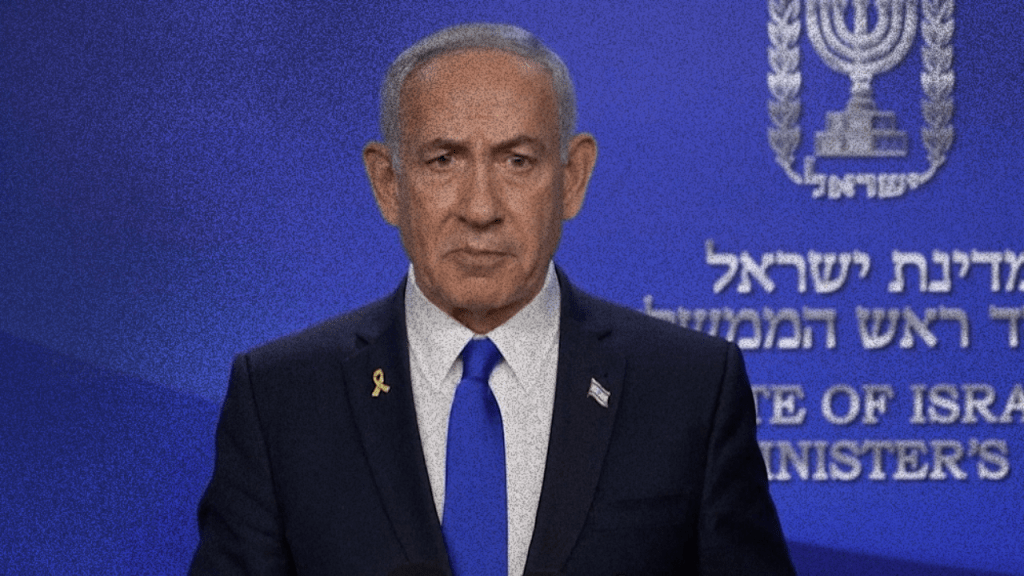
On February 28, 2026, while U.S. and Israeli forces were conducting active strikes on Iranian military targets, Israeli Prime Minister Benjamin Netanyahu Netanyahu’s AI Persian video appeared on X: an AI-generated clip in which he speaks Persian, addressing the Iranian people directly — “In the coming days, we will strike thousands of targets of the terror regime. We will create conditions for the brave people of Iran so they can free themselves from the chains of tyranny.” He called on Iranians to “take to the streets in their millions to finish the job, to topple the terror regime.” U.S. President Donald Trump issued his own address simultaneously: Trump’s regime-change appeal — “When we are finished, take over your government. It will be yours to take.”
Taken individually, each of these statements might be analyzed as propaganda, as electoral posturing, or as hollow rhetoric. Taken together — an AI-generated voice speaking the target population’s language, paired with live bombardment, issued simultaneously by two heads of state — they are something more specific. They are a doctrine being announced in public. For how this doctrine connects to the longer-standing pattern of weaponizing diaspora communities and witness narratives around Iran, see the weaponized diaspora piece.
What Is Actually New
The United States has operated influence operations targeting foreign civilian populations for decades. Voice of America was established during World War II. Radio Free Europe was CIA-funded throughout the Cold War, broadcasting into Soviet-bloc countries with the explicit goal of undermining Communist governments. The U.S. bombed Iraq in 2003 with openly stated regime-change objectives and direct appeals to the Iraqi people. None of this is secret.
What makes the current moment distinct is not any single element but their convergence. An AI-generated video of a sitting head of state, speaking the target population’s language fluently, synchronized in real time with active military strikes, issued publicly without institutional intermediary or deniable distance, framed explicitly as liberation — this combination has not been used before at this scale or in this form.
Cold War influence operations were designed to be at least partially deniable. Radio Free Europe’s CIA funding was not officially confirmed until 1971. The structural separation between the information operation and the military action was deliberately maintained, because collapsing it openly would have undermined the claim that the messaging represented truth rather than belligerence. That separation is now gone.
This is also not the first time Netanyahu has attempted this specific move. During the June 2025 Iran war, Netanyahu called on Iranians to “stand up and let your voices be heard,” framing Israeli bombardment as “clearing the path for you to achieve your freedom.” No mass protests materialized. But The Intercept documented what followed: a Citizen Lab documented campaign — coordinated, AI-driven, Persian-language — that used fake news reports, deepfake videos of Iranian singers, and inauthentic social media accounts pushing pro-Israel, pro-Pahlavi content. The February 28 video is not an improvisation. It is the escalation of an infrastructure that has been operational for months.
The Claim Being Made Is About Sovereignty
The video is not primarily a persuasion effort. As a persuasion effort, it is of limited direct effectiveness — Iranians’ internet access has been heavily disrupted by their own government, and there is no evidence that the June 2025 appeals produced the mass uprising they called for. Iran’s coercive state apparatus, IRGC regime support in particular, remains solidly behind the government, making a public uprising very unlikely under current conditions.
The function of the video is not to move masses in Tehran. It is to establish a legitimacy claim. When Netanyahu speaks in Persian to the Iranian people while bombing them, he is not asking for their permission. He is asserting the right to speak over their government to them — to position himself as the more authentic representative of their interests than their own state. That assertion, made publicly and defended by allies, is what does the normative work.
This is the distinction that matters. Arguments, even false or manipulative ones, engage with an audience. Assertions of this kind do something different: they claim a relationship. They position the attacking state not as an enemy but as a liberator whose violence is a form of solidarity. And once that claim is made publicly and not universally condemned, it becomes available for reuse.
Deterrence Is Not a Norm
The draft rebuttal to concerns about this precedent usually takes the form of: this is constrained by deterrence. If Russia or China tried to replicate this, they would face consequences that outweigh any benefit.
This misunderstands the nature of the problem. Deterrence governs catastrophic outcomes. It does not preserve norms. It tells states what they cannot do without triggering mutual annihilation. It says very little about what they are permitted to do in the space below that threshold — and that is precisely the space being carved out here.
AI-generated messaging in a target population’s language, paired with selective military strikes, sits comfortably below the level that triggers nuclear retaliation. It is attractive specifically because it exploits the ambiguity of that space. And the norms that once governed that space — that sitting heads of state do not openly claim the right to speak to foreign civilian populations as liberation authorities during active bombardment — do not survive when powerful states breach them openly and their allies defend the breach.
Al Jazeera’s reporting on the strikes noted the observation from the National Iranian American Council: NIAC’s direct warning that the U.S. commitment to regime-change rhetoric represents “a loss for the American people, as it suggests the US may be committed to a long and unpredictable military boondoggle.” That framing captures the immediate policy risk. The longer-term risk is structural. If the behavior is defended rather than condemned by the states with the most capacity to set international norms, it enters the available toolkit for everyone else.
The Ukraine Precedent Works Both Ways
The implicit argument — that Russia’s behavior in Ukraine established this pattern — is worth examining directly. Russia has targeted Ukrainian infrastructure, framed the Ukrainian government as illegitimate, issued messages to civilians, and claimed to act on behalf of a population suppressed by its own state. Western governments rightly condemned that framing.
But norms function only when they are applied consistently. If the claim that a foreign state may speak to a civilian population, bypass their government, and frame active bombardment as liberation is condemned in one context and defended in another, the norm does not exist. What exists is power politics dressed in normative language — a legitimacy framework that applies to adversaries and exempts allies. That is precisely the condition under which rivals no longer need to manufacture justifications. The justification exists, articulated and defended by the states that set the rules.
Selective enforcement does not preserve norms. It destroys them faster than open defiance.
Escalation by Precedent
How norms collapse is not mysterious. A powerful actor violates a taboo under conditions it frames as exceptional. Allies rationalize the breach as necessary, specific, and contained. Rivals absorb the logic without accepting the justification. Everyone insists the situation is controlled until the precedent is standard practice.
The critical error is focusing on intent. The argument that Israel and the United States mean well — that they genuinely believe they are acting in the interests of the Iranian people — is not the relevant question. Systems absorb behavior, not motives. Once a practice is normalized by powerful actors and defended publicly, it becomes available to anyone with the capacity to use it.
Xi Jinping and Vladimir Putin do not lack the technical infrastructure to produce AI-generated videos in the languages of target populations. What has restrained that particular combination of tools was legitimacy. That restraint is now weaker than it was yesterday.
The Real Danger Is Not the Video
The real danger is not the video itself. The video is a symptom of a doctrine that was already in development — visible in the June 2025 influence campaign, in the Citizen Lab-documented AI influence infrastructure, in Netanyahu’s years-long effort to position Israeli military action as the fulfillment of Iranian popular aspiration.
The real danger is that a practice which requires explicit deniability to function is now conducted in public, defended by allies, and covered as a tactical innovation rather than a normative rupture. When that happens, the argument that rivals should not do the same loses its principled foundation. It retains only a power-based foundation: we can, you shouldn’t. That is not a norm. That is a hierarchy claiming normative language.
Once active strikes are paired openly with regime-change appeals in the target population’s own language, and the combination is treated as a defensible act of statecraft rather than a violation, the prohibition is over. What remains is negotiation over which states get to use the tool, and under what circumstances. That negotiation will not go well for the people of any country whose government finds itself on the wrong side of it. For the structural context that made this intervention possible — the political, historical, and diplomatic forces that ensured the war was coming — see the structural context piece. For how the same conflict sits in relation to Palestine solidarity, see Iran and Palestine together.
Sources
- Netanyahu Posts AI Video Speaking Persian to Iranian People — Ynet News, February 28, 2026
- Israel and US attack Iran — CNN, February 28, 2026
- Israel’s AI Influence Campaign in Iran — The Intercept, January 2026
- Trump and Netanyahu Want Regime Change, But Iran’s Regime Was Built for Survival — The Conversation
- Netanyahu’s War: Analysts Say Trump’s Iran Strikes Benefit Israel, Not US — Al Jazeera, March 1, 2026
- Why the U.S.–Israel War on Iran Was Always Coming — Spark Solidarity
- Weaponized Diaspora and the Witnesses Empire Needs — Spark Solidarity
- Iran, Palestine, and the Politics of Contradiction — Spark Solidarity