
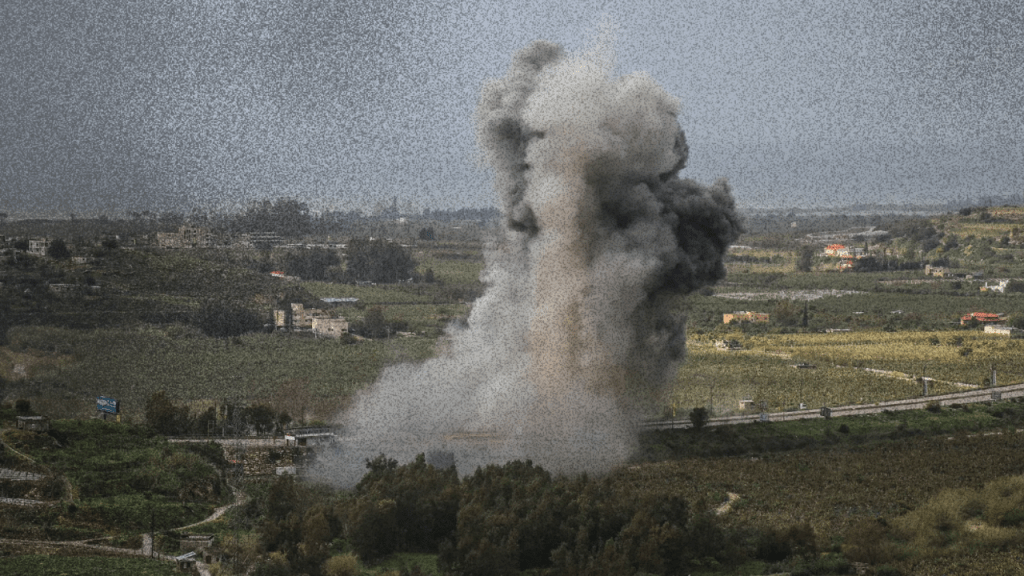
Israel Lebanon ground invasion 2026 — bridges destroyed while evacuation is ordered. This is not a contradiction. It is the strategy.
The Israeli military has described its ground operation in southern Lebanon, launched on March 16, as “limited” and “targeted.” The scale of preparation tells a different story. Five divisions have entered Lebanon since the operation began, with a sixth being prepared for deployment. Troop levels along the northern border have surged. Forces have repositioned across southern Lebanese territory, establishing forward positions designed for sustained operations rather than rapid withdrawal. When an army prepares this way, the language of limits is not a description of intent. It is a frame for domestic and international consumption.
The immediate consequences have been severe. Over a million people have been displaced since the intensified campaign began in early March. Entire communities in the south have emptied as civilians flee under escalating evacuation orders — first south of the Litani River, then extended northward to the Zahrani River, 40 kilometers from the Israeli border. The Lebanese health ministry counts over 1,000 dead. Casualty figures continue to rise as airstrikes and ground operations intensify in tandem.
Evacuate — Then Destroy the Route Out
At the center of this displacement sits a specific and deliberate contradiction. Israeli Defense Minister Israel Katz ordered the military to destroy all Litani River crossings — the same river civilians are being instructed to move north of. Between March 13 and 22, the Israeli military struck at least four Litani River bridges. The stated military justification is standard: the bridges were being used by Hezbollah to move fighters and equipment southward. That rationale may be accurate. It does not change what the destruction produces.
The bridges are not incidental infrastructure. They are the primary routes through which civilians can comply with evacuation orders. Their destruction serves the tactical objective of degrading Hezbollah’s mobility. It simultaneously traps the civilian population it is supposed to be protecting. The contradiction is direct: civilians are ordered to leave, then denied the principal means of doing so safely. This is not collateral damage in any meaningful sense of the term. It is the operational logic of the campaign made visible. By ordering evacuation and simultaneously severing the evacuation infrastructure, the Israeli military is not managing a humanitarian emergency — it is constructing one. The conditions for return are being destroyed at the same moment as the conditions for departure.
Depopulation as Strategy, Not Side Effect
Human Rights Watch documented that on March 16, Katz stated that “hundreds of thousands of Shiite residents of southern Lebanon will not return to their homes south of the Litani area until the safety of Israel’s northern residents is guaranteed” — a condition whose definition Israel alone controls and which carries no timeline. On March 22, Katz and Netanyahu ordered the acceleration of home demolitions in border villages, explicitly citing the Beit Hanoun and Rafah models in Gaza. The IDF spokesman stated on March 18 that bridges would be struck to prevent movement into southern Lebanon. This is the sequence: evacuate, demolish, sever access, hold return contingent on an undefined Israeli security threshold.
The result is a depopulated zone whose conditions for repopulation are controlled entirely by the occupying force. A senior Israeli official told Axios: “We are going to do what we did in Gaza.” The reference is precise. In Gaza, the combination of displacement orders, infrastructure destruction, and open-ended return conditions produced a zone where return has become structurally impossible for most of the population regardless of whether active hostilities continue. The same architecture is being built in southern Lebanon, on a compressed timeline, with explicit public statements from senior officials naming it as the intent.
Multiple Fronts, One Conflict System
The Lebanon operation is not separate from the wider war. It is integrated into it. The conditions that produce mass displacement in Lebanon interact with those in Gaza and Iran — not as parallel crises but as components of a single expanding system. Operations in Lebanon increase pressure on Hezbollah. Pressure on Hezbollah alters Iran’s calculations. Iranian responses shape Israeli decision-making across all fronts. Each theater reinforces the others, and each escalation makes de-escalation more structurally costly.
Civilian displacement plays a specific function in this system. Large-scale movement of people — a million displaced in weeks — destabilizes regions beyond the immediate conflict zone. It strains Lebanese state capacity, alters demographics in ways that persist long after active fighting subsides, and creates humanitarian crises that become independent variables in the political landscape. The framing of these displacements as security-driven rather than strategic obscures this function. Naming it clearly is the precondition for responding to it accurately.
Return Is Not Guaranteed — That Is the Strategy
The ground invasion of southern Lebanon is being fought on two simultaneous tracks: military advance and structural foreclosure of return. Infrastructure is damaged. Homes are demolished under explicit orders. Access routes are severed. The stated condition for civilian return — Israeli security for northern communities — is undefined, unilaterally controlled, and carries no timeline. Even if active hostilities decrease, the practical and legal barriers to return remain. As Human Rights Watch concluded: “the Israeli defense minister’s statement signals that Israel will prevent residents from returning to their homes for an indefinite period.”
This is how short-term military actions translate into long-term structural changes. The battlefield is not just contested through force — it is reshaped through movement, access, and engineered absence. The logic that made this war inevitable is the same logic now organizing how it is being fought in Lebanon: not toward a negotiated settlement, not toward defined military objectives with defined endpoints, but toward territorial and demographic facts on the ground that outlast the conflict itself. The war is no longer spreading. It is integrating — and the integration is being built one demolished bridge at a time.
Sources
- Human Rights Watch — Israeli Officials Signal Stepped-Up Atrocities in Lebanon, March 2026
- Al Jazeera — Lebanon’s Aoun warns Israeli attack on bridge “prelude to ground invasion,” March 2026
- Axios — Israel planning massive ground invasion of Lebanon, officials say, March 2026
- Time — How an Israeli ground invasion of Lebanon could unfold, March 2026





 Spark Solidarity