Three narratives of the Iran war emerged when the strikes landed on February 28 — their irreconcilability is not a side effect. It is the engine.
One War, Three Incompatible Versions, Same Moment
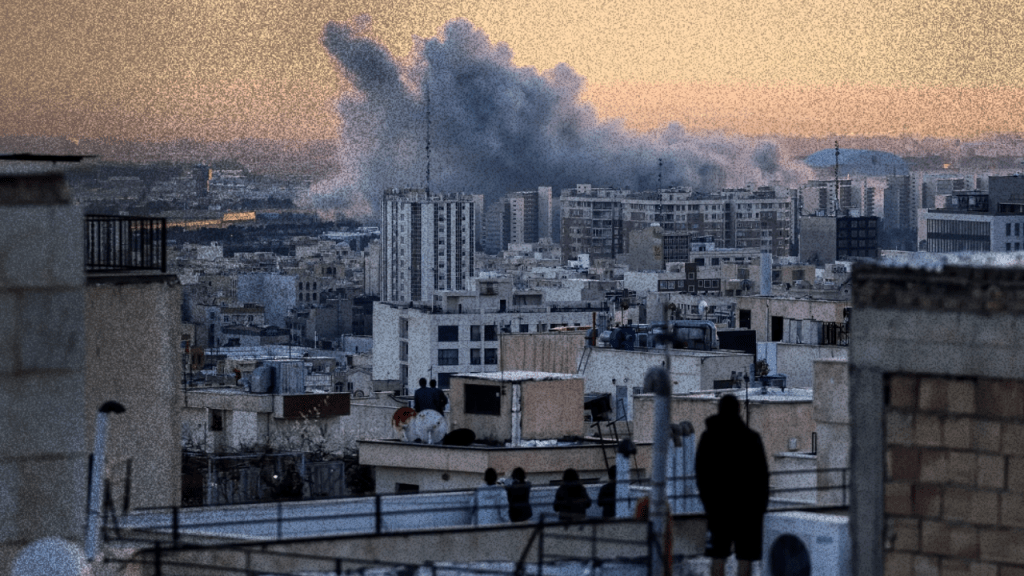
On February 28, 2026, the United States and Israel launched a coordinated assault on Iran — striking nuclear and missile infrastructure, assassinating Supreme Leader Ali Khamenei, and killing dozens of civilians in the opening hours. By the time the first damage assessments were filed, the war had already fractured into three mutually exclusive accounts of what had happened and why. Washington called it prevention. Tehran called it betrayal. Independent analysts and international observers called it the latest iteration of a doctrine that has never produced the stability it claims to seek. These three interpretations did not develop over days of subsequent spin — they existed simultaneously, from the first strike. That simultaneity is the story. A war that begins without a shared baseline of cause or responsibility does not have a path toward de-escalation. It has a structural mandate for escalation.
The Preemptive Doctrine Makes Force Prior to Diplomacy
Washington’s framing was immediate. The strikes were not an act of war but a defensive necessity. Iran’s nuclear program and regional posture represented an imminent threat requiring decisive action before it materialized. Trump formally grounded the operation in Article II presidential authority, not the 2001 AUMF — but the underlying doctrine is the same post-9/11 architecture. The National Security Strategy of 2002 shifted the imminence standard, asserting the right to strike before threats fully materialized. What matters under this doctrine is not what a state is doing but what it could do. U.S. intelligence had placed Iran’s intercontinental ballistic missile capability at 2035 at the earliest. That timeline did not slow the decision. The doctrine precedes the evidence — which means it also precedes any diplomacy that might make the evidence irrelevant. That is not a bug in the framework. It is the framework.
And it sets up a question the U.S. framing cannot answer: if the threat is defined by what Iran might eventually become, what was the point of the negotiations that were underway when the missiles launched? Stimson Center analysts noted that Trump’s explicit rejection of diplomacy in favor of force has the ultimate effect of incentivizing proliferation and making adversaries structurally unwilling to negotiate with Washington. The preemptive doctrine does not produce security. It produces the perpetual insecurity that justifies its own continued use.
The Diplomatic Betrayal Framing Is Grounded in the Calendar
In mid-February 2026, the U.S. and Iran were engaged in a new round of indirect nuclear negotiations mediated by Oman. A fourth round of technical talks was scheduled for the week of March 3 — days after the strikes. The Omani foreign minister had publicly reported breakthrough potential as recently as February 27, including signals that Iran was prepared to limit uranium stockpiling. Trump told reporters he was “not thrilled” with the negotiations. The following morning, the strikes began. Araghchi stated publicly that the United States had “betrayed diplomacy mid-negotiation.” This is not a rhetorical posture that can be dismissed as regime messaging. The sequence is on the record: active talks, Omani confirmation of progress, Trump’s public dissatisfaction, strikes.
Iran’s characterization that diplomacy was deliberately bypassed rather than exhausted is chronologically grounded. Arms Control Association confirmed there was no evidence Iran had made a decision to weaponize its nuclear program, that no imminent military threat existed, and that the Trump administration did not exhaust diplomatic options before striking. Read against the preemptive doctrine: a framework that acts on future potential, not present reality, was never structurally compatible with good-faith negotiation. The betrayal was not a decision made on February 28. It was built into the doctrine years earlier.
The Third Narrative Rejects Both Official Framings
Beyond the two official framings, a third analysis took shape across international media, legal scholars, and independent analysts — and it is categorically different because it refuses to argue within their terms. It does not ask whether the strikes were justified under the preemptive-defense doctrine, or whether Iran’s negotiating posture was adequate. It asks whether the doctrine itself produces the outcomes it claims to seek. Russia’s condemnation at the Security Council meeting described the operation as “a deliberate, premeditated, and unprovoked act of armed aggression against a sovereign UN member state, in direct violation of international law.” The Stimson Center noted that the failure to exhaust diplomacy before striking incentivizes proliferation globally. The Arms Control Association stated the failure to negotiate in good faith was “inexcusable, given the devastating consequences.”
This framing situates February 28 within a repeating pattern: military force deployed to maintain geopolitical dominance produces not resolution but reproduction of the conditions that generated the conflict. As documented in the context of how Washington deploys pretext, the pretext changes — nuclear program, WMDs, regime destabilization — but the operational logic does not. This third analysis is the one the U.S. framing most needs to suppress — because unlike Iran’s “betrayal” narrative, it cannot be answered by claiming the negotiations were insufficient. It challenges the entire architecture. And it is the one the manufactured enmity apparatus is designed to make invisible.
Narrative Fragmentation Is a Force Multiplier, Not a Failure
Three narratives that do not intersect do not produce a war that can be talked down. They produce a war in which every action confirms the expectations of whoever is watching. A U.S. defensive operation is Iranian aggression-provocation. An Iranian military response is proof the strikes were necessary. An international condemnation is dismissed as anti-Western bias. Each interpretation is internally coherent. Each reinforces the divide rather than narrowing it. This is what narrative control as weapon actually means in practice — not that one side wins the information war, but that the information war forecloses the terrain on which a political settlement might otherwise become possible. By week three of the conflict, this had evolved further: narrative moved markets, simultaneous contradictory official claims circulated as live events, and destroyed context rather than false data became the primary weapon.
When three irreconcilable interpretations are established in the first twenty-four hours — each with its own internal logic, its own audience, and its own evidentiary standard — de-escalation does not become difficult. It becomes structurally incoherent. There is no shared reality in which to negotiate a return to something. The doctrine ensured that before the first strike landed. February 28 did not create this condition. It revealed it.
Sources
- Araghchi on diplomatic betrayal — Al Jazeera
- Oman signals talks breakthrough — Al Jazeera
- Iran posed no imminent threat — Arms Control Association
- Stimson experts on Epic Fury — Stimson Center
- Article II war authority — Lawfare
- UN Security Council emergency meeting — UN
- Iran-U.S. negotiations timeline — Wikipedia
- 2026 Iran war — Wikipedia
- Panama Canal pretext — Spark Solidarity
- Weaponized diaspora — Spark Solidarity
- Iran war narrative — Spark Solidarity
- US-Iran information war — Spark Solidarity