Iran shot down a U.S. F-15E deep inside its territory, exposing the defensive capacity Washington claimed had already been destroyed.
The Dates Only Look Contradictory
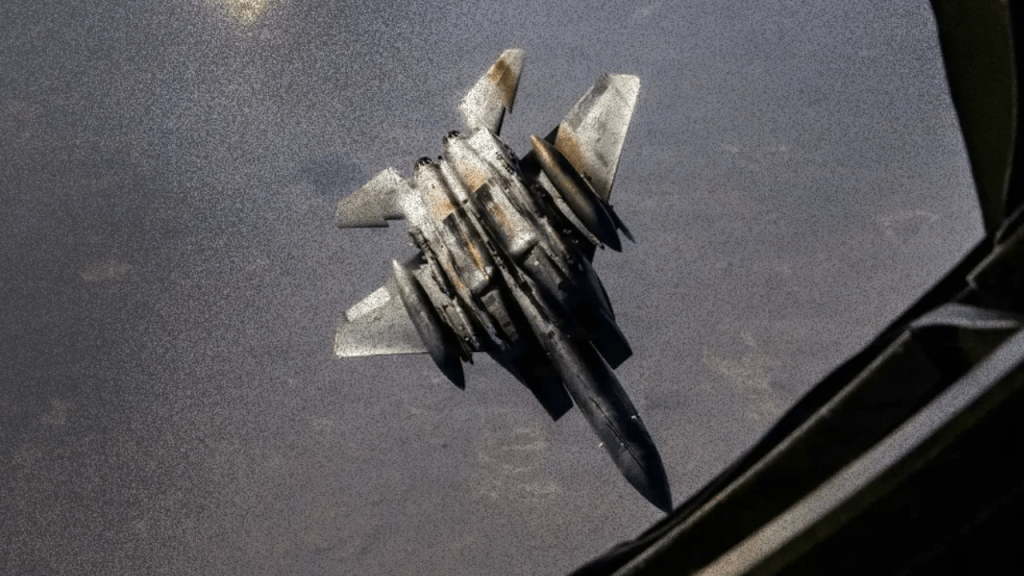
In the early hours of April 3 in Iran, still late April 2 on the U.S. East Coast, Iranian fire brought down a two-seat U.S. Air Force F-15E Strike Eagle conducting a combat mission inside Iranian territory. Both crew members ejected. The pilot was recovered during the first rescue operation, while the weapons systems officer remained hidden inside Iran for more than a day before a second extraction brought him out early April 5 local time.
This timezone seam explains why official and media accounts use different dates. CENTCOM records the shootdown as April 2 and the completed rescues as April 4. Reporting based on Iranian local time places the shootdown on April 3 and the final recovery on April 5. The live WordPress publication date of April 4 in Toronto is therefore coherent and does not need to be changed.
The facts beneath the calendar remain straightforward. An American fighter entered Iran as part of an aggressive war, Iranian forces destroyed it, and Washington then had to penetrate Iranian territory twice to recover the crew. The rescue succeeded. The official story of uncontested American dominance did not survive it.
The Official Story Was Already on the Record
One day before the shootdown, CENTCOM commander Admiral Brad Cooper described the campaign as making “undeniable progress.” He said Iran’s aircraft were no longer flying and that its air and missile defence systems had “largely been destroyed.” CENTCOM published the statement on April 2. Donald Trump had gone further in his April 1 address, saying Iran had “no anti-aircraft equipment,” its radar was “100 percent annihilated” and the United States was “unstoppable as a military force.”
Iranian fire brought down the F-15E immediately after those claims. An A-10 supporting the first rescue was also hit. Its pilot kept the damaged aircraft flying until leaving the immediate battlespace, then ejected over Kuwait and was recovered. Helicopters retrieving the F-15E pilot also came under Iranian fire.
The standard defence of Washington’s narrative is that air superiority never means zero risk. That statement is true in isolation, but it does not answer the argument. The public claim was not that Iran retained dangerous residual systems beneath broad American superiority. The public claim was that Iran had no anti-aircraft equipment, no functioning radar and almost no air-defence capacity left. Those are different claims.
The F-15E did not prove that the United States had lost every operational advantage over Iran. It proved that American officials had converted advantage into fantasy, then presented that fantasy as a description of the battlespace.
This Was Iran Defending Its Own Airspace
The F-15E was not a civilian aircraft, a neutral observer or a lost plane passing over disputed territory. It was an advanced American strike fighter flying a combat mission inside Iran during a war initiated by the United States and Israel. Iran had every right to detect it, target it and bring it down.
Western coverage often treats American entry into Iranian airspace as the natural condition of the war. Iran’s defence then appears as the disruptive event. That formulation reverses what happened. The intrusion created the confrontation, and Iranian resistance imposed a consequence on it.
Trump later attributed the shootdown to a fortunate hit by an Iranian using a shoulder-fired heat-seeking missile. That description came from the commander of the attacking power and should not be treated as an independently verified technical account. Even on its own terms, however, it concedes the central point: an Iranian defender retained a weapon, found an American aircraft and destroyed it. Calling the hit lucky does not restore the claim that Iran possessed no anti-aircraft capability.
A military system does not have to remain intact in its original form to continue resisting. Dispersed weapons, mobile launchers, passive sensors, improvised communications and surviving local units can remain dangerous after centralized radar and command networks have been heavily damaged. Iran did not have to recreate its prewar air-defence architecture. It had to preserve enough capability to make American operations costly. The F-15E wreckage demonstrated that it had.
The Rescue Force Revealed the Scale of Iranian Resistance
The original article understated the size of the rescue by describing a five-aircraft formation as though it represented the full operation. The first extraction included HH-60W rescue helicopters, HC-130 support aircraft, A-10s and protective air cover. Later U.S. accounts said the initial rescue force grew to 21 military aircraft. Across the complete two-day effort, hundreds of personnel and roughly 176 aircraft were involved. The second extraction alone reportedly used approximately 155 aircraft for protection, surveillance, refuelling, deception and direct support.
That scale was not ceremonial. Iranian forces were searching for the missing weapons systems officer. American aircraft had to protect him, misdirect the search, suppress Iranian defenders and create a corridor through which another force could enter the country.
During the first rescue, an A-10 was struck and ultimately lost. The helicopter carrying the recovered F-15E pilot came under close-range fire. A second helicopter was also hit, and one crew member sustained a minor injury, according to the later U.S. briefing. The second extraction added further losses. Two MC-130 aircraft and two Army MH-6 helicopters became stranded at a makeshift landing area and were destroyed by U.S. forces rather than left behind.
This was not a clean retrieval from airspace rendered harmless by American bombing. Iranian resistance forced Washington to assemble a major operation, accept additional aircraft losses and send specialized forces deep into a country it claimed could no longer defend itself. The rescue was an American tactical success inside an Iranian strategic rebuttal.
The Aircraft Loss Record Was Larger Than the Briefings Suggested
The F-15E joined an aircraft-loss record that had already contradicted the language of frictionless dominance. On March 1, Kuwaiti air defences mistakenly shot down three U.S. F-15Es during active combat involving Iranian missiles, drones and aircraft. All six crew members ejected and survived. On March 12, a KC-135 tanker crashed in western Iraq during operations supporting the war. All six airmen aboard were killed, while a second KC-135 involved in the incident landed with severe damage.
On March 19, an F-35A was struck by ground fire over Iran and made an emergency landing. Its pilot suffered shrapnel wounds. The aircraft was damaged but not destroyed, so it should not be counted as a total loss. The April 3 operation added the F-15E destroyed by Iranian fire and the A-10 lost after being hit during the rescue. Before later rescue disclosures, that produced six known crewed aircraft destroyed or crashed, not the seven claimed in the previous version.
The April 6 account added the two MC-130s and two MH-6s destroyed after becoming stranded. The broader material record therefore reached at least ten crewed aircraft destroyed, crashed or deliberately destroyed during operations, plus the damaged F-35. Roughly a dozen MQ-9 Reaper drones had also reportedly been lost by this stage, although CENTCOM had not publicly itemized each unmanned-aircraft loss.
The categories are not identical. Friendly fire, collision, enemy action and destruction during an extraction should not be collapsed into one causal claim. They belong in the same operational accounting because all were consumed by the war Washington described as controlled, decisive and nearing completion.
Degraded Is Not Destroyed
Iran’s conventional air-defence network had undoubtedly been attacked and damaged. The United States and Israel had spent weeks striking radar sites, launchers, airfields, command facilities and weapons infrastructure. American aircraft were able to conduct a high volume of missions inside Iran. None of that supports the claim that Iranian defence had ceased to exist.
The F-35 incident on March 19 had already shown that Iranian ground fire could reach an advanced stealth aircraft. The F-15E shootdown then produced the first acknowledged loss of a crewed American aircraft to Iranian enemy fire in the campaign. The rescue operation provided additional evidence. Iran struck the A-10 and fired effectively on the extraction helicopters. Iranian forces mobilized to search for the missing officer, forcing Washington to protect him with surveillance, strikes, deception and a huge second rescue force.
“Degraded” describes a force that has lost part of its capacity. “Destroyed” describes one that can no longer produce meaningful military effects. Iran continued producing those effects.
The insistence that a surviving weapon was merely an isolated exception reverses the burden of proof. Washington was the party claiming total destruction. Every successful Iranian engagement therefore belonged inside the evaluation of that claim. Iran did not have to prevent every American sortie to disprove it. One destroyed fighter, another lost attack aircraft, damaged helicopters and a rescue operation involving 176 aircraft were sufficient.
Iran Preserved the Capacity to Impose Costs
Iran’s defensive achievement was not measured by matching the United States aircraft for aircraft. The United States entered the war with a larger air force, a global basing network, extensive tanker support, satellite surveillance and Israeli cooperation. Iran’s task was to survive the opening destruction and preserve enough capacity to deny Washington a cost-free campaign. That logic appears throughout Iran’s Deterrence Strategy and the Limits of Moral Appeals.
Deterrence under conditions of extreme asymmetry does not require total denial. It requires uncertainty, adaptation and recurring costs. A surviving mobile system can force additional electronic warfare. A damaged fighter can require emergency recovery infrastructure. A downed aircraft can draw dozens or hundreds of other aircraft into a protection and extraction operation.
The F-15E shootdown therefore mattered beyond the value of one aircraft. It compelled Washington to expose more forces, allocate more surveillance and refuelling capacity, conduct additional strikes and accept further losses. Iran turned one successful defensive engagement into an operational problem that lasted two days and reached far beyond the original crash site.
That is how a materially weaker state resists a stronger one. It does not erase the attacker’s advantages. It prevents those advantages from becoming immunity.
The Briefing Language Concealed the Purpose of the Claims
Statements about annihilated radar and destroyed defences were not merely optimistic battlefield assessments. They helped produce a political story about the war. If Iranian resistance had already been eliminated, continued American bombing could be presented as controlled cleanup. Aircraft losses became isolated accidents, while Iranian retaliation became irrational persistence rather than evidence of surviving capacity.
This is the narrative inversion examined in Iran War Narrative Inverts Who Struck First. The language also prepared the public for regime change. A country described as militarily helpless could be attacked more deeply without the expected costs receiving serious attention. Its leadership could be targeted, its infrastructure destroyed and its political system destabilized under the assumption that the main military question had already been settled.
The shootdown interrupted that story. Iran was not a passive target waiting for Washington to determine its future. It remained an organized state with armed institutions capable of adapting, defending territory and compelling the United States to respond. That did not make Iran invulnerable. It made the fantasy of Iranian helplessness impossible to sustain without ignoring the wreckage.
Wars Widen Through Compounding Necessity
The April 3 to April 5 sequence demonstrates how a war expands through decisions that officials present as unavoidable. The F-15E was shot down, the crew ejected and American doctrine required an immediate rescue effort.
The first rescue came under fire and lost an A-10. One F-15E crew member remained inside Iran, and Iranian forces searched for him. Washington then assembled a much larger second operation involving fighters, bombers, tankers, drones, special-operations aircraft, helicopters, intelligence assets and ground forces.
Each response created additional exposure. Aircraft entered Iranian airspace to retrieve personnel from an aircraft already destroyed there. More aircraft protected those aircraft. Surveillance and strikes were used to prevent Iranian forces from reaching the missing officer. Equipment became stranded and had to be destroyed. None of these steps was politically neutral because each began from the decision to conduct offensive combat missions inside Iran.
The sequence did not show that Iran was dangerously expanding a contained war. It showed that American intervention generated obligations and risks that pulled more American forces into Iranian territory. Iran’s attempt to capture an enemy officer operating inside the country was treated as an escalation, while the American operation to prevent that capture was treated as rescue. The language assigned normality to the invader and aggression to the defender.
The companion article, Iran’s Hostage Infrastructure and the Leverage Economy, examines the political leverage that a captured American airman could have created and why Washington committed such an enormous force to prevent it.
What the Shootdown Proved
The F-15E shootdown did not prove that Iran controlled its skies. It proved that the United States did not. Control was partial, contested and purchased through continuing risk. Iran retained enough defensive capacity to destroy an advanced strike fighter, hit the rescue force and compel one of the largest combat search-and-rescue operations in recent American history.
That outcome cannot be reconciled with claims that Iranian anti-aircraft weapons were gone and its radar completely annihilated. The political conclusion is not that American air power was imaginary. It is that Iranian resistance remained operational under conditions designed to destroy it.
Iran absorbed weeks of attack, adapted and continued imposing losses. Its defenders disrupted the narrative that the war had become a one-sided administrative exercise. They forced Washington to reveal how much force was required to operate inside a country it described as defenceless.
The rescue brought both crew members home. It also exposed the material limits of the official story. Iran was degraded, attacked and heavily outgunned. It was not defeated, passive or incapable of defending its territory. The F-15E wreckage proved it.
Sources
- U.S. Central Command, “U.S. Continues Strikes into Iran After Successful Rescue of F-15E Aircrew,” April 5, 2026
- Air & Space Forces Magazine, “F-15E Downed over Iran, A-10 Crashes in Region,” April 3, updated April 5, 2026
- Air & Space Forces Magazine, “The Rescue of DUDE 44: Inside the Massive Operation to Save Two Downed Airmen in Iran,” April 6, 2026
- Air & Space Forces Magazine, “F-15E Aviator Missing in Iran Rescued by U.S. Forces,” April 5, 2026
- Axios, “Second Crew Member From F-15 Downed in Iran Rescued by U.S. Forces,” April 4–5, 2026
- Axios, “U.S. Launched ‘Air Armada’ to Rescue F-15 Crew in Iran,” April 6, 2026
- CBS News, “American Fighter Jet Shot Down over Iran,” April 3, 2026
- U.S. Central Command, “Three U.S. F-15s Involved in Friendly Fire Incident in Kuwait,” March 2, 2026
- Air & Space Forces Magazine, “Six Airmen Dead in KC-135 Crash,” March 13, 2026
- Air & Space Forces Magazine, “USAF F-35 Lands After Taking Fire over Iran,” March 19, 2026
- ABC News, “‘No Air Defenses’: Trump Touted American Dominance Before Jet Was Downed,” April 3, 2026
- U.S. Central Command, April 2 statement by Admiral Brad Cooper