

Quebec sovereignty movement is back on the table for a new generation — but the movement has no answer to its own question.
The Parti Québécois will win the October 2026 election. Paul St-Pierre Plamondon has pledged a referendum in the first mandate. Fifty-six percent of Quebecers aged 18 to 34 support independence — the highest level in thirty years. Four consecutive byelection wins, a governing party that collapsed from ninety seats to projected zero, and a generation that has decided the national question is open again. The conditions for a third referendum are more present now than at any point since 1995. See Quebec’s 2026 election.
None of that is the interesting question. The interesting question is what Quebec independence is actually for — and whether the sovereignty movement that is currently surging has an answer. It doesn’t. Not yet. And without one, the historical pattern is clear: the movement wins cultural power, fails to transform class relations, and then uses cultural identity as a substitute for class politics until it exhausts itself and turns inward. Quebec has been through this cycle once. The ethnonationalist drift of the contemporary PQ — restrictive immigration policy, French-decline anxiety, soft identitarianism dressed in social-democratic remnants — is not a deviation from the project. It is what happens when the project runs out of content.
The argument here is that the content exists. Quebec has the institutional machinery for a genuinely different kind of sovereignty project — one oriented toward a different international order, grounded in class politics rather than ethnic identity, and capable of building a majority that the ethnic-nationalist version structurally cannot reach. But that machinery requires orientation. And the movement that is going to inherit power in October has not yet decided what to do with it.
To understand what the sovereignty movement is and why it keeps producing the same results, you have to understand the story Quebec tells about itself — because that story is not just mythology.
It is the ideological sediment of real material history, and the parts of it that are both wrong and right for the wrong reasons are wrong in ways that have direct, deep social, cultural and political consequences today.
The Myth of New France and What It Actually Built
The story Quebec tells about itself begins with the coureurs des bois and the early settlers of New France — the glorious founders, men and women who carved a civilization out of the St. Lawrence valley, who built something distinct from the English colonies to the south and the imperial metropole they had left behind.
There is real content to that myth. But before that content can be assessed honestly, something has to be named that the myth almost never names: the territory the French settlers were building on was not empty. It was the pays d’en haut — “the upper country” — a vast region of the Great Lakes and St. Lawrence watershed that had been home to Ottawas, Ojibwes, Potawatomis, Hurons, Cree, Innu, Mohawk, Anishinaabe, and dozens of other nations for millennia before a French ship appeared on the horizon.
New France was not a civilization carved out of wilderness. It was a colonial project built on land that belonged to someone else. The French settlers who came between the early 1600s and the British Conquest of 1760 were settlers. That is the starting point. Everything else — the material distinctiveness, the communal organization, the different relationship with Indigenous nations — is real and worth analyzing, but it is downstream of that fact, not a substitute for it.
What made French colonialism materially different from the Anglo-Protestant model was not benevolence. It was structure. The French colonial economy in the pays d’en haut ran on the fur trade, and the fur trade required Indigenous nations as active partners — as hunters, trappers, guides, traders, and military allies. This was not a relationship of equals, but it was a relationship of interdependence that the French colonial project could not function without. The result was something the English colonial model in the south largely did not produce: sustained cohabitation, intermarriage, military alliance, and a degree of cultural exchange between French habitants and the Indigenous nations of the Great Lakes and St. Lawrence regions. The tribes of the pays d’en haut — the Ottawas, Ojibwes, and Potawatomis of the Great Lakes, the Miamis and Kickapoos of the Illinois Country, the Delawares and Shawnees of the Ohio valley — had long-established relationships with French settlers that included trade, diplomacy, and in many cases kinship. This was a material fact of the colonial economy, not a moral achievement of French character.
The critical point — the one that French exceptionalist readings of this history consistently obscure — is what the Indigenous nations of the pays d’en haut actually understood their relationship with the French to mean. They understood it as an alliance between sovereign peoples, not as an acceptance of French sovereignty over their territory. When a British garrison took possession of Fort Detroit from the French in 1760, local Indians cautioned them directly: “this country was given by God to the Indians.” When the first Englishman reached Fort Michilimackinac, the Ojibwe chief Minavavana told him plainly: “Englishman, although you have conquered the French, you have not yet conquered us.” The distinction Minavavana was drawing was not between good French colonizers and bad British ones. It was between a strategic alliance that Indigenous nations had entered on their own terms, and a sovereignty claim they had never conceded to anyone. The French had been tolerated as trading partners and military allies within a territorial arrangement the Indigenous nations still understood as theirs. The British were being told, from the first moment of their arrival, that no transfer of European imperial title changed that underlying fact.
Pontiac’s War, launched in 1763 by a confederation of Indigenous nations across the pays d’en haut, makes this explicit in the most material terms available. The war was not a reaction to the British replacing the French — it was a reaction to the British revealing what the French colonial relationship had partially concealed: that European presence in the pays d’en haut was always, underneath the alliance relationships, a colonial project whose logic was extraction and eventual dispossession. General Jeffery Amherst’s policies — cutting off the gift exchanges that had structured Franco-Indigenous diplomacy, restricting gunpowder and ammunition, treating Indigenous nations as conquered peoples rather than allies — stripped away the transactional cover that had made cohabitation functional and exposed the underlying claim. The Indigenous nations of the pays d’en haut went to war not because they had loved the French and now missed them, but because the British had made the colonial project’s true nature impossible to ignore. Nine British forts fell.
Amherst, desperate, proposed biological warfare — the deliberate distribution of smallpox-infected blankets to Indigenous communities, a plan his officers implemented before he even finished authorizing it. The war ended in negotiation rather than military defeat for either side. The Royal Proclamation of 1763, issued by the British Crown in direct response to the uprising, drew a boundary between colonial settlement and Indigenous territory — an implicit acknowledgment that the sovereignty claims Minavavana had articulated were not extinguished by any European treaty. That Proclamation still informs the legal relationship between the Canadian state and First Nations today. It is the legal ancestor of Section 35.
All of this is the context in which the phrase je me souviens — Quebec’s official motto, inscribed on every license plate — needs to be read. The phrase’s dominant interpretation within Quebec nationalism is that it refers to the Conquest: we remember that we were French before we were British, that something was taken from us in 1760, that our distinctiveness predates and survives our subordination within the Canadian federal framework. That reading is real and has genuine political content.
But there is a current within Quebec nationalism that reaches further back, into the pays d’en haut history, and uses it to make a different kind of claim: that the French were better colonizers, that they lived with the Indigenous peoples rather than displacing them, that the intermarriage and alliance relationships of New France represent a form of cohabitation the Anglo-Protestant model was incapable of. In this reading, je me souviens carries a faint echo of “we remember when this land was shared” — a nostalgic claim to a colonial relationship that was more humane, more integrated, more worthy of remembrance than what the British brought. It functions, in this usage, not entirely unlike “the South will rise again” — a memory of a specific social arrangement, selectively recalled, that manages to simultaneously victimize the people doing the remembering and erase what the people who were actually there at the time were saying about whose land it was. Minavavana was not saying the French had been good to his people. He was saying the land was never anyone’s to give. Je me souviens, in its nationalist exceptionalist form, remembers the alliance and forgets that sentence entirely.
With that established, the material distinctiveness of French settler society is worth taking seriously — not as evidence of French colonial virtue, but as a structural fact that shaped the class formation the Quiet Revolution would later inherit. The French settlers who built New France were not building an Anglo-Protestant commercial society. They were building something organized differently: a Catholic, communal, agricultural society whose basic unit was the parish and whose material logic was collective survival rather than individual accumulation. The seigneurial land system, the rang strips of farmland along river roads that placed homesteads in proximity and created mutual dependence, the caisses populaires model that would emerge from this tradition centuries later — these were structural features of a colonial society organized around a different relationship to land, credit, and collective life than the one Weber analyzed as the material infrastructure of capitalist accumulation. This distinctiveness was real. It was also produced within a colonial project, on land that was not the settlers’, in a relationship with Indigenous nations whose own sovereignty the French presence was steadily, if more slowly than the British, eroding.
For roughly a century and a half, New France built this communal settler society under French imperial administration — subject to the seigneurial land system, the Church’s grip on education and social reproduction, and the interests of French merchants and military governors who viewed the territory primarily as a source of furs and a strategic buffer against the English. New France was a distinct civilization in the making. It was also, from the beginning, a colony within a colony: French settlers subordinate to French imperial capital, living on land whose prior owners had not ceded it and were making that fact known with increasing clarity as the eighteenth century progressed. The glorious settler myth is accurate about the material distinctiveness. It is silent about both the conditions under which that distinctiveness was produced and the people whose displacement made it possible.
After the Conquest of 1760, the British replaced the French imperial administration but left the Catholic Church largely intact — a pragmatic decision that recognized the Church as the most effective instrument of social control in a colony they had just acquired by force. The result was a social arrangement that would persist for nearly two hundred years: English capital ran the economy — the banks, the railways, the resource extraction industries, the Montreal commercial houses — while the Church administered everything else. Education was in French and Catholic.
The professions, the government ministries, the boardrooms were in English and Protestant. The Francophone majority of Quebec was, in material terms, a subordinated working class within its own settler colony: culturally distinct, organizationally coherent through the parish and the caisse populaire, and economically subordinate to a ruling class that spoke a different language and worshipped a different God. Beneath both of them — beneath English capital and the French working class and the Church that administered the space between them — the Indigenous nations of the territory continued to assert, in legal forums and in the living reality of their communities, that the Proclamation of 1763 had recognized something no subsequent colonial arrangement had extinguished: that this country was given by God to the Indians, and that no transfer of European imperial title had changed that.
This is the contrast that defined Quebec against the rest of Canada — but it is a contrast that has to be held within the larger picture, not extracted from it. In English Canada, the colonial and capitalist orders were largely continuous: the same class that ran the economy ran the institutions, spoke the same language as the state, and faced no fundamental cultural rupture between market life and political life. In Quebec, the rupture was constitutive. Being Francophone meant belonging to a community organized around collective survival while being economically subordinate to an Anglophone ruling class that controlled the commanding heights. What it meant to be Québécois was inseparable from this material contradiction. Identity and class were fused from the beginning.
But that fusion happened on stolen land, within a colonial project that had simply changed its administrative language in 1760, and the sovereignty of the Indigenous nations underneath the whole arrangement had not been resolved by any of it — not by the French alliance, not by the Conquest, not by the Church, not by the Quiet Revolution that was coming. That unresolved sovereignty is not a complication added to Quebec’s story from outside. It is structural to it. It was there from the first coureur des bois who paddled into the pays d’en haut and decided to stay.
What the Catholic Material Base Actually Was
The standard account of the Quiet Revolution — the transformation of Quebec society led largely by the Liberal government of Jean Lesage, beginning in 1960 — begins with the Church as oppressor: controlling education, suppressing dissent, keeping Francophone Quebec in a pre-modern social order while English capital ran the economy. That account is accurate as far as it goes. What it misses is what the Church also was: the organizational infrastructure of a genuinely communal way of life that had persisted since the seventeenth century.
The parish was the unit of social reproduction. Desjardins and the caisses populaires — founded by Alphonse Desjardins in 1900 on explicitly Catholic cooperative principles — built a financial system in which capital was held collectively at the community level rather than extracted by distant English-Canadian banks. The rang system, the physical geography of rural Quebec, placed homesteads in strips along river roads that created proximity and mutual dependence rather than the isolated Protestant homesteads Weber analyzed as the material infrastructure of bourgeois individualism. These were not spiritual distinctions. They were structural ones.
Catholic Quebec was organized differently from Anglo-Protestant modernity — not because of theology, but because of how production, credit, and social life were arranged. It is worth holding onto the fact that this communal organization was being built on land whose original peoples had organized their own collective economies for millennia before the parish arrived — and that the rang system’s strips ran across a territory the Royal Proclamation of 1763 had nominally recognized as not fully surrendered. The communal way of life that Quebec nationalism later claimed to be defending was a settler communalism, real in its material content, built on top of a prior dispossession the Church’s administrative grip never acknowledged and the sovereignty movement has still not fully reckoned with.
Weber’s argument in The Protestant Ethic and the Spirit of Capitalism was that Calvinist theology produced specific material practices — frugality, reinvestment, individual accountability to God — that built the infrastructure of capitalist accumulation. The Catholic communal tradition produced different material practices: collective credit, mutual obligation, the subordination of individual accumulation to community stability. The Church was reactionary in its politics and its theology. It was also the organizational form through which a specific way of life reproduced itself. When the Quiet Revolution dismantled the Church’s administrative functions, it replaced them with a secular state. What it did not replace — what it left to the market — was the communal organizing those functions had been embedded in. The market dissolved it. The liberation struggle that produced the sovereignty movement was defending this material organization of life. Language was the symbol. Community was the substance. The movement won the symbol and lost the substance, and has been managing that loss ever since.
The Capture: How the National Bourgeoisie Took the Movement
The Quiet Revolution created something that had not existed before in Quebec: a Francophone professional class with access to state power. The Lesage government nationalized Hydro-Québec in 1962 under the slogan maîtres chez nous — masters in our own house — and built the institutional architecture of a modern secular state: a Ministry of Education, a public pension system, a provincial civil service staffed by Francophones. For the first time, the doctors, lawyers, engineers, professors, and civil servants who made up Quebec’s professional-managerial class could build careers in French, within institutions they controlled. This was the national bourgeoisie — a class defined not by its ownership of production, but by its management of institutions, its control of cultural reproduction, and its interest in a Quebec state strong enough to protect its position against both English Canadian capital and working-class demands from below. Their revolution was real. Its limits were class limits.
Out of this ferment, and from the radicalized margin that found the Quiet Revolution’s pace too slow and its ambitions too modest, came the Front de libération du Québec. The FLQ was founded in 1963, drawing on networks of young Francophone radicals who were reading Third World liberation theory and concluding that Quebec’s situation — Francophone workers economically subordinate in their own territory — constituted a colonial condition analogous to those being confronted by armed movements in Algeria, Cuba, and Vietnam. The FLQ carried out bombings, bank robberies, and ultimately, in October 1970, the kidnapping of British trade commissioner James Cross and the kidnapping and murder of Quebec Labour Minister Pierre Laporte. Prime Minister Pierre Trudeau invoked the War Measures Act, suspended civil liberties, and arrested hundreds of activists across Quebec. The FLQ was finished as a political force.
The FLQ’s theoretical anchor was Frantz Fanon — the Martinican psychiatrist and Algerian independence movement theorist whose work, particularly The Wretched of the Earth (1961), argued that colonial violence produced a specific psychological deformation in the colonized, and that the violence of anti-colonial liberation was not just militarily necessary but psychologically redemptive: it remade the colonized subject as an agent rather than a victim. Fanon theorized from within a specific material situation: Algeria under French occupation, characterized by racialized dispossession, land seizure, the physical removal of the indigenous population from its territory, and the categorical exclusion of Algerians from the political community of the colonizer. The pieds-noirs were a settler colony in the full sense — a population imported to replace, not administer, the people already there.
The FLN’s armed struggle emerged from those conditions: a century of dispossession, a population with no electoral path to power, and a colonial administration that maintained its rule through systematic torture and massacre. Quebec in 1963 had industrial capitalism, formal democratic rights, a Francophone majority that had never been removed from its territory, and an electoral system through which that majority could, in principle, govern. The analogy was romantic. It named something real about economic subordination and something false about the structure of the oppression.
Pierre Vallières gave the analogy its most powerful and its most problematic expression in his 1968 book Nègres blancs d’Amérique — published in English as White N*ggers of America — written while he was imprisoned in New York after a protest at the United Nations. The title drew an explicit parallel between the condition of Black Americans under racial capitalism and the condition of Francophone Quebecers under English-Canadian capital. Vallières was a genuine leftist whose analysis of class exploitation in Quebec was sharp and whose solidarity with Black American liberation movements was sincere. The category error in the title — the conflation of racialized dispossession with linguistic economic subordination — reflects the limits of the FLQ’s political analysis as much as its passion.
Vallières himself later repudiated armed struggle and moved toward electoral politics. The FLQ’s violence was not a revolutionary strategy. It was idiosyncratic, personalized, and disconnected from any organizational capacity to hold or transform state power. It criminalized the broader cause of Quebec independence, drove public opinion against the left of the sovereignty movement, and handed the state a justification for repression that it used with precision. The armed struggle produced not liberation but a crackdown — and cleared the field for the moderate current that was quietly doing the work the FLQ could not.
The error was not in the politics. It was in the form. Revolutionary theory is not a template — it is a method. The FLQ borrowed the form of Third World armed liberation struggle without the material conditions that made that form correct: military occupation, racialized dispossession, the categorical exclusion of a majority from the political community of the colonizer, and the complete absence of an electoral path to power. To be precise: racialized dispossession was absolutely happening in Quebec — it had been happening to the Cree, Innu, Mohawk, and Anishinaabe peoples whose territory the entire settler colonial project, French and British alike, was built on. What Quebec’s Francophone majority did not face was racialized dispossession of themselves. They were economically subordinated, linguistically humiliated, and politically marginalized within a capitalist democracy — real grievances, with a real electoral path to power that the FLQ chose to bypass. The analogy to Algeria named something true about exploitation and something false about the structure of the oppression.
When the form is transplanted without the conditions, it does not produce liberation. It produces spectacle — and spectacle, in a functioning capitalist democracy, is absorbed by the state and turned against the movement that generated it. The FLQ is the clearest possible demonstration of what happens when you apply the right theory to the wrong conditions: you don’t get Algeria. You get the War Measures Act.
The Parti Québécois was founded in 1968 by René Lévesque, a former Liberal cabinet minister who had led the Hydro-Québec nationalization and concluded that Quebec independence was the necessary next step. The PQ was built to be the institutional vehicle that the FLQ had never been: a mass electoral party, social-democratic in its economic program, committed to achieving independence through a referendum rather than armed action. Lévesque was a builder. He understood that the sovereignty movement needed an organization capable of governing, not just agitating. The PQ spent its first decade constructing exactly that — recruiting the professional class produced by the Quiet Revolution, building union alliances, developing a platform that connected independence to a social democratic project credible enough to win a parliamentary majority. In 1976, it did. The PQ won the provincial election and took power for the first time.
Vincent Bevins, the journalist and author of If We Burn (2023) — a global study of how the largest protest movements in history consistently failed to produce the change they demanded — offers a framework that applies precisely here: rupture without organizational structure gets filled by whoever was already building institutions. The FLQ produced rupture. The PQ was building institutions. The PQ inherited the legitimacy the FLQ had generated without the liability of what the FLQ had done. The Quiet Revolution had produced a class that needed access to state power; the PQ was the organizational form through which that class took it.
The national bourgeoisie delivered what its class position required. The Church was replaced by a secular state with the same administrative hierarchy, now in French. English capital was replaced by Francophone capital — the Caisse de dépôt directing investment toward Francophone-owned enterprises, Bombardier and SNC-Lavalin emerging as national champions in aerospace and engineering, Desjardins consolidating the cooperative financial network into a major institutional player. These were real transformations of the productive forces within Quebec’s economy. Aerospace manufacturing is a means of production. A provincially controlled pension fund directing capital investment is a productive force.
The Francophone working class gained access to better-paying jobs, French-language workplaces, and a social democratic state that built genuine public goods — health care, education, affordable electricity, a welfare system more generous than the rest of Canada’s. Living standards rose substantially. The quality of life for Francophone Quebecers improved in material, measurable terms. That is not nothing. It is, in fact, the sharpest edge of the contradiction — because those gains were real, and they were achieved within the terms of capitalism, integrated into the imperial core, and delivered by a class whose interest was never collective economic self-determination but access to the commanding heights on the same terms English capital had always enjoyed them, only now in French.
The working-class content of the original grievances — control of the means of production, collective economic self-determination, the communal way of life that pre-capitalist Catholic Quebec had organized — was not delivered. It was deferred. What changed was not the terms of control but the language in which control was exercised. The caisses populaires were now a French institution rather than an English one, but they were still channeling working-class savings toward investment decisions made by a professional managerial class. Hydro-Québec was publicly owned, but the direction of its expansion was set by the same national bourgeoisie that had replaced English capital. A public company is a productive force — but a productive force pointed in the direction the ruling class decides to point it. The transformation that mattered — collective democratic control over what those productive forces produced and for whom — was deferred in favor of a cultural signifier: it is ours now, it is French now, and that was offered as a substitute for the deeper question of who it actually served.
The Hinge: From Means of Production to Means of Signification
The PQ’s first referendum came in 1980 and failed — 60% voted No. Lévesque’s social democratic sovereignty project had its limits exposed: the working class it claimed to represent was not yet convinced that independence was the vehicle for the transformation it needed, and the federal government under Pierre Trudeau ran a fear campaign that worked. The PQ stayed in power, governed as a conventional social-democratic party, and in 1982 Trudeau patriated the Canadian Constitution without Quebec’s agreement — the foundational constitutional wound that Quebec nationalism has been relitigating ever since.
The Meech Lake Accord of 1987, which would have recognized Quebec as a “distinct society” within Canada, collapsed in 1990 when Manitoba and Newfoundland failed to ratify it. Charlottetown failed in a national referendum in 1992. Every attempt at constitutional accommodation produced failure, and every failure sharpened the argument for independence. By the time the second referendum arrived in 1995, the conditions for a Yes had been built through fifteen years of constitutional exclusion, economic recession, and the organizing of a new generation that had grown up entirely within the post-Quiet Revolution secular Quebec — French-speaking, educated in public institutions, and possessed of an identity grounded not in the Church but in the state itself.
What had also happened between 1980 and 1995 was the election, in 1984, of Brian Mulroney — a Conservative from Baie-Comeau, Quebec, who became Canada’s equivalent of Reagan and Thatcher: the political vehicle through which continental neoliberalism restructured the Canadian economy. The Free Trade Agreement of 1988 and then NAFTA in 1994 integrated Canada into a continental economic order dominated by American capital, dismantled tariff protections, and accelerated the deindustrialization of Quebec’s manufacturing base. The sick irony of Mulroney being a Tory from Quebec — from the province whose working-class distinctiveness he was in the process of dissolving into continental consumer capitalism — was not lost on the left, but it was lost on the sovereignty movement, which was too focused on the constitutional question to fully reckon with what free trade was doing to the material conditions it claimed to be defending. Bill 101 francised the signs while NAFTA restructured the economy behind them. Language survived. The communal economic arrangements that language had named began to dissolve faster than the cultural gains could compensate.
It was in this context — post-NAFTA, post-Charlottetown, in the neoliberal transformation of the 1980s and early 1990s — that the sovereignty project shifted its center of gravity from controlling the means of production to controlling the means of signification. The question stopped being: who owns Hydro-Québec, who directs the Caisse, who controls the terms of labor in Quebec’s resource economy. The question became: whose language is on the signs, whose culture is in the schools, whose face is in the institutions. Je me souviens — we remember — calcified around this substitution: not the memory of a productive forces project waiting to be completed, but the memory of a cultural distinctiveness waiting to be defended. The motto that could have meant “we remember what the Quiet Revolution built and what it still needs to do” came to mean “we remember that we are French.” The historical memory narrowed to the symbol and forgot the substance — which is precisely what je me souviens does in its nationalist exceptionalist form when it reaches back to the pays d’en haut alliance history: it remembers the cohabitation and forgets Minavavana.
The 1982 Constitution Act, which Trudeau pushed through without Quebec’s signature, had included a Charter of Rights and Freedoms. Quebec used the notwithstanding clause to protect Bill 101 from Charter challenge — and in doing so, established the legal architecture of cultural protection. At first this felt like progress. The gains were visible and immediate — the transformation of Montreal’s linguistic public space, francisation of the workplace, the establishment of a French-language public sphere in a city that had been functionally bilingual-English for a century and a half. After generations of economic subordination expressed partly through linguistic humiliation, these were not trivial gains.
But neoliberalism was atomizing the collective content in parallel. Language survived. Collectivity didn’t. The caisses populaires merged into Desjardins, which became a financial institution indistinguishable in its operations from any other bank. The cooperative infrastructure dissolved into market logic. The parish was gone. The rang system had given way, decades earlier, to suburban development patterns identical to Ontario’s. What remained was the symbol of a dissolved way of life — French as the marker of an identity whose material content had been consumed by the same capitalism it was supposed to be defending against.
The movement accepted the substitution partly because the national bourgeoisie that led it had already gotten what it needed, and partly because imperial core integration made the original grievances feel less urgent. Not solved. Pacified. The standard of living was high enough that the deeper question — what is this society for, who does it serve, what does it owe to the people who built it — could be deferred. The 1982 Constitution had at least produced one legacy: a Charte de la langue française with constitutional teeth and a model for how the Quebec state could use the notwithstanding clause to protect its legislative capacity. It was deployed for language. It was never extended to the productive forces the movement had originally meant to reclaim.
The Fog: What the Movement Is Actually Doing Now
The national bourgeoisie uses cultural identity to avoid class analysis. This is not a conspiracy. The fog is sincere — cultural identity is the actual basis of their class position. The Francophone professional class that controls Quebec’s major institutions, that runs its cultural industries, that staffs its government ministries and directs its investment vehicles, has a material interest in the primacy of French cultural identity as an organizing political principle. It keeps the right questions unasked. What is the Caisse de dépôt investing in — and toward whose benefit? Who controls the direction of Hydro-Québec’s expansion, and on what terms? What does the bijural legal system enable that common law does not, and why has that capacity never been used for the collective arrangements it structurally permits? These questions do not get asked because asking them would require analysis of class, not culture. The fog is not neutral. It is functional.
It is worth being precise about who we mean when we say national bourgeoisie. The socialist left in Quebec — those who have broken from electoral illusions almost entirely, who understand capitalism as a system rather than a management problem, who are more likely to be at the tail end of the 56% under-35 sovereignty number or to have checked out of it — is not the national bourgeoisie, even when it is composed of Francophones, even when it works in the same institutions. The distinction that matters is between those who have a class interest in managing capitalism in French and those who want to transcend it. The former are the national bourgeoisie. The latter are the internationalist socialist current that the national bourgeoisie has consistently worked to contain, absorb, or marginalize within the sovereignty coalition.
The contemporary PQ under Paul St-Pierre Plamondon represents the logical endpoint of the national bourgeoisie’s trajectory. PSPP is the most committed sovereigntist leader the PQ has had in decades — clear on the referendum pledge, unwilling to hedge on the independence question in the way his predecessors did. He is also running a platform built on French-decline anxiety, restrictive immigration policy, and the cultural-conservative wing of Quebec nationalism. He has echoed Trump’s criticisms of Canadian border policy. The Charter of Values lineage — the CAQ’s Bill 21 banning religious symbols for public sector workers, which drew on political terrain the PQ pioneered — runs directly through the party’s current electoral coalition. This is not PSPP being uniquely bad. This is what the project produces when cultural politics exhausts itself and turns inward: ethnic self-assertion, anxiety about demographic change, the defense of a symbol whose material content was dissolved a generation ago.
This endpoint is not an accident and it is not unique to Quebec. Across Europe, we have seen repeatedly how social democratic nationalism — movements that begin with genuinely progressive content, genuine working-class grievances, genuine aspirations toward collective self-determination — resolves, under the pressure of capitalism’s end stage, into the maintenance of a preferred cultural community rather than actual collective democratic transformation. The logic is structural: when you organize politically around cultural identity rather than class position, the boundary of the political community becomes the central question, and every economic crisis becomes a question of who belongs rather than who controls.
Social democracy that lacks a theory of capitalism ultimately becomes a project for defending the living standards of one group of people against the claims of others. The movement that is currently surging in Quebec has consciously tried to decouple sovereignty from ethnonationalism — but this decoupling is not stable as long as the sovereignty project remains organized around cultural identity as its primary axis. Ethnonationalism is not an aberration from cultural nationalism. It is cultural nationalism meeting capitalism at its limit.
The New Generation: Three Movements, Not One
The 56% under-35 sovereignty number is real. It is the most important electoral data point in Quebec politics right now — more important than any current polling, because it tells you where this goes regardless of what happens in October. But it is not a left mandate. It is three distinct phenomena running under the same banner, with very different political content.
The first is the organized student left. The Mouvement Étudiant Indépendantiste describes its vision explicitly as inclusive, green, feminist, and supportive of Indigenous rights. This is continuous with the social-democratic wing of the PQ tradition and with the printemps érable of 2012 — the student strike that shut down Quebec for months and produced a generation of politically formed young Quebecers. The MEI is trying to decouple sovereignty from ethnonationalism and reconnect it to the class and ecological politics of the left. It is ideologically coherent. It does not yet have institutional weight.
The second is the TikTok cultural nationalist wave, whose most visible figure is Kinji00 — Monteiro-Beauchamp — a seventeen-year-old rapper whose videos have accumulated millions of views by being simultaneously proud, irreverent, and explicitly anti-ethnonationalist. “We don’t give a damn where you were born,” is the line that circulates. The content is culturally nationalist — Quebec as a distinct, vibrant, living thing worth defending — without being programmatic. There is no economic analysis, no institutional argument, no theory of what independence would do. It is a vibe. It is the raw material of a political movement: nationalist energy, generational pride, the refusal of the ethnic framing that has dominated the older sovereignty tradition. It has not been given content yet. That vacancy is the political stakes.
The third is the PQ-aligned chunk — the social-democratic left of the national bourgeoisie, young students and members of the professional-managerial class who are rallying behind PSPP’s platform and finding in it a vehicle for their nationalism. To be clear about the class position here: this is not the internationalist socialist left. It is the segment of the national bourgeoisie that still retains social-democratic instincts — that wants a stronger welfare state, more French, better public services — but whose analysis stops short of confronting capitalism as such. This is the capture risk. The unfilled ideological space of the TikTok wave is available to be colonized by the politics that gets there first with a coherent frame.
The PQ is getting there first in a lot of cases, not because its platform is compelling on the merits but because it is organized, it has a clear position, and the left alternative is in disarray. Québec solidaire — which should be the institutional anchor for the student left and the political content for the TikTok wave — is at 9% in the polls, has lost both recognizable faces simultaneously, and is projected to win a handful of seats in October. The 56% under-35s have not been given a coherent account of what sovereignty would actually do — and more specifically, they have not been given a coherent account of social democracy that doesn’t ultimately lead back to ethnonationalism, more French, and in the end, higher rents.
The left’s task within the imperial core, within capitalist democracy, is not to wait for conditions that don’t exist here. It is the war of position — building counter-hegemonic institutions, winning the battle of ideas, establishing the infrastructure of a new society within the shell of the old one, so that when conditions shift, the transformation is already underway. That work requires a project worth joining. The PQ is not that project. Québec solidaire, in its current state, is not yet capable of being it. The vacancy is real and it is urgent.
The Machinery the Quiet Revolution Accidentally Built
Here is what is easy to miss in the referendum debate: the productive forces for a genuinely different Quebec exist now, operative now, no independence required. The Quiet Revolution built them while trying to do something else — consolidate national bourgeois power within the Canadian federal framework — and left behind institutional infrastructure that a different political project could use for different ends. These are not symbolic assets. They are the material productive forces of a society: the instruments through which labor is organized, capital is directed, and social life is reproduced. The fact that they currently operate within the terms of capitalism does not diminish their potential as instruments of transformation — it sharpens the contradiction, because capitalism is collapsing, and Quebec has a better chance for a line of flight to a new kind of social system than most other provinces or states in North America, precisely because of this historical and material inheritance.
The Caisse de dépôt et placement directs hundreds of billions in provincial pension capital. Ontario’s pension capital sits in the federal CPP, managed at arm’s length from the provincial government. Quebec’s sits in a provincially controlled institution with an explicit mandate to invest in Quebec’s economic development. The Canada-Quebec Immigration Accord gives Quebec independent control over its immigration selection — it chooses its own immigrants within federal numerical limits, runs its own integration programs, and has operated a de facto provincial immigration system since 1991. Revenu Québec collects taxes independently of the Canada Revenue Agency. The bijural legal system — civil law operating alongside common law — is structurally more amenable to collective economic arrangements, cooperative ownership structures, and public interest regulation than the common law framework every other province operates under. Hydro-Québec is publicly owned, provides among the lowest electricity rates in North America, and generates substantial provincial revenue. Bill 101 with the notwithstanding clause gives Quebec quasi-constitutional provincial supremacy on language that no other province has.
The standard sovereigntist argument is that independence is the prerequisite for transformation — that the federal framework blocks the policy choices a genuine left-Quebec would want to make, and that sovereignty is therefore the necessary first step. The actual argument, looking at what exists, is different: the capacity for transformation is already present. The blockage is not constitutional. It is political and ideological. The Caisse is not being used to fund cooperative housing at scale — not because the federal government prevents it, but because the national bourgeoisie that controls it has different investment priorities. Hydro-Québec’s expansion is not being structured as a model for the public ownership of advanced technology in renewable energy, nuclear fusion, and advanced health care infrastructure — not because Ottawa blocks it, but because the political will to extend the model doesn’t exist. The machinery is pointed at deeper continental integration and the management of French cultural identity within the imperial core. It could be pointed elsewhere.
What Independence Is For: The International Dimension
The 1995 referendum arrived in a specific conjuncture that we are now, thirty years later, directly re-encountering. NAFTA had come into force in 1994. The continental integration that Mulroney had begun was now the structural framework of the Quebec economy — 75% of Quebec’s exports went to the American market, and the terms of that relationship were set not in Quebec City or Ottawa but in Washington and the boardrooms of multinational capital. The Yes side’s sovereignty-partnership proposal — independence with economic association, the Canadian dollar retained, free movement of goods and people maintained — was designed to reassure voters that independence would not rupture this integration. The ambiguity was strategic. It was also the clearest possible sign that the sovereignty movement had not answered its own question. If an independent Quebec maintains dollar hegemony, continental free trade, and the same imperial core integration, what has changed? The 1995 campaign failed by 50,000 votes. But the deeper failure was not the margin. It was the absence of a coherent account of what independence was for beyond the cultural layer.
We are relitigating those questions now, in 2026, because Trump’s tariffs have reintroduced the NAFTA crisis in a new form. The continental integration that Quebec’s economy was structured around is being disrupted by the same American power that integration was supposed to secure access to. Every Quebecer watching Ottawa scramble to protect Canadian industries from American protectionism is watching, in real time, the argument the Yes side could not quite make in 1995: belonging to Canada does not protect you from American capital. It just means the negotiation happens in English, at arm’s length, by a federal government whose electoral center of gravity is in Ontario. The question of what Quebec’s institutional capacity could do differently — differently than Ottawa, differently than deeper continental integration — is more urgent in 2026 than it has been at any point since the referendum.
The answer has to be international before it can be domestic. The constraints on Quebec’s policy choices are not primarily constitutional — they are imperial. The deeper limits are set by integration into the US-dominated unipolar order: dollar hegemony, NATO military obligations, IMF conditionality on any government that steps too far outside the acceptable range of economic policy, and the sanction threat that hangs over any state that seriously challenges American interests. An independent Quebec that exits Canada and joins NATO, maintains dollar-system dependence, and seeks IMF imprimatur for its economic policy has not broken from the imperial core. It has replicated Canada at a smaller scale, in French.
The alternative is BRICS orientation — not as a branding exercise, but as the concrete institutional expression of a specific set of policy choices. BRICS — the bloc originally comprising Brazil, Russia, India, China, and South Africa, and now expanded to include Iran, Ethiopia, Egypt, the UAE, and others — has in the past decade developed a parallel financial architecture to the dollar-IMF system: the New Development Bank, which finances infrastructure and development projects in member currencies without the austerity conditionality the IMF attaches to its loans. The NDB has financed renewable energy, transportation, and urban development projects across the Global South on terms that the Bretton Woods institutions would not offer.
For an independent Quebec oriented toward this framework, the practical implications are specific: development financing without conditionality, trade relationships that reduce the 75% American export concentration that is Quebec’s single biggest structural vulnerability, and the institutional basis for an economic policy that prioritizes public ownership and collective development rather than the investor-protection framework of NAFTA’s successor agreements. The full argument for what BRICS orientation makes materially possible is in Quebec in BRICS. The point is that independence without this orientation is not a break. It is a reorganization of the same dependency under a different flag.
There is one more piece that the international dimension requires — and it connects to a dimension of the constitutional question that neither the 1995 campaign nor the current PQ platform has confronted honestly. Alberta’s push for sovereignty — the firewall politics, the Alberta Sovereignty Act, the provincial rights movement gaining institutional traction in the west — will force a relitigating of the constitutional arrangements that the Meech Lake and Charlottetown failures left unresolved. The conditions that produced those failures have not been addressed. They have been deferred. When Alberta and Quebec are simultaneously asserting the primacy of provincial jurisdiction against federal authority, the Canadian constitutional framework faces a stress it was not designed to absorb.
For Quebec, this is structurally useful — a federal system under that kind of centrifugal pressure is one in which the arguments for independence become harder for federalists to dismiss. But it also makes visible something that the sovereignty movement has consistently refused to confront: the Canadian state’s ultimate project, shared between federal and provincial governments, has been the undermining of Section 35 of the Constitution Act — the recognition of Aboriginal and treaty rights — and the eventual administrative dissolution of Indian status as a legal category. The development logic of both an Alberta asserting provincial sovereignty over resource extraction and a Quebec asserting national sovereignty over its territory moves in the same direction: the elimination of the prior claims of First Nations peoples as a binding constraint on what the new state can do with the land.
An independent Quebec that secures its sovereignty by removing itself from the federal obligation to honor Section 35 protections, while developing its territory on terms set by the national bourgeoisie rather than the peoples who have lived on that land since before New France was a concept, is not a post-colonial project. It is a re-colonization in French, with a new flag. A sovereign Quebec that enters the world while maintaining colonial relationships with Cree, Innu, Mohawk, and Anishinaabe nations inside its claimed borders — borders that have never been fully surrendered, whose prior owners told the British in 1760 what they are still saying now, and whose claims the Royal Proclamation of 1763 acknowledged precisely because Pontiac’s War made ignoring them militarily untenable — is not a Global South-aligned state. It is a micro-imperial one — the same logic as the Canadian state it left.
The decolonial break has to be internal before it can be external. Treaty negotiation and co-governance arrangements with Indigenous nations are not a concession to be made after independence in exchange for support during the referendum campaign. They are the constitutional foundation that makes left-sovereignty legible as something other than a white European settler project seeking multipolar cover. And they are also, critically, the break that severs Quebec’s own colonial inheritance — not just from Canada, but from its history as a French colony, as it enters a genuinely new multipolar world order.
October 2026 and What Comes After
The PQ wins in October. The 338Canada model gives it 99% odds of winning the most seats. The majority/minority question is genuinely open — the model currently shows 68% odds of a majority, 31% of a plurality. That 31% matters enormously. A PQ minority dependent on Québec solidaire confidence and supply is the scenario where the young left wing of the sovereignty movement — the student left, the printemps érable generation, the 56% of under-35s who want independence but haven’t been given a coherent account of what it would do — has an institutional anchor and a structural check on PQ ethnonationalist drift. QS holds eight of its eleven seats in Montreal, in urban ridings insulated from the regional PQ wave running through francophone Quebec outside the metropolis. Those seats haven’t been tested in a byelection. They may hold. If they do, and if the PQ lands at sixty rather than sixty-six, the balance-of-power scenario is real.
What the trade war does to this picture is genuinely uncertain but structurally predictable in its direction. Trump’s tariffs have temporarily suppressed sovereignty support — driving a Canadian unity bump, pushing Quebecers toward federalist parties, making the case for independence harder to make when the whole country is being threatened by the same neighbour. But the Canadian unity bump rests on the assumption that Ottawa will protect Quebec’s interests against American pressure. Under conditions of permanent protectionism, that assumption structurally cannot hold. The federal shield failed on steel and aluminum. It will fail again. Every failure strengthens the PQ’s counter-argument: belonging to Canada provided no protection. The question of what Quebec’s institutional capacity could do differently becomes more urgent with each failure, not less.
The generational pipeline makes this a long game regardless of what happens in October. The 56% under-35 sovereignty number is not going away. It is the cohort that will be voting in every election for the next forty years. The question is whether it finds a political home that can give it content — a sovereignty project that answers its own question, that connects independence to class, to ecology, to Indigenous co-governance, to a reorientation of Quebec’s productive forces toward a different international order — or whether the vacancy gets filled by the identitarian politics that are currently the default.
The Machinery Needs Direction, Not a Referendum
The communal way of life that made Quebec materially distinct is almost entirely gone — but not quite. You can still find it at the municipal level: in tenant law that is more protective than any other province, in consumer law where the civil code gives Quebecers rights that common law jurisdictions don’t extend, in the social fabric of certain neighborhoods and certain institutions that retain something of the cooperative logic the caisses populaires once organized at scale. It is fading every day, and no amount of language enforcement is going to maintain it, because what is killing it is not English. What is killing it is neoliberalism in its end stage — the same force that killed it in every other corner of the world where collective ways of life once organized against capital accumulation. The French on the signs is not a substitute for the cooperative credit system that once kept capital circulating at the community level. It is a memorial to it.
The productive forces the Quiet Revolution accidentally built are the real inheritance. They exist now. They are operative now. No referendum required. The bijural legal system permits collective ownership structures that common law resists. The Caisse could fund cooperative housing, worker-owned enterprises, provincial green infrastructure on terms no private financial institution would offer. The Canada-Quebec Accord gives Quebec immigration selection — a left-Quebec uses that capacity to build the diverse, multilingual, class-conscious political community that can actually win a referendum, rather than the culturally anxious restrictionist coalition the PQ is currently assembling. Hydro-Québec’s public ownership model gets extended to advanced technology in renewable energy, nuclear fusion, and the public development of health care infrastructure — not because independence made it possible, but because the political will to do it exists and the legal framework permits it.
The question is not whether we are French enough, distinct enough, culturally pure enough to deserve a country. That question produces the Charter of Values, produces Bill 21, produces PSPP echoing Trump on border policy, produces the ethnonationalist drift that a generation of young Quebecers is simultaneously attracted to and uncomfortable with — attracted because it names something real about the desire for collective self-determination, uncomfortable because they can feel that it is pointed in the wrong direction without yet having a clear account of what the right direction is.
What the Caisse invests in, who controls Hydro-Québec’s direction, what the bijural legal system enables, whether NATO exit frees the defence budget for social investment, whether Indigenous co-governance is the constitutional foundation or the deferred concession — these are the questions. They are answerable. They do not wait for a referendum. They begin with the government that takes office in October, with whatever mandate the election produces, and with what Quebecers demand from the productive forces while they have them. The fog is a choice. It has never been an innocent one. And the deepest layer of the fog — the one that reaches back past the Quiet Revolution, past the Conquest, past the seigneurial system, all the way to the first coureur des bois who paddled into the pays d’en haut and called it New France — is the one that mistakes a settler colonial project’s communal organization for an Indigenous relationship to land. That confusion is not incidental to the sovereignty movement’s current drift. It is structural to it. Clearing it is where the different project begins.
Resolving Contradiction With Five Points
The FLQ made the error of borrowing the form. What this article is proposing is the opposite: borrowing the method, and applying it to the conditions we actually have. That distinction is everything. The form of struggle is determined by material conditions — by what the state is, by what the class structure looks like, by what instruments of power are available and to whom. The method of analysis is portable. It travels across contexts precisely because it does not tell you what to do. It tells you how to see — how to identify which contradiction is primary, how to organize the secondary ones around its resolution, how to build a coalition that holds together long enough to actually change things rather than just announce its own intentions.
The Italian communist Antonio Gramsci, writing from a fascist prison in the 1930s, was the first to formalize what the correct form of struggle looks like inside the imperial core — inside a capitalist democracy where the state maintains its rule not primarily through military force but through the manufacture of consent, where the conditions for armed insurrection do not exist and where transplanting revolutionary forms from colonial liberation struggles produces not liberation but criminalization. He called it the war of position: the slow, institutional, counter-hegemonic work of building the new society inside the shell of the old one.
Not waiting for a moment of rupture that the material conditions don’t support. Not performing revolutionary politics for an audience that isn’t convinced. Building the infrastructure — the institutions, the productive forces, the ideological framework — that makes transformation possible when conditions shift. The Caisse reoriented toward cooperative development. Hydro-Québec’s model extended to advanced technology and public health infrastructure. The bijural legal system used for what it structurally permits. The Canada-Quebec Accord’s immigration powers used to build the coalition rather than manage the cultural anxiety. This is what the war of position looks like in Quebec in 2026. It does not require a referendum. It requires a government that understands what it has inherited and decides to use it.
Now here is the model for navigating the contradictions that the war of position must hold simultaneously. There is a political project that takes the national question — the Francophone majority’s desire for collective self-determination — and refuses to let it be defined by ethnic exclusion, insisting instead that the nation is constituted by residence, by participation, by shared investment in collective institutions rather than by ancestry or cultural origin. It takes the class question and connects it concretely to the institutional machinery that already exists: the Caisse as a collective development bank, Hydro-Québec as a model to be extended, the bijural legal system as a framework for cooperative ownership.
It takes the colonial question and resolves it not by deferral but by co-governance: actual shared jurisdiction, actual treaty implementation, actual constitutional recognition that makes Indigenous self-determination the foundation of sovereignty rather than its obstacle. It takes the ecological question and extends public ownership to the productive forces of the next economy — renewable energy, nuclear fusion, health care technology as a public good. And it takes the international question and answers it by orienting toward the multipolar world: non-alignment, BRICS partnership, development finance that serves collective social needs rather than investor returns.
A project that holds all of those orientations simultaneously is not incoherent. It is structured. The secondary contradictions — language, identity, cultural distinctiveness — are real and are not dismissed. They are organized around the primary contradiction rather than allowed to substitute for it. The national question becomes the vehicle for the class question, not its substitute. Identity becomes the expression of a collective political project rather than the project itself. The result is a coalition that can actually win a referendum — not the 49.4% of 1995, built on a narrow Francophone ethnic base with a sovereignty-partnership proposal that couldn’t answer its own question, but a genuine majority built from Francophone workers, new Quebecers, Indigenous co-governance partners, the 56% of under-35s who want something real, and the internationalist socialist current that has been waiting for a project worth joining.
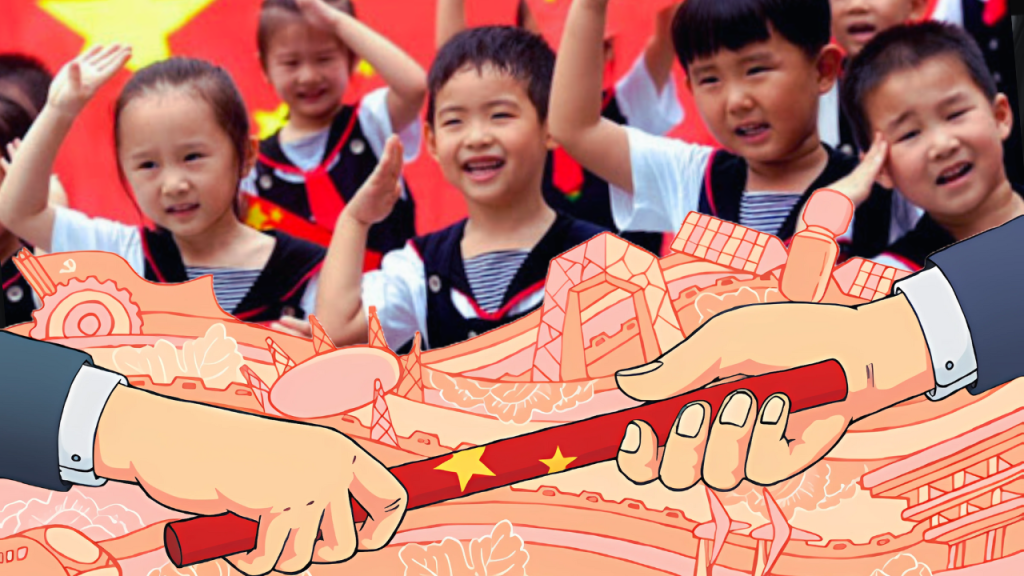
This model is, in fact, a star. A five-pointed star, where each point represents one of the forces that must be organized — the national, the class, the colonial, the ecological, the international — and the center is the primary contradiction that gives the whole structure its direction. The person who formalized this analytical framework was Mao Zedong, the Chinese Communist leader whose theory of contradiction — articulated in his 1937 essay “On Contradiction” — argued that every complex situation contains multiple contradictions, that one is always principal, and that the task of political organization is to identify the principal contradiction and orient all secondary contradictions toward its resolution. Marxism, Mao insisted, is not a dogma. It is a method.
You apply the method to the concrete conditions — the conditions you actually have, not the ones a different struggle had in a different century on a different continent. The five-pointed star of the Chinese national flag represents exactly this applied to China’s specific contradictions: the CCP at the center, and the four classes whose contradictions it organized — the working class, the peasantry, the urban petty bourgeoisie, the national bourgeoisie — held in relationship by the primary contradiction with imperialism rather than allowed to fragment against each other. China’s conditions were not Quebec’s conditions. The method is the same.
Quebec is an imperial core formation with unusual productive forces, a generation that has decided the national question is open again, and a left that has not yet given that generation a coherent account of what it is fighting for. The principal contradiction is not the English-French question. It is the question of whether Quebec’s institutional capacity gets used to deepen integration into a collapsing imperial core or to build something new in a multipolar world. The national, class, colonial, and ecological contradictions are all real and all matter. None of them can be resolved by a sovereignty project that leaves the primary contradiction untouched.
Together, oriented correctly, they are the material for a different kind of independence — not a reorganization of the same dependency under a new flag, but a collective democratic project in which Quebecers of every origin, in partnership with the Indigenous nations whose sovereignty is the foundation of any legitimate claim to this territory, build something worth the name of a country: a new multipolar world, built on peace, collective social development, and the democratic control of the productive forces that the Quiet Revolution accidentally bequeathed to us. On what that multipolar world is actually being built toward, see China’s 2050 project. The method has been there the whole time. The conditions are ours to apply it to.
Sources
- Spark Solidarity. “Quebec Election 2026: Balance of Power.” March 2026. Quebec Election 2026
- Spark Solidarity. “Quebec in BRICS.” January 2026. Quebec in BRICS
- 338Canada / Qc125 (Philippe J. Fournier). Quebec electoral projections. February–March 2026. 338Canada Quebec projections
- Global News. “Support for Quebec sovereignty at 30-year low, according to new poll.” March 4, 2026. Global News report
- CBC News. “With Legault out and the CAQ reeling, here’s where Quebec’s parties stand.” January 19, 2026. CBC News report
- The Walrus. “The End of the Legault Era.” January 14, 2026. The Walrus piece
- The Walrus. “Most Quebecers Oppose Sovereignty. Even More Reject Another Referendum.” January 20, 2026. The Walrus analysis
- The Walrus. “Trump’s Tariffs May Do the Impossible: Make Quebec Love Canada.” April 2025. The Walrus article
- Globe and Mail. “Will 2026 be the year of Quebec sovereignty’s comeback?” December 2025. Globe and Mail
- Global News. “Parti Québécois faces drop in support for sovereignty amid Trump threats.” February 2025. Global News coverage
- Policy Options / IRPP. “Sovereignty: Can the Parti Québécois turn a revival into reality?” October 2025. Policy Options IRPP
- CBC News. “A grassroots dream at a crossroads as Québec Solidaire looks back on 20 years.” February 27, 2026. CBC News article
- CBC News. “Parti Québécois takes Chicoutimi in 4th consecutive byelection win.” February 2026. CBC byelection report
- Angus Reid Institute. “Unity or Separation: Quebec, Alberta & Canada’s future.” February 18, 2026. Angus Reid poll
- Bevins, Vincent. If We Burn: The Mass Protest Decade and the Missing Revolution. PublicAffairs, 2023.
- Weber, Max. The Protestant Ethic and the Spirit of Capitalism. 1905.
- Vallières, Pierre. Nègres blancs d’Amérique. Parti pris, 1968.
- Fanon, Frantz. The Wretched of the Earth. François Maspero, 1961.
- Gramsci, Antonio. Prison Notebooks. 1929–1935.
- Mao Zedong. “On Contradiction.” August 1937. Marxists.org full text
- Canada-Quebec Accord. 1991. Canada.ca official text
- Spark Solidarity. “China: Socialism by 2050.” December 2025. China Socialism 2050
- Dowd, Gregory Evans. War under Heaven: Pontiac, the Indian Nations, and the British Empire. Johns Hopkins University Press, 2002.
- Royal Proclamation of 1763. British Crown. October 7, 1763.

 Spark Solidarity